Engineering Advances in Type 1 Diabetes Management

Generated from prompt:

I want to create a presentatio about Type 1 diabetes in Engineering field. I want to touch model-based and data-driven approach and current trends on this topic in diabetes reseacrh. For the model base, I'm familiar (like FDA simulator, clinical trials), but i want to expand on MPC controllers. For the data driven, I'm not familiar on the current trends, but i think something like glucose forecasting (different architectures) using CGM, insulin pumps and fault detection, meal detection algorithm, hybrid close loop, advanced hybrid close loop, LLM and neuran network , digital twin (like ReplayBG), machine learning for decision support system. I also want strong references

This presentation reviews model-based control (MPC), data-driven intelligence (deep learning for glucose forecasting), hybrid systems like artificial pancreas, and emerging AI (LLMs, digital twins) for automated, personalized T1D care.

April 9, 202611 slides
Slide 1 of 11

Slide 1 - Type 1 Diabetes in Engineering

Type 1 Diabetes in Engineering: Advances and Future Trends

Bridging Model-Based Control and Data-Driven Intelligence in Diabetes Management

---

Photo by Trnava University on Unsplash
Slide 1 - Type 1 Diabetes in Engineering
Slide 2 of 11

Slide 2 - Presentation Agenda

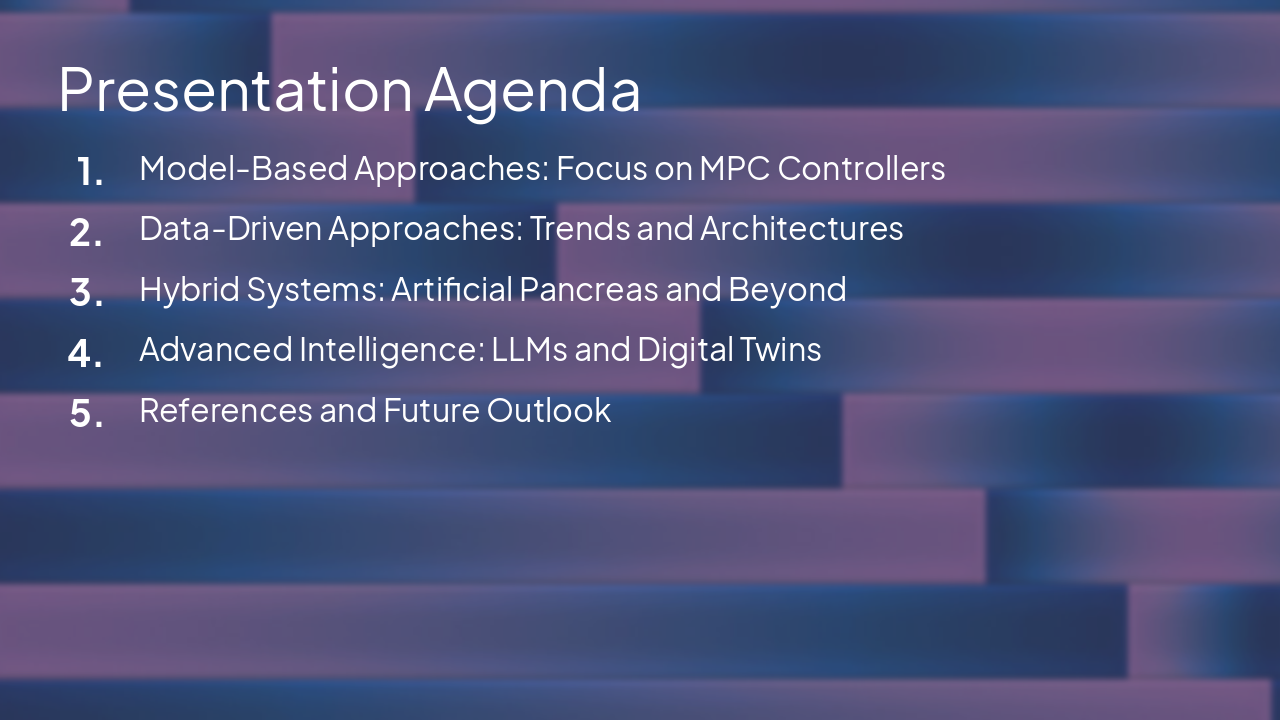
  • Model-Based Approaches: Focus on MPC Controllers
  • Data-Driven Approaches: Trends and Architectures
  • Hybrid Systems: Artificial Pancreas and Beyond
  • Advanced Intelligence: LLMs and Digital Twins
  • References and Future Outlook

---

Photo by Martin Martz on Unsplash

Slide 2 - Presentation Agenda
Slide 3 of 11

Slide 3 - Model-Based Control

1

Model-Based Control in T1D

From FDA Simulators to Advanced Model Predictive Control (MPC)

---

Photo by Sven Mieke on Unsplash
Slide 3 - Model-Based Control
Slide 4 of 11

Slide 4 - Model Predictive Control (MPC) Overview

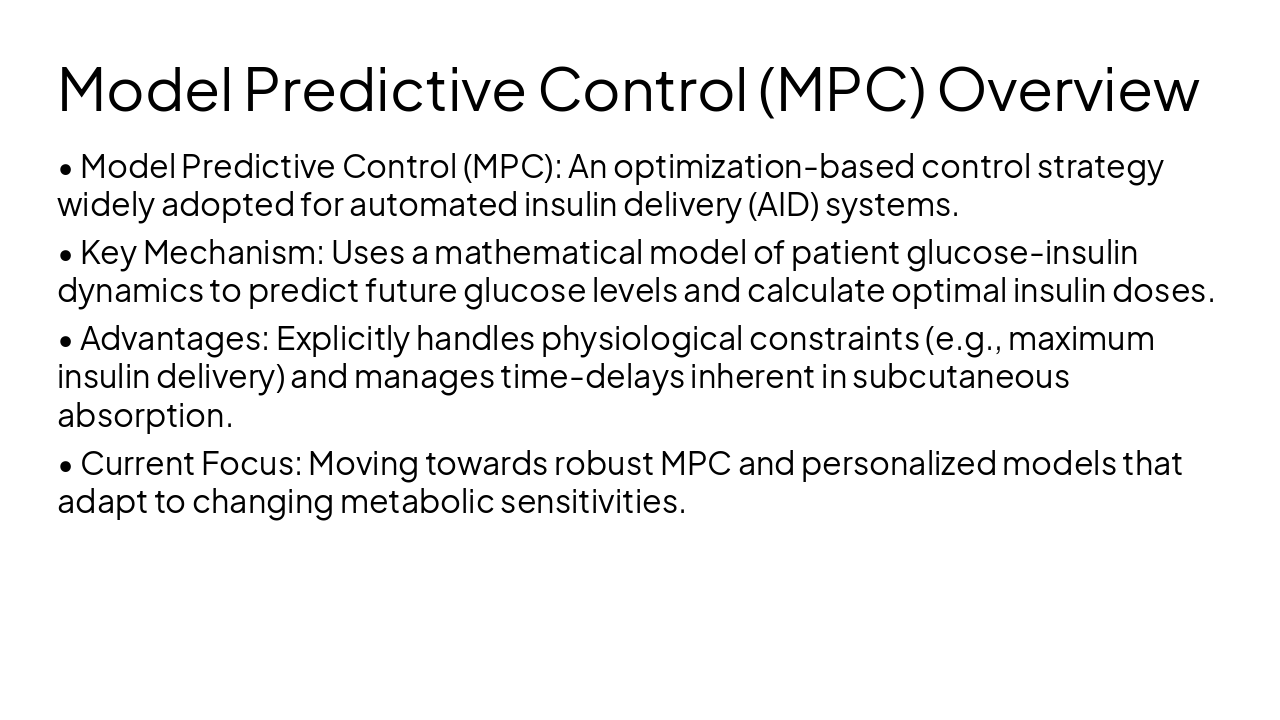
  • Model Predictive Control (MPC): An optimization-based control strategy widely adopted for automated insulin delivery (AID) systems.
  • Key Mechanism: Uses a mathematical model of patient glucose-insulin dynamics to predict future glucose levels and calculate optimal insulin doses.
  • Advantages: Explicitly handles physiological constraints (e.g., maximum insulin delivery) and manages time-delays inherent in subcutaneous absorption.
  • Current Focus: Moving towards robust MPC and personalized models that adapt to changing metabolic sensitivities.
Slide 4 - Model Predictive Control (MPC) Overview
Slide 5 of 11

Slide 5 - Data-Driven Trends

2

Data-Driven Trends in Diabetes Research

Harnessing CGM Data for Predictive Intelligence

---

Photo by Deng Xiang on Unsplash
Slide 5 - Data-Driven Trends
Slide 6 of 11

Slide 6 - Key Data-Driven Research Areas

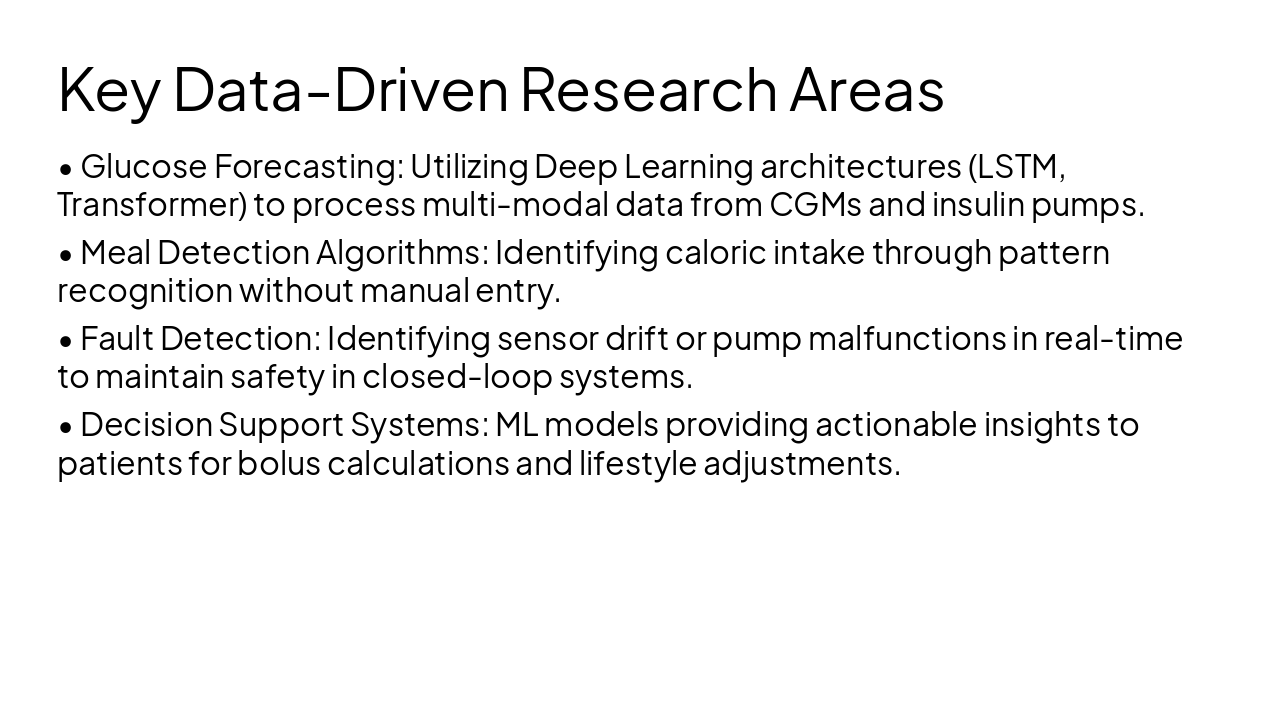
  • Glucose Forecasting: Utilizing Deep Learning architectures (LSTM, Transformer) to process multi-modal data from CGMs and insulin pumps.
  • Meal Detection Algorithms: Identifying caloric intake through pattern recognition without manual entry.
  • Fault Detection: Identifying sensor drift or pump malfunctions in real-time to maintain safety in closed-loop systems.
  • Decision Support Systems: ML models providing actionable insights to patients for bolus calculations and lifestyle adjustments.
Slide 6 - Key Data-Driven Research Areas
Slide 7 of 11

Slide 7 - System Evolution: HCL to Digital Twins

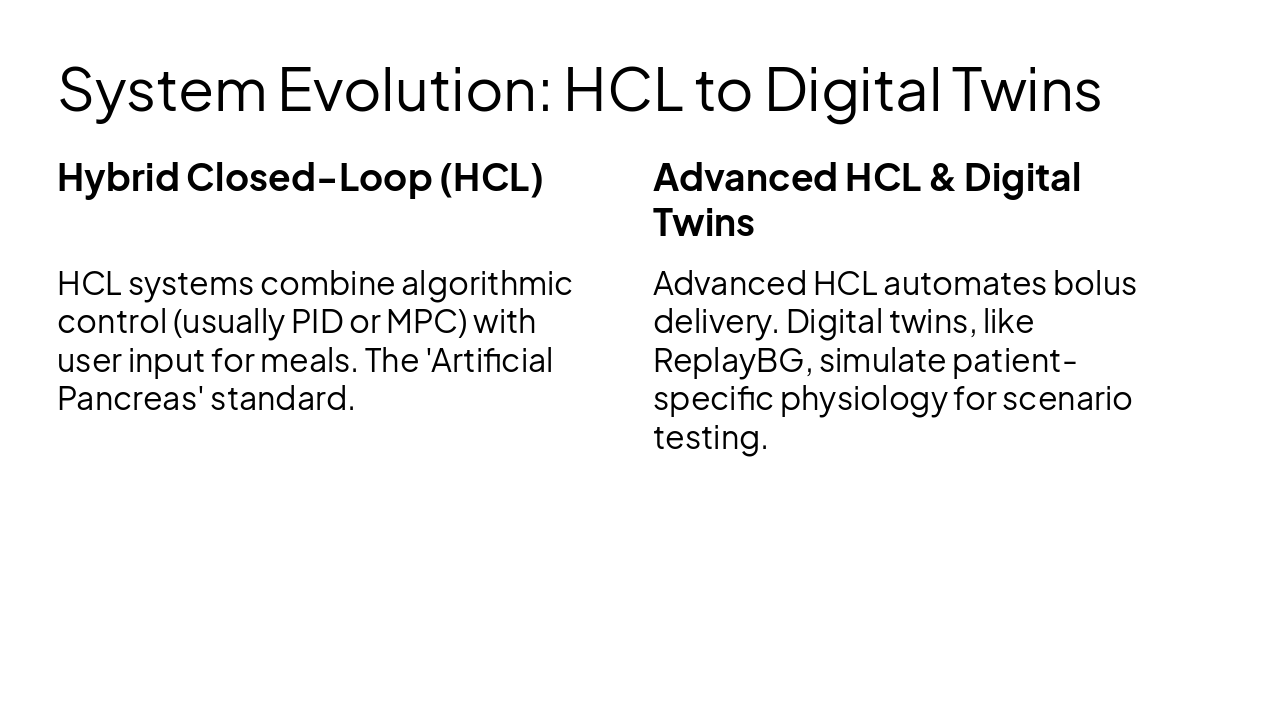
Hybrid Closed-Loop (HCL) HCL systems combine algorithmic control (usually PID or MPC) with user input for meals. The 'Artificial Pancreas' standard.

Advanced HCL & Digital Twins Advanced HCL automates bolus delivery. Digital twins, like ReplayBG, simulate patient-specific physiology for scenario testing.
Slide 7 - System Evolution: HCL to Digital Twins
Slide 8 of 11

Slide 8 - LLMs, Neural Networks, and Hybrid AI

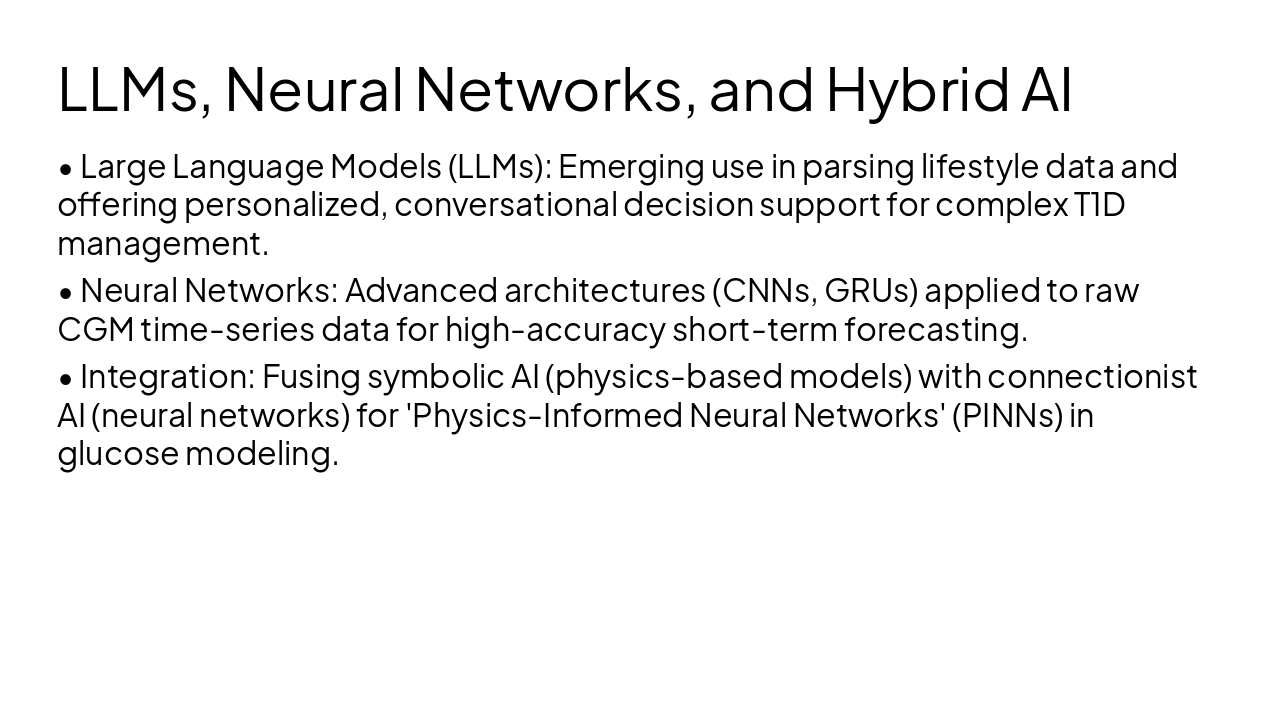
  • Large Language Models (LLMs): Emerging use in parsing lifestyle data and offering personalized, conversational decision support for complex T1D management.
  • Neural Networks: Advanced architectures (CNNs, GRUs) applied to raw CGM time-series data for high-accuracy short-term forecasting.
  • Integration: Fusing symbolic AI (physics-based models) with connectionist AI (neural networks) for 'Physics-Informed Neural Networks' (PINNs) in glucose modeling.
Slide 8 - LLMs, Neural Networks, and Hybrid AI
Slide 9 of 11

Slide 9 - Summary of Research Domains

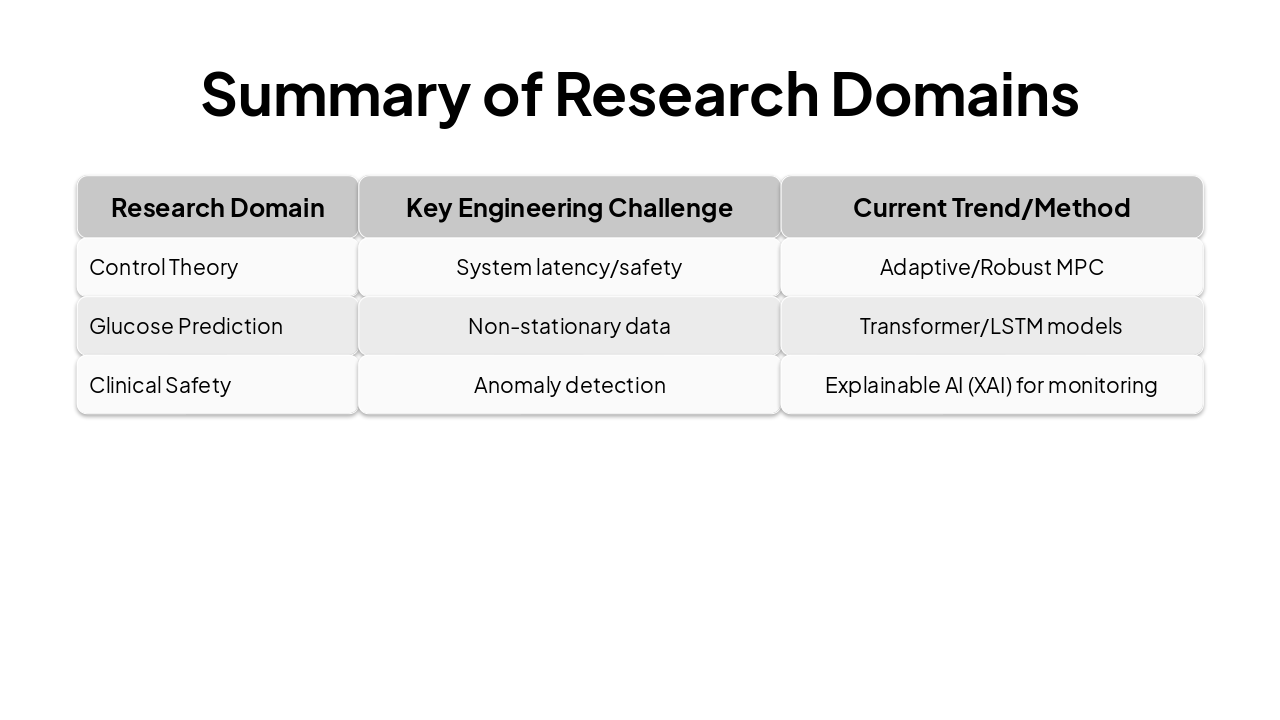
Research DomainKey Engineering ChallengeCurrent Trend/Method
Control TheorySystem latency/safetyAdaptive/Robust MPC
Glucose PredictionNon-stationary dataTransformer/LSTM models
Clinical SafetyAnomaly detectionExplainable AI (XAI) for monitoring
Slide 9 - Summary of Research Domains
Slide 10 of 11

Slide 10 - Selected Key References

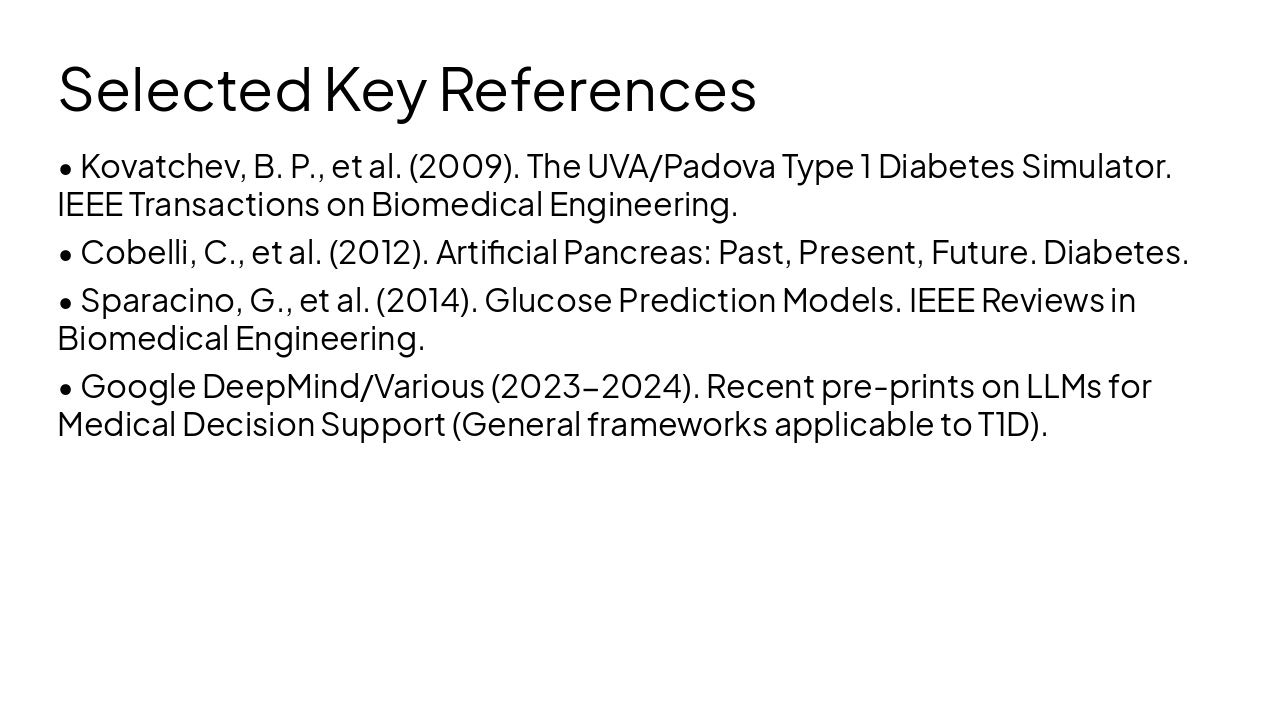
  • Kovatchev, B. P., et al. (2009). The UVA/Padova Type 1 Diabetes Simulator. IEEE Transactions on Biomedical Engineering.
  • Cobelli, C., et al. (2012). Artificial Pancreas: Past, Present, Future. Diabetes.
  • Sparacino, G., et al. (2014). Glucose Prediction Models. IEEE Reviews in Biomedical Engineering.
  • Google DeepMind/Various (2023-2024). Recent pre-prints on LLMs for Medical Decision Support (General frameworks applicable to T1D).
Slide 10 - Selected Key References
Slide 11 of 11

Slide 11 - Conclusion

Engineering the Future of Diabetes Care

Toward Fully Automated, Safe, and Personalized T1D Management

---

Photo by kevin laminto on Unsplash
Slide 11 - Conclusion

Discover More Presentations

Explore thousands of AI-generated presentations for inspiration

Browse Presentations
Powered by AI

Create Your Own Presentation

Generate professional presentations in seconds with Karaf's AI. Customize this presentation or start from scratch.

Create New Presentation

Powered by Karaf.ai — AI-Powered Presentation Generator