The Fascinating World of Turtles

Generated from prompt:

A Google Slides presentation about turtles, covering types, habitats, diet, anatomy, conservation, and fun facts.

Explore turtles' types (sea & freshwater), habitats, diet, anatomy, conservation challenges, and fun facts in this engaging 9-slide presentation urging support for turtle protection.

January 9, 20269 slides
Slide 1 of 9

Slide 1 - The Fascinating World of Turtles

This title slide introduces "The Fascinating World of Turtles" as its main theme. The subtitle highlights key topics to explore, including types, habitats, diet, anatomy, conservation, and fun facts.

The Fascinating World of Turtles

Discover types, habitats, diet, anatomy, conservation, and fun facts!

Source: Google Slides presentation on turtles

Speaker Notes
Welcome the audience to this educational journey covering types, habitats, diet, anatomy, conservation, and fun facts.
Slide 1 - The Fascinating World of Turtles
Slide 2 of 9

Slide 2 - Presentation Agenda

This agenda slide outlines the structure of a presentation on turtles, listing key topics such as Types of Turtles, Habitats, Diet, Anatomy, and Conservation. It concludes with sections on Fun Facts and a final Conclusion.

Presentation Agenda

  1. Types of Turtles
  2. Habitats
  3. Diet
  4. Anatomy
  5. Conservation
  6. Fun Facts
  7. Conclusion

Source: Google Slides presentation about turtles

Speaker Notes
Overview of the key sections in the turtle presentation.
Slide 2 - Presentation Agenda
Slide 3 of 9

Slide 3 - Types of Turtles

This section header slide, titled "Types of Turtles" and numbered 03, introduces the topic. It features a subtitle inviting exploration of diverse species, from majestic sea turtles to resilient tortoises.

Types of Turtles

03

Types of Turtles

Explore diverse species from majestic sea turtles to resilient tortoises.

Source: Google Slides presentation about turtles

Speaker Notes
Introduce the diverse species of turtles, from sea turtles to tortoises, setting the stage for exploring their varieties.
Slide 3 - Types of Turtles
Slide 4 of 9

Slide 4 - Main Types

The slide outlines the main types of turtles, including seven species of sea turtles like Green and Loggerhead. It also covers freshwater turtles such as the Red-eared Slider, land-dwelling tortoises like the Galápagos, and brackish water terrapins.

Main Types

  • Sea Turtles: 7 species (e.g., Green, Loggerhead)
  • Freshwater Turtles: e.g., Red-eared Slider
  • Tortoises: Land-dwelling (e.g., Galápagos)
  • Terrapins: Brackish water dwellers
Slide 4 - Main Types
Slide 5 of 9

Slide 5 - Habitats, Diet & Anatomy

This section header slide, titled "Habitats, Diet & Anatomy" (Section 04), introduces a topic exploring the living environments, food sources, and distinctive physical features of the subjects. The subtitle emphasizes delving into where they live, what they eat, and their unique body structures.

Habitats, Diet & Anatomy

04

Habitats, Diet & Anatomy

Exploring where they live, what they eat, and unique body structures.

Source: Turtle Presentation

Speaker Notes
Cover where turtles live, their diets, and unique anatomical features.
Slide 5 - Habitats, Diet & Anatomy
Slide 6 of 9

Slide 6 - Habitats & Diet

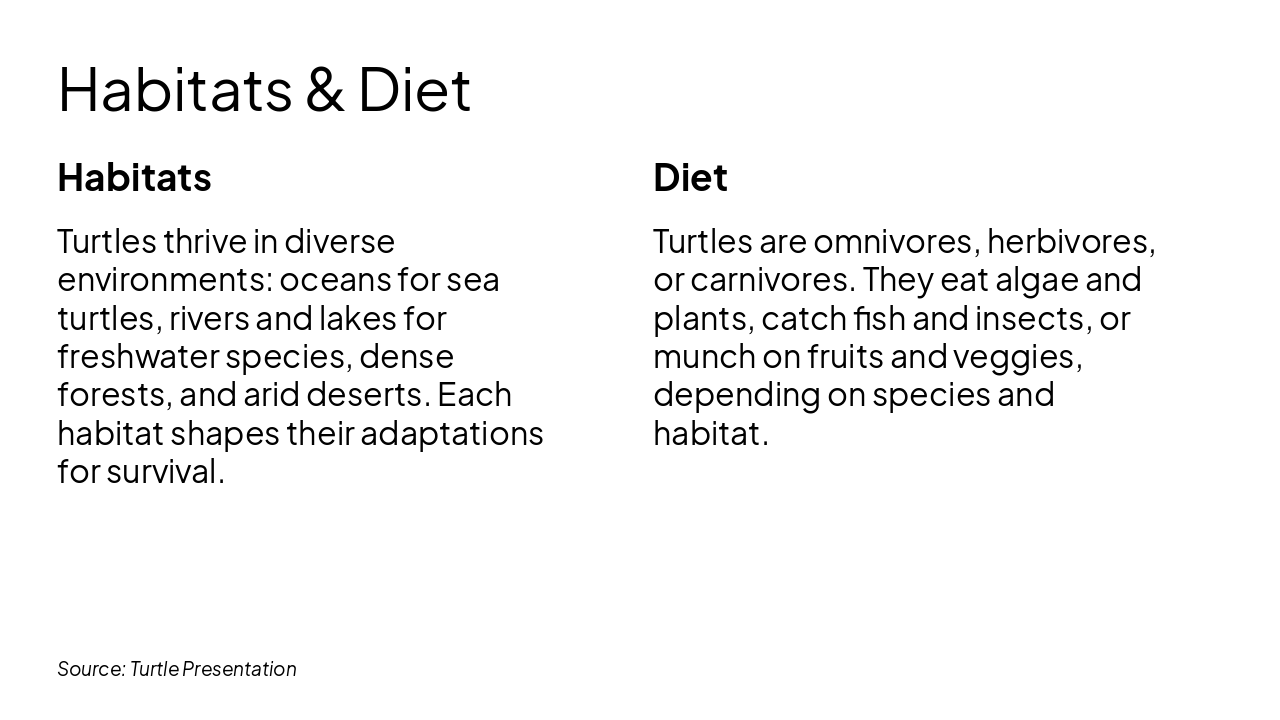
Turtles inhabit diverse environments, including oceans for sea turtles, rivers and lakes for freshwater species, dense forests, and arid deserts, each shaping their survival adaptations. Their diet varies by species and habitat, with turtles being omnivores, herbivores, or carnivores that consume algae, plants, fish, insects, fruits, and vegetables.

Habitats & Diet

HabitatsDiet
Turtles thrive in diverse environments: oceans for sea turtles, rivers and lakes for freshwater species, dense forests, and arid deserts. Each habitat shapes their adaptations for survival.Turtles are omnivores, herbivores, or carnivores. They eat algae and plants, catch fish and insects, or munch on fruits and veggies, depending on species and habitat.

Source: Turtle Presentation

Slide 6 - Habitats & Diet
Slide 7 of 9

Slide 7 - Turtle Anatomy

The slide on Turtle Anatomy highlights the hard shell, consisting of the carapace on top and plastron on bottom. It also features retractable head and limbs for protection, along with powerful flippers for efficient swimming.

Turtle Anatomy

!Image

  • Hard shell: carapace (top) and plastron (bottom)
  • Retractable head and limbs for protection
  • Powerful flippers enable efficient swimming

Source: Wikipedia: Turtle

Slide 7 - Turtle Anatomy
Slide 8 of 9

Slide 8 - Conservation & Fun Facts

50% of turtle species are endangered due to poaching and habitat loss. Fun facts include the oldest recorded turtle living 188 years and some migrating 10,000 miles.

Conservation & Fun Facts

  • 50%: Species Endangered
  • Due to poaching & habitat loss

  • 188: Longest Lifespan
  • Oldest recorded turtle lived 188 years

  • 10,000: Migration Distance
  • Some turtles migrate 10,000 miles

Slide 8 - Conservation & Fun Facts
Slide 9 of 9

Slide 9 - Protect Our Turtles

The slide "Protect Our Turtles" concludes by emphasizing that turtles endure and urging support for conservation now, with a thank you note and turtle emoji. Its subtitle calls to join efforts safeguarding their 200-million-year legacy.

Protect Our Turtles

Turtles Endure. Support Conservation Now! Thank You! 🐢

Join efforts to safeguard their 200M-year legacy.

Source: Turtles: 200M Years of Resilience

Speaker Notes
Summarize key points briefly, emphasize urgency of conservation, end with thanks and Q&A.
Slide 9 - Protect Our Turtles

Discover More Presentations

Explore thousands of AI-generated presentations for inspiration

Browse Presentations
Powered by AI

Create Your Own Presentation

Generate professional presentations in seconds with Karaf's AI. Customize this presentation or start from scratch.

Create New Presentation

Powered by Karaf.ai — AI-Powered Presentation Generator