N. Gregory Mankiw's Principles of Economics: Ten Core Principles with Key Examples

Generated from prompt:

призентация на 25 страниц 10 принципов экономики по книги мэн кью с кейсами из этой же книги

This presentation provides a comprehensive overview of N. Gregory Mankiw's 'Principles of Economics,' the world's most popular introductory economics textbook. It covers the ten fundamental principles, grouped into how people make decisions (Principles 1-4), how people interact (Principles 5-7), and how the economy as a whole works (Principles 8-10). Each principle is illustrated with real-world cases, examples, and visuals like production possibility frontiers and comparative advantage tables.

May 6, 202620 slides
Slide 1 of 20

Slide 1 - N. Gregory Mankiw's Principles of Economics

N. Gregory Mankiw's Principles of Economics

With Key Cases and Examples from the Book

---

Photo by khaled khazna on Unsplash
Slide 1 - N. Gregory Mankiw's Principles of Economics
Slide 2 of 20

Slide 2 - Presentation Outline

  • Introduction to Mankiw's Book
  • Principles 1-4: How People Make Decisions
  • Principles 5-7: How People Interact
  • Principles 8-10: How the Economy as a Whole Works
  • Key Takeaways and Conclusion

---

Photo by Nastuh Abootalebi on Unsplash

Slide 2 - Presentation Outline
Slide 3 of 20

Slide 3 - Introduction

1

Mankiw's Principles of Economics

Overview of the Book and Its Ten Core Principles

---

Photo by AMONWAT DUMKRUT on Unsplash
Slide 3 - Introduction
Slide 4 of 20

Slide 4 - About the Book

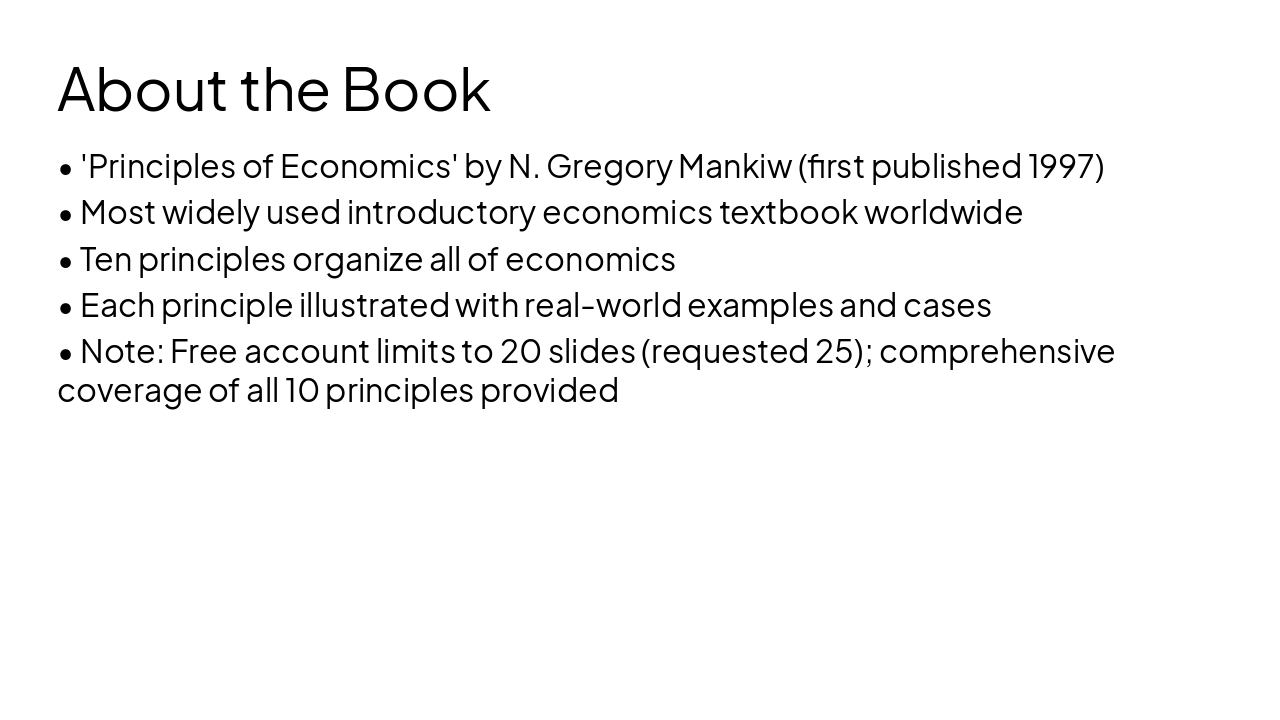
  • 'Principles of Economics' by N. Gregory Mankiw (first published 1997)
  • Most widely used introductory economics textbook worldwide
  • Ten principles organize all of economics
  • Each principle illustrated with real-world examples and cases
  • Note: Free account limits to 20 slides (requested 25); comprehensive coverage of all 10 principles provided
Slide 4 - About the Book
Slide 5 of 20

Slide 5 - Mankiw on Economics

> Economics is the study of how society manages its scarce resources.

— N. Gregory Mankiw

---

Photo by Elimende Inagella on Unsplash
Slide 5 - Mankiw on Economics
Slide 6 of 20

Slide 6 - Principles 1-4

2

How People Make Decisions

Individual Decision-Making Fundamentals

---

Photo by Tom Wheatley on Unsplash

Slide 6 - Principles 1-4
Slide 7 of 20

Slide 7 - Principle 1: People Face Trade-offs

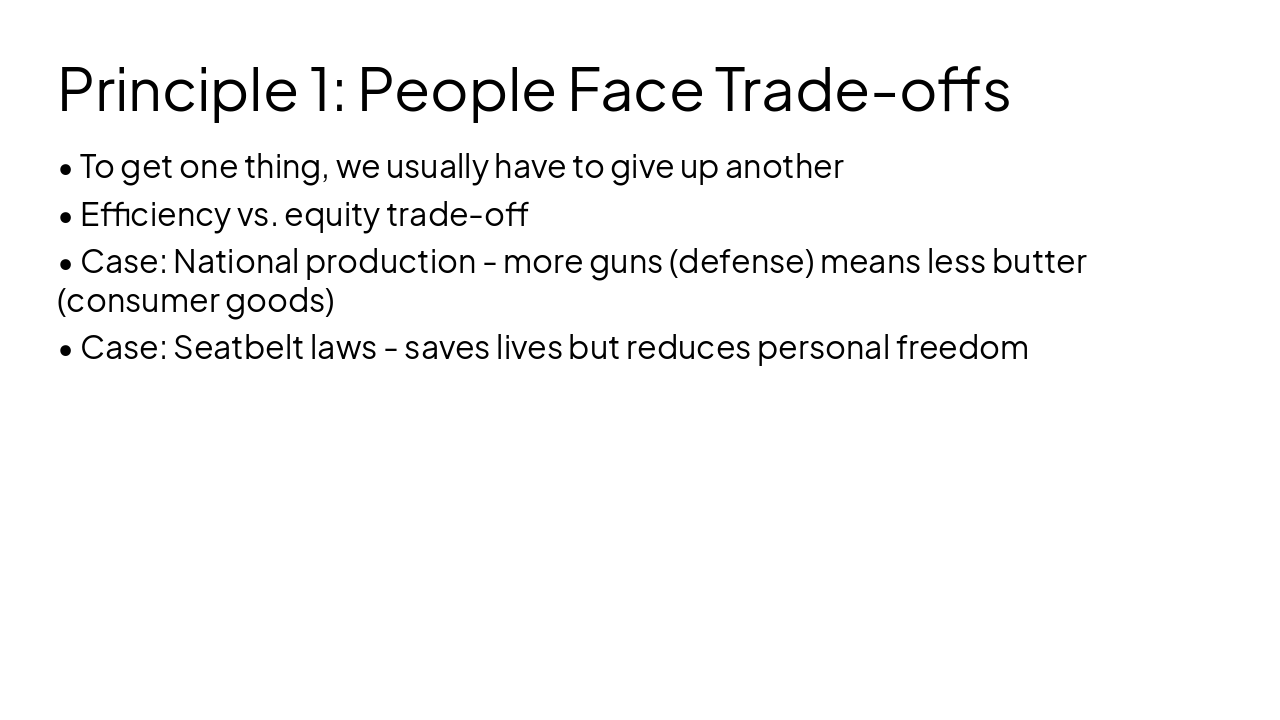
  • To get one thing, we usually have to give up another
  • Efficiency vs. equity trade-off
  • Case: National production - more guns (defense) means less butter (consumer goods)
  • Case: Seatbelt laws - saves lives but reduces personal freedom
Slide 7 - Principle 1: People Face Trade-offs
Slide 8 of 20

Slide 8 - Visualizing Trade-offs

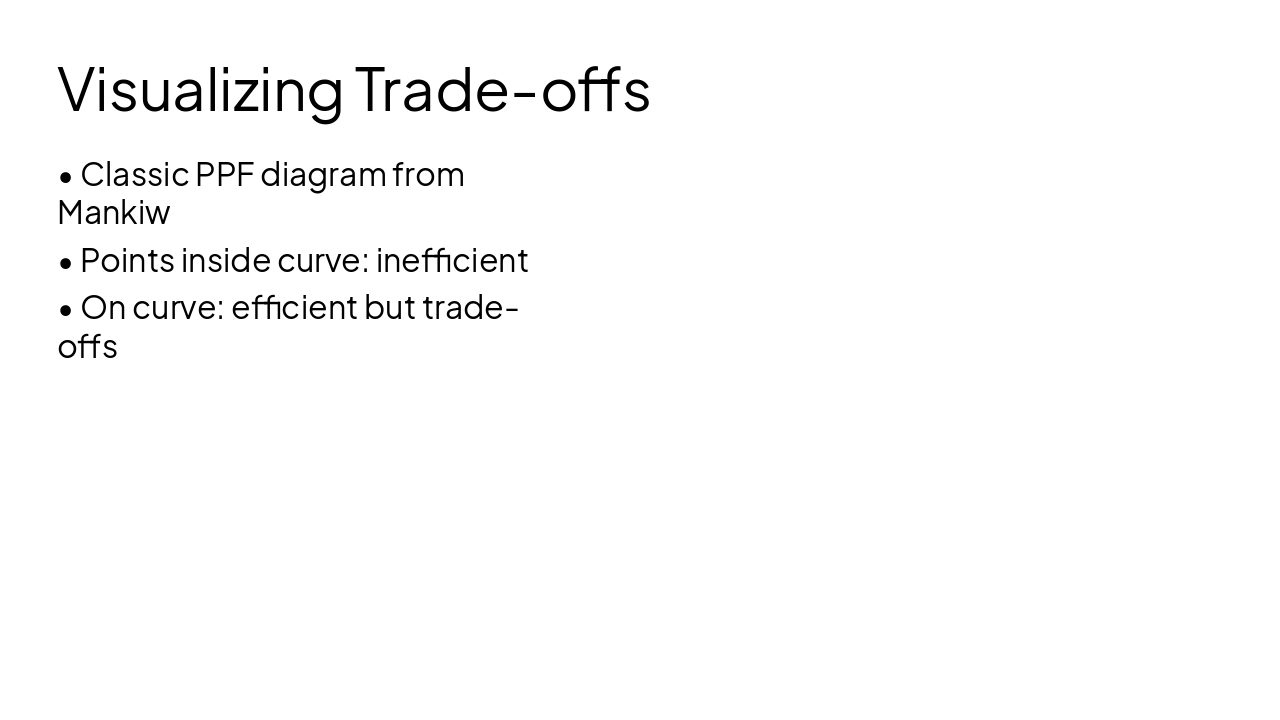
  • Classic PPF diagram from Mankiw
  • Points inside curve: inefficient
  • On curve: efficient but trade-offs
Slide 8 - Visualizing Trade-offs
Slide 9 of 20

Slide 9 - Principle 2: Opportunity Cost

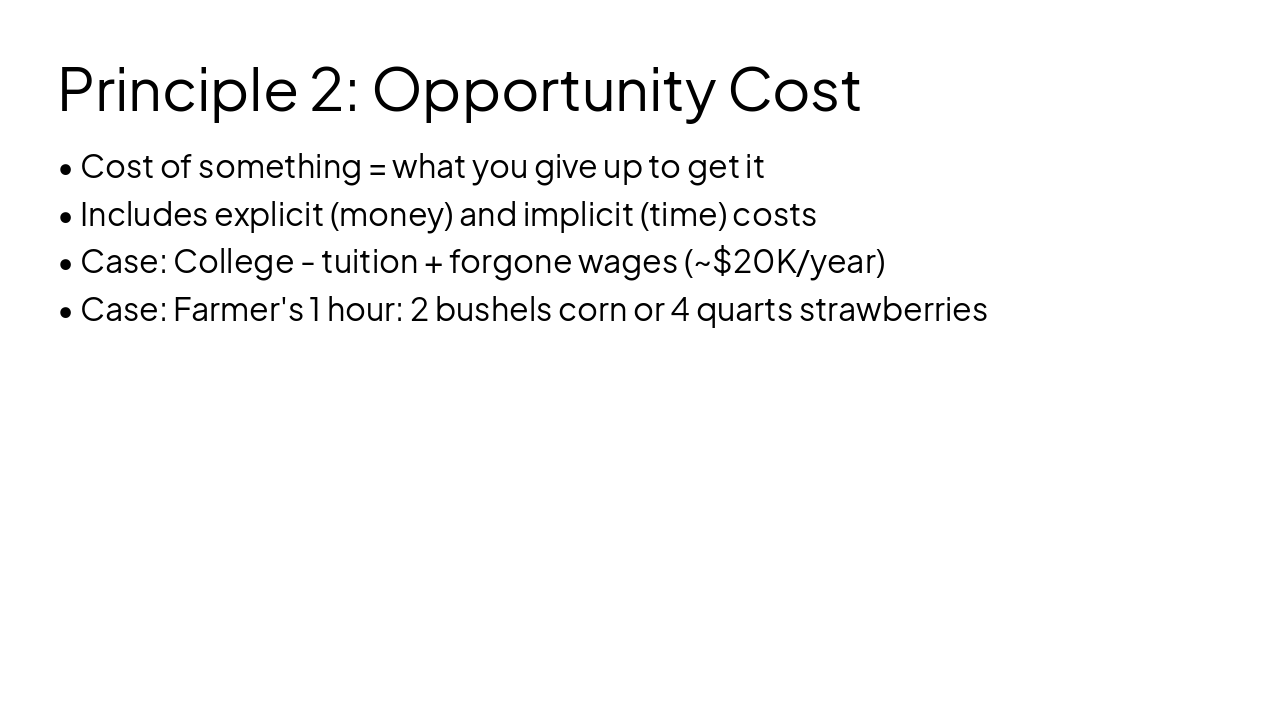
  • Cost of something = what you give up to get it
  • Includes explicit (money) and implicit (time) costs
  • Case: College - tuition + forgone wages (~$20K/year)
  • Case: Farmer's 1 hour: 2 bushels corn or 4 quarts strawberries
Slide 9 - Principle 2: Opportunity Cost
Slide 10 of 20

Slide 10 - Principle 3: Rational People Think at the Margin

  • Marginal change: extra benefit/cost of one more unit
  • Compare marginal benefit vs. marginal cost
  • Case: Factory - produce one more car if revenue > cost
  • Case: Study one more hour if exam improvement > free time value
Slide 10 - Principle 3: Rational People Think at the Margin
Slide 11 of 20

Slide 11 - Principle 4: People Respond to Incentives

  • Incentive: something that induces change in behavior
  • Well-designed incentives key to policy
  • Case: Higher cigarette tax → fewer smokers
  • Case: Mandatory seatbelts → more driving (moral hazard), higher speed limits → more accidents
Slide 11 - Principle 4: People Respond to Incentives
Slide 12 of 20

Slide 12 - Principles 5-7

3

How People Interact

Benefits of Trade and Markets

---

Photo by Vitaly Gariev on Unsplash

Slide 12 - Principles 5-7
Slide 13 of 20

Slide 13 - Principle 5: Trade Can Make Everyone Better Off

  • Trade allows specialization based on comparative advantage
  • Even if one more productive in everything
  • Case: Two people - Tom (better at both food/cloth) trades with Jane
  • Outcome: Both consume more than alone
Slide 13 - Principle 5: Trade Can Make Everyone Better Off
Slide 14 of 20

Slide 14 - Comparative Advantage Example

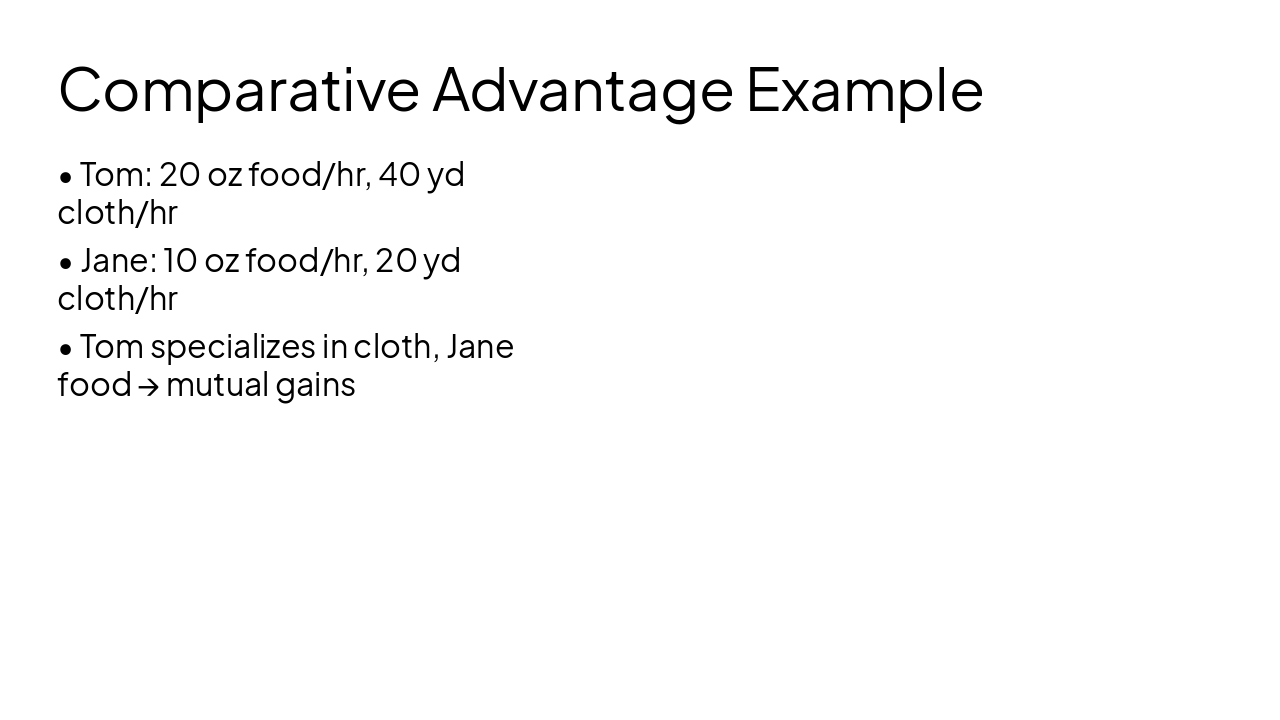
  • Tom: 20 oz food/hr, 40 yd cloth/hr
  • Jane: 10 oz food/hr, 20 yd cloth/hr
  • Tom specializes in cloth, Jane food → mutual gains
Slide 14 - Comparative Advantage Example
Slide 15 of 20

Slide 15 - Principle 6: Markets Are a Good Way to Organize Activity

  • Market economy: households/firms interact via markets
  • Adam Smith's 'invisible hand' → promotes social good
  • Case: Restaurant allocates scarce tables to diners who value most
Slide 15 - Principle 6: Markets Are a Good Way to Organize Activity
Slide 16 of 20

Slide 16 - Principle 7: Governments Can Sometimes Improve Market Outcomes

  • Markets fail: externalities, market power
  • Gov enforces property rights, corrects failures
  • Case: Pollution externality → Pigovian tax on factories
  • Case: Monopoly → antitrust laws
Slide 16 - Principle 7: Governments Can Sometimes Improve Market Outcomes
Slide 17 of 20

Slide 17 - Principles 8-10

4

How the Economy as a Whole Works

Macroeconomic Perspectives

---

Photo by Valorie Barela on Unsplash

Slide 17 - Principles 8-10
Slide 18 of 20

Slide 18 - Principle 8: Standard of Living Depends on Productivity

  • Productivity: goods/services per hour worked
  • Almost sole determinant of living standards
  • Case: U.S. vs. Mexico: higher productivity → higher wages ($30/hr vs. $3/hr)
  • Boost via human capital, tech, resources
Slide 18 - Principle 8: Standard of Living Depends on Productivity
Slide 19 of 20

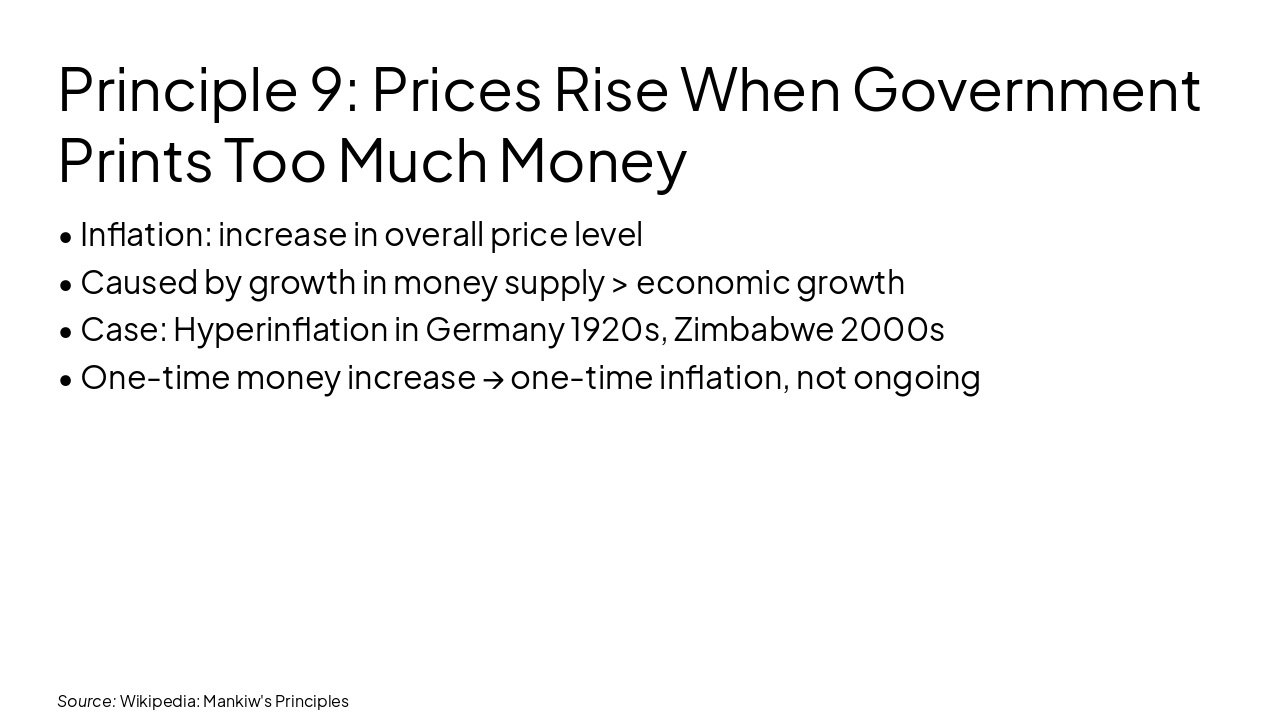
Slide 19 - Principle 9: Prices Rise When Government Prints Too Much Money

  • Inflation: increase in overall price level
  • Caused by growth in money supply > economic growth
  • Case: Hyperinflation in Germany 1920s, Zimbabwe 2000s
  • One-time money increase → one-time inflation, not ongoing

Source: Wikipedia: Mankiw's Principles
Slide 19 - Principle 9: Prices Rise When Government Prints Too Much Money
Slide 20 of 20

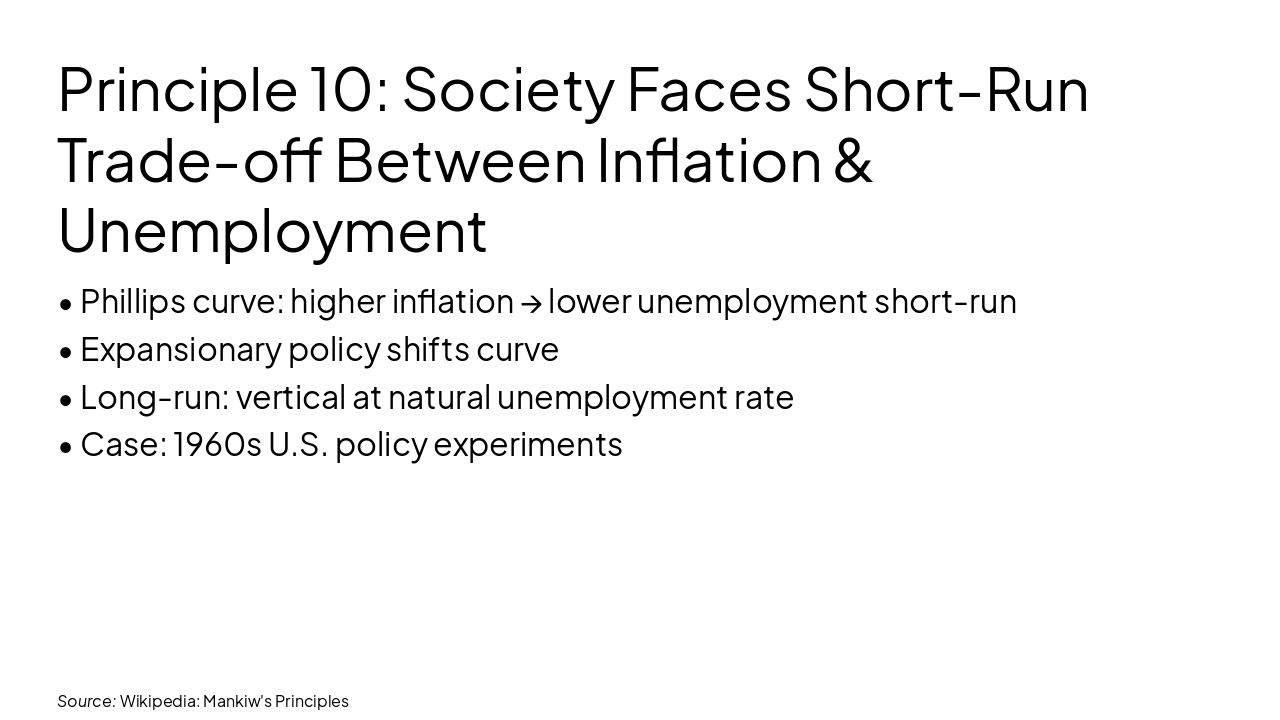
Slide 20 - Principle 10: Society Faces Short-Run Trade-off Between Inflation & Unemployment

  • Phillips curve: higher inflation → lower unemployment short-run
  • Expansionary policy shifts curve
  • Long-run: vertical at natural unemployment rate
  • Case: 1960s U.S. policy experiments

Source: Wikipedia: Mankiw's Principles
Slide 20 - Principle 10: Society Faces Short-Run Trade-off Between Inflation & Unemployment

Discover More Presentations

Explore thousands of AI-generated presentations for inspiration

Browse Presentations
Powered by AI

Create Your Own Presentation

Generate professional presentations in seconds with Karaf's AI. Customize this presentation or start from scratch.

Create New Presentation

Powered by Karaf.ai — AI-Powered Presentation Generator