Students’ Awareness & Investment in Indian Stocks (45 chars)

Generated from prompt:

Create a formal academic PowerPoint presentation titled 'A Study on Students’ Awareness and Investment Behaviour in the Indian Stock Market'. The presentation should include relevant stock market and education-related images/icons. Maintain a clean, professional academic theme (blue/white color scheme, minimal design). Content should follow these 14 slides: 1. Title Slide – A Study on Students’ Awareness and Investment Behaviour in the Indian Stock Market; Course: B.Com (Hons + Research); Semester: 7th; School of Commerce, DAVV; Guided by: Dr. Anjali Pandey. 2. Introduction – Importance of Indian stock market, student interest, digital platforms, awareness gap, and focus of the study. 3. Background of the Study – BSE/NSE overview, investment options, regulatory role, and students as emerging investors. 4. Overview of the Indian Stock Market – Opportunities, ease through technology, and risks. 5. Role of SEBI – Regulation, transparency, investor protection, awareness programs. 6. Role of Young Investors – Contribution, early investment habits, challenges. 7. Objectives of the Study – Awareness, perceptions, preferences, and challenges. 8. Hypotheses of the Study – Null and alternative hypotheses on awareness, perceptions, preferences, and challenges. 9. Research Methodology – Descriptive, quantitative, convenience sampling, Google Form data from students aged 18–25. 10. Sample Profile – 109 responses, undergraduate students, different streams, age 18–25. 11. Findings – Awareness vs. knowledge gap, confidence levels, SIP preference, barriers, willingness with guidance. 12. Conclusion – Awareness but low confidence, risk perception influence, financial education importance. 13. Suggestions – Financial literacy, workshops, SIP promotion, mentorship, safe platforms. 14. Bibliography – References and official reports used. Style: formal, academic, with images and icons relevant to finance, stock market, and students.

Academic study on Indian students' (18-25) stock market awareness, perceptions, and behaviors via survey of 109 undergrads. Findings show awareness gaps, SIP preference, low confidence; recommends lit

December 13, 202514 slides
Slide 1 of 14

Slide 1 - Students’ Awareness and Investment Behaviour in Indian Stock Market

This title slide introduces a study on students' awareness and investment behavior in the Indian stock market. It specifies the project for B.Com (Hons + Research) 7th Semester at School of Commerce, DAVV, guided by Dr. Anjali Pandey.

A Study on Students’ Awareness and Investment Behaviour

in the Indian Stock Market

B.Com (Hons + Research) | 7th Semester School of Commerce, DAVV Guided by: Dr. Anjali Pandey

Source: DAVV university logo and stock market icon (bull/bear or graph icon)

Slide 1 - Students’ Awareness and Investment Behaviour in Indian Stock Market
Slide 2 of 14

Slide 2 - Introduction

This introductory slide highlights the importance of the Indian stock market, rising student interest via digital platforms, and an awareness gap among youth. It focuses the study on students' knowledge and behavior.

Introduction

  • Importance of the Indian stock market
  • Rising student interest via digital platforms
  • Awareness gap among youth
  • Study focus: Students’ knowledge & behavior
Slide 2 - Introduction
Slide 3 of 14

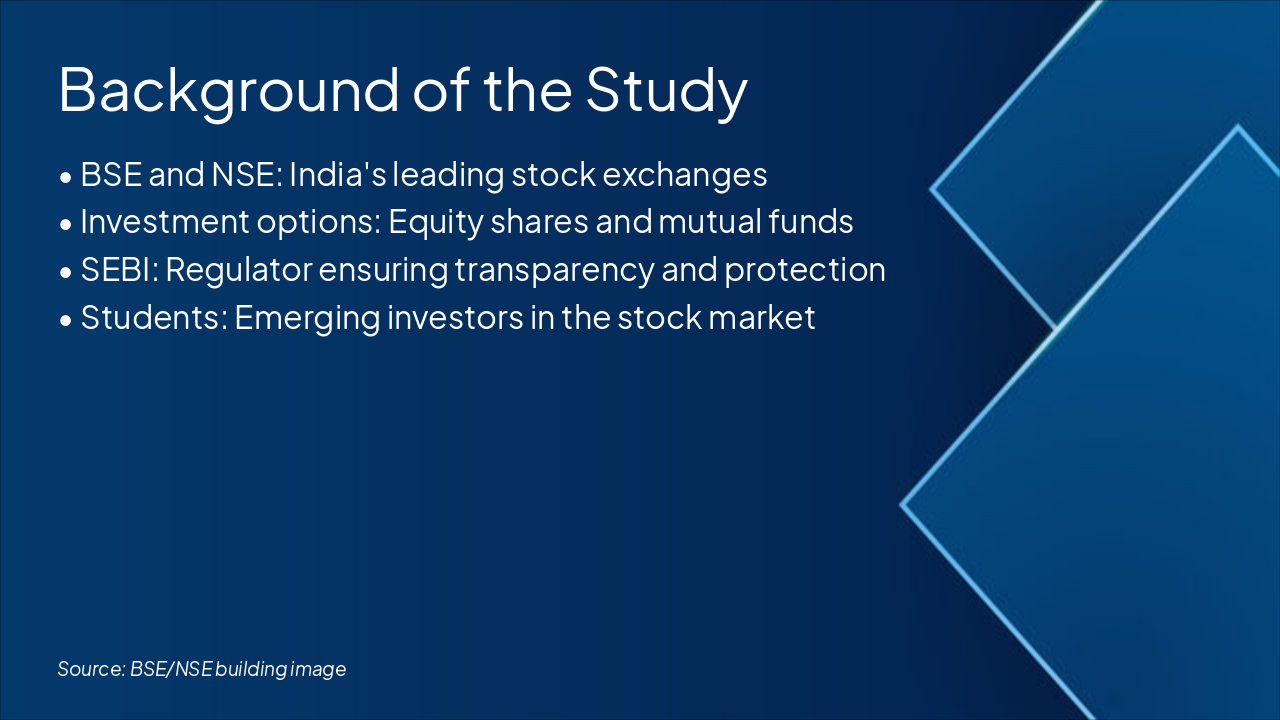
Slide 3 - Background of the Study

India's leading stock exchanges, BSE and NSE, offer investment options like equity shares and mutual funds, regulated by SEBI for transparency and investor protection. The slide highlights students as emerging participants in the stock market.

Background of the Study

  • BSE and NSE: India's leading stock exchanges
  • Investment options: Equity shares and mutual funds
  • SEBI: Regulator ensuring transparency and protection
  • Students: Emerging investors in the stock market

Source: BSE/NSE building image

Speaker Notes
Highlight the foundational elements of the Indian stock market and the role of students as new investors.
Slide 3 - Background of the Study
Slide 4 of 14

Slide 4 - Overview of the Indian Stock Market

The Indian stock market slide highlights opportunities like high growth potential and easy access via apps such as Zerodha, enabling effortless investing through smartphones and low brokerage. It also outlines key risks, including high volatility, unpredictable losses, scams, and pump-and-dump schemes, stressing the need for caution.

Overview of the Indian Stock Market

Opportunities & Technological EaseKey Risks
Indian stock market offers high growth potential with rising indices. Apps like Zerodha simplify access via intuitive interfaces, demat accounts, and low brokerage, enabling students to invest effortlessly from smartphones.High volatility leads to unpredictable price swings and potential losses. Scams, fraudulent schemes, and pump-and-dump tactics threaten novice investors, underscoring the need for awareness and caution.
Slide 4 - Overview of the Indian Stock Market
Slide 5 of 14

Slide 5 - Role of SEBI

SEBI regulates securities markets effectively and ensures transparency in transactions. It protects investor interests comprehensively while promoting awareness programs and education.

Role of SEBI

  • Regulates securities markets effectively
  • Ensures transparency in transactions
  • Protects investor interests comprehensively
  • Promotes awareness programs and education

Source: SEBI logo/icon

Slide 5 - Role of SEBI
Slide 6 of 14

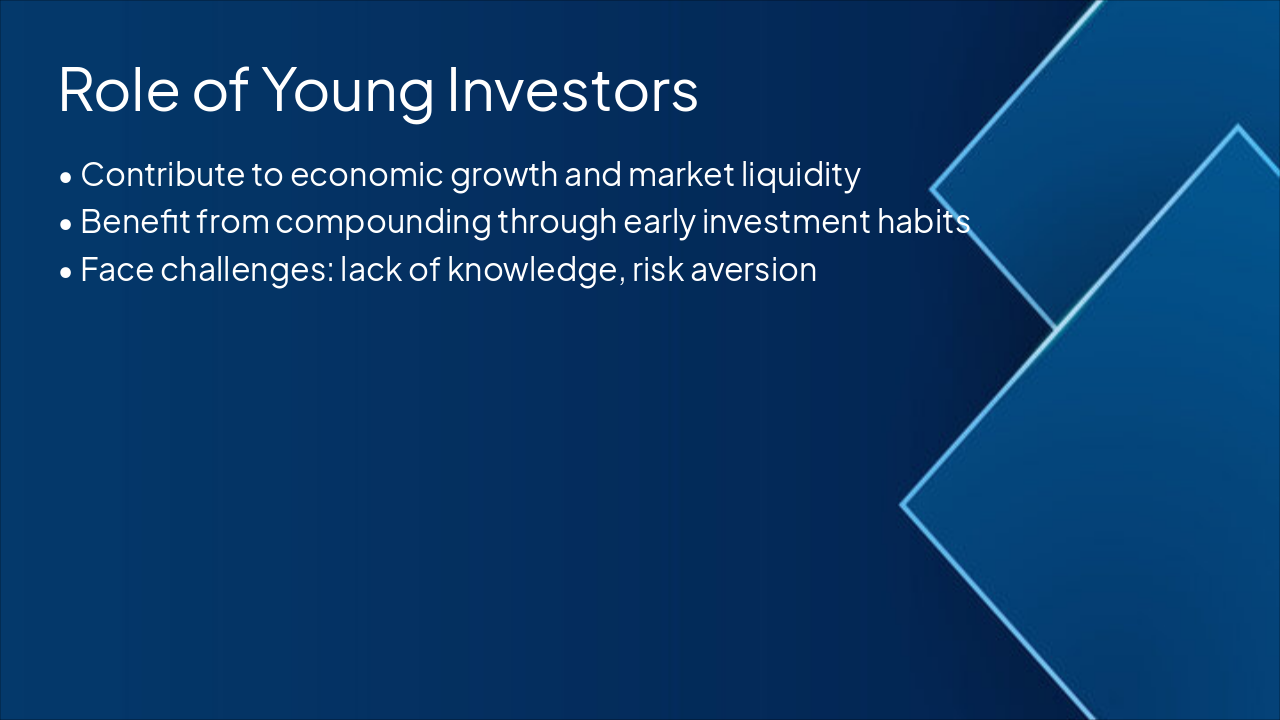
Slide 6 - Role of Young Investors

Young investors contribute to economic growth and market liquidity while benefiting from compounding through early investment habits. They face challenges like lack of knowledge and risk aversion.

Role of Young Investors

  • Contribute to economic growth and market liquidity
  • Benefit from compounding through early investment habits
  • Face challenges: lack of knowledge, risk aversion
Slide 6 - Role of Young Investors
Slide 7 of 14

Slide 7 - Objectives of the Study

The slide titled "Objectives of the Study" lists the key goals of the research as an agenda. These objectives are to assess awareness levels, analyze perceptions, identify preferences, and explore challenges.

Objectives of the Study

  1. 1. Assess awareness levels
  2. 2. Analyze perceptions
  3. 3. Identify preferences
  4. 4. Explore challenges

Source: A Study on Students’ Awareness and Investment Behaviour in the Indian Stock Market

Slide 7 - Objectives of the Study
Slide 8 of 14

Slide 8 - Hypotheses of the Study

The slide presents the study's null hypothesis (H₀), stating no significant awareness gap among students on the Indian stock market or differences in risk/reward perceptions, investment preferences (e.g., SIP vs. direct stocks), or challenges. The alternative hypothesis (H₁) posits a significant awareness gap with notable differences in perceptions, preferences, and barriers to stock market participation.

Hypotheses of the Study

Null Hypothesis (H₀)Alternative Hypothesis (H₁)
No significant awareness gap among students on Indian stock market. No differences in perceptions of risks/rewards, investment preferences (e.g., SIP vs. direct stocks), or perceived challenges.Significant awareness gap exists among students. Notable differences in perceptions, preferences for investment options, and barriers/challenges faced in stock market participation.
Slide 8 - Hypotheses of the Study
Slide 9 of 14

Slide 9 - Research Methodology

The research methodology uses a descriptive and quantitative approach with convenience sampling via an online Google Form survey. Target respondents are students aged 18–25.

Research Methodology

  • Descriptive and quantitative research approach
  • Convenience sampling technique utilized
  • Online Google Form survey instrument
  • Target respondents: Students aged 18–25
Slide 9 - Research Methodology
Slide 10 of 14

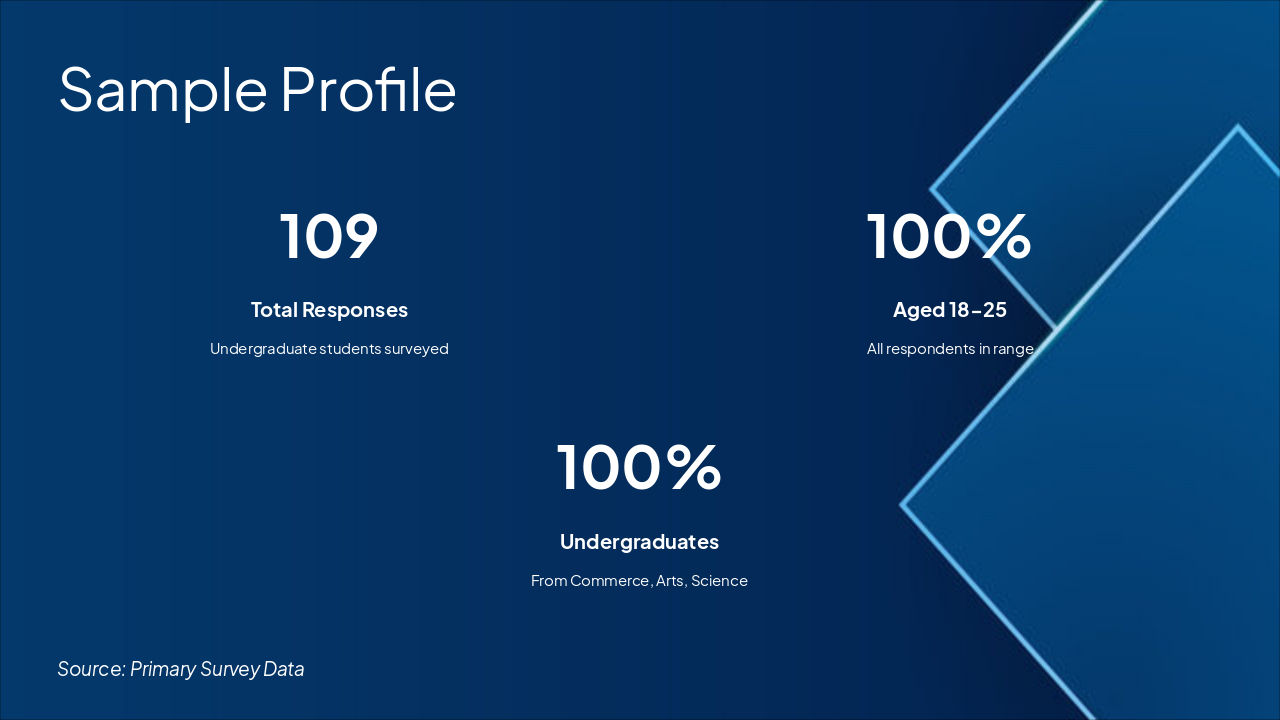
Slide 10 - Sample Profile

The Sample Profile stats slide reports 109 total responses from surveyed undergraduate students. All 100% of respondents are aged 18-25 and undergraduates from Commerce, Arts, or Science faculties.

Sample Profile

  • 109: Total Responses
  • Undergraduate students surveyed

  • 100%: Aged 18-25
  • All respondents in range

  • 100%: Undergraduates

From Commerce, Arts, Science Source: Primary Survey Data

Speaker Notes
Emphasize the demographic focus on young undergraduates.
Slide 10 - Sample Profile
Slide 11 of 14

Slide 11 - Findings

92% of respondents are aware of the stock market, but only 28% have in-depth knowledge and 35% feel confident investing. Meanwhile, 75% prefer systematic investment plans (SIP) over lump sum investments.

Findings

  • 92%: Aware of Stock Market
  • High general awareness

  • 28%: In-depth Knowledge
  • Low detailed understanding

  • 35%: Investment Confidence
  • Low self-assessed levels

  • 75%: Prefer SIP Investments

Systematic over lump sum Source: Survey of 109 Students

Speaker Notes
Highlight the awareness-knowledge gap and preferences; use bar charts for comparison.
Slide 11 - Findings
Slide 12 of 14

Slide 12 - Conclusion

The conclusion slide notes low confidence despite present awareness, with risk perception as a key influencer and a need for financial education. It closes with thanks and a call to embrace financial education for confident investing.

Conclusion

• Awareness present but confidence low

  • Risk perception key influencer
  • Need for financial education

Closing: Thank you for your attention. Call-to-action: Embrace financial education to invest confidently.

Source: A Study on Students’ Awareness and Investment Behaviour in the Indian Stock Market

Speaker Notes
Display graduation cap and stock market icons on the slide. Emphasize key takeaways with bullets. End with closing message and call-to-action. Maintain blue/white academic theme.
Slide 12 - Conclusion
Slide 13 of 14

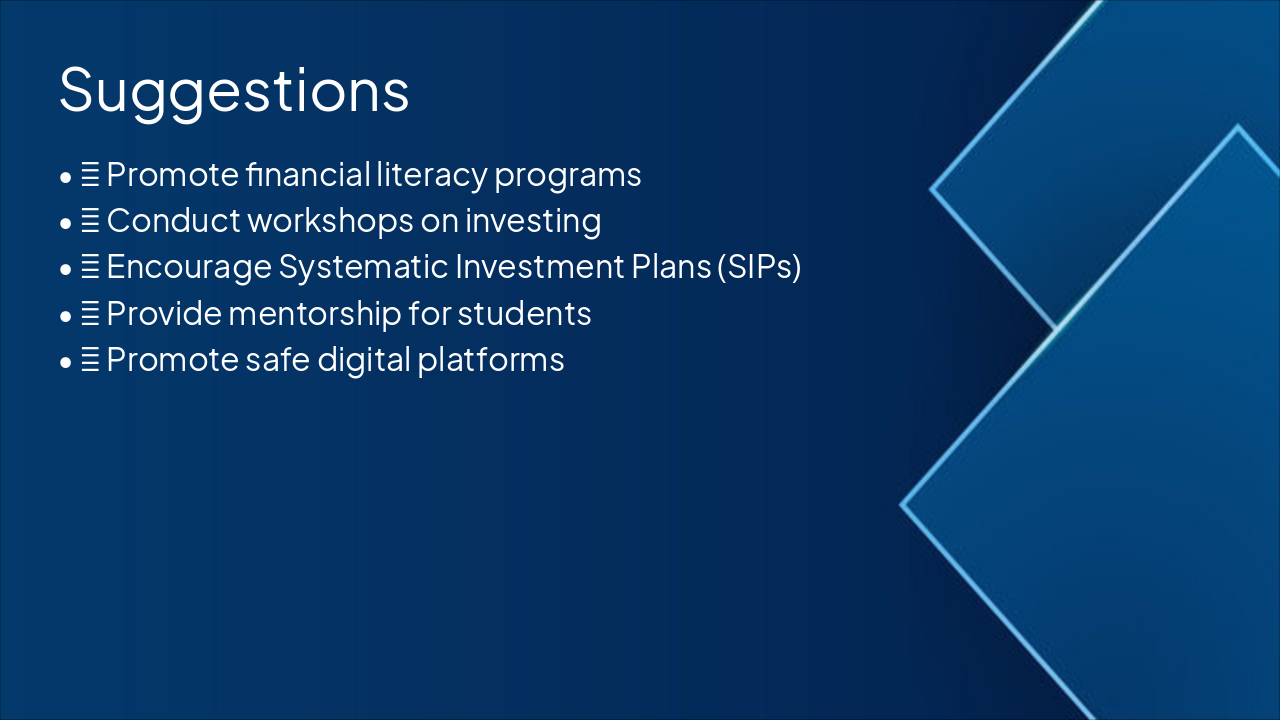
Slide 13 - Suggestions

The "Suggestions" slide proposes initiatives to boost financial literacy and safe investing. Key points include promoting literacy programs, investment workshops, SIPs, student mentorship, and secure digital platforms.

Suggestions

  • 💡 Promote financial literacy programs
  • 💡 Conduct workshops on investing
  • 💡 Encourage Systematic Investment Plans (SIPs)
  • 💡 Provide mentorship for students
  • 💡 Promote safe digital platforms
Slide 13 - Suggestions
Slide 14 of 14

Slide 14 - Bibliography

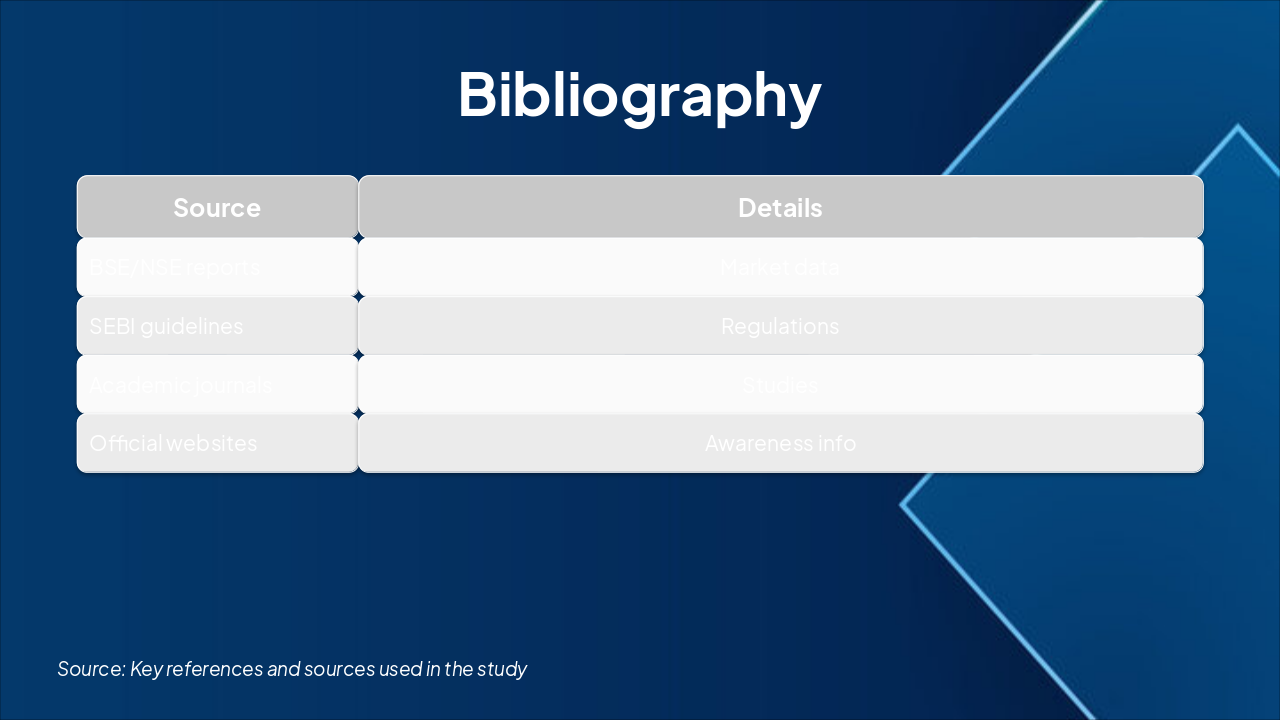
The Bibliography slide features a table listing key sources and their details. It includes BSE/NSE reports for market data, SEBI guidelines for regulations, academic journals for studies, and official websites for awareness info.

Bibliography

{ "headers": [ "Source", "Details" ], "rows": [ [ "BSE/NSE reports", "Market data" ], [ "SEBI guidelines", "Regulations" ], [ "Academic journals", "Studies" ], [ "Official websites", "Awareness info" ] ] }

Source: Key references and sources used in the study

Speaker Notes
References including official reports and academic sources.
Slide 14 - Bibliography

Discover More Presentations

Explore thousands of AI-generated presentations for inspiration

Browse Presentations
Powered by AI

Create Your Own Presentation

Generate professional presentations in seconds with Karaf's AI. Customize this presentation or start from scratch.

Create New Presentation

Powered by Karaf.ai — AI-Powered Presentation Generator