Optimizing Gypsum Board Drying Efficiency

Generated from prompt:

PROMPT START You are an expert in industrial process optimization, energy analysis, drying technology, WRG systems, KPI modeling and presentation design. Create a professional, corporate-style report/presentation based on the following detailed project description. The output must include: Executive Summary Technical process explanation (Trockner, zones, energy flows) KPI definitions & formulas Analysis of water loss, energy consumption & WRG Charts/diagrams (conceptual or real, depending on tool capability) Results & interpretation Conclusions Next steps & recommendations Process flow diagrams, zone diagrams, KPI tables, and energy flow visualizations Use clear wording, structured sections, and production-ready styling. 🔷 PROJECT CONTEXT (Lindner NORIT GmbH) The company produces gypsum fiber boards in Dettelbach, Werk 1 using two large chamber dryers (Trockner 1 & 2). Drying process characteristics: 4 heated drying zones (Zone 2 to Zone 5) Abbindezone + Zone 1 (no drying) Cooling zone Weekly operation (Mon cold-start + Tue–Fri steady state) Product thicknesses from 30–44 mm Evaporation load varies by product type WRG via exhaust-air heat exchanger Additional WRG: compressor waste heat (Trockner 2) The project evaluates the energy efficiency, WRG performance, and KPI behavior under real production conditions. 🔷 DATA SOURCES Use the following data sources (describe them in the report): Hourly energy consumption (electric + gas converted to kWh) Water loss per product (manual weighing results) Product dimensions, thickness, and density Takt time & zone timing model (71 carts, zone arrival times) WRG inlet/outlet temperatures (needed later) Drying experiment example (L36) 🔷 TECHNICAL DEFINITIONS & FORMULAS Include and explain: KPIs: kWh/kg evaporated water kWh/m³ product kWh per Hordenwagen Trocknungsrate (kg/h) ΔT per zone WRG efficiency η_WRG Formulas: KPI_H₂O = Energy_total / Water_evaporated KPI_m³ = Energy_total / Product_volume η_WRG = (T_supply_out – T_supply_in) / (T_exhaust_in – T_exhaust_out) Explain these KPIs clearly and visually. 🔷 WATER LOSS EXPERIMENT Include a section summarizing: Water loss measured across drying zones L-, N-, U-, Y-type products Mass before/after each zone Calculation of: Water removed per zone % of total water Cumulative drying curve Linking water loss to: Energy per zone Zone efficiency η_zone Include diagrams such as: “Zone vs. Moisture Loss” “Cumulative Drying Curve” 🔷 EXAMPLE KPI EVALUATION: L36 DRYING RUN Include these exact values: Energy (25–28 August) Electric: 6119.51 kWh Thermal: 42624.75 kWh Total energy: 48,744.27 kWh Water loss: 2.52 kg KPI result: ~19,348 kWh/kg H₂O Explain why this is extremely high (because total dryer energy for the entire system is divided by one board). 🔷 REQUIRED OUTPUT CONTENT Produce a complete report or PPT-style structure with: 1. Executive Summary Include: Project purpose Key findings KPI insights Energy hotspots (Zone 2 = highest energy, Monday cold-start effects) WRG potential 2. Process Overview Dryer system layout diagram Zones & cart timing Heat recovery flows 3. KPI System All KPI definitions Formula diagrams Interpretation guidelines 4. Water Loss Analysis Zone-by-zone evaporation Drying curve Efficiency patterns 5. Energy Consumption Analysis Monday vs steady-state comparison Zone 2 as main energy driver Product-thickness correlations Energy per product type 6. WRG Evaluation WRG principle Potential efficiency (70–75% theoretical) What data is still needed 7. Results (Based on Provided Data) Include: L36 KPI result Expected ranges Insights from data structure Identification of missing parameters 8. Conclusions Current drying is stable but inefficient in cold start Zone 2 is dominant energy consumer WRG data missing → prevents full evaluation KPI model framework successfully established 9. Next Steps Provide concrete recommendations: Short-Term Complete WRG data collection (Zuluft/Abluft temperatures & flow rates) Complete water loss mapping for all product types Validate cart timing model for precise synchronization Medium-Term Build full KPI prediction model Compare products by: Thickness Water load Evaporation profile Long-Term Energy optimization actions: Reduce Zone 2 temperature peaks WRG enhancement Air volume control Sequence optimization Standby strategies for Monday startup 🔷 VISUAL REQUIREMENTS Ask the tool to include: Zone layout diagrams WRG heat exchanger diagram KPI formula graphics Drying curve chart Energy vs zone chart Energy vs product thickness chart Summary tables Flowcharts Use clean colors, modern design, and consistent layout. PROMPT END

This presentation analyzes energy use in Lindner NORIT's gypsum fiber board drying process, highlighting high KPIs like 19,348 kWh/kg H₂O, Zone 2 hotspots, cold-start inefficiencies, and WRG potential

November 18, 202527 slides
Slide 1 of 27

Slide 1 - Energy Efficiency and Optimization of Gypsum Fiber Board Drying at Lindner NORIT GmbH

The slide's title highlights the focus on improving energy efficiency and optimizing the drying process for gypsum fiber boards at Lindner NORIT GmbH. Its subtitle specifies an evaluation of the drying process, key performance indicators (KPIs), and WRG performance at Dettelbach Werk 1.

Energy Efficiency and Optimization of Gypsum Fiber Board Drying

Evaluating drying process, KPIs, and WRG performance in Dettelbach Werk 1

Source: Lindner NORIT GmbH
Slide 1
Slide 2 of 27

Slide 2 - Presentation Agenda

The presentation agenda outlines a structured overview of a project on dryer energy efficiency, starting with an executive summary covering purpose, key findings, and energy insights. It proceeds through process overview and KPI definitions, zone-by-zone water loss and energy analysis, WRG evaluation with results, and concludes with efficiency insights plus optimization recommendations.

Presentation Agenda

  1. Executive Summary

Project purpose, key findings, and energy insights

  1. Process Overview & KPI System

Dryer zones, heat flows, and performance metric definitions

  1. Water Loss & Energy Analysis

Zone-by-zone evaporation, consumption patterns, and hotspots

  1. WRG Evaluation & Results

Heat recovery assessment, KPI outcomes, and interpretations

  1. Conclusions & Next Steps

Efficiency insights and optimization recommendations

Source: Lindner NORIT GmbH Drying Process Optimization
Slide 2
Slide 3 of 27

Slide 3 - Executive Summary

This section header slide, titled "Executive Summary" and numbered as 02, introduces the key focus of the presentation. It features a subtitle emphasizing the evaluation of energy efficiency, waste heat recovery, and key performance indicators in the context of gypsum board drying processes.

Executive Summary

02

Executive Summary

Evaluating energy efficiency, waste heat recovery, and KPIs in gypsum board drying

Source: Lindner NORIT GmbH Drying Process Optimization
--- Speaker Notes: Project purpose: Evaluate energy efficiency, WRG, and KPIs. Key findings: Zone 2 energy hotspot, cold-start inefficiencies, WRG potential 70-75%. KPI insights and recommendations preview.

Slide 3
Slide 4 of 27

Slide 4 - Key Findings and Insights

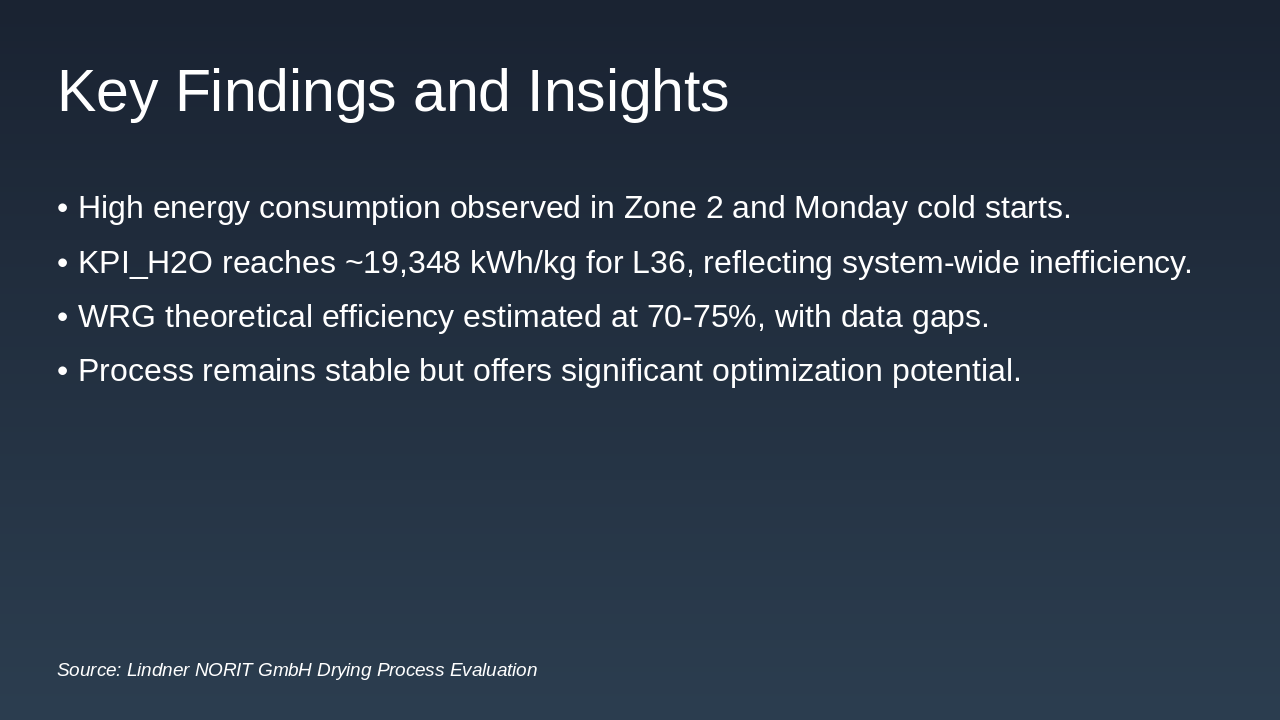
The slide highlights high energy consumption in Zone 2 and during Monday cold starts, along with a striking inefficiency metric where KPIH2O reaches approximately 19,348 kWh/kg for L36 across the system. It also notes that the WRG process maintains theoretical efficiency of 70-75% despite data gaps, remains stable overall, and holds substantial potential for optimization.

Key Findings and Insights

  • High energy consumption observed in Zone 2 and Monday cold starts.
  • KPIH2O reaches ~19,348 kWh/kg for L36, reflecting system-wide inefficiency.
  • WRG theoretical efficiency estimated at 70-75%, with data gaps.
  • Process remains stable but offers significant optimization potential.

Source: Lindner NORIT GmbH Drying Process Evaluation
--- Speaker Notes: Highlight energy hotspots, KPI anomalies, and optimization opportunities.

Slide 4
Slide 5 of 27

Slide 5 - Process Overview: Dryer System Layout

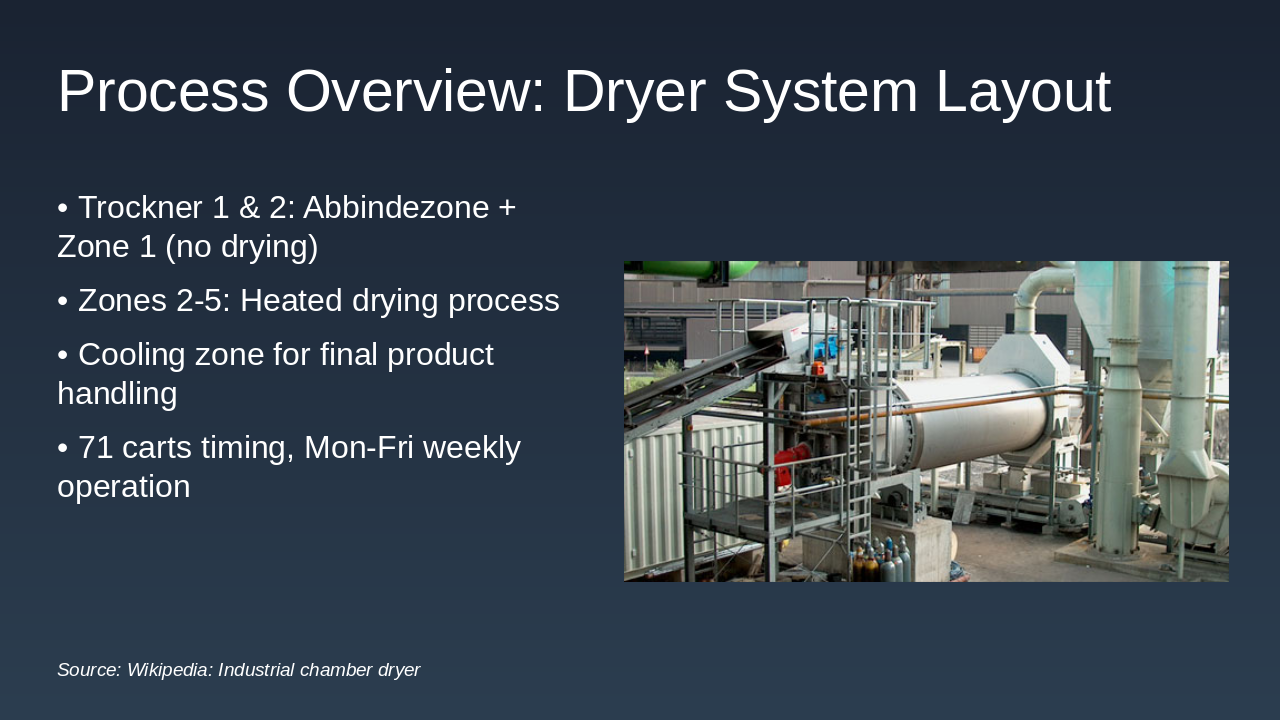
The slide illustrates the layout of a dryer system, starting with Trockner 1 and 2 in the Abbindezone plus Zone 1 where no drying occurs. It then covers Zones 2-5 for the heated drying process, followed by a cooling zone for final product handling, with the system operating on 71 carts timed weekly from Monday to Friday.

Process Overview: Dryer System Layout

!Image

  • Trockner 1 & 2: Abbindezone + Zone 1 (no drying)
  • Zones 2-5: Heated drying process
  • Cooling zone for final product handling
  • 71 carts timing, Mon-Fri weekly operation

Source: Wikipedia: Industrial chamber dryer

--- Speaker Notes: Conceptual diagram illustrating the layout of Trockner 1 and 2, including zones and operational timing for gypsum fiber board drying.

Slide 5
Slide 6 of 27

Slide 6 - Zones, Cart Timing, and Heat Recovery Flows

The slide describes a dryer's configuration, featuring four heated zones (Zones 2-5) for evaporation, an Abbindezone and Zone 1 without drying, a cooling zone, and products varying in 30-44 mm thickness with evaporation loads depending on type (L-, N-, U-, Y-). It also covers heat recovery through exhaust-air exchangers for Trockner 1&2 and compressor waste heat in Trockner 2, alongside a takt time model that monitors 71 carts' zone arrivals to synchronize energy flows and timing for weekly operations, starting with a cold-start on Monday and steady-state from Tuesday to Friday.

Zones, Cart Timing, and Heat Recovery Flows

Drying Zones and Product SpecificationsHeat Recovery and Takt Time Model
The dryer features 4 heated zones (Zones 2-5) for evaporation, plus Abbindezone and Zone 1 (no drying) and a cooling zone. Products range from 30-44 mm thickness, with evaporation load varying by type (L-, N-, U-, Y-products).WRG utilizes exhaust-air heat exchanger for Trockner 1&2, plus compressor waste heat integration in Trockner 2. Takt time model tracks 71 carts' zone arrival times, enabling precise energy flow and timing synchronization for weekly operations (Mon cold-start, Tue-Fri steady-state).

Source: Lindner NORIT GmbH Drying Process Analysis
Slide 6
Slide 7 of 27

Slide 7 - KPI System

The slide titled "KPI System" serves as a section header for the third part of the presentation. It introduces definitions, formulas, and interpretation guidelines for key energy efficiency metrics.

KPI System

03

KPI System

Definitions, formulas, and interpretation for energy efficiency metrics.

Slide 7
Slide 8 of 27

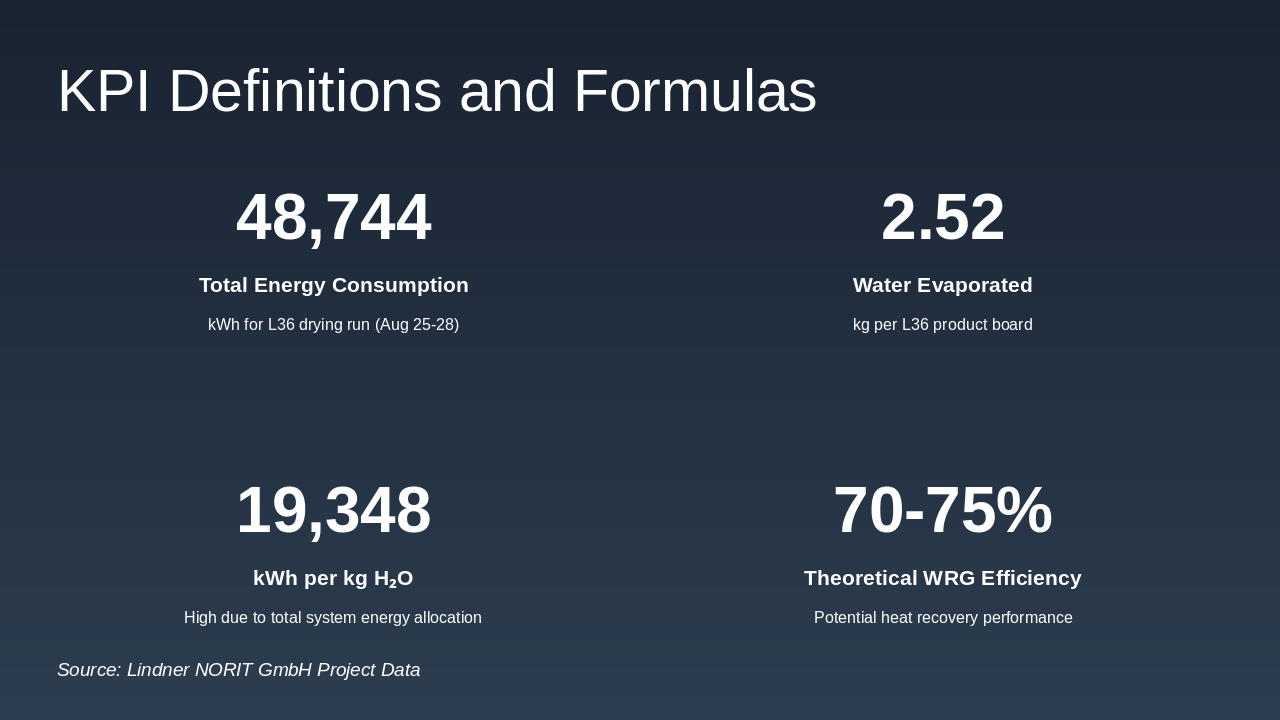
Slide 8 - KPI Definitions and Formulas

The slide defines key performance indicators (KPIs) for an L36 drying run from August 25-28, including total energy consumption of 48,744 kWh, water evaporated at 2.52 kg per product board, and 19,348 kWh per kg of H₂O due to system energy allocation. It also notes a theoretical WRG efficiency of 70-75% for potential heat recovery performance.

KPI Definitions and Formulas

  • 48,744: Total Energy Consumption

kWh for L36 drying run (Aug 25-28)

  • 2.52: Water Evaporated

kg per L36 product board

  • 19,348: kWh per kg H₂O

High due to total system energy allocation

  • 70-75%: Theoretical WRG Efficiency

Potential heat recovery performance

Source: Lindner NORIT GmbH Project Data

--- Speaker Notes: Highlight the high KPI value due to system-wide energy division by single board; emphasize need for WRG data.

Slide 8
Slide 9 of 27

Slide 9 - Additional KPIs and Guidelines

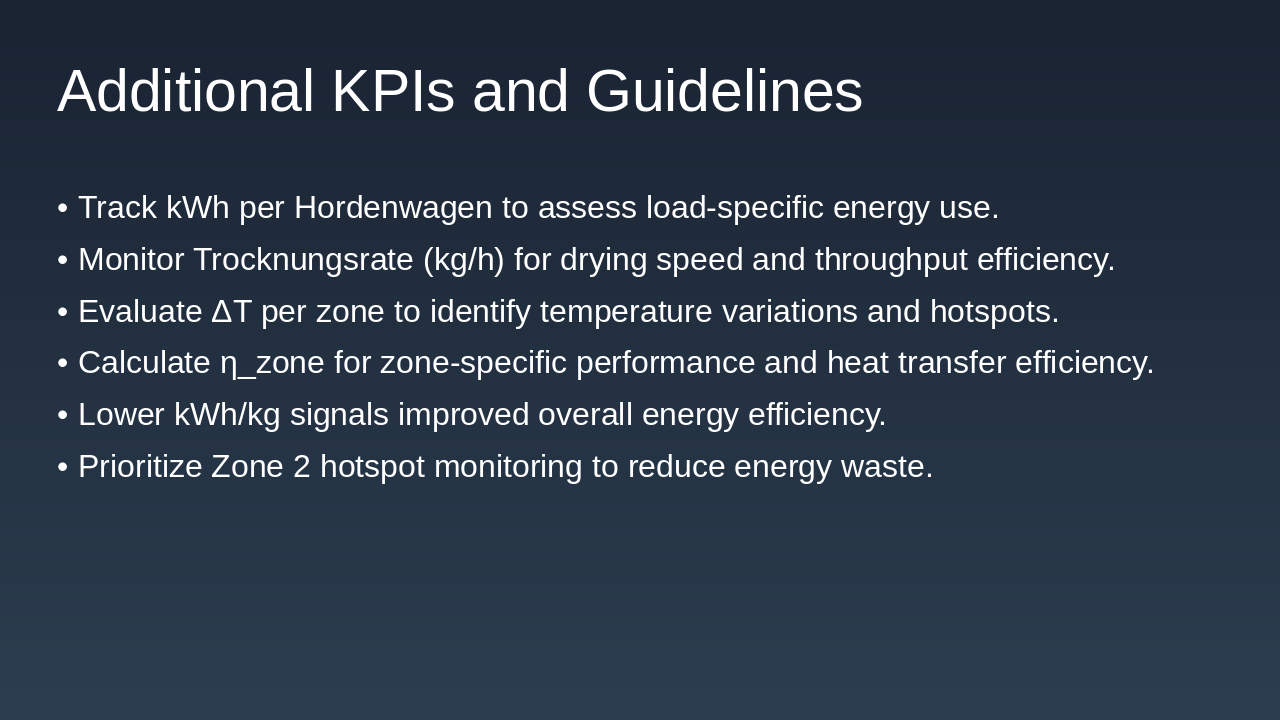
The slide outlines key performance indicators (KPIs) for monitoring energy efficiency in a drying process, including kWh per Hordenwagen for load-specific use, Trocknungsrate (kg/h) for throughput, ΔT per zone for temperature variations, and ηzone for heat transfer. It emphasizes that lower kWh/kg indicates better overall efficiency and prioritizes hotspot monitoring in Zone 2 to minimize energy waste.

Additional KPIs and Guidelines

  • Track kWh per Hordenwagen to assess load-specific energy use.
  • Monitor Trocknungsrate (kg/h) for drying speed and throughput efficiency.
  • Evaluate ΔT per zone to identify temperature variations and hotspots.
  • Calculate ηzone for zone-specific performance and heat transfer efficiency.
  • Lower kWh/kg signals improved overall energy efficiency.
  • Prioritize Zone 2 hotspot monitoring to reduce energy waste.

--- Speaker Notes: Emphasize efficiency metrics and Zone 2 monitoring for optimization.

Slide 9
Slide 10 of 27

Slide 10 - Water Loss Analysis

This section header slide introduces the Water Loss Analysis, focusing on zone-by-zone evaporation processes for L-, N-, U-, and Y-products. It highlights drying curves and their connections to efficiency metrics.

Water Loss Analysis

Water Loss Analysis

Zone-by-zone evaporation for L-, N-, U-, Y-products; drying curves and efficiency links.

Slide 10
Slide 11 of 27

Slide 11 - Zone vs. Moisture Loss Diagram

The slide features a bar chart illustrating water removal as a percentage of the total across different zones, based on mass measurements taken before and after each zone. A cumulative curve shows the progression of evaporation, highlighting Zone 2 as the area with the highest moisture loss.

Zone vs. Moisture Loss Diagram

!Image

  • Bar chart shows water removed per zone as % of total.
  • Mass measurements before and after each zone.
  • Cumulative curve depicts evaporation progression.
  • Identifies Zone 2 as highest moisture loss area.

Source: industrial drying process

--- Speaker Notes: This diagram illustrates water removal efficiency across drying zones, highlighting key evaporation patterns.

Slide 11
Slide 12 of 27

Slide 12 - Efficiency Patterns and Links

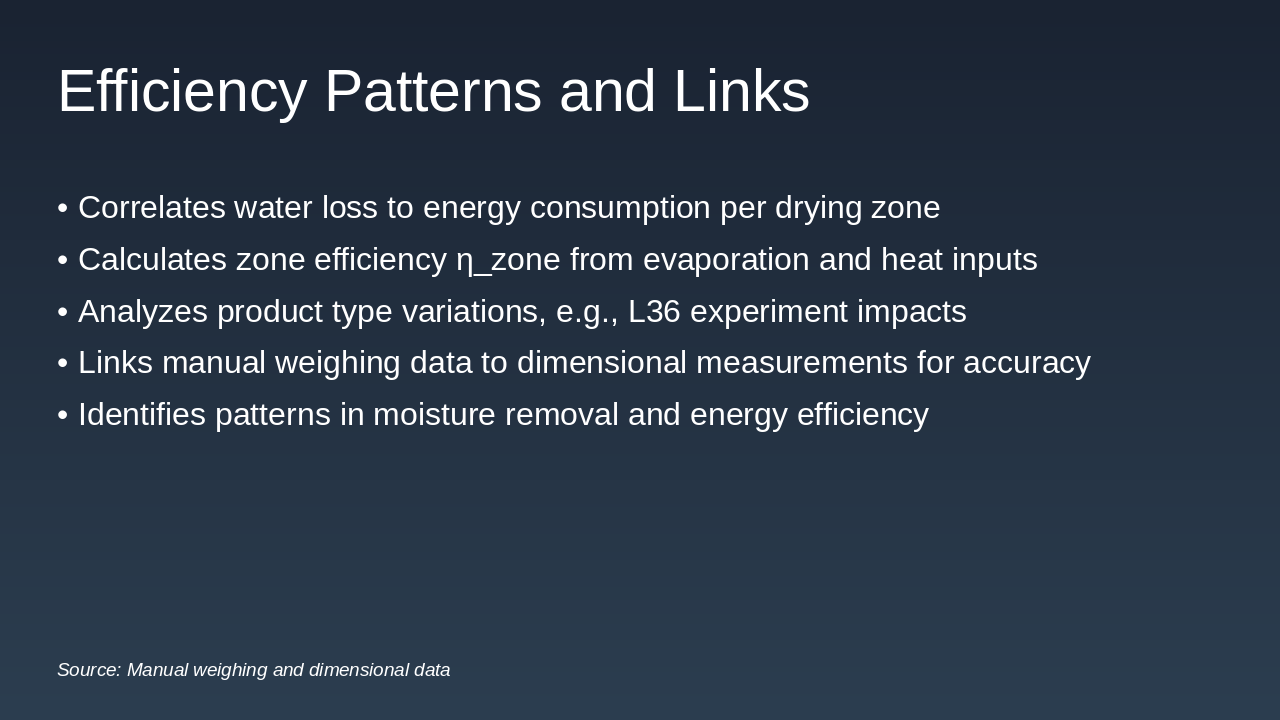
This slide outlines efficiency patterns in drying processes by correlating water loss to energy consumption per zone and calculating zone efficiency based on evaporation and heat inputs. It also analyzes variations by product type, such as L36 experiments, links manual weighing data to dimensional measurements for accuracy, and identifies patterns in moisture removal and overall energy efficiency.

Efficiency Patterns and Links

  • Correlates water loss to energy consumption per drying zone
  • Calculates zone efficiency η_zone from evaporation and heat inputs
  • Analyzes product type variations, e.g., L36 experiment impacts
  • Links manual weighing data to dimensional measurements for accuracy
  • Identifies patterns in moisture removal and energy efficiency

Source: Manual weighing and dimensional data

--- Speaker Notes: Discuss how water loss ties to energy, zone efficiencies, and product variations like L36.

Slide 12
Slide 13 of 27

Slide 13 - Energy Consumption Analysis

This section header slide introduces "Energy Consumption Analysis" as Section 6. It features a subtitle highlighting comparisons, hotspots, and correlations derived from hourly data.

Energy Consumption Analysis

6

Energy Consumption Analysis

Comparisons, hotspots, and correlations based on hourly data.

--- Speaker Notes: Comparisons, hotspots, and correlations based on hourly data.

Slide 13
Slide 14 of 27

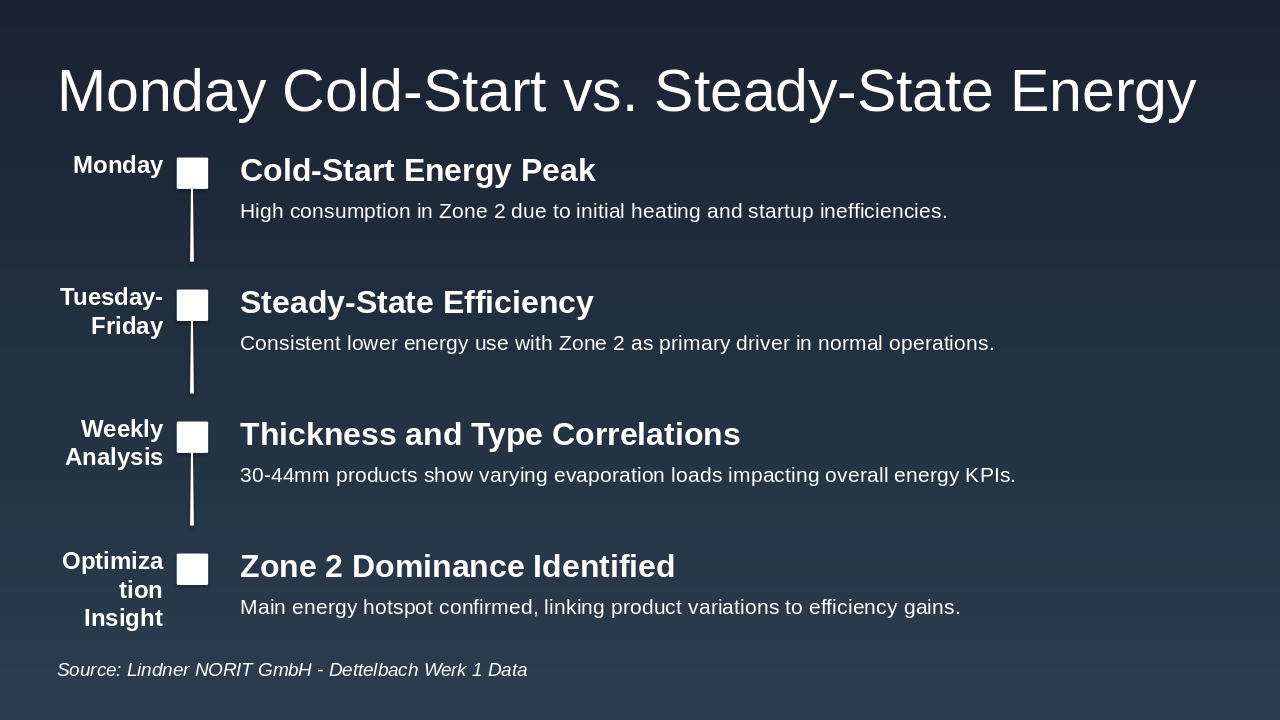
Slide 14 - Monday Cold-Start vs. Steady-State Energy

The slide compares Monday's cold-start energy peak, driven by high consumption in Zone 2 from initial heating inefficiencies, to the steady-state efficiency seen Tuesday through Friday, where Zone 2 remains the primary driver but with consistently lower energy use. It also includes weekly analysis linking 30-44mm product thickness and types to varying evaporation loads on energy KPIs, confirming Zone 2 as the main hotspot for optimization opportunities tied to product variations.

Monday Cold-Start vs. Steady-State Energy

Monday: Cold-Start Energy Peak High consumption in Zone 2 due to initial heating and startup inefficiencies. Tuesday-Friday: Steady-State Efficiency Consistent lower energy use with Zone 2 as primary driver in normal operations. Weekly Analysis: Thickness and Type Correlations 30-44mm products show varying evaporation loads impacting overall energy KPIs. Optimization Insight: Zone 2 Dominance Identified Main energy hotspot confirmed, linking product variations to efficiency gains.

Source: Lindner NORIT GmbH - Dettelbach Werk 1 Data
--- Speaker Notes: Emphasize Zone 2's role and thickness correlations for energy optimization strategies.

Slide 14
Slide 15 of 27

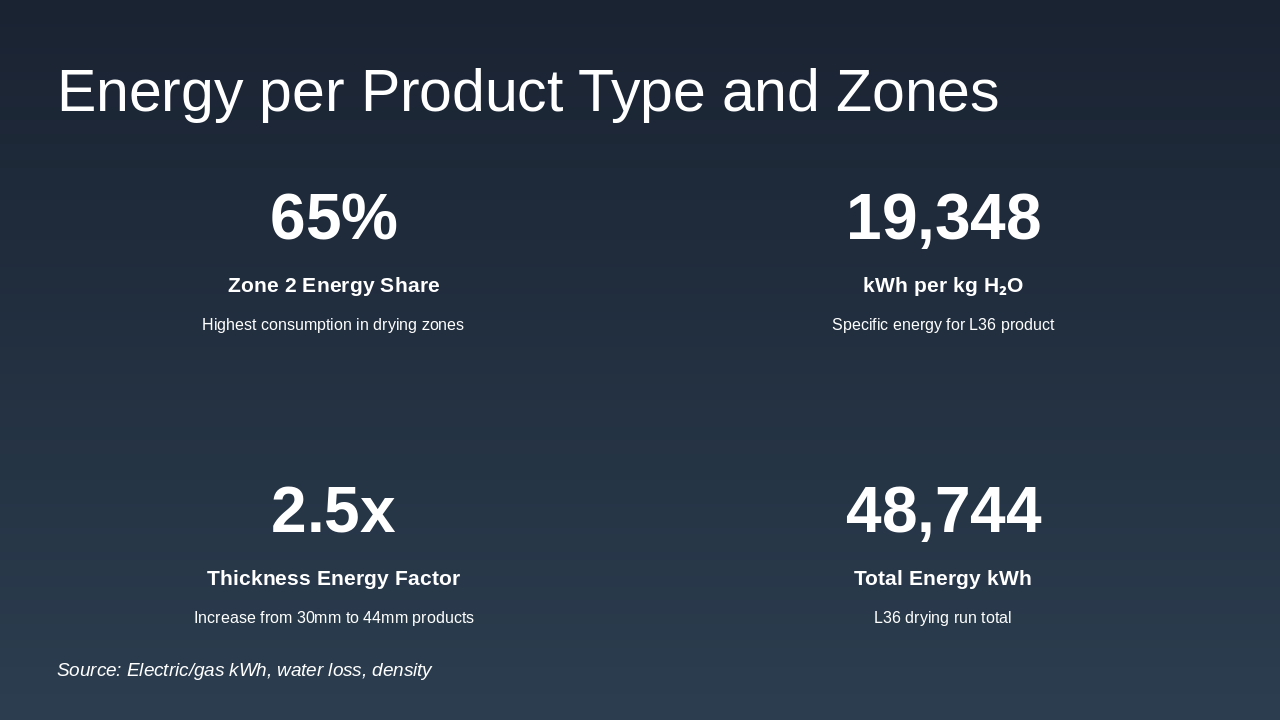
Slide 15 - Energy per Product Type and Zones

The slide highlights energy consumption patterns across product types and zones, with Zone 2 accounting for the highest share at 65% due to intensive drying activities. It also details specific metrics for the L36 product, including 19,348 kWh per kg of H₂O, a 2.5x energy increase from 30mm to 44mm thickness, and a total of 48,744 kWh for the drying run.

Energy per Product Type and Zones

  • 65%: Zone 2 Energy Share

Highest consumption in drying zones

  • 19,348: kWh per kg H₂O

Specific energy for L36 product

  • 2.5x: Thickness Energy Factor

Increase from 30mm to 44mm products

  • 48,744: Total Energy kWh

L36 drying run total

Source: Electric/gas kWh, water loss, density

--- Speaker Notes: Emphasize Zone 2 as the primary energy hotspot and correlations with product thickness; discuss implications for optimization.

Slide 15
Slide 16 of 27

Slide 16 - WRG Evaluation

This slide serves as a section header titled "WRG Evaluation," marking it as the sixth section in the presentation. It features a subtitle focusing on the principles and potential of waste heat recovery.

WRG Evaluation

06

WRG Evaluation

Waste Heat Recovery Principles and Potential

Source: Lindner NORIT GmbH Project

--- Speaker Notes: Introduce waste heat recovery principles and assess potential for efficiency gains in the drying process.

Slide 16
Slide 17 of 27

Slide 17 - WRG Heat Exchanger Diagram

The slide presents a diagram of the WRG Heat Exchanger, illustrating how exhaust air transfers heat to supply air while integrating compressor waste heat for energy recovery. It highlights a theoretical efficiency of 70-75% and notes that performance requires data on inlet/outlet temperatures and flows.

WRG Heat Exchanger Diagram

!Image

  • Exhaust air transfers heat to supply air
  • Compressor waste heat integrated for recovery
  • Theoretical efficiency: 70-75%
  • Requires inlet/outlet temperatures and flows

Source: Heat exchanger

--- Speaker Notes: Conceptual flow: Exhaust air to supply air recovery + compressor waste heat. Theoretical efficiency 70-75%. Needed: Inlet/outlet temps, flows.

Slide 17
Slide 18 of 27

Slide 18 - WRG Principle and Data Needs

The WRG principle involves heat transfer through an exhaust-air exchanger to enhance drying efficiency by 70-75%. However, full evaluation requires missing data on intake and exhaust air temperatures, as well as flow rates.

WRG Principle and Data Needs

  • WRG principle: Heat transfer via exhaust-air exchanger.
  • Potential: Improves overall drying efficiency by 70-75%.
  • Missing data: Zuluft and Abluft temperatures for evaluation.
  • Missing data: Flow rates required for full WRG assessment.
Slide 18
Slide 19 of 27

Slide 19 - Results Based on Provided Data

This slide serves as a section header titled "Results Based on Provided Data," marking it as section 7 in the presentation. It includes a subtitle focusing on the L36 evaluation and key insights derived from the data.

Results Based on Provided Data

7

Results Based on Provided Data

L36 evaluation and insights

--- Speaker Notes: L36 evaluation and insights.

Slide 19
Slide 20 of 27

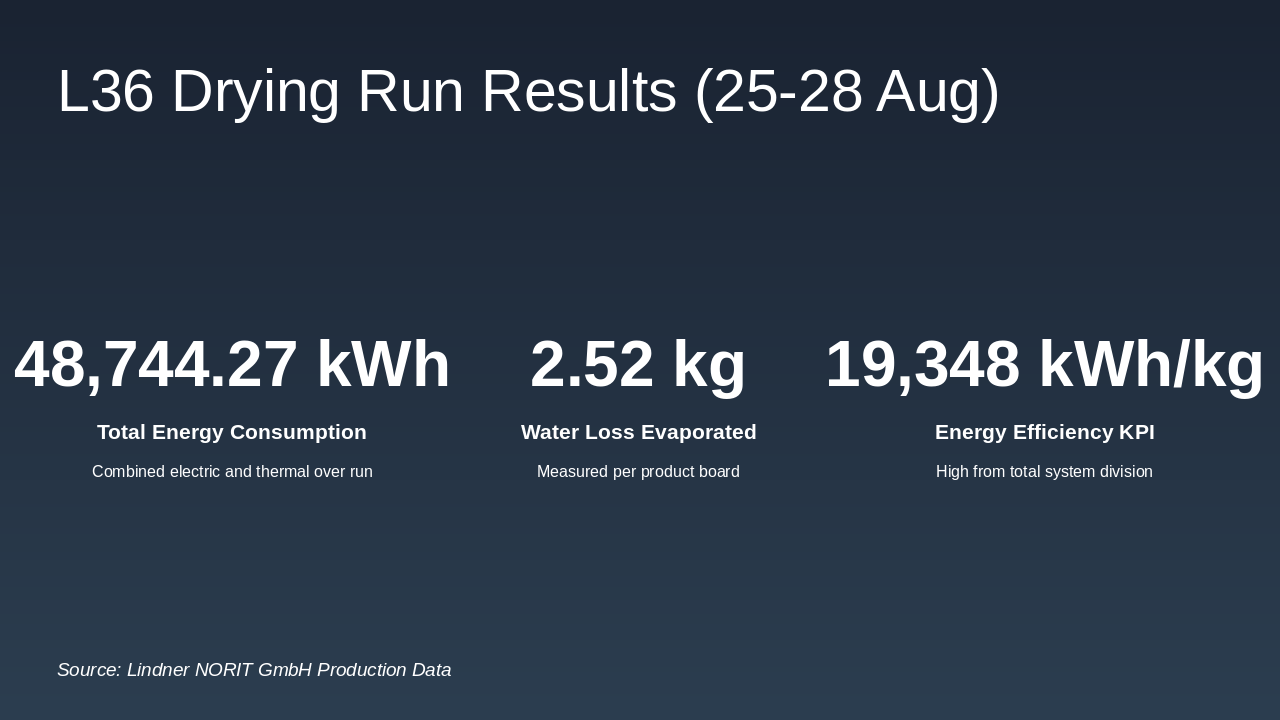
Slide 20 - L36 Drying Run Results (25-28 Aug)

The L36 Drying Run from August 25-28 recorded a total energy consumption of 48,744.27 kWh, combining electric and thermal usage across the run. It achieved 2.52 kg of water loss through evaporation per product board, with an energy efficiency KPI of 19,348 kWh/kg, noted as high due to total system division.

L36 Drying Run Results (25-28 Aug)

  • 48,744.27 kWh: Total Energy Consumption

Combined electric and thermal over run

  • 2.52 kg: Water Loss Evaporated

Measured per product board

  • 19,348 kWh/kg: Energy Efficiency KPI

High from total system division

Source: Lindner NORIT GmbH Production Data
--- Speaker Notes: Highlight the high KPI value due to system-wide energy division by single board; expected lower for full load.

Slide 20
Slide 21 of 27

Slide 21 - Insights and Missing Parameters

The slide highlights insights from data analysis, noting stable operations despite inefficient cold starts, while establishing a KPI framework for effective performance monitoring. It also identifies key gaps, including missing full WRG data that hinders complete heat recovery evaluation and incomplete water mapping that limits evaporation profile analysis.

Insights and Missing Parameters

  • Data structure shows stable operations but inefficient cold starts.
  • Missing full WRG data prevents complete heat recovery evaluation.
  • Incomplete water mapping limits evaporation profile analysis.
  • KPI framework established for effective performance monitoring.
Slide 21
Slide 22 of 27

Slide 22 - Conclusions

This section header slide is titled "Conclusions" and marked as section 08 in the presentation. It features a subtitle that summarizes the stability, inefficiencies, and key achievements discussed throughout the content.

Conclusions

08

Conclusions

Summary of stability, inefficiencies, and achievements.

--- Speaker Notes: Summary of stability, inefficiencies, and achievements.

Slide 22
Slide 23 of 27

Slide 23 - Key Conclusions

The drying process demonstrates stability, though cold-start inefficiencies persist, with Zone 2 emerging as the primary energy consumer. While the WRG performance could not be evaluated due to data gaps, the KPI model framework has been successfully established.

Key Conclusions

  • Drying process stable, but cold-start remains inefficient.
  • Zone 2 identified as dominant energy consumer.
  • WRG performance unevaluated due to data gaps.
  • KPI model framework successfully established.
Slide 23
Slide 24 of 27

Slide 24 - Next Steps and Recommendations

This section header slide, titled "Next Steps and Recommendations," outlines the ninth segment of the presentation. It features a subtitle emphasizing short-, medium-, and long-term actions aimed at optimization.

Next Steps and Recommendations

09

Next Steps and Recommendations

Short-, medium-, long-term actions for optimization

Source: Lindner NORIT GmbH Drying Optimization Project

--- Speaker Notes: Outline short-, medium-, and long-term actions to enhance energy efficiency and process optimization in the gypsum fiber board drying system.

Slide 24
Slide 25 of 27

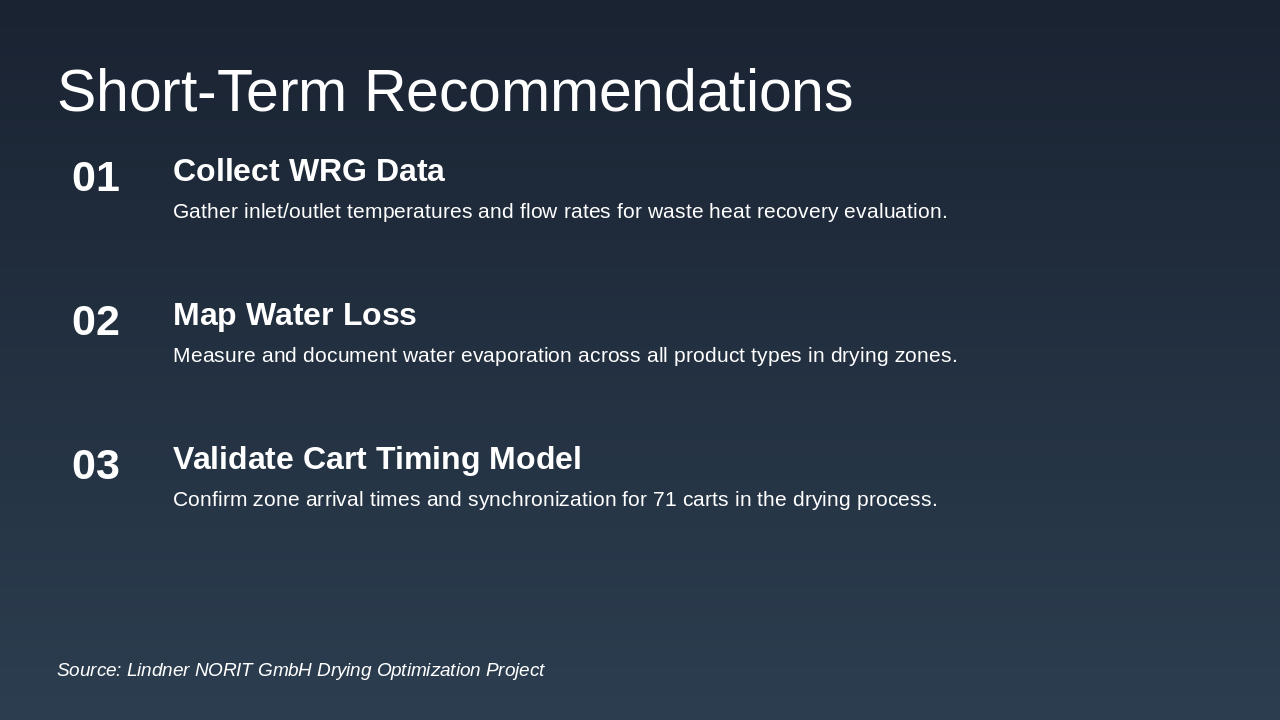
Slide 25 - Short-Term Recommendations

The Short-Term Recommendations agenda slide outlines three key actions for process evaluation in a drying operation. These include collecting waste heat recovery data on inlet/outlet temperatures and flow rates, mapping water evaporation losses across all product types in drying zones, and validating the timing model for 71 carts' zone arrivals and synchronization.

Short-Term Recommendations

  1. Collect WRG Data

Gather inlet/outlet temperatures and flow rates for waste heat recovery evaluation.

  1. Map Water Loss

Measure and document water evaporation across all product types in drying zones.

  1. Validate Cart Timing Model

Confirm zone arrival times and synchronization for 71 carts in the drying process.

Source: Lindner NORIT GmbH Drying Optimization Project

Slide 25
Slide 26 of 27

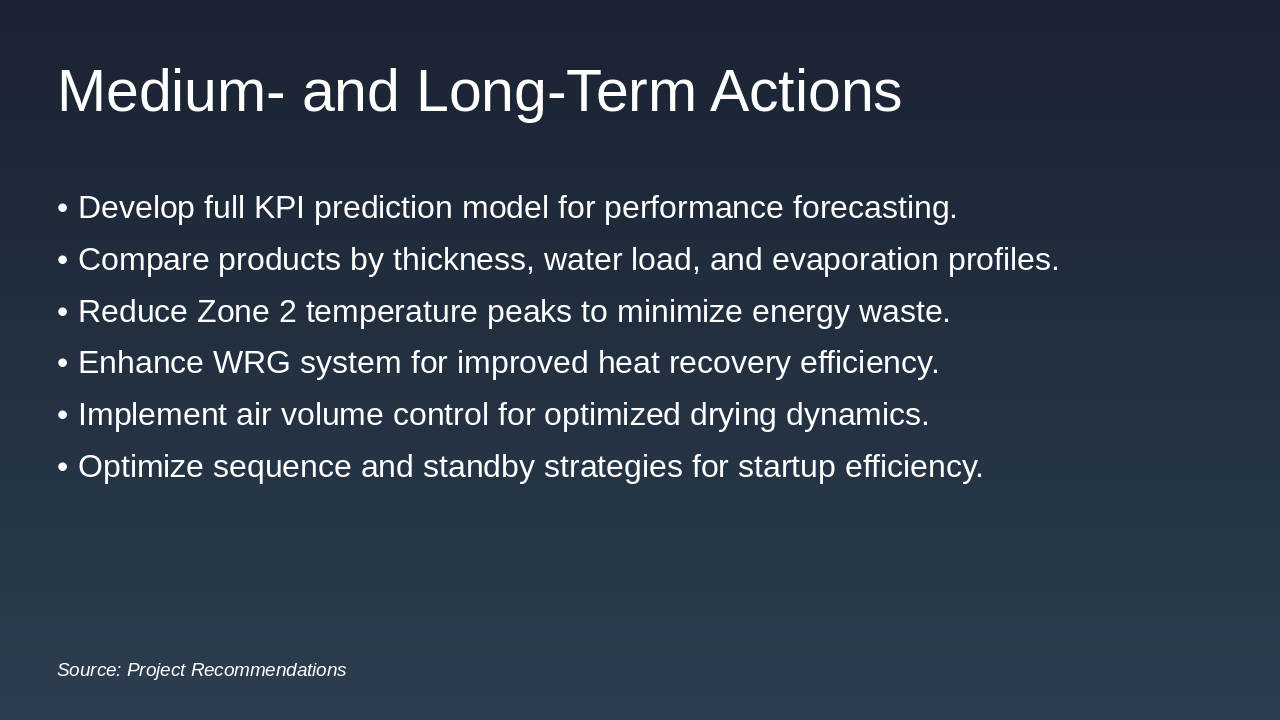
Slide 26 - Medium- and Long-Term Actions

The slide outlines medium- and long-term actions to enhance industrial process efficiency, including developing a full KPI prediction model for performance forecasting and comparing products based on thickness, water load, and evaporation profiles. Additional initiatives focus on reducing Zone 2 temperature peaks to cut energy waste, enhancing the WRG system for better heat recovery, implementing air volume control for optimized drying, and refining startup sequences and standby strategies.

Medium- and Long-Term Actions

  • Develop full KPI prediction model for performance forecasting.
  • Compare products by thickness, water load, and evaporation profiles.
  • Reduce Zone 2 temperature peaks to minimize energy waste.
  • Enhance WRG system for improved heat recovery efficiency.
  • Implement air volume control for optimized drying dynamics.
  • Optimize sequence and standby strategies for startup efficiency.

Source: Project Recommendations

--- Speaker Notes: Outline strategic actions for sustained energy efficiency improvements in drying process.

Slide 26
Slide 27 of 27

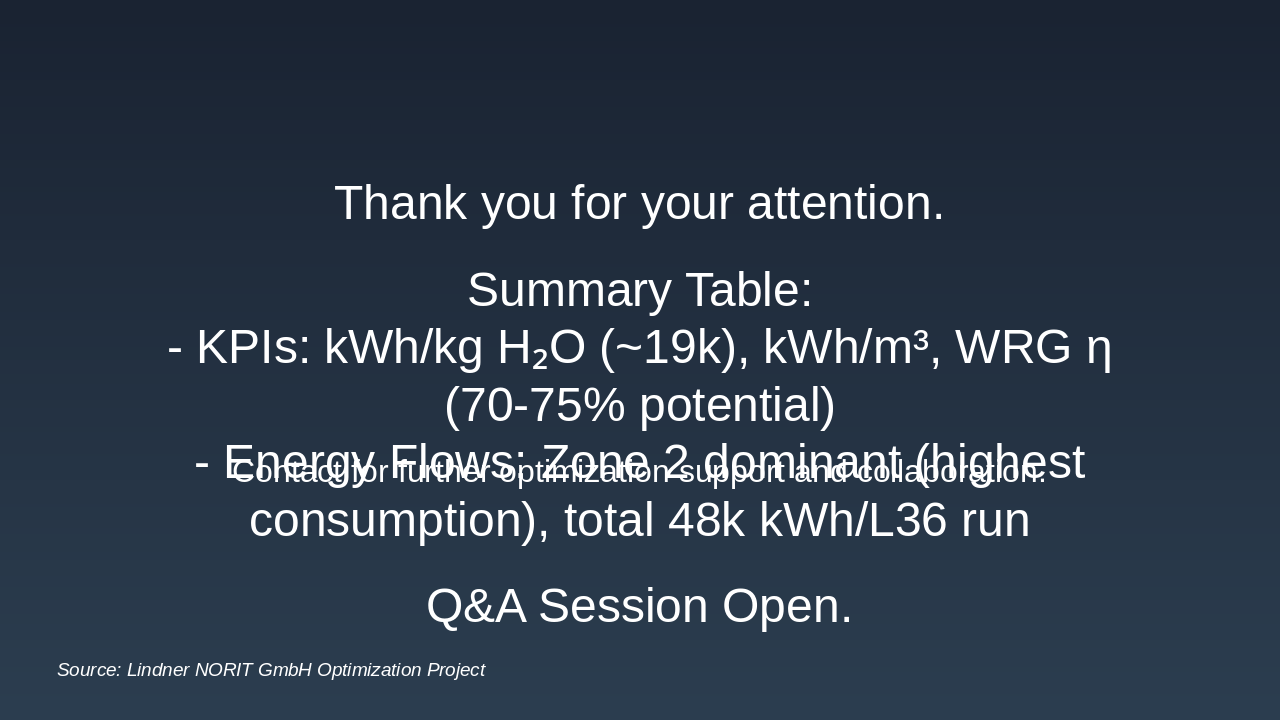
Slide 27 - Thank You and Q&A

The slide concludes the presentation with a thank you for attention and a summary table highlighting key KPIs like kWh/kg H₂O (~19k), kWh/m³, and WRG efficiency (70-75% potential), alongside energy flows noting Zone 2 as the dominant consumer in a total of 48k kWh for the L36 run. It opens a Q&A session and offers contact for further optimization support and collaboration.

Thank You and Q&A

Thank you for your attention.

Summary Table:

  • KPIs: kWh/kg H₂O (~19k), kWh/m³, WRG η (70-75% potential)
  • Energy Flows: Zone 2 dominant (highest consumption), total 48k kWh/L36 run

Q&A Session Open.

Contact for further optimization support and collaboration.

Source: Lindner NORIT GmbH Optimization Project
--- Speaker Notes: Summarize key takeaways: stable but inefficient drying, Zone 2 hotspot, WRG potential. Invite questions and offer contact for support. Highlight summary table.

Slide 27
Powered by AI

Create Your Own Presentation

Generate professional presentations in seconds with Karaf's AI. Customize this presentation or start from scratch.

Create New Presentation

Powered by Karaf.ai — AI-Powered Presentation Generator