Exploring Key Artists, Characteristics, and Masterpieces in Modern Art Movements

Generated from prompt:

Choose 5 art movements and then add full name of artist birth death dates there nationality photo of the artist art movement definition a clear detention in students words I’m in 11 th grade key charcteristics of the moment time period and historical context title of art works images brief description of each artist influences techniques materials used interesting facts do this for 5 diffrent movements

This presentation for 11th grade art students explores five pivotal modern art movements: Impressionism (Monet), Post-Impressionism (van Gogh), Expressionism (Munch), Cubism (Picasso), and Abstract Expressionism (Pollock). Each section includes definitions and characteristics, key artist profiles with influences and techniques, famous works with descriptions and impacts, and concludes with takeaways on how art evolves to reflect emotions, society, and innovation.

May 14, 202622 slides
Slide 1 of 22

Slide 1 - Exploring Key Artists, Characteristics, and Masterpieces

Exploring Key Artists, Characteristics, and Masterpieces

For 11th Grade Art Students

---

Photo by JOHN TOWNER on Unsplash
Slide 1 - Exploring Key Artists,
Characteristics, and Masterpieces
Slide 2 of 22

Slide 2 - Presentation Overview

  • Impressionism
  • Post-Impressionism
  • Expressionism
  • Cubism
  • Abstract Expressionism
  • Key Takeaways

---

Photo by Zhang Xinxin on Unsplash

Slide 2 - Presentation Overview
Slide 3 of 22

Slide 3 - Impressionism

1

Impressionism

19th-century movement focusing on light and everyday moments (1870s-1880s)

---

Photo by Tirza van Dijk on Unsplash
Slide 3 - Impressionism
Slide 4 of 22

Slide 4 - Definition & Characteristics

  • Definition (in my words): Artists captured quick impressions of light and color in daily life, using loose brushstrokes instead of perfect details.
  • Key traits: Visible brush strokes, open composition, changing light effects, ordinary subjects, unusual angles, movement.
  • Time/Context: Paris 1870s-1880s, reaction against rigid academy art; named after Monet's 'Impression, Sunrise' mocked by critics.
Slide 4 - Definition & Characteristics
Slide 5 of 22

Slide 5 - Key Artist: Claude Monet

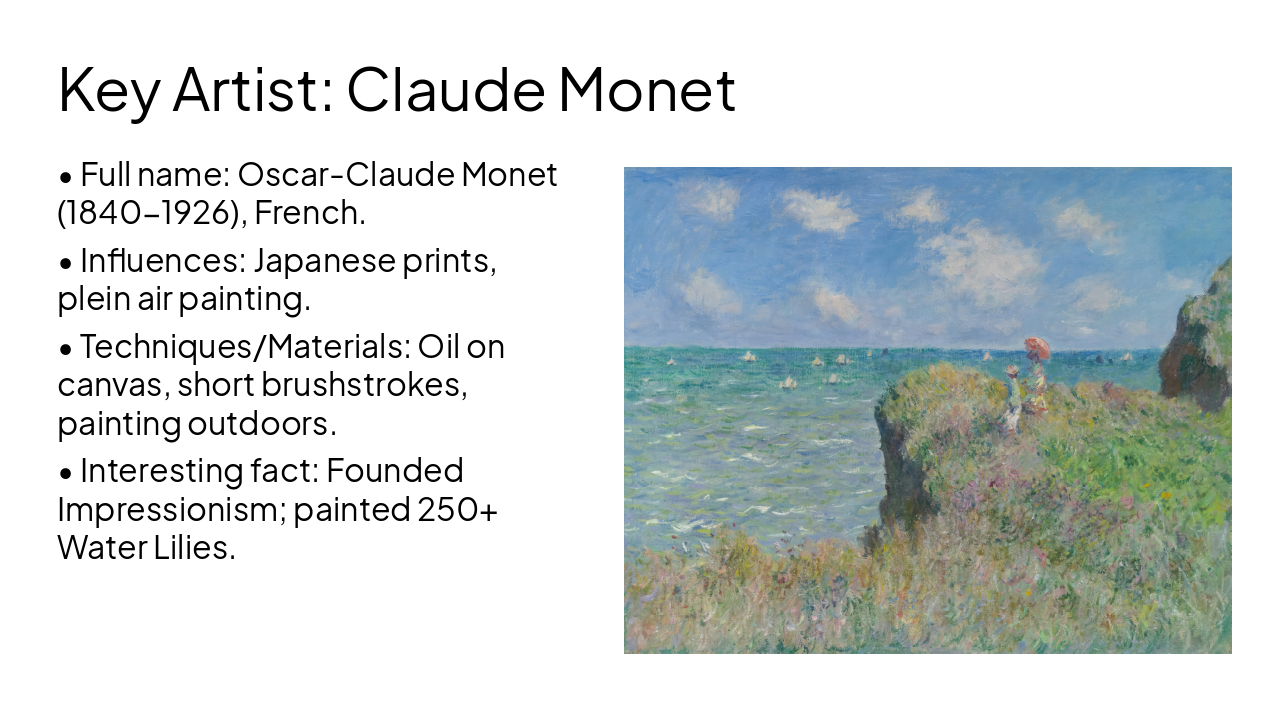
  • Full name: Oscar-Claude Monet (1840-1926), French.
  • Influences: Japanese prints, plein air painting.
  • Techniques/Materials: Oil on canvas, short brushstrokes, painting outdoors.
  • Interesting fact: Founded Impressionism; painted 250+ Water Lilies.

---

Photo by Art Institute of Chicago on Unsplash
Slide 5 - Key Artist: Claude Monet
Slide 6 of 22

Slide 6 - Famous Work: Impression, Sunrise

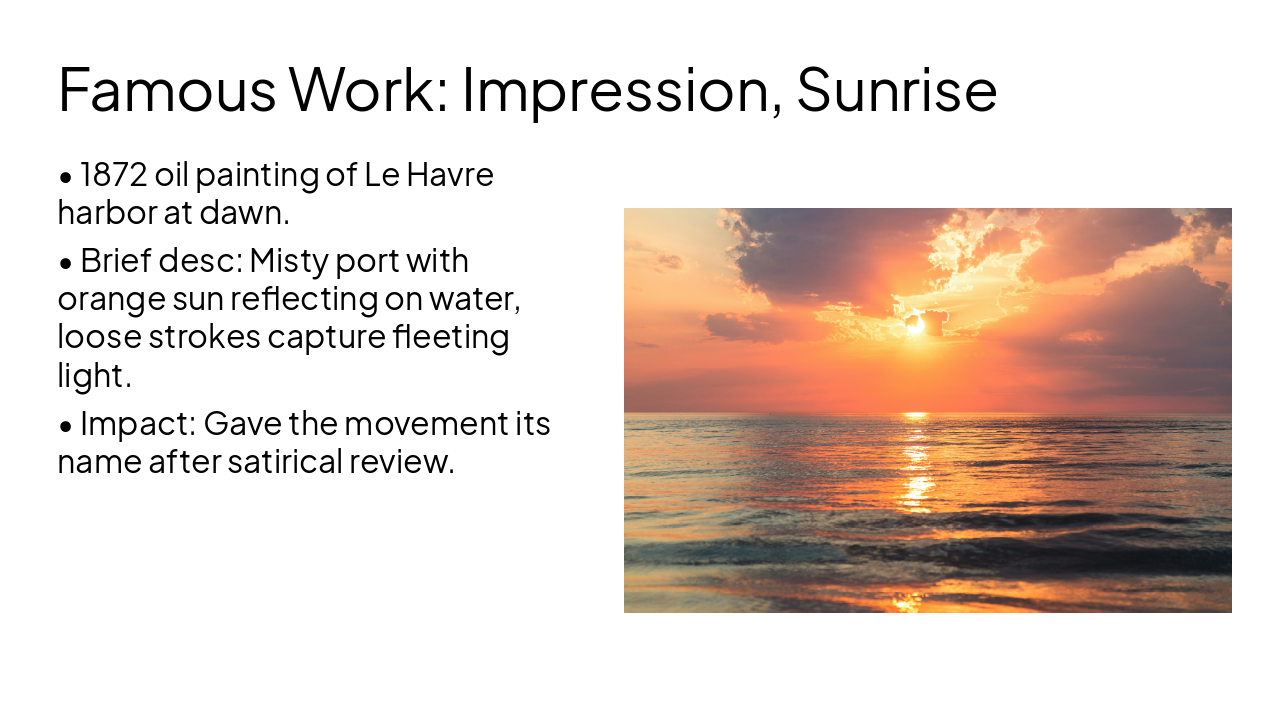
  • 1872 oil painting of Le Havre harbor at dawn.
  • Brief desc: Misty port with orange sun reflecting on water, loose strokes capture fleeting light.
  • Impact: Gave the movement its name after satirical review.

---

Photo by Sebastien Gabriel on Unsplash
Slide 6 - Famous Work: Impression, Sunrise
Slide 7 of 22

Slide 7 - Post-Impressionism

2

Post-Impressionism

Extended Impressionism with emotion and structure (1886-1905)

---

Photo by Paolo Santarsiero on Unsplash
Slide 7 - Post-Impressionism
Slide 8 of 22

Slide 8 - Definition & Characteristics

  • Definition (in my words): Built on Impressionism but added personal feelings, bold colors, and geometric shapes for deeper meaning.
  • Key traits: Vivid colors, impasto paint, distorted forms, symbolic content; groups like Les Nabis, Symbolism.
  • Time/Context: France late 1880s-1905, reaction to Impressionism's limits; term by Roger Fry in 1910.
Slide 8 - Definition & Characteristics
Slide 9 of 22

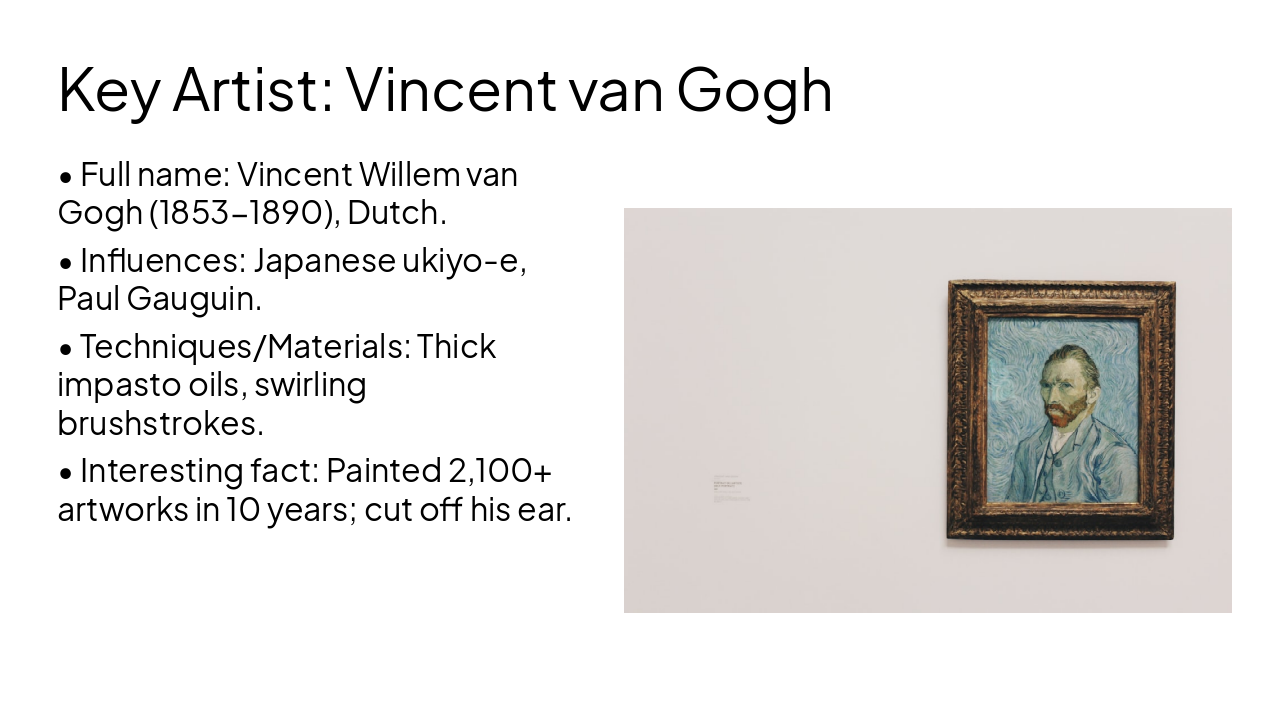
Slide 9 - Key Artist: Vincent van Gogh

  • Full name: Vincent Willem van Gogh (1853-1890), Dutch.
  • Influences: Japanese ukiyo-e, Paul Gauguin.
  • Techniques/Materials: Thick impasto oils, swirling brushstrokes.
  • Interesting fact: Painted 2,100+ artworks in 10 years; cut off his ear.

---

Photo by Alina Grubnyak on Unsplash
Slide 9 - Key Artist: Vincent van Gogh
Slide 10 of 22

Slide 10 - Famous Work: The Starry Night

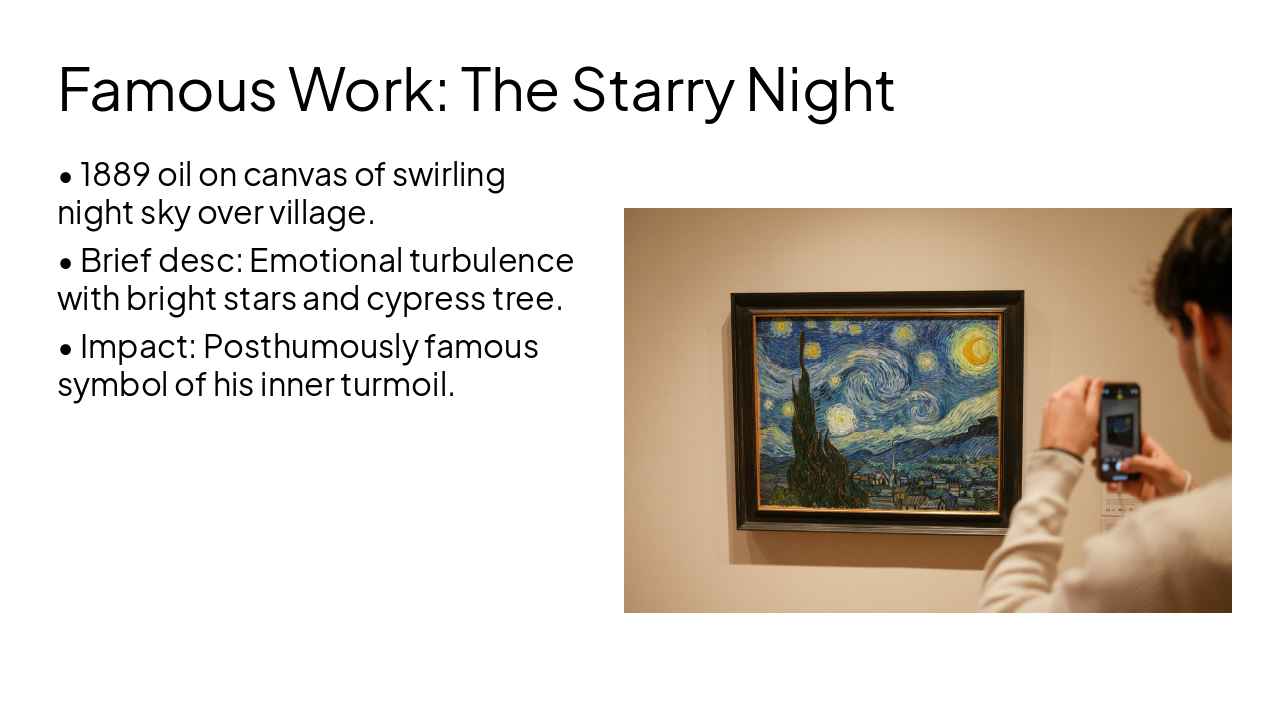
  • 1889 oil on canvas of swirling night sky over village.
  • Brief desc: Emotional turbulence with bright stars and cypress tree.
  • Impact: Posthumously famous symbol of his inner turmoil.

---

Photo by Kevin Snow on Unsplash
Slide 10 - Famous Work: The Starry Night
Slide 11 of 22

Slide 11 - Expressionism

3

Expressionism

Early 20th-century emotional distortion (pre-WWI)

---

Photo by Hyunwon Jang on Unsplash

Slide 11 - Expressionism
Slide 12 of 22

Slide 12 - Definition & Characteristics

  • Definition (in my words): Artists twisted reality to show raw feelings like fear or angst, ignoring real looks for emotion.
  • Key traits: Subjective views, distorted shapes/colors, evokes moods over reality.
  • Time/Context: Northern Europe ~1905-1920s, Weimar Republic; reaction to Naturalism/Impressionism; popular in Berlin.
Slide 12 - Definition & Characteristics
Slide 13 of 22

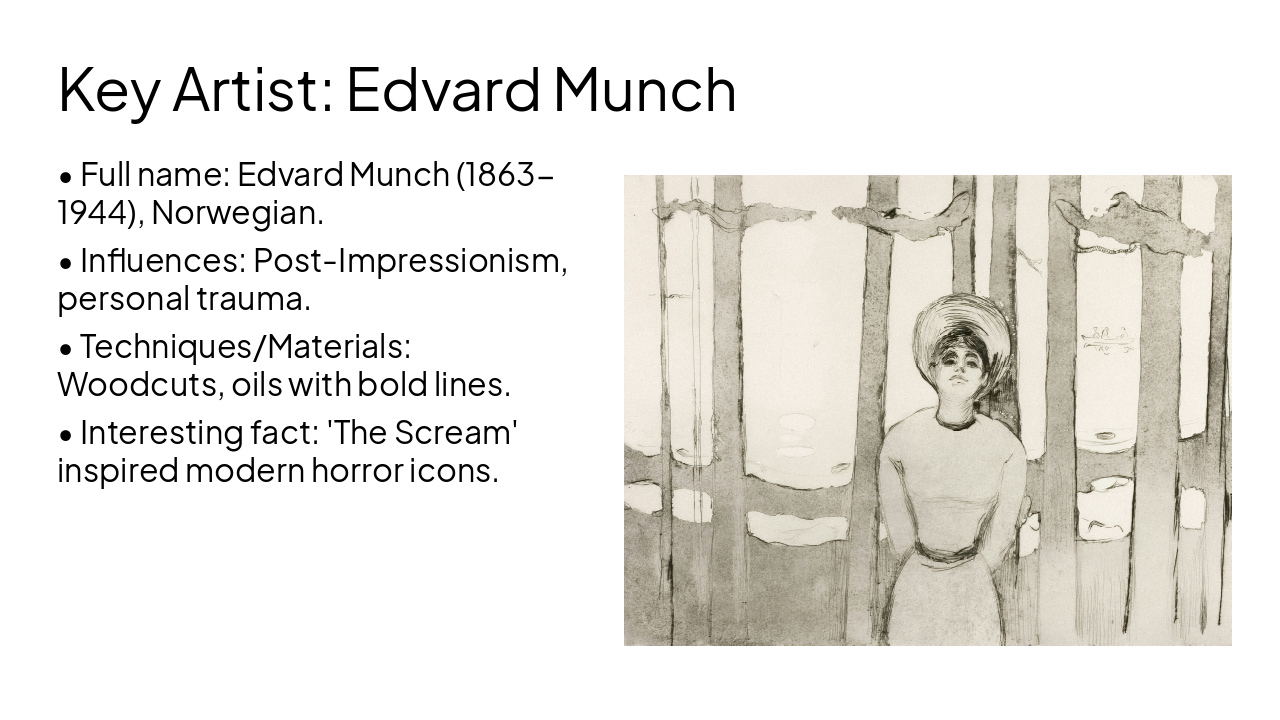
Slide 13 - Key Artist: Edvard Munch

  • Full name: Edvard Munch (1863-1944), Norwegian.
  • Influences: Post-Impressionism, personal trauma.
  • Techniques/Materials: Woodcuts, oils with bold lines.
  • Interesting fact: 'The Scream' inspired modern horror icons.

---

Photo by Art Institute of Chicago on Unsplash
Slide 13 - Key Artist: Edvard Munch
Slide 14 of 22

Slide 14 - Famous Work: The Scream

  • 1893 tempera and crayon on cardboard.
  • Brief desc: Figure on bridge with swirling sky, hands on face in agony.
  • Impact: Icon of human anxiety.

---

Photo by Europeana on Unsplash

Slide 14 - Famous Work: The Scream
Slide 15 of 22

Slide 15 - Cubism

4

Cubism

Early 20th-century multi-perspective revolution (1907-1920s)

---

Photo by Lucia Macedo on Unsplash
Slide 15 - Cubism
Slide 16 of 22

Slide 16 - Definition & Characteristics

  • Definition (in my words): Broke objects into geometric pieces shown from multiple angles at once, like puzzles.
  • Key traits: Abstract forms, multiple viewpoints, faceted shapes; introduced collage.
  • Time/Context: Paris 1907-1920s, pioneered by Picasso/Braque; influenced by Cézanne; sparked Futurism/Dada.
Slide 16 - Definition & Characteristics
Slide 17 of 22

Slide 17 - Key Artist: Pablo Picasso

  • Full name: Pablo Ruiz Picasso (1881-1973), Spanish.
  • Influences: African art, Cézanne.
  • Techniques/Materials: Oil, charcoal, collage on canvas.
  • Interesting fact: Co-invented Cubism; produced 50,000+ works.

---

Photo by Europeana on Unsplash

Slide 17 - Key Artist: Pablo Picasso
Slide 18 of 22

Slide 18 - Famous Work: Les Demoiselles d'Avignon

  • 1907 oil on canvas of five nude women.
  • Brief desc: Angular faces/bodies inspired by African masks.
  • Impact: Proto-Cubism landmark.

---

Photo by Chelsea Essig on Unsplash
Slide 18 - Famous Work: Les Demoiselles d'Avignon
Slide 19 of 22

Slide 19 - Abstract Expressionism

5

Abstract Expressionism

Post-WWII American freedom in paint (1940s-1950s)

---

Photo by Doug Vos on Unsplash
Slide 19 - Abstract Expressionism
Slide 20 of 22

Slide 20 - Definition & Characteristics

  • Definition (in my words): Pure emotion poured onto canvas without recognizable subjects, big bold strokes or drips.
  • Key traits: Spontaneous, subconscious; action painting, color fields.
  • Time/Context: New York post-WWII 1940s-1950s; shifted art center from Paris; influenced by Surrealism.
Slide 20 - Definition & Characteristics
Slide 21 of 22

Slide 21 - Key Artist: Jackson Pollock

  • Full name: Paul Jackson Pollock (1912-1956), American.
  • Influences: Surrealism, Picasso, Native American sand painting.
  • Techniques/Materials: Drip technique, house paint on large canvases laid on floor.
  • Interesting fact: 'Jack the Dripper'; died in car crash at 44.

---

Photo by Saad Ahmad on Unsplash

Slide 21 - Key Artist: Jackson Pollock
Slide 22 of 22

Slide 22 - Key Takeaways

Art movements evolve, reflecting emotions, society, and innovation. From light impressions to emotional abstraction.

Thanks for exploring! Questions?

---

Photo by Joyce Hankins on Unsplash
Slide 22 - Key Takeaways

Discover More Presentations

Explore thousands of AI-generated presentations for inspiration

Browse Presentations
Powered by AI

Create Your Own Presentation

Generate professional presentations in seconds with Karaf's AI. Customize this presentation or start from scratch.

Create New Presentation

Powered by Karaf.ai — AI-Powered Presentation Generator