Foundations of Educational Leadership: Unit 1

Generated from prompt:

FINAL high-quality PowerPoint for B.Ed students on Unit 1: Introduction to Organization, Administration, and Management. Ensure download reliability. Clean modern design, readable fonts, icons. 17 slides: 1 Title, 2 Objectives, 3 Organization definition + school example, 4 Concept (structure, formal/informal), 5 Administration + school example, 6 Management + classroom example, 7 Detailed comparison table, 8 Importance in education, 9 Good vs Poor management, 10 Elements overview, 11 Planning (lesson plan), 12 Organizing (school/class), 13 Staffing (roles in education), 14 Directing (leadership, motivation), 15 Controlling (assessment), 16 Summary, 17 Activity/discussion. Use simple professional language and add visual/icon suggestions.

This deck introduces organization, administration, and management in education, distinguishing their roles, exploring key elements like planning and controlling, and highlighting their importance for effective schools with practical examples and a mg

April 12, 202617 slides
Slide 1 of 17

Slide 1 - Educational Leadership Foundation

Introduction to Organization, Administration, and Management

Understanding Key Foundations for Effective Schools (Unit 1)
Slide 1 - Educational Leadership Foundation
Slide 2 of 17

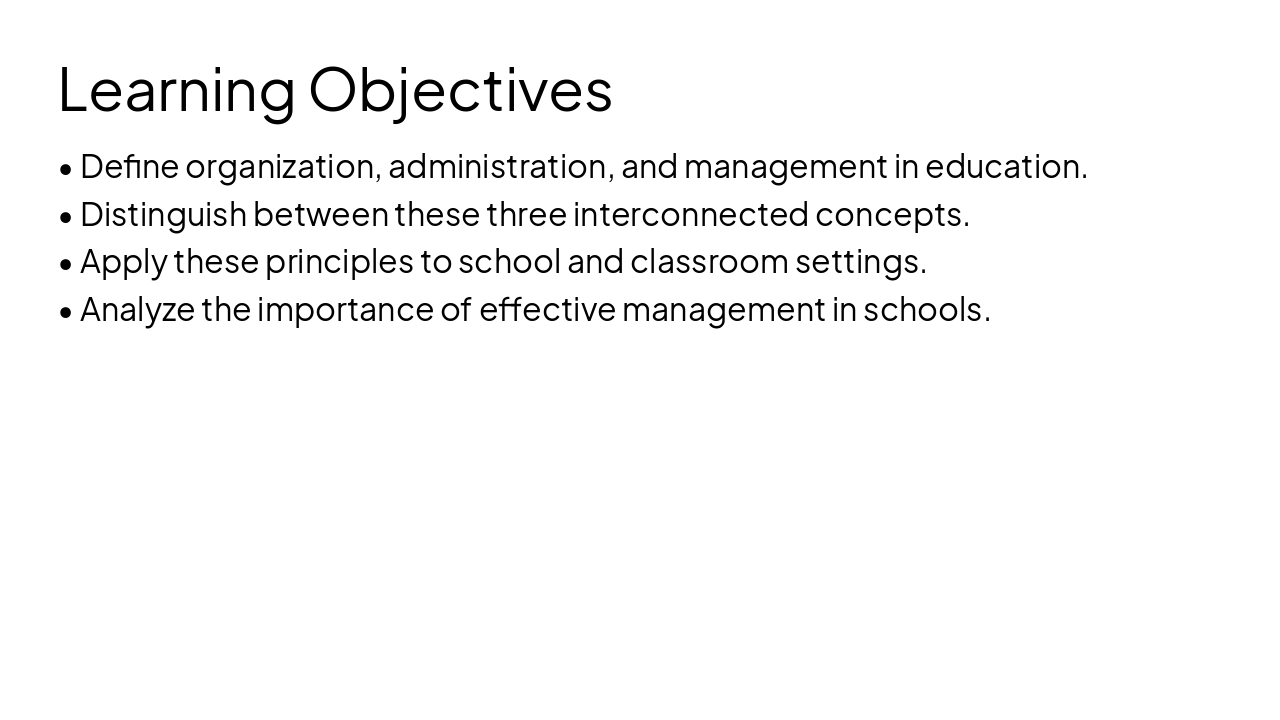
Slide 2 - Learning Objectives

  • Define organization, administration, and management in education.
  • Distinguish between these three interconnected concepts.
  • Apply these principles to school and classroom settings.
  • Analyze the importance of effective management in schools.
Slide 2 - Learning Objectives
Slide 3 of 17

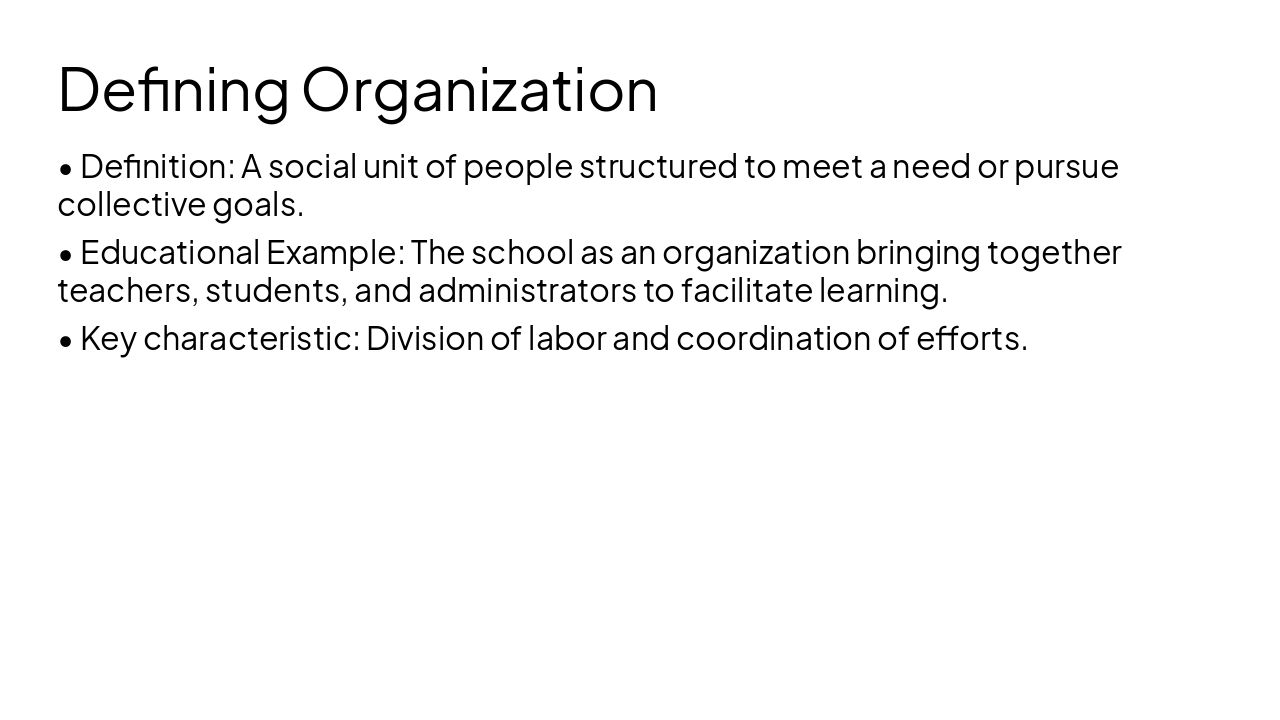
Slide 3 - Defining Organization

  • Definition: A social unit of people structured to meet a need or pursue collective goals.
  • Educational Example: The school as an organization bringing together teachers, students, and administrators to facilitate learning.
  • Key characteristic: Division of labor and coordination of efforts.
Slide 3 - Defining Organization
Slide 4 of 17

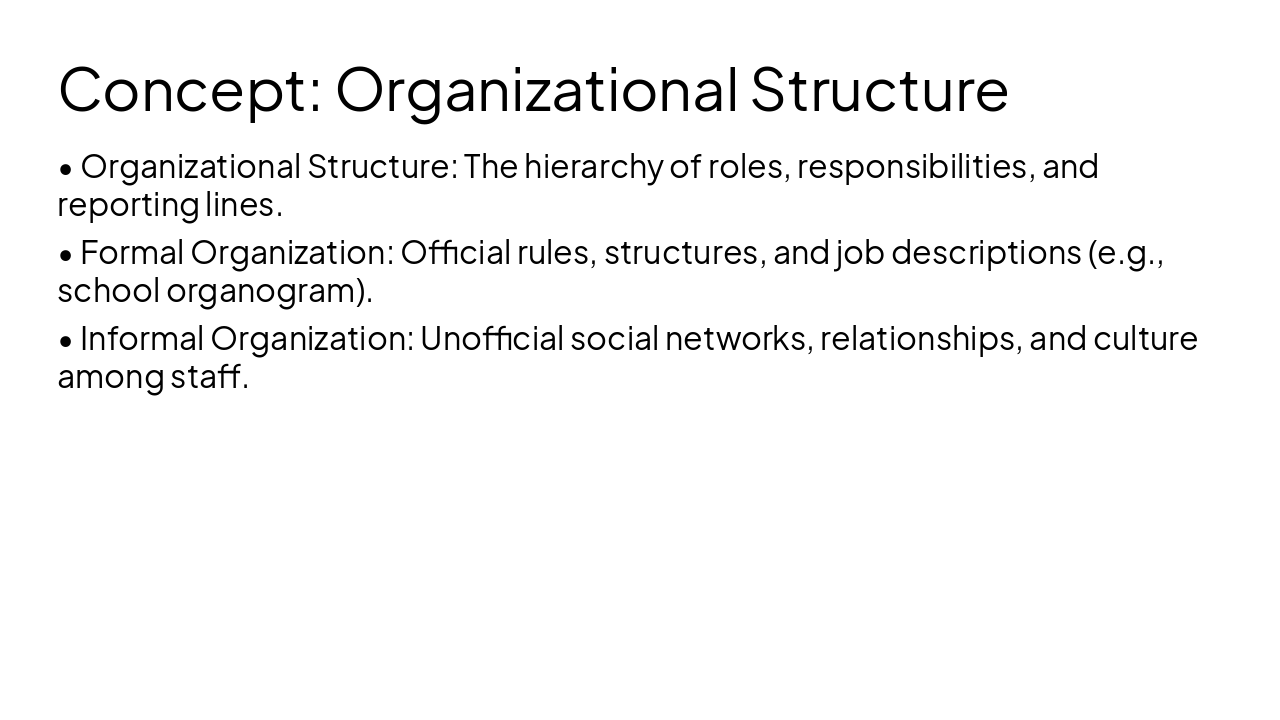
Slide 4 - Concept: Organizational Structure

  • Organizational Structure: The hierarchy of roles, responsibilities, and reporting lines.
  • Formal Organization: Official rules, structures, and job descriptions (e.g., school organogram).
  • Informal Organization: Unofficial social networks, relationships, and culture among staff.
Slide 4 - Concept: Organizational Structure
Slide 5 of 17

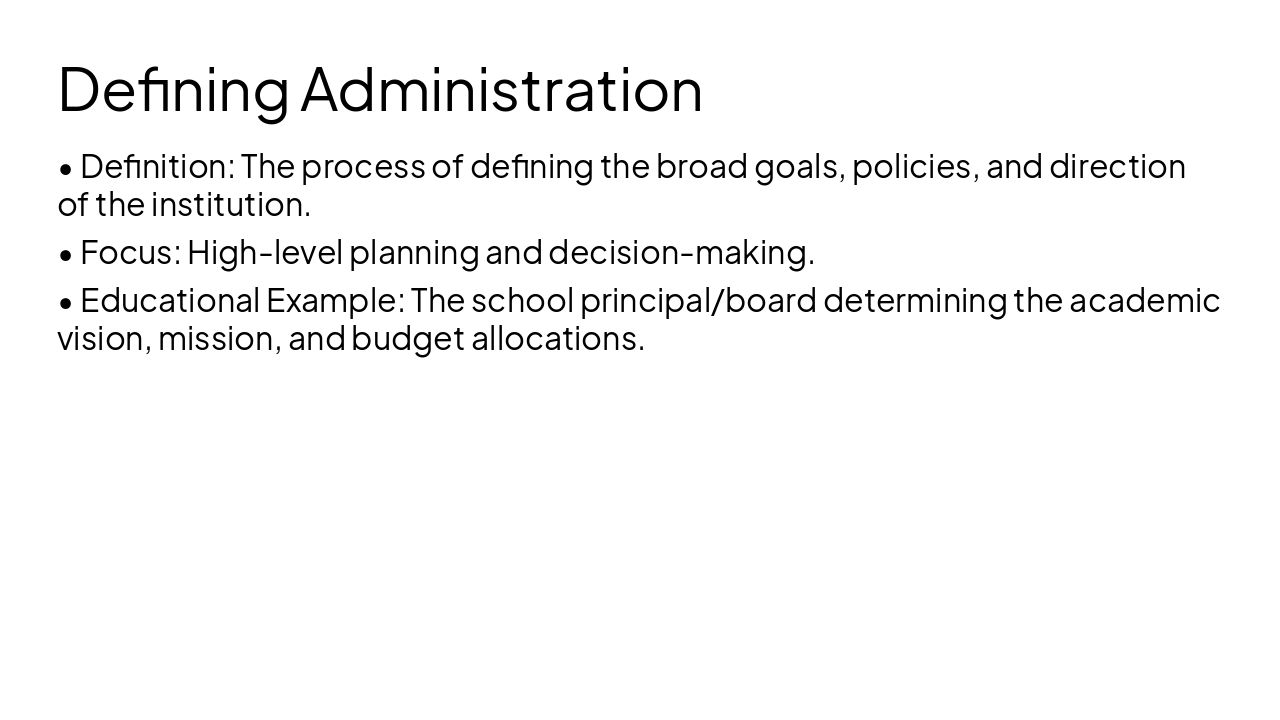
Slide 5 - Defining Administration

  • Definition: The process of defining the broad goals, policies, and direction of the institution.
  • Focus: High-level planning and decision-making.
  • Educational Example: The school principal/board determining the academic vision, mission, and budget allocations.
Slide 5 - Defining Administration
Slide 6 of 17

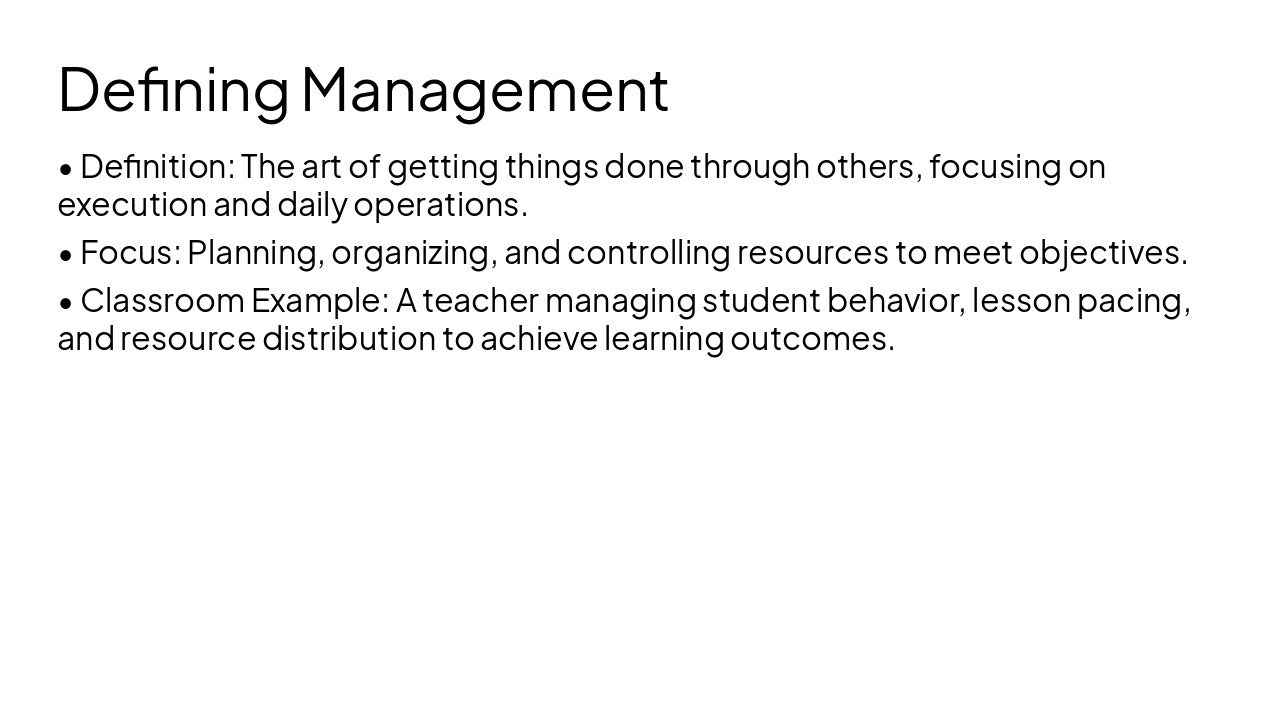
Slide 6 - Defining Management

  • Definition: The art of getting things done through others, focusing on execution and daily operations.
  • Focus: Planning, organizing, and controlling resources to meet objectives.
  • Classroom Example: A teacher managing student behavior, lesson pacing, and resource distribution to achieve learning outcomes.
Slide 6 - Defining Management
Slide 7 of 17

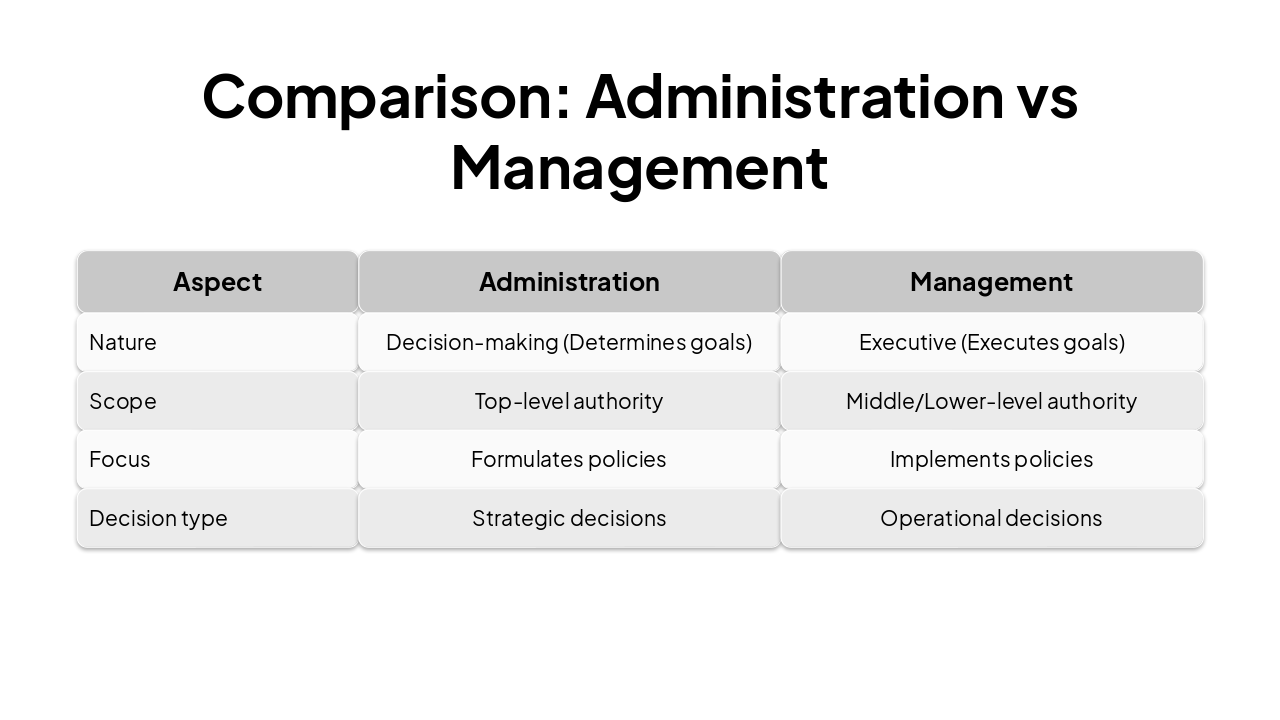
Slide 7 - Comparison: Administration vs Management

AspectAdministrationManagement
NatureDecision-making (Determines goals)Executive (Executes goals)
ScopeTop-level authorityMiddle/Lower-level authority
FocusFormulates policiesImplements policies
Decision typeStrategic decisionsOperational decisions
Slide 7 - Comparison: Administration vs Management
Slide 8 of 17

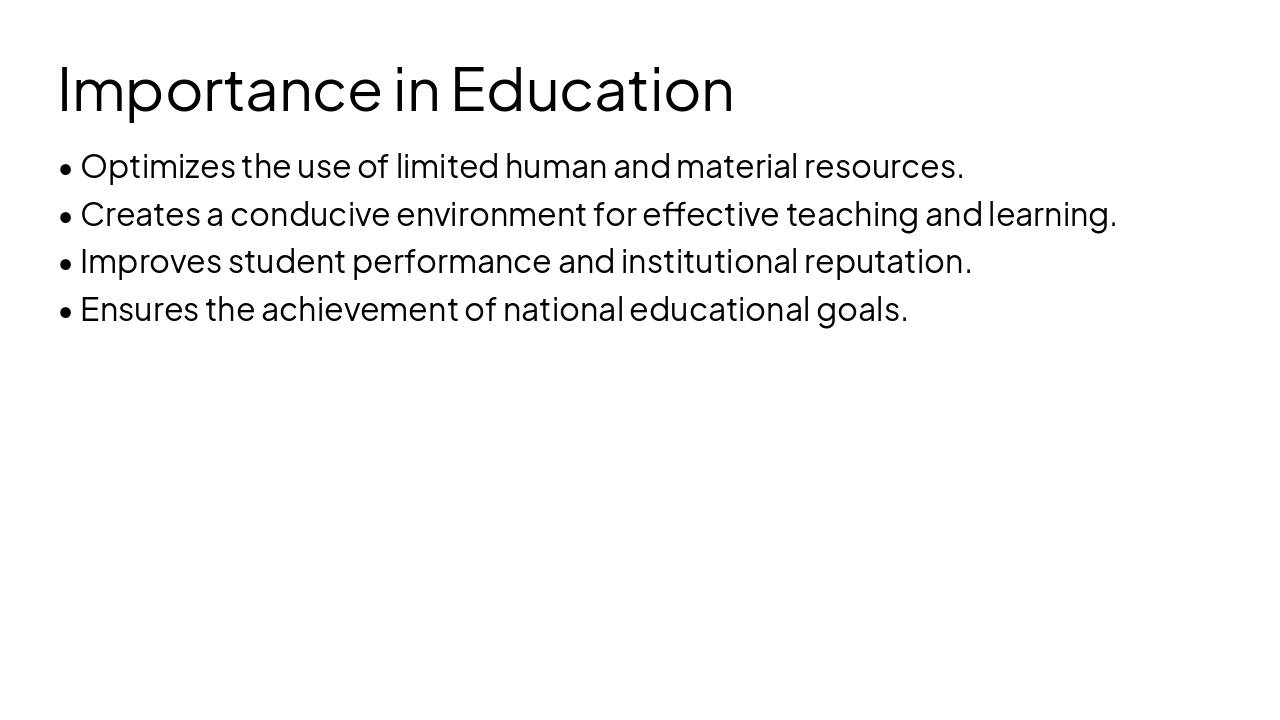
Slide 8 - Importance in Education

  • Optimizes the use of limited human and material resources.
  • Creates a conducive environment for effective teaching and learning.
  • Improves student performance and institutional reputation.
  • Ensures the achievement of national educational goals.
Slide 8 - Importance in Education
Slide 9 of 17

Slide 9 - Good vs Poor Management

Good Management Characteristics Clear goal setting, active communication, supportive leadership, efficient resource use, motivated staff.

Poor Management Signs Lack of direction, micromanagement, poor conflict resolution, low morale, wasted resources.
Slide 9 - Good vs Poor Management
Slide 10 of 17

Slide 10 - Elements of Management Overview

  • Planning: Determining in advance what to do.
  • Organizing: Arranging resources to execute the plan.
  • Staffing: Recruiting and developing personnel.
  • Directing: Guiding, leading, and motivating.
  • Controlling: Monitoring performance against standards.
Slide 10 - Elements of Management Overview
Slide 11 of 17

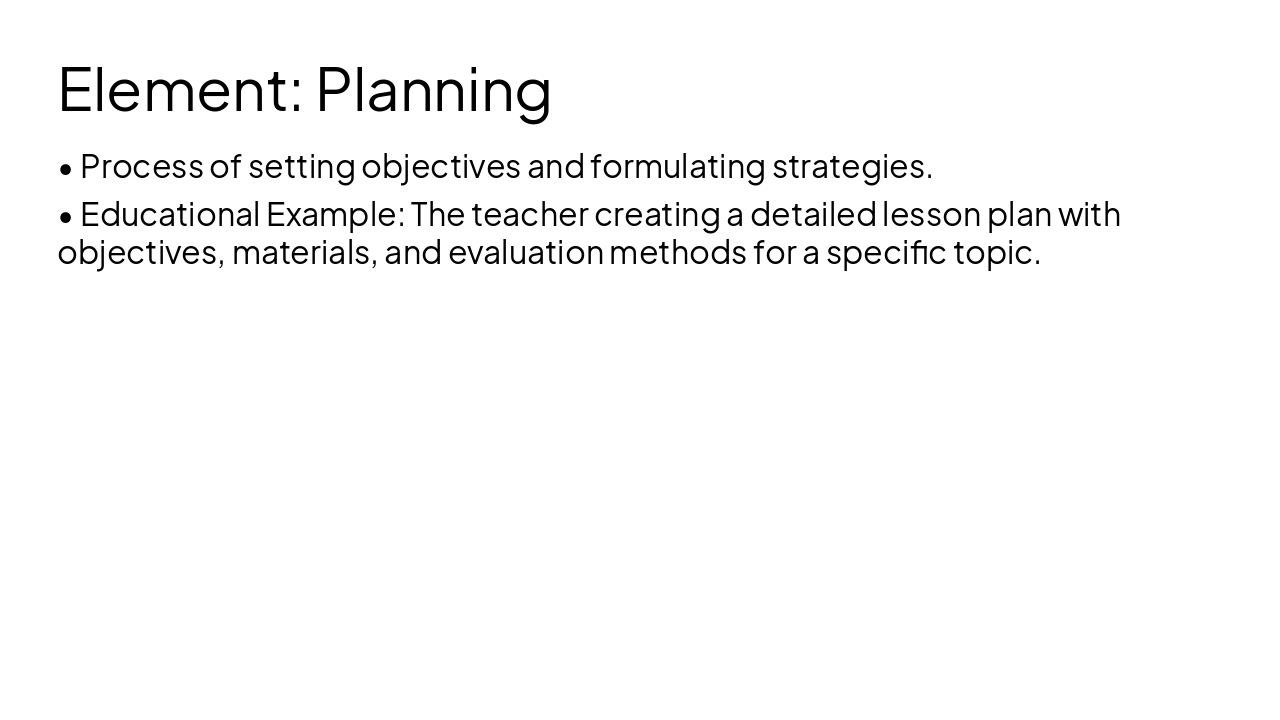
Slide 11 - Element: Planning

  • Process of setting objectives and formulating strategies.
  • Educational Example: The teacher creating a detailed lesson plan with objectives, materials, and evaluation methods for a specific topic.
Slide 11 - Element: Planning
Slide 12 of 17

Slide 12 - Element: Organizing

  • Structuring tasks and allocating resources efficiently.
  • Educational Example: Dividing students into groups for a project, assigning roles, and organizing the classroom layout for collaborative learning.
Slide 12 - Element: Organizing
Slide 13 of 17

Slide 13 - Element: Staffing

  • Acquiring, training, and retaining the right people for the right roles.
  • Educational Example: School leadership assigning subject matter experts to appropriate grade levels and professional development programs.
Slide 13 - Element: Staffing
Slide 14 of 17

Slide 14 - Element: Directing

  • Leading, influencing, and guiding people towards goal achievement.
  • Educational Example: A teacher using praise, incentives, and modeling to motivate students and lead classroom discussions.
Slide 14 - Element: Directing
Slide 15 of 17

Slide 15 - Element: Controlling

  • Evaluating progress and making adjustments to ensure objectives are met.
  • Educational Example: Using formative assessment (quizzes/feedback) to monitor student learning and adjust teaching strategies accordingly.
Slide 15 - Element: Controlling
Slide 16 of 17

Slide 16 - Summary

  • Organization: The structure for achieving collective goals.
  • Administration: Strategic vision and policy setting.
  • Management: Execution and operational excellence.
  • Success depends on the harmonious interaction of these functions.
Slide 16 - Summary
Slide 17 of 17

Slide 17 - Reflections and Next Steps

Analyze a school issue and identify if it is an administrative or managerial challenge.

Group Discussion & Activity
Slide 17 - Reflections and Next Steps

Discover More Presentations

Explore thousands of AI-generated presentations for inspiration

Browse Presentations
Powered by AI

Create Your Own Presentation

Generate professional presentations in seconds with Karaf's AI. Customize this presentation or start from scratch.

Create New Presentation

Powered by Karaf.ai — AI-Powered Presentation Generator