Semiconductors: Fundamentals, Materials, Doping, History, and Industry Overview

Generated from prompt:

make a presentation about semiconductors

This presentation explores the essentials of semiconductors, including their definition as materials with conductivity between conductors and insulators, key materials like silicon and gallium arsenide, the doping process to create n-type and p-type semiconductors forming p-n junctions, historical milestones from the 1947 transistor invention to integrated circuits, pioneer companies such as Fairchild Semiconductor and Texas Instruments, industry statistics with $556 billion in global sales in 2021 projected to reach $727 billion by 2027, and applications in diodes, transistors, microchips,激光d

May 6, 202612 slides
Slide 1 of 12

Slide 1 - Semiconductors

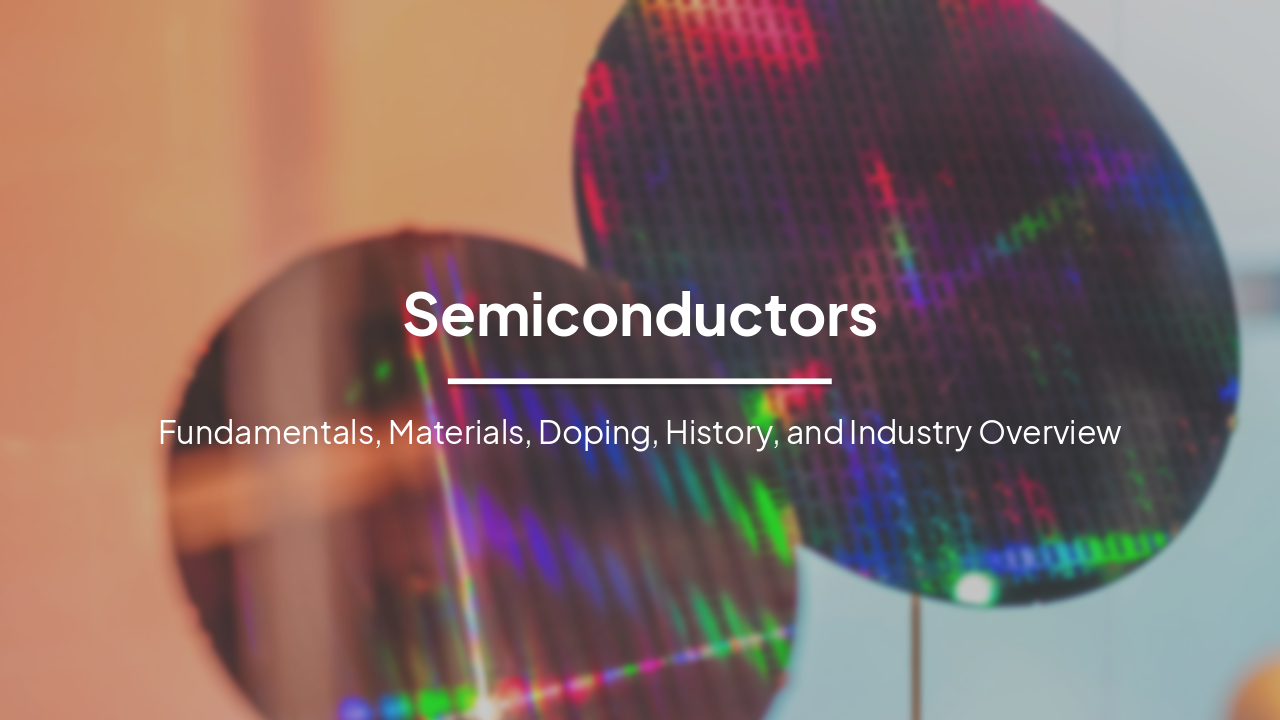
Semiconductors

Fundamentals, Materials, Doping, History, and Industry Overview

---

Photo by Igor Shalyminov on Unsplash
Slide 1 - Semiconductors
Slide 2 of 12

Slide 2 - Presentation Agenda

  • What are Semiconductors?
  • Common Materials
  • Doping Process
  • n-type vs p-type Semiconductors
  • Historical Milestones
  • Pioneer Companies
  • Industry Statistics
  • Key Applications & Conclusion

---

Photo by L N on Unsplash

Slide 2 - Presentation Agenda
Slide 3 of 12

Slide 3 - Section 1: Fundamentals

1

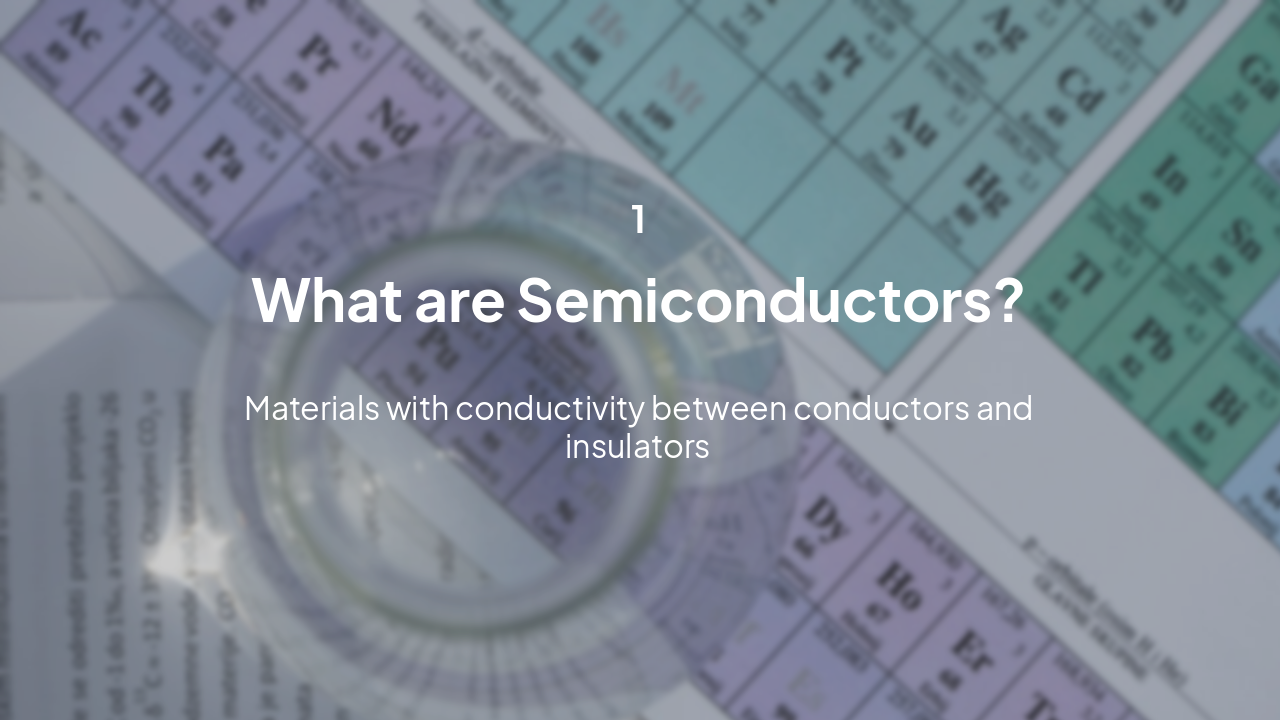
What are Semiconductors?

Materials with conductivity between conductors and insulators

---

Photo by Vedrana Filipović on Unsplash
Slide 3 - Section 1: Fundamentals
Slide 4 of 12

Slide 4 - Semiconductor Basics

  • Material with electrical conductivity between conductor (e.g., metals) and insulator (e.g., glass)
  • Conductivity modified by 'doping' - adding impurities to crystal structure
  • Two differently doped regions form a semiconductor junction
  • Basis for diodes, transistors, and most modern electronics
  • Sometimes refers to devices like microchips and processors

Source: Wikipedia: Semiconductor

Slide 4 - Semiconductor Basics
Slide 5 of 12

Slide 5 - Key Semiconductor Materials

  • Silicon: Most common, basis for most electronic circuits
  • Germanium: Early semiconductor
  • Gallium Arsenide: 2nd most common; laser diodes, solar cells, microwave ICs
  • Others: Elements near 'metalloid staircase' on periodic table

---

Photo by Igor Shalyminov on Unsplash

Source: Wikipedia: Semiconductor
Slide 5 - Key Semiconductor Materials
Slide 6 of 12

Slide 6 - Doping Fundamentals

2

Doping Process

Adding impurities to control conductivity and create p-n junctions

---

Photo by Bill Xi on Unsplash

Slide 6 - Doping Fundamentals
Slide 7 of 12

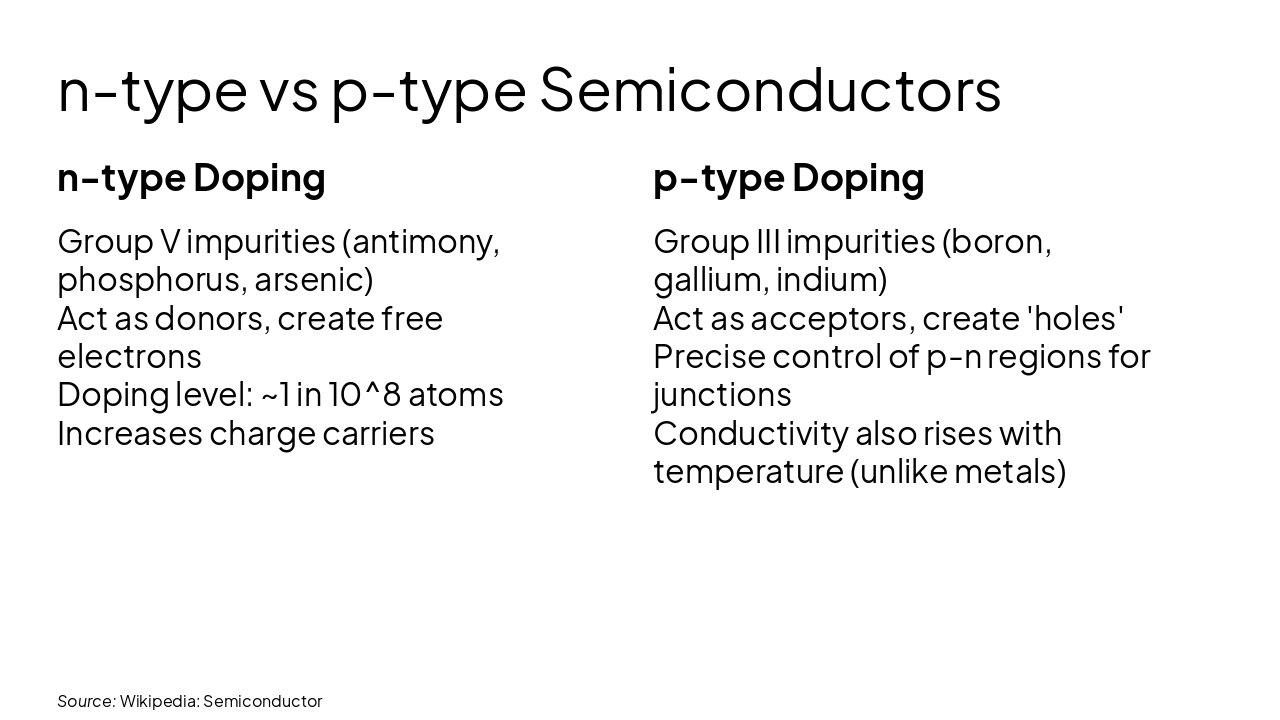
Slide 7 - n-type vs p-type Semiconductors

n-type Doping Group V impurities (antimony, phosphorus, arsenic) Act as donors, create free electrons Doping level: ~1 in 10^8 atoms Increases charge carriers

p-type Doping Group III impurities (boron, gallium, indium) Act as acceptors, create 'holes' Precise control of p-n regions for junctions Conductivity also rises with temperature (unlike metals)

Source: Wikipedia: Semiconductor

Slide 7 - n-type vs p-type Semiconductors
Slide 8 of 12

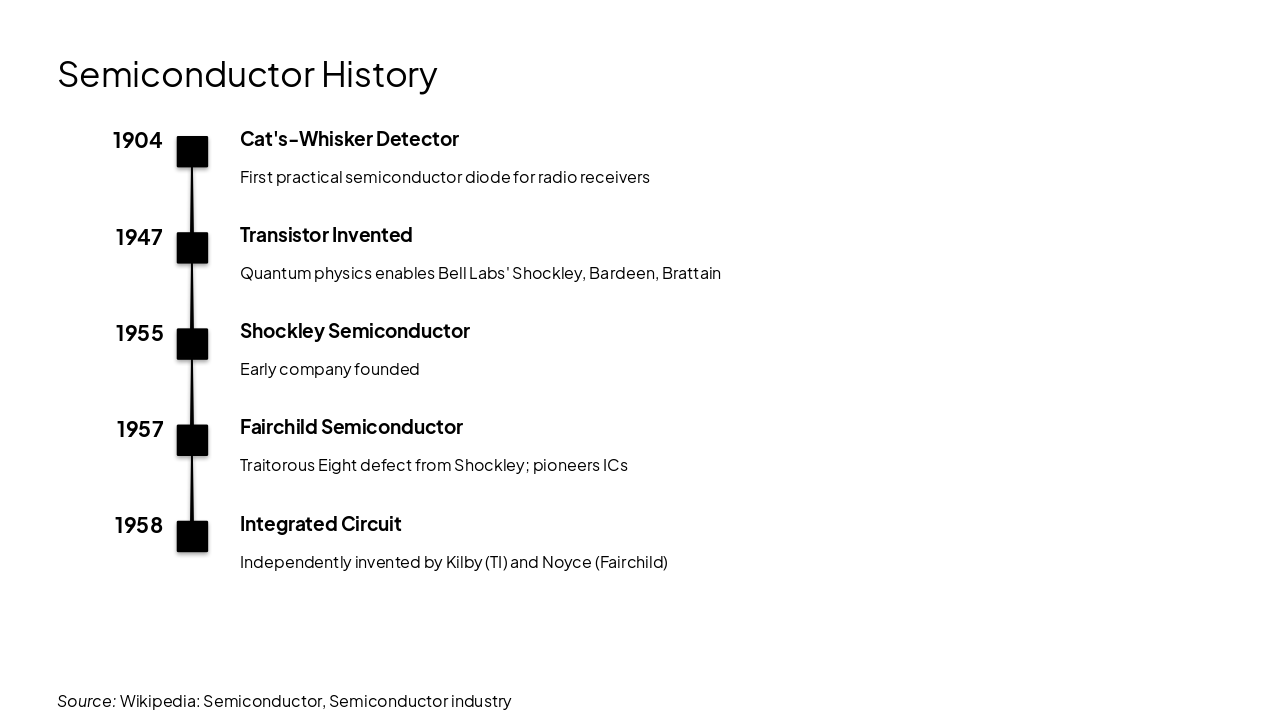
Slide 8 - Semiconductor History

1904: Cat's-Whisker Detector First practical semiconductor diode for radio receivers 1947: Transistor Invented Quantum physics enables Bell Labs' Shockley, Bardeen, Brattain 1955: Shockley Semiconductor Early company founded 1957: Fairchild Semiconductor Traitorous Eight defect from Shockley; pioneers ICs 1958: Integrated Circuit Independently invented by Kilby (TI) and Noyce (Fairchild)

Source: Wikipedia: Semiconductor, Semiconductor industry

Slide 8 - Semiconductor History
Slide 9 of 12

Slide 9 - Pioneer Companies

  • Fairchild Semiconductor (1957): Founded by 'Traitorous Eight' from Shockley Lab; pioneered transistors & ICs; acquired by ON Semi in 2016
  • Shockley Semiconductor (1955): Early entrant
  • Texas Instruments: Jack Kilby invented IC (1958)
  • Others: Motorola (1952), Bell Labs (transistor 1947/48), Sylvania, Centralab

Source: Wikipedia: Fairchild Semiconductor, Semiconductor industry

Slide 9 - Pioneer Companies
Slide 10 of 12

Slide 10 - Industry Statistics

  • $556B: 2021 Global Sales
  • 1.15T: Units Shipped 2021
  • $727B: Projected 2027
  • $193B: China Sales 2021

---

Photo by Debagni Sarkhel on Unsplash

Source: Wikipedia: Semiconductor industry
Slide 10 - Industry Statistics
Slide 11 of 12

Slide 11 - Applications and Properties

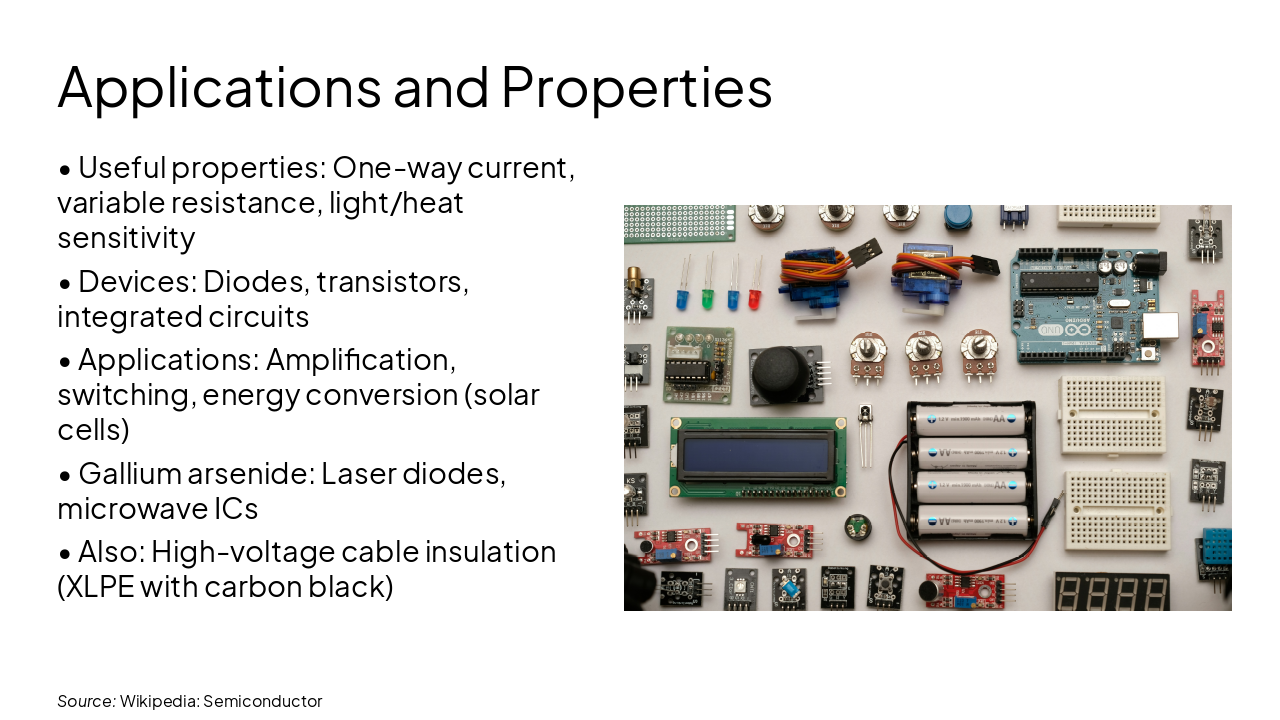
  • Useful properties: One-way current, variable resistance, light/heat sensitivity
  • Devices: Diodes, transistors, integrated circuits
  • Applications: Amplification, switching, energy conversion (solar cells)
  • Gallium arsenide: Laser diodes, microwave ICs
  • Also: High-voltage cable insulation (XLPE with carbon black)

---

Photo by Robin Glauser on Unsplash

Source: Wikipedia: Semiconductor
Slide 11 - Applications and Properties
Slide 12 of 12

Slide 12 - Key Takeaways

Semiconductors: Bridge between conductors & insulators Doped for p-n junctions enabling diodes, transistors, ICs Silicon dominant; industry sales hit $556B in 2021, heading to $727B by 2027 Pioneers like Fairchild drove transistor & IC revolutions

Essential foundation of modern electronics and future technologies

---

Photo by Hyunwon Jang on Unsplash
Slide 12 - Key Takeaways

Discover More Presentations

Explore thousands of AI-generated presentations for inspiration

Browse Presentations
Powered by AI

Create Your Own Presentation

Generate professional presentations in seconds with Karaf's AI. Customize this presentation or start from scratch.

Create New Presentation

Powered by Karaf.ai — AI-Powered Presentation Generator