Slide 1 of 9
Slide 1 - Title Slide
MTT Assay for Determining Cell Viability and Cytotoxicity
Presented by: Ifra Ramzan

Generated from prompt:
Title: MTT Assay for Determining Cell Viability and Cytotoxicity Author: Ifra Ramzan Date: December 15, 2025 Slide 1: Title Slide - MTT Assay for Determining Cell Viability and Cytotoxicity - Presented by: Ifra Ramzan - Date: December 15, 2025 Slide 2: Introduction - The MTT Assay is a widely used method in cell biology. - It evaluates cell health, viability, and cytotoxicity. - Based on metabolic activity of living cells. Slide 3: What the MTT Assay Measures - Cell Viability and Proliferation: Indicates number of active cells. - Cytotoxicity: Measures the effect of drugs or chemicals on cell survival. - Cellular Metabolic Activity: Reflects mitochondrial enzyme function. Slide 4: Principle of the Assay - Uses the yellow tetrazolium salt, MTT. - Living cells contain mitochondrial dehydrogenases. - These enzymes reduce MTT into purple formazan crystals. - Only viable cells can perform this conversion. Slide 5: Key Reaction - MTT (yellow) → Formazan (purple) - Reaction catalyzed by NAD(P)H-dependent oxidoreductase enzymes. - Indicates metabolic activity and cell viability. Slide 6: Procedure Overview 1. Add MTT reagent to cell cultures. 2. Incubate to allow formazan formation. 3. Add solubilization solution (e.g., SDS-HCl). 4. Measure absorbance using a spectrophotometer. Slide 7: Quantification and Measurement - Absorbance measured at 570 nm (range 500–600 nm). - Intensity of color ∝ Number of viable cells. - Compared to untreated control to determine cytotoxicity. Slide 8: Data Interpretation - High absorbance → More viable cells. - Low absorbance → Greater cytotoxic effect. - Results expressed as % viability relative to control. Slide 9: Applications - Drug screening. - Toxicity testing. - Assessing cell proliferation. - Evaluating experimental treatments. Slide 10: Summary - MTT Assay is a simple, reliable, and cost-effective method. - Measures metabolic activity as a proxy for cell viability. - Widely used in biological and pharmaceutical research.
Introduces MTT Assay, a simple method assessing cell viability/cytotoxicity via MTT reduction to purple formazan by viable cells' enzymes. Covers principle, procedure, 570 nm absorbance measurement, d
MTT Assay for Determining Cell Viability and Cytotoxicity
Presented by: Ifra Ramzan
This slide introduces a widely used method in cell biology. It evaluates cell health, viability, and cytotoxicity based on the metabolic activity of living cells.
Source: MTT Assay for Determining Cell Viability and Cytotoxicity Author: Ifra Ramzan Date: December 15, 2025

The assay uses yellow MTT tetrazolium salt, reduced by mitochondrial dehydrogenases in living cells to purple formazan crystals. Only viable cells perform this conversion.
Source: Ifra Ramzan

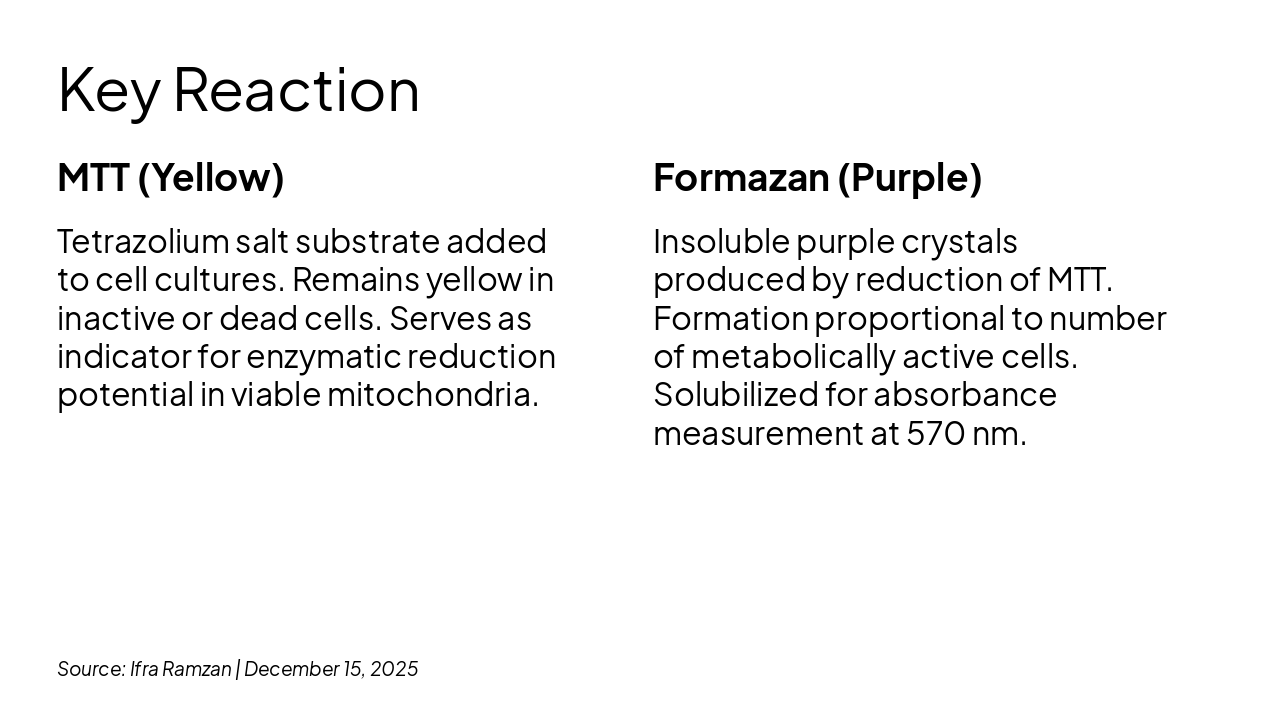
The slide describes the MTT assay's key reaction, where yellow MTT tetrazolium salt is added to cells and remains yellow in inactive or dead cells, indicating viable mitochondrial activity. It is reduced to insoluble purple formazan crystals proportional to metabolically active cells, which are solubilized for absorbance measurement at 570 nm.
| MTT (Yellow) | Formazan (Purple) |
|---|---|
| Tetrazolium salt substrate added to cell cultures. Remains yellow in inactive or dead cells. Serves as indicator for enzymatic reduction potential in viable mitochondria. | Insoluble purple crystals produced by reduction of MTT. Formation proportional to number of metabolically active cells. Solubilized for absorbance measurement at 570 nm. |
Source: Ifra Ramzan | December 15, 2025
The slide provides a workflow overview of the MTT assay procedure with four steps: adding MTT reagent to cell cultures, incubating for formazan formation, solubilizing with SDS-HCl, and measuring absorbance via spectrophotometer. It presents these in a simple table format under "Step" and "Procedure" headers.
{ "headers": [ "Step", "Procedure" ], "rows": [ [ "Add MTT", "Add MTT reagent to cell cultures." ], [ "Incubate", "Incubate to allow formazan formation." ], [ "Solubilize", "Add solubilization solution (e.g., SDS-HCl)." ], [ "Measure", "Measure absorbance using spectrophotometer." ] ] }
Source: Ifra Ramzan

Absorbance is measured at 570 nm (500–600 nm range), with color intensity proportional to viable cells. Cytotoxicity is determined by comparing results to untreated controls.
Source: Ifra Ramzan

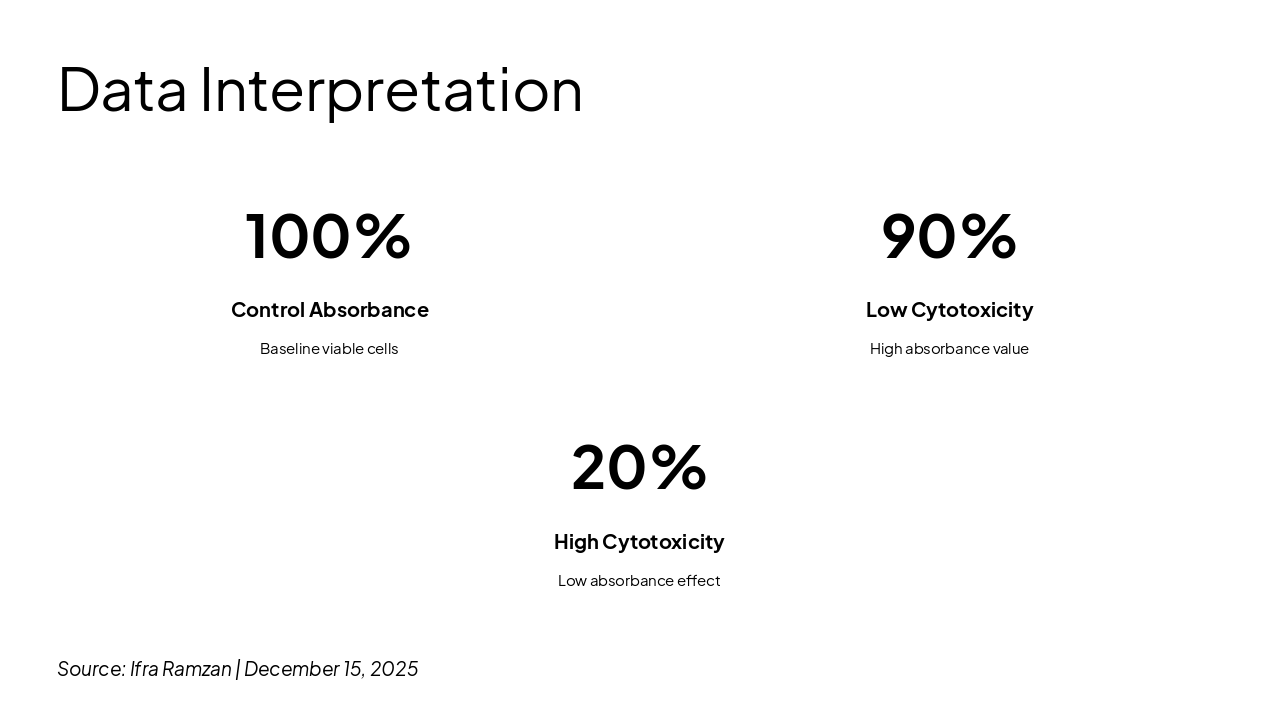
The "Data Interpretation" slide outlines absorbance stats from a cell viability assay. It defines 100% control absorbance as baseline viable cells, 90% as low cytotoxicity with high absorbance, and 20% as high cytotoxicity with low absorbance.
Baseline viable cells
High absorbance value
Low absorbance effect Source: Ifra Ramzan | December 15, 2025
The "Applications" slide lists key uses of the technology. These include drug screening for therapeutics, toxicity testing of chemicals, assessing cell proliferation rates, and evaluating experimental treatment efficacy.
Source: MTT Assay for Determining Cell Viability and Cytotoxicity - Ifra Ramzan

This conclusion slide summarizes the MTT Assay as simple, reliable, and cost-effective, measuring metabolic activity as a proxy for cell viability. It highlights its widespread use in biological and pharmaceutical research, ending with "Thank You!"
MTT Assay:
Thank You!
Source: MTT Assay for Determining Cell Viability and Cytotoxicity | Ifra Ramzan | December 15, 2025

Explore thousands of AI-generated presentations for inspiration
Generate professional presentations in seconds with Karaf's AI. Customize this presentation or start from scratch.