Understanding Turtles: Biology, Ecology, and Conservation

Generated from prompt:

Presentation about turtles: introduction, types of turtles, anatomy, habitats, diet, life cycle, importance in ecosystems, threats and conservation, interesting facts, conclusion.

This presentation offers a comprehensive overview of turtles (Order Testudines), covering their classification, anatomy, habitats, diet, life cycle, ecological importance, conservation threats, and interesting facts.

March 9, 202611 slides
Slide 1 of 11

Slide 1 - Understanding Turtles

Understanding Turtles: Biology, Ecology, and Conservation

An Overview of the Order Testudines
Slide 1 - Understanding Turtles
Slide 2 of 11

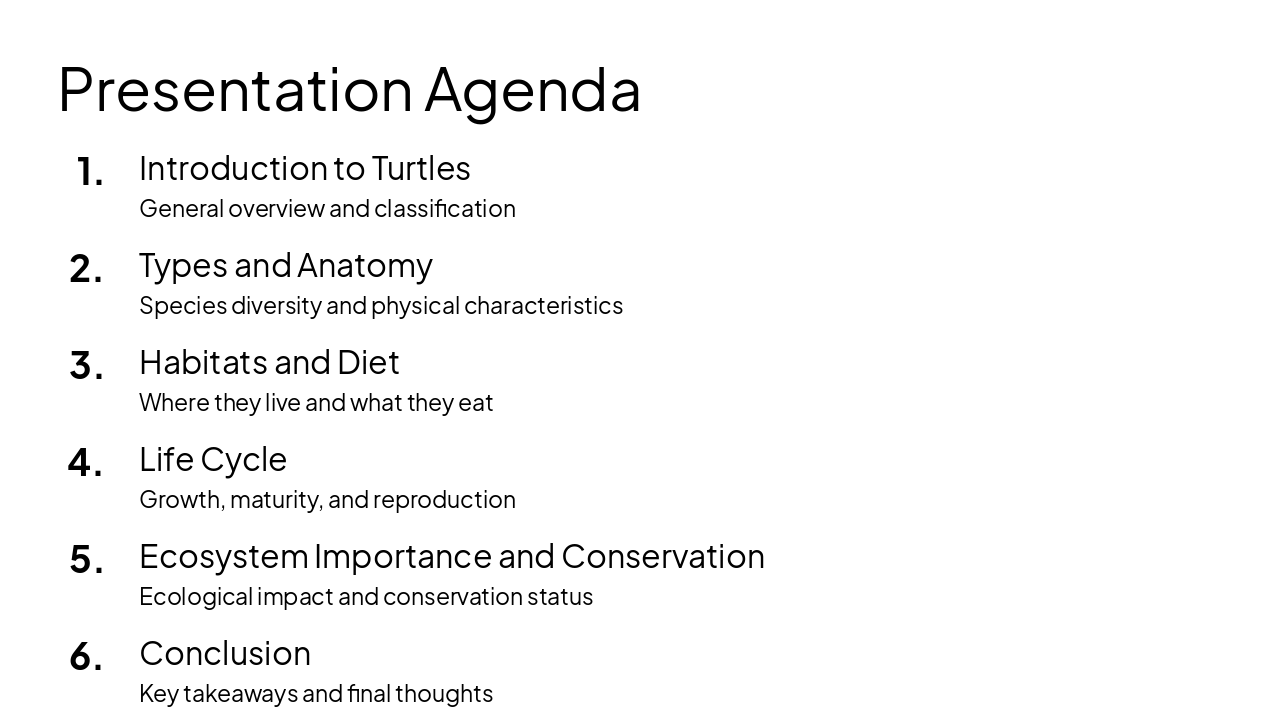
Slide 2 - Presentation Agenda

  • Introduction to Turtles: General overview and classification
  • Types and Anatomy: Species diversity and physical characteristics
  • Habitats and Diet: Where they live and what they eat
  • Life Cycle: Growth, maturity, and reproduction
  • Ecosystem Importance and Conservation: Ecological impact and conservation status
  • Conclusion: Key takeaways and final thoughts
Slide 2 - Presentation Agenda
Slide 3 of 11

Slide 3 - Introduction and Classification

1

Introduction and Classification

Defining the Order Testudines

Slide 3 - Introduction and Classification
Slide 4 of 11

Slide 4 - Introduction to Turtles

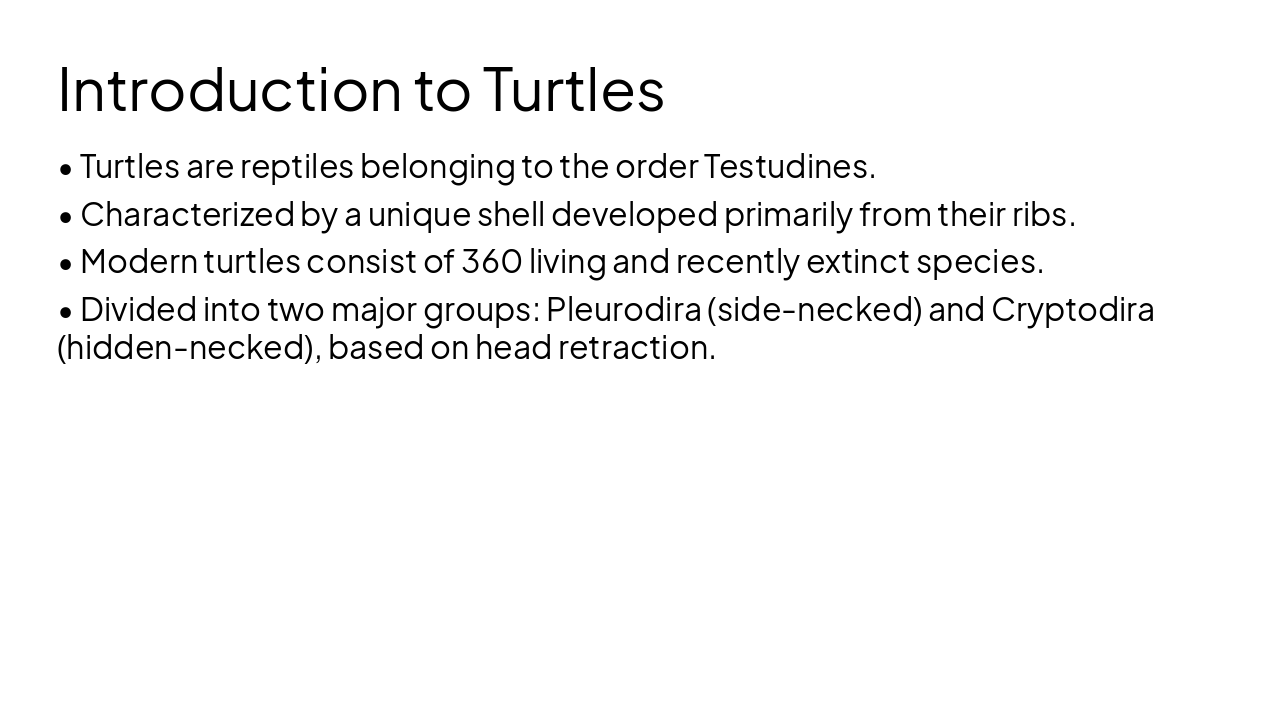
  • Turtles are reptiles belonging to the order Testudines.
  • Characterized by a unique shell developed primarily from their ribs.
  • Modern turtles consist of 360 living and recently extinct species.
  • Divided into two major groups: Pleurodira (side-necked) and Cryptodira (hidden-necked), based on head retraction.
Slide 4 - Introduction to Turtles
Slide 5 of 11

Slide 5 - Anatomy and Habitat

2

Anatomy and Habitat

Structure and Environmental Distribution
Slide 5 - Anatomy and Habitat
Slide 6 of 11

Slide 6 - Anatomy and Habitats

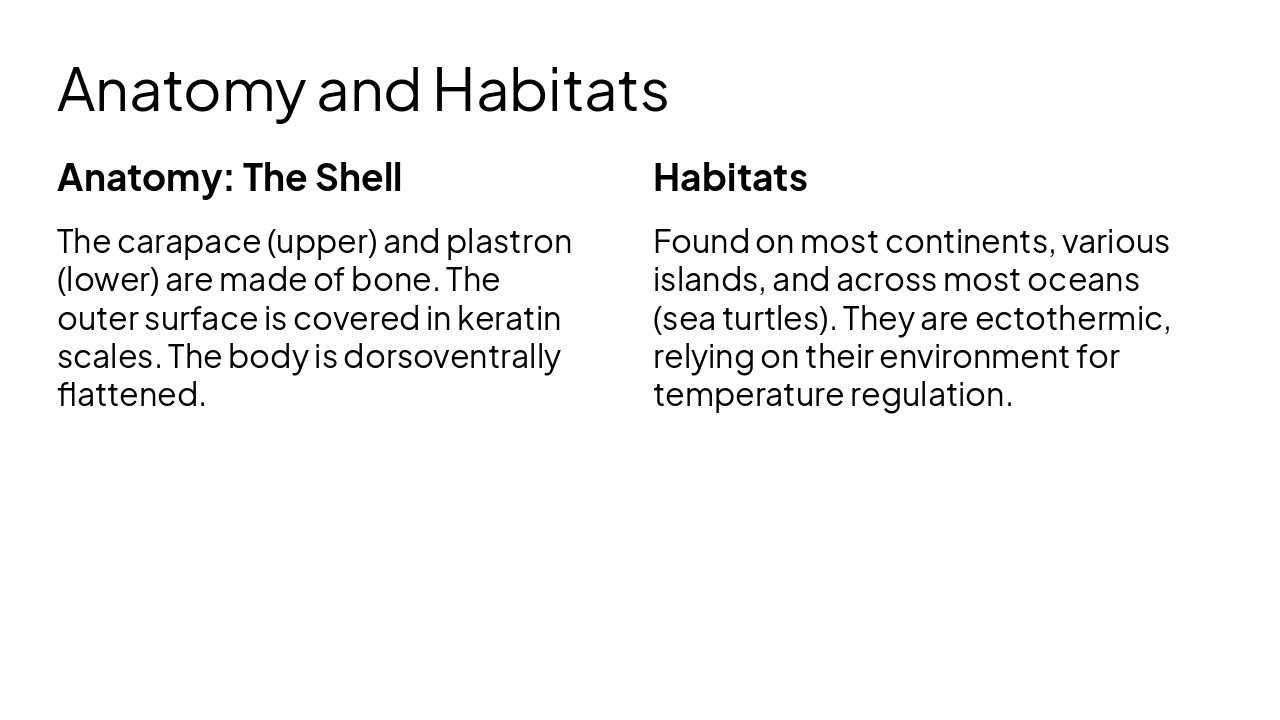
Anatomy: The Shell The carapace (upper) and plastron (lower) are made of bone. The outer surface is covered in keratin scales. The body is dorsoventrally flattened.

Habitats Found on most continents, various islands, and across most oceans (sea turtles). They are ectothermic, relying on their environment for temperature regulation.
Slide 6 - Anatomy and Habitats
Slide 7 of 11

Slide 7 - Diet and Life Cycle

3

Diet and Life Cycle

Feeding Habits and Reproduction

Slide 7 - Diet and Life Cycle
Slide 8 of 11

Slide 8 - Diet and Life Cycle

  • Diet: Generally opportunistic omnivores; feed on plants and slow-moving animals. Green sea turtles are the only aquatic species herbivorous as adults.
  • Life Cycle: Do not lay eggs underwater. Migrate between feeding grounds and nesting beaches. Some species can live up to 90 years.
  • Hatching: Females dig nests on beaches; hatchlings emerge and navigate to the water.
Slide 8 - Diet and Life Cycle
Slide 9 of 11

Slide 9 - Conservation and Facts

4

Conservation and Facts

Addressing Threats and Interesting Discoveries
Slide 9 - Conservation and Facts
Slide 10 of 11

Slide 10 - Threats, Conservation, and Facts

  • Threats: Habitat destruction, bycatch in fishing nets, pollution, and illegal hunting for food or shells.
  • Conservation: 5 out of 7 sea turtle species are listed as threatened on the IUCN Red List. Protection laws are in place in many countries.
  • Interesting Fact: Turtles have appeared in global myths and folktales for centuries.
Slide 10 - Threats, Conservation, and Facts
Slide 11 of 11

Slide 11 - Conclusion

Turtles play vital roles in ecosystems; continued conservation efforts are essential to ensure their survival for future generations.

Protecting Our Ancient Reptilian Friends
Slide 11 - Conclusion

Discover More Presentations

Explore thousands of AI-generated presentations for inspiration

Browse Presentations
Powered by AI

Create Your Own Presentation

Generate professional presentations in seconds with Karaf's AI. Customize this presentation or start from scratch.

Create New Presentation

Powered by Karaf.ai — AI-Powered Presentation Generator