AI-Driven Forensic Microbiome Pipeline for Postmortem PMI

Generated from prompt:

Create a professional Master's level PowerPoint presentation titled "AI-Driven Forensic Microbiome Pipeline for Postmortem Analysis" for a 10-minute academic presentation. Slides with minimal text and clear headings. Include speaker notes for each slide. Slides: 1. Title Slide: Project Title, Name: Avanti Pandit, MSc Bioinformatics, Internship details 2. Introduction: forensic science overview, PMI importance, microbiome role 3. Aim: develop bioinformatics pipeline, integrate AI/ML 4. Objectives: dataset collection, preprocessing, taxonomic classification, ML-ready data 5. Problem Statement: limits of traditional methods, lack of biological integration, need AI 6. Methodology: stepwise workflow: SRA/ENA data → FASTQ → FastQC → Trimming (Trimmomatic/fastp) → Post-QC (FastQC + MultiQC) → Kraken2 classification 7. Tools Used: SRA Toolkit, FastQC, MultiQC, Trimmomatic/fastp, Kraken2, Galaxy 8. Data Processing: paired-end reads, cleaning/filtering, importance of quality 9. Kraken Classification: k-mer method, input FASTQ, output reports 10. Results: preprocessing & classification done, microbial abundance reports 11. Future Scope: feature matrix, ML models, PMI prediction 12. Significance: improved forensic accuracy, AI + bioinformatics integration 13. Conclusion: pipeline complete till classification, ready for ML 14. Thank You slide Design: minimal text, academic style, clean layout, subtle icons/visual cues. Also ensure each slide has concise but informative speaker notes explaining the points.

This MSc Bioinformatics internship project presents a scalable bioinformatics pipeline for postmortem microbiome analysis in forensics. It covers microbiome succession for PMI estimation, data processing from SRA, Kraken2 taxonomic classification, AI

March 19, 202611 slides
Slide 1 of 11

Slide 1 - Title Slide

AI-Driven Forensic Microbiome Pipeline for Postmortem Analysis

Avanti Pandit, MSc Bioinformatics | Internship Project Presentation
Slide 1 - Title Slide
Slide 2 of 11

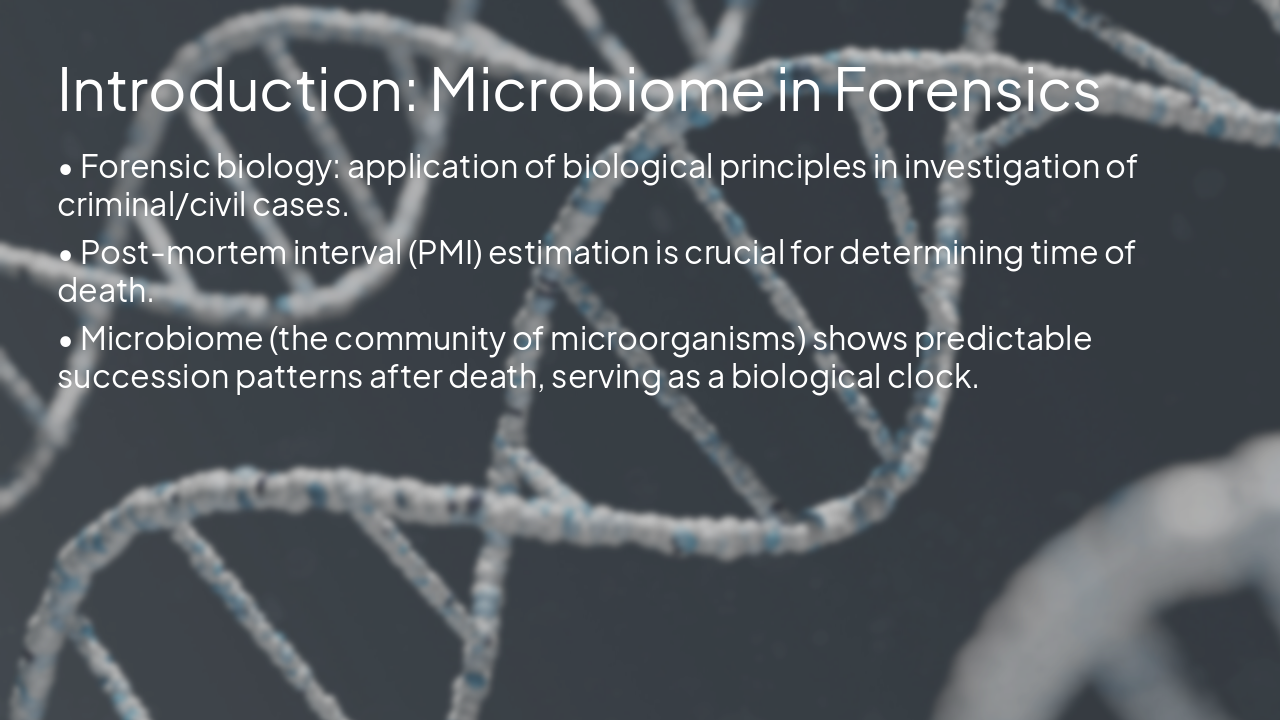
Slide 2 - Introduction: Microbiome in Forensics

  • Forensic biology: application of biological principles in investigation of criminal/civil cases.
  • Post-mortem interval (PMI) estimation is crucial for determining time of death.
  • Microbiome (the community of microorganisms) shows predictable succession patterns after death, serving as a biological clock.

---

Photo by Warren Umoh on Unsplash

Slide 2 - Introduction: Microbiome in Forensics
Slide 3 of 11

Slide 3 - Aim: AI-Driven Pipeline Development

  • Develop a robust, scalable bioinformatics pipeline for processing microbial sequencing data.
  • Integrate AI and Machine Learning models to predict the post-mortem interval based on microbial succession.

---

Photo by Leif Christoph Gottwald on Unsplash
Slide 3 - Aim: AI-Driven Pipeline Development
Slide 4 of 11

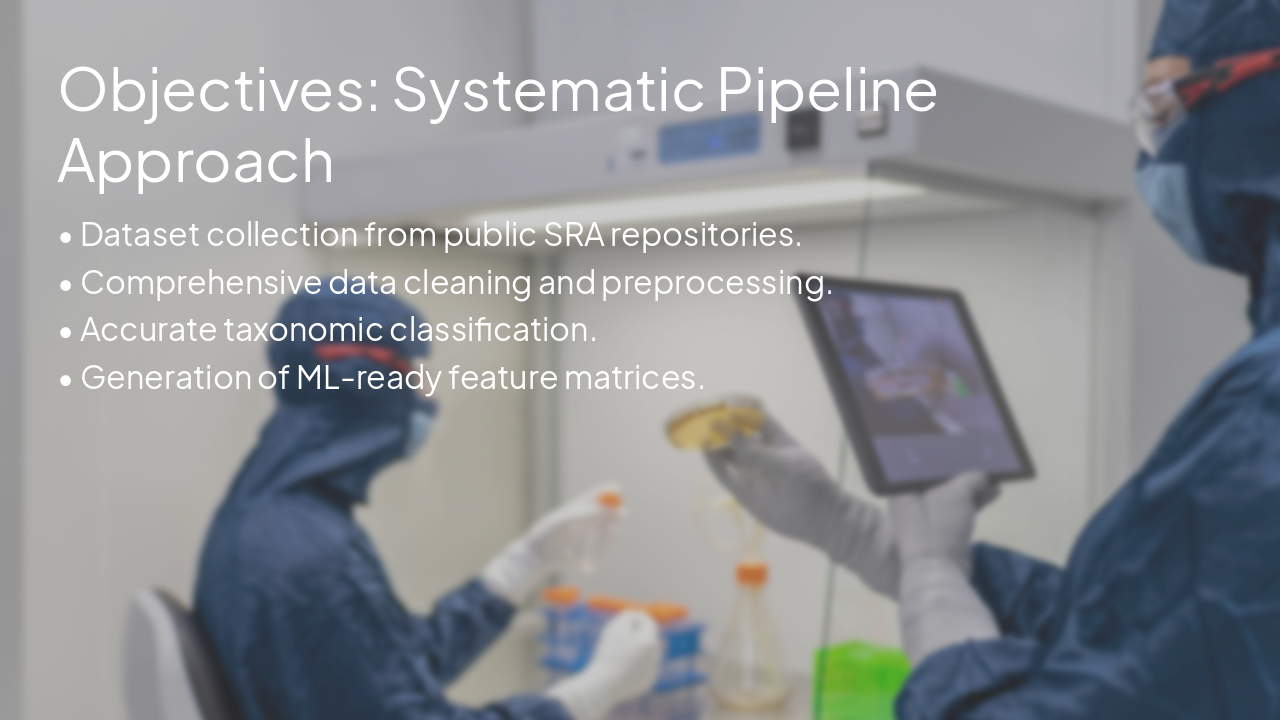
Slide 4 - Objectives: Systematic Pipeline Approach

  • Dataset collection from public SRA repositories.
  • Comprehensive data cleaning and preprocessing.
  • Accurate taxonomic classification.
  • Generation of ML-ready feature matrices.

---

Photo by Toon Lambrechts on Unsplash
Slide 4 - Objectives: Systematic Pipeline Approach
Slide 5 of 11

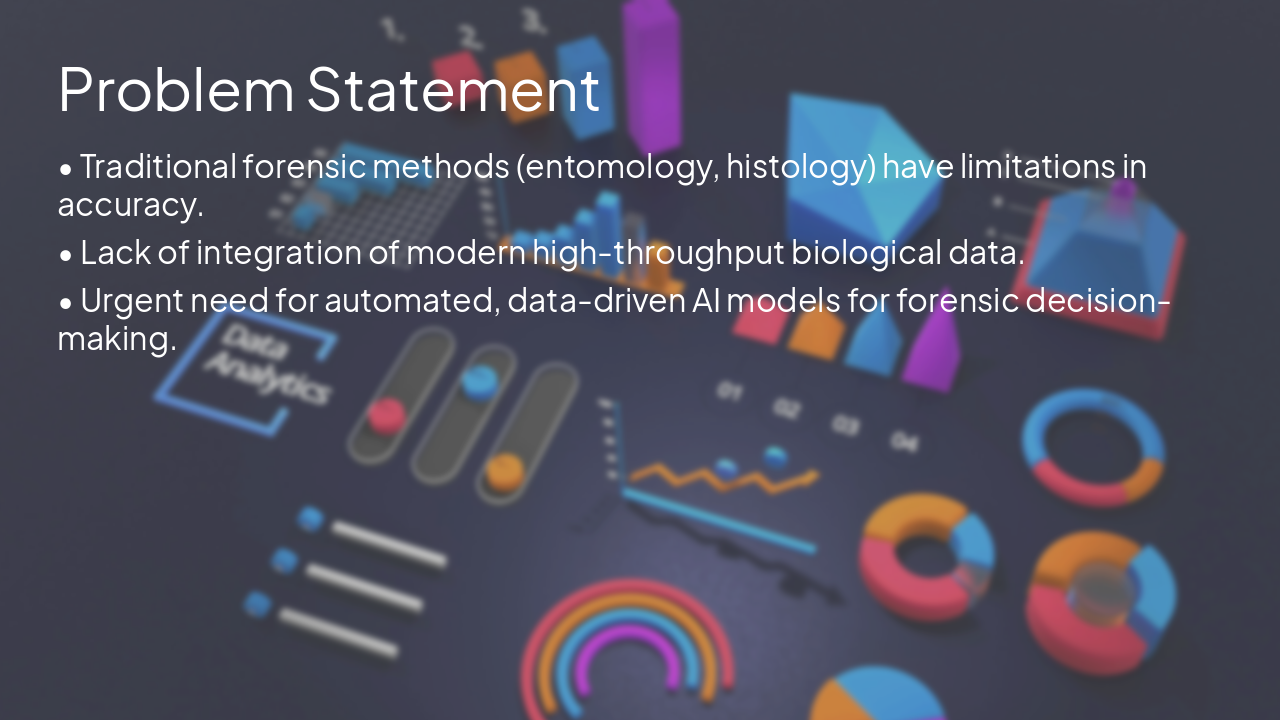
Slide 5 - Problem Statement

  • Traditional forensic methods (entomology, histology) have limitations in accuracy.
  • Lack of integration of modern high-throughput biological data.
  • Urgent need for automated, data-driven AI models for forensic decision-making.

---

Photo by Deng Xiang on Unsplash

Slide 5 - Problem Statement
Slide 6 of 11

Slide 6 - Data Processing: Ensuring Integrity

  • Utilized paired-end read architecture for increased confidence.
  • Applied strict filters to remove low-quality adapters.
  • Ensured high-depth coverage for accurate taxonomic identification.

---

Photo by Markus Spiske on Unsplash
Slide 6 - Data Processing: Ensuring Integrity
Slide 7 of 11

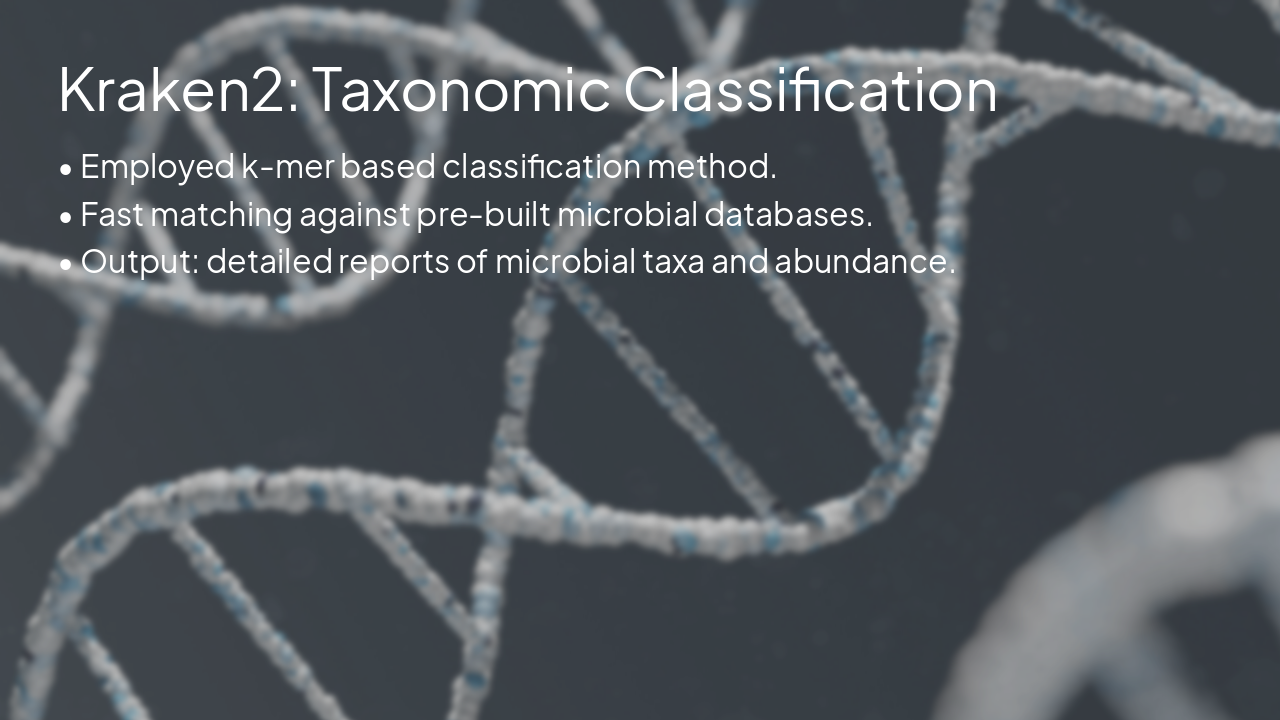
Slide 7 - Kraken2: Taxonomic Classification

  • Employed k-mer based classification method.
  • Fast matching against pre-built microbial databases.
  • Output: detailed reports of microbial taxa and abundance.

---

Photo by Warren Umoh on Unsplash

Slide 7 - Kraken2: Taxonomic Classification
Slide 8 of 11

Slide 8 - Future Scope: Machine Learning Integration

  • Construct a microbial feature matrix.
  • Train AI models (Random Forest, SVM) for PMI prediction.
  • Validate against independent forensic validation datasets.

---

Photo by Vinh Nguyen on Unsplash

Slide 8 - Future Scope: Machine Learning Integration
Slide 9 of 11

Slide 9 - Significance: Forensic Advancement

  • Enhance precision and objectivity in forensic PMI estimations.
  • Seamlessly bridge bioinformatics pipelines with AI-driven insights.
  • Potential for future courtroom evidence reliability improvement.

---

Photo by Sangharsh Lohakare on Unsplash

Slide 9 - Significance: Forensic Advancement
Slide 10 of 11

Slide 10 - Conclusion

Bioinformatics Pipeline Successfully Established for Forensic Microbiome Analysis

Ready for ML Model Development and Validation

---

Photo by Sebastien Gabriel on Unsplash

Slide 10 - Conclusion

Discover More Presentations

Explore thousands of AI-generated presentations for inspiration

Browse Presentations
Powered by AI

Create Your Own Presentation

Generate professional presentations in seconds with Karaf's AI. Customize this presentation or start from scratch.

Create New Presentation

Powered by Karaf.ai — AI-Powered Presentation Generator