Anatomy of the Eye: Key Structures

Generated from prompt:

Create a professional 6-slide PowerPoint presentation on the topic 'Anatomy of the Eye'. The slides should cover key structures and functions, using clear diagrams and concise bullet points suitable for an educational or medical audience.

A 6-slide PPT overview of eye anatomy for educational/medical audiences, covering external protections (eyelids, sclera), anterior chamber, lens, posterior structures (vitreous humor, retina), and key

December 22, 20256 slides
Slide 1 of 6

Slide 1 - Anatomy of the Eye

This title slide is titled "Anatomy of the Eye" and serves as an introduction to the topic. Its subtitle, "Exploring Key Structures and Functions," indicates a focus on the main components and roles of the eye's anatomy.

Anatomy of the Eye

Exploring Key Structures and Functions

Source: Professional educational presentation on the eye's key structures and functions

Speaker Notes
Welcome the audience and outline the presentation covering key eye structures and functions.
Slide 1 - Anatomy of the Eye
Slide 2 of 6

Slide 2 - Overview of the Eye

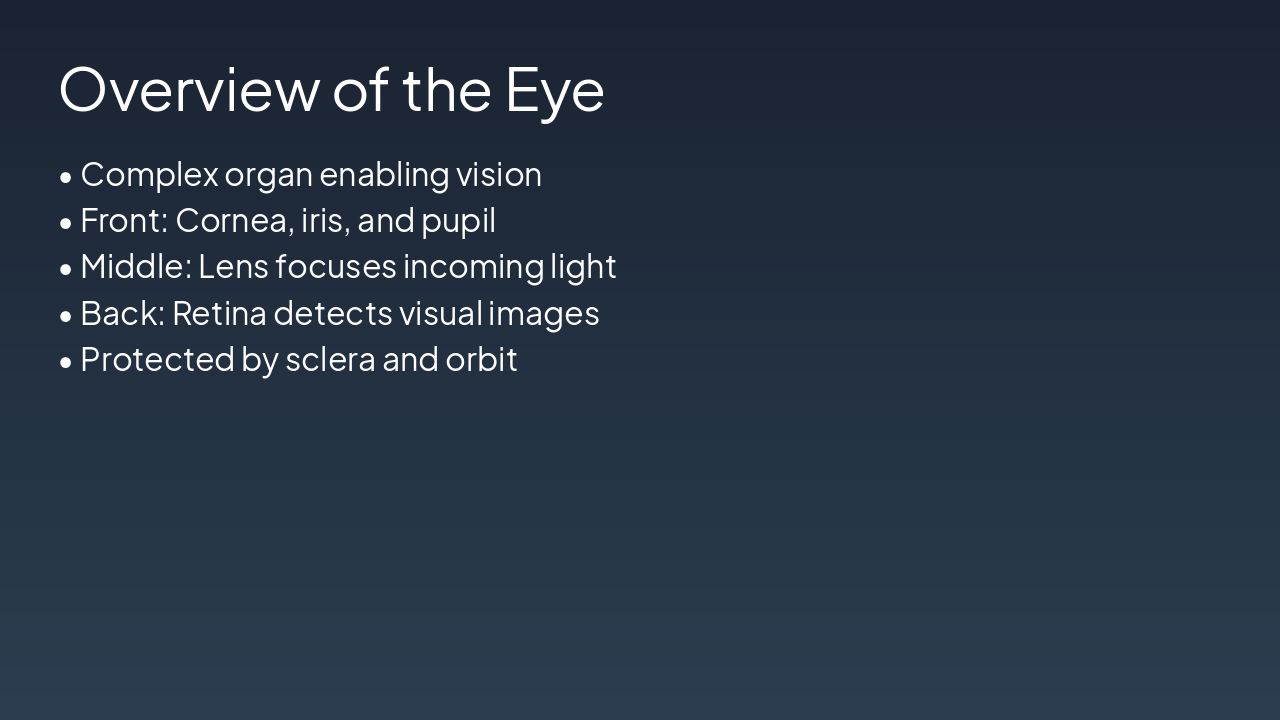
The eye is a complex organ that enables vision, with its front featuring the cornea, iris, and pupil. The middle contains the lens that focuses light, the back has the retina that detects images, and it is protected by the sclera and orbit.

Overview of the Eye

  • Complex organ enabling vision
  • Front: Cornea, iris, and pupil
  • Middle: Lens focuses incoming light
  • Back: Retina detects visual images
  • Protected by sclera and orbit
Speaker Notes
This slide provides a high-level overview of the eye's structure and protection, setting the stage for detailed anatomy.
Slide 2 - Overview of the Eye
Slide 3 of 6

Slide 3 - External Eye Structures

The slide "External Eye Structures" highlights key protective and functional features of the eye. Eyelids and eyelashes shield from debris and pathogens, the sclera offers structural support, the cornea refracts light and protects internals, and the iris with pupil regulates light entry.

External Eye Structures

!Image

  • Eyelids and eyelashes protect eye from debris and pathogens
  • Sclera provides structural support and protection
  • Cornea refracts light and shields internal structures
  • Iris and pupil regulate light entry

Source: Wikipedia search: 'Human eye'

Slide 3 - External Eye Structures
Slide 4 of 6

Slide 4 - Anterior Chamber & Lens

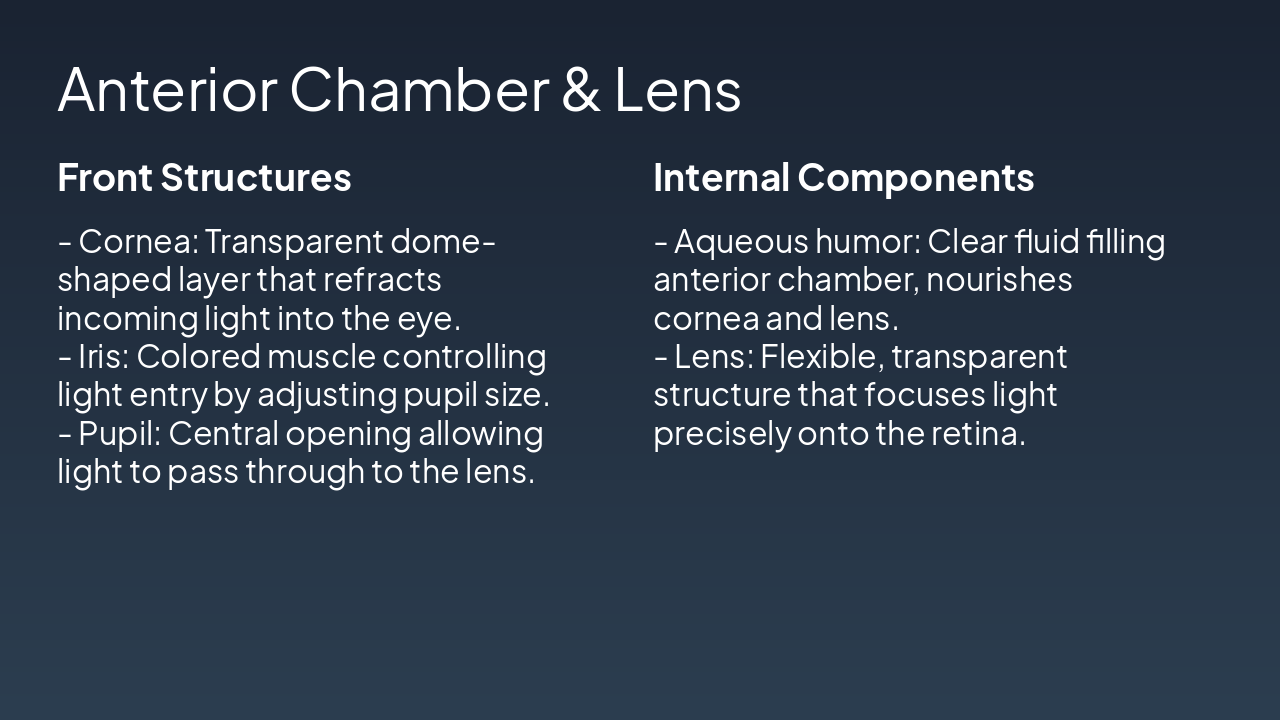
The slide "Anterior Chamber & Lens" describes front eye structures on the left: the cornea (transparent dome refracting light), iris (colored muscle adjusting pupil size), and pupil (central light opening). On the right, it covers internal components: aqueous humor (clear fluid nourishing cornea and lens) and lens (flexible structure focusing light on the retina).

Anterior Chamber & Lens

Front StructuresInternal Components

| - Cornea: Transparent dome-shaped layer that refracts incoming light into the eye.

  • Iris: Colored muscle controlling light entry by adjusting pupil size.
  • Pupil: Central opening allowing light to pass through to the lens. | - Aqueous humor: Clear fluid filling anterior chamber, nourishes cornea and lens.
  • Lens: Flexible, transparent structure that focuses light precisely onto the retina. |
Speaker Notes
This slide highlights the key components of the anterior chamber and lens, separating the protective front structures from the nourishing and focusing elements.
Slide 4 - Anterior Chamber & Lens
Slide 5 of 6

Slide 5 - Posterior Structures

The slide on Posterior Structures outlines key eye components: vitreous humor for maintaining shape and stability, retina with photoreceptors for light detection, optic nerve for signal transmission, macula and fovea for high-acuity central vision, and choroid for retinal nourishment. These elements collectively support optical function and visual processing.

Posterior Structures

  • Vitreous humor: maintains eye shape and optical stability
  • Retina: contains photoreceptors (rods and cones) for light detection
  • Optic nerve: transmits visual signals to the brain
  • Macula and fovea: provide central, high-acuity vision
  • Choroid: supplies nutrients and oxygen to the retina
Speaker Notes
These posterior structures are crucial for vision processing and maintenance of eye shape. Highlight the retina's role in photoreception and the optic nerve's signal transmission.
Slide 5 - Posterior Structures
Slide 6 of 6

Slide 6 - Key Functions Summary

The eye captures light, focuses it via the lens, converts it to signals in the retina, and interprets it in the brain. Mastering eye anatomy enhances diagnosis and education, with questions invited.

Key Functions Summary

<ul><li>Eye captures light</li><li>Lens focuses image</li><li>Retina converts to signals</li><li>Brain interprets vision</li><li>Anatomy aids diagnosis & education</li></ul><p><strong>Questions?</strong></p>

Mastering Eye Anatomy Enhances Diagnosis & Education

Source: Anatomy of the Eye Presentation

Speaker Notes
Recap the visual pathway: light entry, focusing, signal conversion, and brain interpretation. Emphasize diagnostic and educational value. Invite questions.
Slide 6 - Key Functions Summary

Discover More Presentations

Explore thousands of AI-generated presentations for inspiration

Browse Presentations
Powered by AI

Create Your Own Presentation

Generate professional presentations in seconds with Karaf's AI. Customize this presentation or start from scratch.

Create New Presentation

Powered by Karaf.ai — AI-Powered Presentation Generator