Mastering Impression Management

Generated from prompt:

Make the presentation more professional and smooth

This presentation explores impression management as a key social psychology concept, drawing on Goffman's dramaturgical theory. It covers motives, self-presentation strategies, historical evolution, a

November 7, 20259 slides
Slide 1 of 9

Slide 1 - Impression Management: Influencing Social Perceptions

The slide's title, "Impression Management: Influencing Social Perceptions," introduces a topic centered on how individuals shape others' views in social settings. Its subtitle describes this as a conscious process in social interactions, drawing from Erving Goffman's foundational work.

Impression Management: Influencing Social Perceptions

Exploring the conscious process in social interactions based on Erving Goffman's foundational work.
Slide 1
Slide 2 of 9

Slide 2 - Presentation Overview

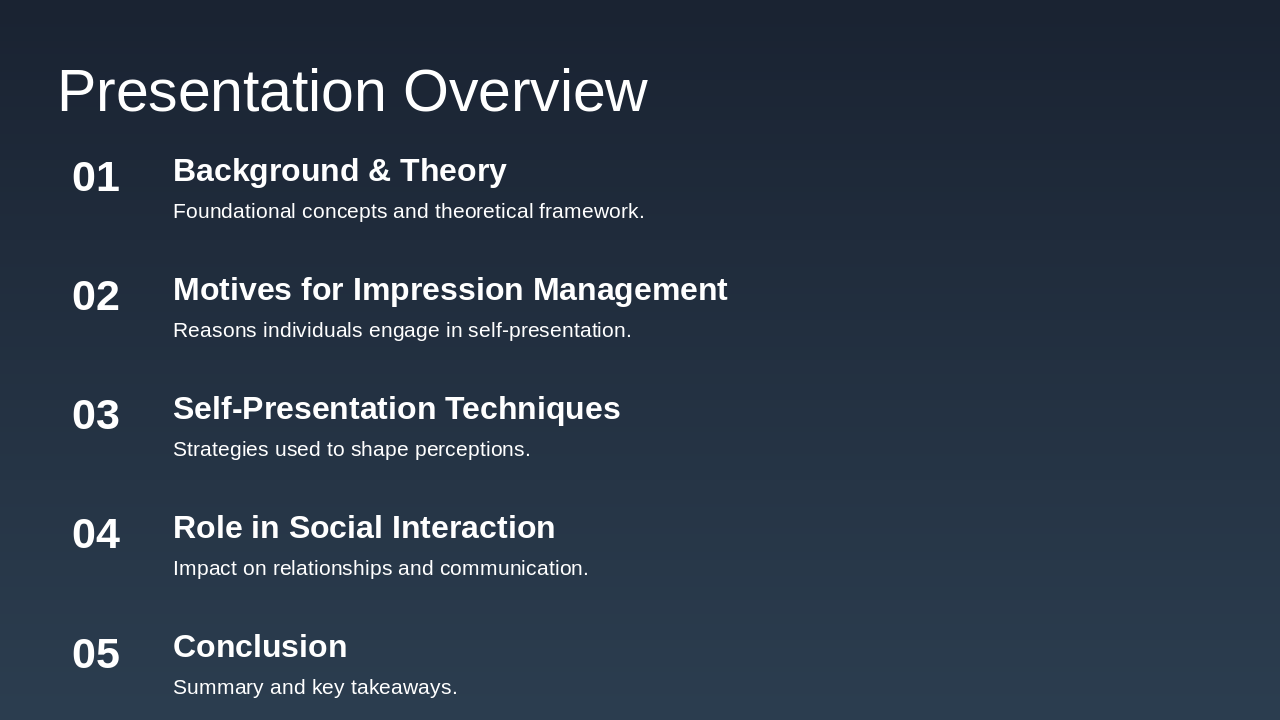
The Presentation Overview slide outlines the agenda for a discussion on impression management, starting with foundational concepts and theoretical framework in the Background & Theory section. It then covers motives for self-presentation, techniques for shaping perceptions, the role in social interactions, and concludes with key takeaways.

Presentation Overview

  1. Background & Theory

Foundational concepts and theoretical framework.

  1. Motives for Impression Management

Reasons individuals engage in self-presentation.

  1. Self-Presentation Techniques

Strategies used to shape perceptions.

  1. Role in Social Interaction

Impact on relationships and communication.

  1. Conclusion

Summary and key takeaways.

--- Speaker Notes: Key sections: Background & Theory, Motives for Impression Management, Self-Presentation Techniques, Role in Social Interaction, and Conclusion. Context: Make the presentation more professional and smooth.

Slide 2
Slide 3 of 9

Slide 3 - Background and Theory

This section header slide introduces the "Background and Theory" part of the presentation. It draws from Erving Goffman's 1956 book (expanded in 1967), The Presentation of Self in Everyday Life, which conceptualizes life as a theatrical performance.

Background and Theory

Background and Theory

From Goffman's 'The Presentation of Self in Everyday Life' (1956, expanded 1967): Life as theater.

Slide 3
Slide 4 of 9

Slide 4 - Goffman's Key Insight

The slide titled "Goffman's Key Insight" presents a quote from Erving Goffman in his 1956 work. It states that individuals stage performances during interactions to manage and control the impressions they convey to others.

Goffman's Key Insight

> The individual is seen as staging performances to control impressions given off in interactions.

— Erving Goffman (1956)

--- Speaker Notes: Make the presentation more professional and smooth

Slide 4
Slide 5 of 9

Slide 5 - Motives for Impression Management

Impression management is driven by the desire to gain social approval from peers and superiors while protecting and enhancing one's personal self-image. It also helps achieve key personal and professional objectives and navigate complex power dynamics in relationships.

Motives for Impression Management

  • Gain social approval from peers and superiors
  • Protect and enhance personal self-image
  • Achieve key personal and professional objectives
  • Navigate complex power dynamics in relationships
Slide 5
Slide 6 of 9

Slide 6 - Self-Presentation vs. Social Interaction

Self-presentation techniques, such as ingratiation for gaining favor, intimidation for asserting dominance, and exemplification for showing moral superiority, allow individuals to craft desired images in social settings and influence others' perceptions. These strategies impact social interactions by shaping group dynamics, fostering alliances or rivalries, building trust through authenticity, and facilitating conflict resolution and cooperation in everyday encounters.

Self-Presentation vs. Social Interaction

Self-Presentation TechniquesInfluence on Social Interaction
Individuals employ strategies such as ingratiation to gain favor, intimidation to assert dominance, and exemplification to demonstrate moral superiority. These methods help craft a desired image in social settings, influencing perceptions and outcomes.These techniques shape group dynamics by fostering alliances or rivalries, building trust through authenticity, and aiding conflict resolution via persuasive communication. In everyday encounters, they enhance cooperation and mitigate misunderstandings effectively.
Slide 6
Slide 7 of 9

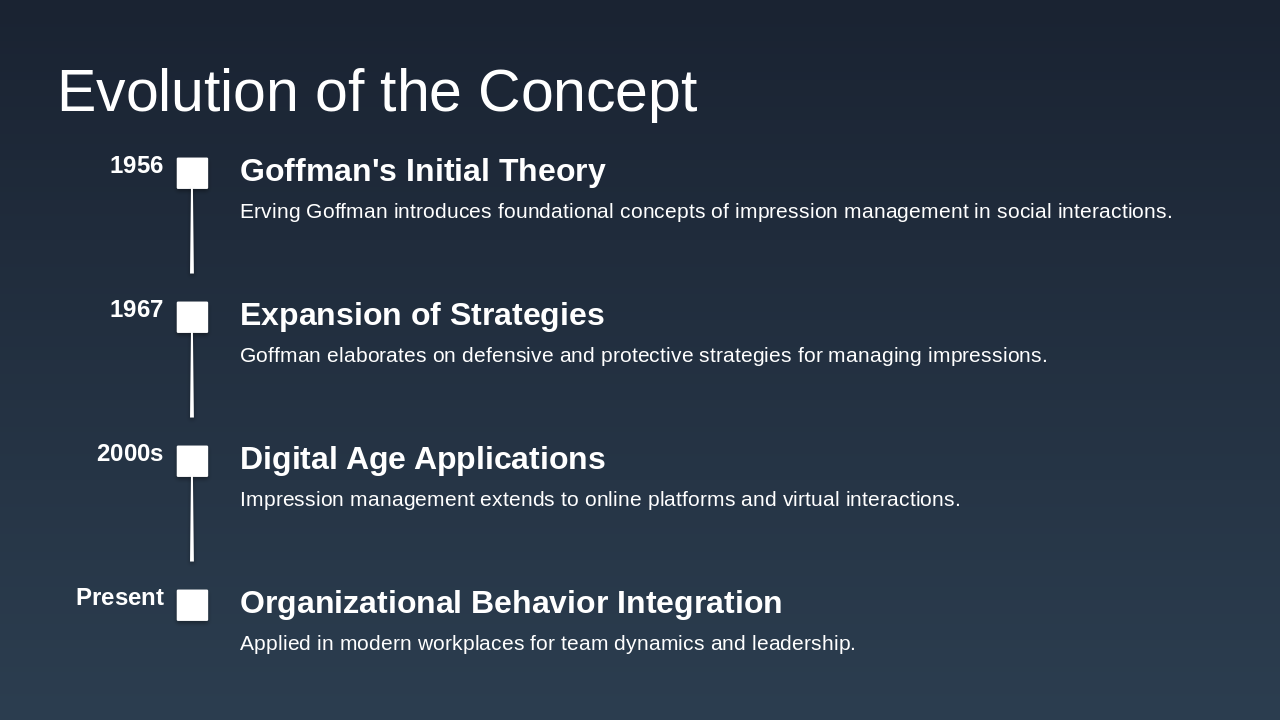
Slide 7 - Evolution of the Concept

The slide outlines the evolution of impression management, starting with Erving Goffman's foundational theory in 1956, which introduced key concepts in social interactions, followed by his 1967 expansion on defensive and protective strategies. It then traces the concept's adaptation to digital platforms in the 2000s and its current integration into organizational behavior for team dynamics and leadership in modern workplaces.

Evolution of the Concept

1956: Goffman's Initial Theory Erving Goffman introduces foundational concepts of impression management in social interactions. 1967: Expansion of Strategies Goffman elaborates on defensive and protective strategies for managing impressions. 2000s: Digital Age Applications Impression management extends to online platforms and virtual interactions. Present: Organizational Behavior Integration Applied in modern workplaces for team dynamics and leadership.

Slide 7
Slide 8 of 9

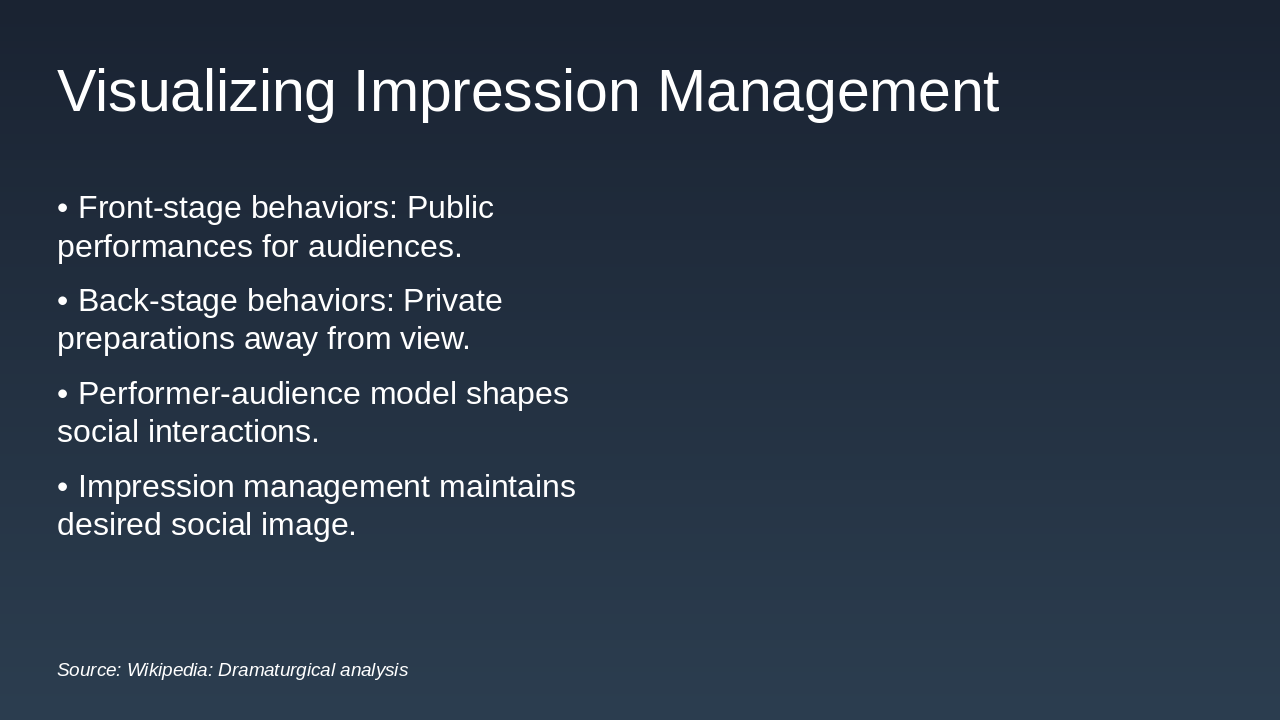
Slide 8 - Visualizing Impression Management

The slide on "Visualizing Impression Management" illustrates the concept through front-stage behaviors, which involve public performances for audiences, and back-stage behaviors, which are private preparations hidden from view. It explains how the performer-audience model influences social interactions while emphasizing impression management's role in sustaining a desired social image.

Visualizing Impression Management

!Image

  • Front-stage behaviors: Public performances for audiences.
  • Back-stage behaviors: Private preparations away from view.
  • Performer-audience model shapes social interactions.
  • Impression management maintains desired social image.

Source: Wikipedia: Dramaturgical analysis

--- Speaker Notes: Diagram showing performer-audience model in social settings, illustrating front-stage vs. back-stage behaviors. Make the presentation more professional and smooth.

Slide 8
Slide 9 of 9

Slide 9 - Key Takeaways

Impression management is vital for navigating social interactions effectively and should be applied ethically to foster genuine connections and success. The slide closes with a message to harness ethical impression management for authentic success and urges implementing these strategies today to strengthen professional relationships.

Key Takeaways

Impression management is essential for effective social navigation. Apply ethically to build genuine connections and success.

Closing Message: Harness ethical impression management for authentic success.

Call-to-Action: Implement these strategies today to enhance your professional relationships.

Slide 9
Powered by AI

Create Your Own Presentation

Generate professional presentations in seconds with Karaf's AI. Customize this presentation or start from scratch.

Create New Presentation

Powered by Karaf.ai — AI-Powered Presentation Generator