Year 8 Science Revision Guide

Generated from prompt:

Create a simple, clear, and visually easy-to-read Year 8 Science revision guide for an autistic student. The topics should include: atoms, elements, compounds, matter and heating, and chemical reactions. Use calm colours, large readable fonts, and clear section dividers. Each topic should include short explanations, examples, and visuals or diagrams to aid understanding.

A simple, autism-friendly guide covering atoms, elements, compounds, matter/heating, and chemical reactions. Features short explanations, examples, diagrams, calm colors, large fonts, and clear sectio

November 29, 20258 slides
Slide 1 of 8

Slide 1 - Welcome to Your Science Revision Guide

The slide features the title "Welcome to Your Science Revision Guide," presented as a welcoming title page. Its subtitle highlights that the guide is tailored for easy learning on key science topics.

Welcome to Your Science Revision Guide

Tailored for easy learning on key topics.
Slide 1 - Welcome to Your Science Revision Guide
Slide 2 of 8

Slide 2 - What We'll Cover

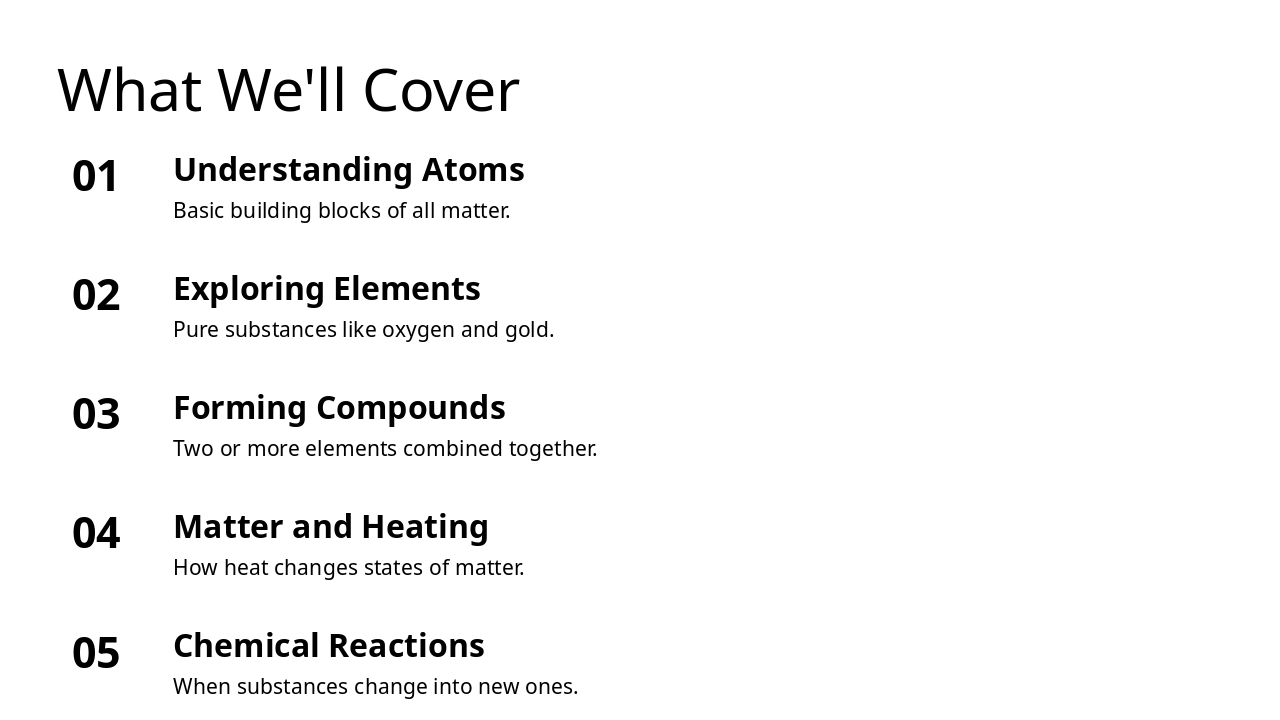
This agenda slide outlines the key topics in a presentation on basic chemistry, starting with understanding atoms as the building blocks of matter and exploring elements like oxygen and gold as pure substances. It continues with forming compounds from combined elements, the effects of heat on states of matter, and chemical reactions that transform substances into new ones.

What We'll Cover

  1. Understanding Atoms
  2. Basic building blocks of all matter.

  3. Exploring Elements
  4. Pure substances like oxygen and gold.

  5. Forming Compounds
  6. Two or more elements combined together.

  7. Matter and Heating
  8. How heat changes states of matter.

  9. Chemical Reactions
  10. When substances change into new ones.

Slide 2 - What We'll Cover
Slide 3 of 8

Slide 3 - What Are Atoms?

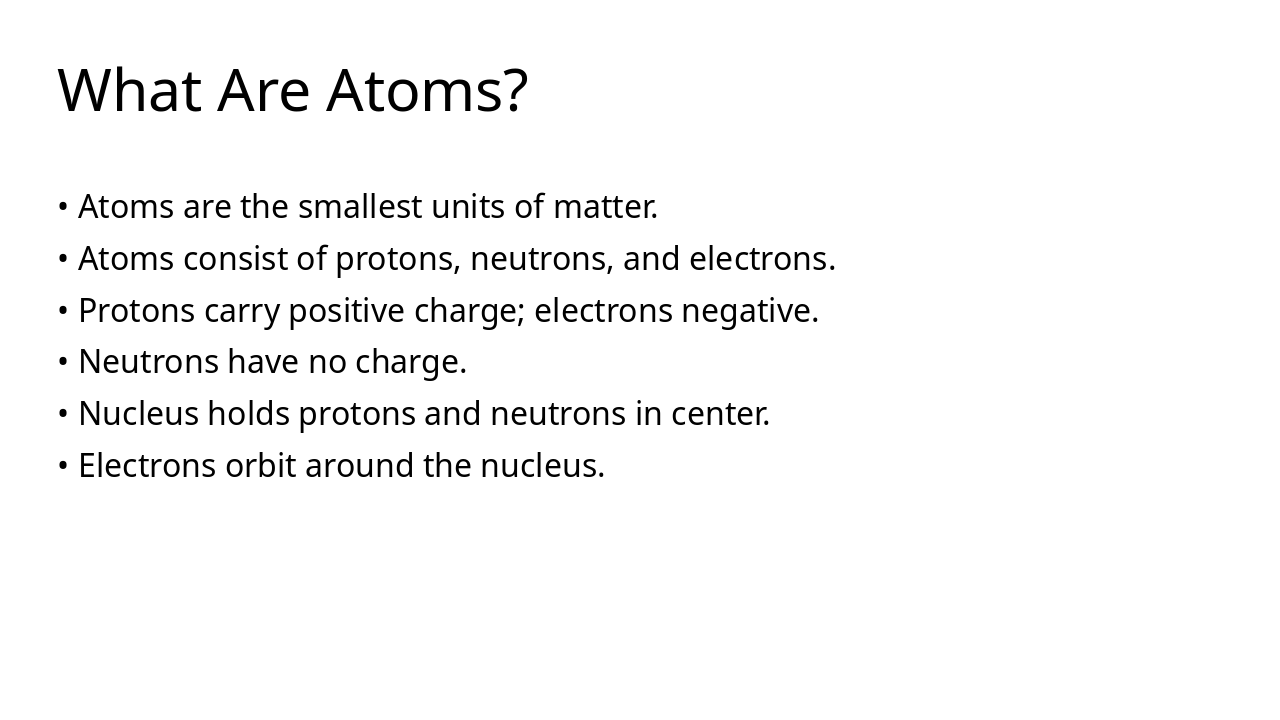
Atoms are the fundamental building blocks of matter, consisting of a central nucleus containing positively charged protons and neutral neutrons, surrounded by negatively charged electrons in orbit. This structure defines the basic composition and charge properties of atoms.

What Are Atoms?

  • Atoms are the smallest units of matter.
  • Atoms consist of protons, neutrons, and electrons.
  • Protons carry positive charge; electrons negative.
  • Neutrons have no charge.
  • Nucleus holds protons and neutrons in center.
  • Electrons orbit around the nucleus.
Slide 3 - What Are Atoms?
Slide 4 of 8

Slide 4 - Understanding Elements

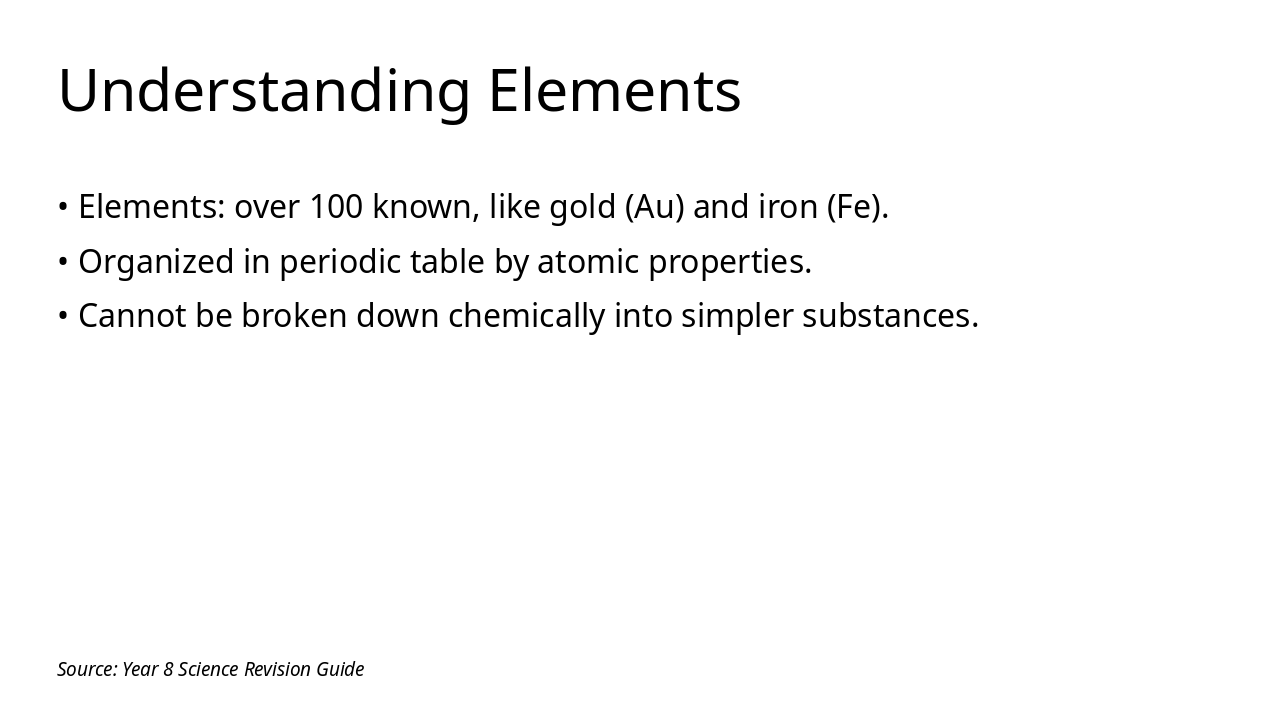
There are over 100 known chemical elements, such as gold (Au) and iron (Fe), which cannot be broken down chemically into simpler substances. These elements are organized in the periodic table based on their atomic properties.

Understanding Elements

  • Elements: over 100 known, like gold (Au) and iron (Fe).
  • Organized in periodic table by atomic properties.
  • Cannot be broken down chemically into simpler substances.

Source: Year 8 Science Revision Guide

Slide 4 - Understanding Elements
Slide 5 of 8

Slide 5 - What Are Compounds?

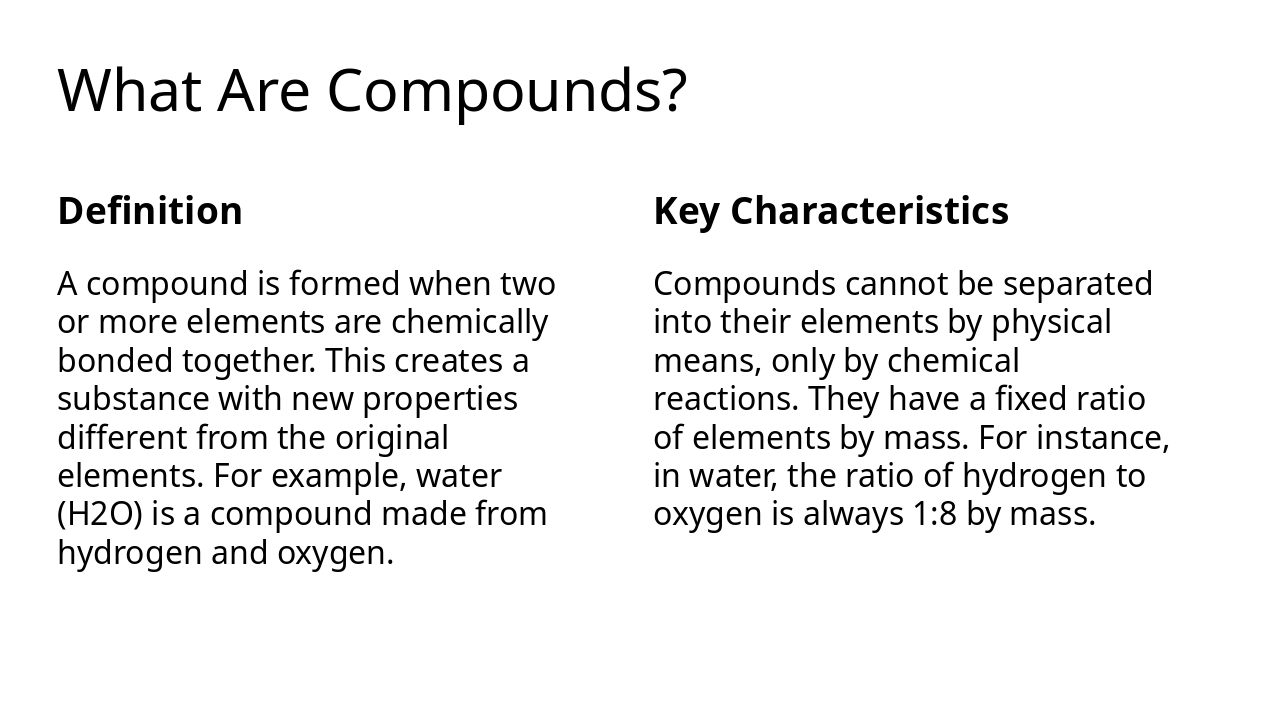
A compound is a substance formed by chemically bonding two or more elements, resulting in new properties distinct from the original elements, such as water (H2O) made from hydrogen and oxygen. Key characteristics include inseparability by physical means—requiring chemical reactions—and a fixed mass ratio of elements, like the 1:8 hydrogen-to-oxygen ratio in water.

What Are Compounds?

DefinitionKey Characteristics
A compound is formed when two or more elements are chemically bonded together. This creates a substance with new properties different from the original elements. For example, water (H2O) is a compound made from hydrogen and oxygen.Compounds cannot be separated into their elements by physical means, only by chemical reactions. They have a fixed ratio of elements by mass. For instance, in water, the ratio of hydrogen to oxygen is always 1:8 by mass.
Slide 5 - What Are Compounds?
Slide 6 of 8

Slide 6 - States of Matter

The slide on States of Matter describes solids as having a fixed shape and volume, like ice; liquids as flowing to take the shape of their container, like water; and gases as spreading out to fill available space, like steam. It also explains that particles vibrate more as heat increases their energy.

States of Matter

  • Solids have fixed shape and volume, like ice.
  • Liquids flow and take container's shape, like water.
  • Gases spread out to fill space, like steam.
  • Particles vibrate more as heat increases energy.
Slide 6 - States of Matter
Slide 7 of 8

Slide 7 - What Happens in Reactions?

In chemical reactions, reactants transform into products as old bonds break and new ones form, often accompanied by energy changes that release heat or light. Observable signs of these reactions include color changes and the formation of gas bubbles.

What Happens in Reactions?

  • Reactants transform into products.
  • Bonds break and new bonds form.
  • Energy changes occur, releasing heat or light.
  • Signs include color changes and gas bubbles.
Slide 7 - What Happens in Reactions?
Slide 8 of 8

Slide 8 - Review and Next Steps

The slide congratulates learners on their progress and encourages reviewing key concepts such as atoms, elements, compounds, matter, heating, and chemical reactions. It recommends practicing with diagrams and examples, and invites questions to a teacher for clarification.

Review and Next Steps

Great job! Review key ideas from atoms, elements, compounds, matter and heating, and chemical reactions. Practice with diagrams and examples. Questions? Ask a teacher.

Slide 8 - Review and Next Steps

Discover More Presentations

Explore thousands of AI-generated presentations for inspiration

Browse Presentations
Powered by AI

Create Your Own Presentation

Generate professional presentations in seconds with Karaf's AI. Customize this presentation or start from scratch.

Create New Presentation

Powered by Karaf.ai — AI-Powered Presentation Generator