10 Key HR Models for 2026 Leaders

Generated from prompt:

Create a presentation titled '10 HR Models Every HR Leader Should Know (In 2026)'. Include the following slides: 1. **Title Slide** — '10 HR Models Every HR Leader Should Know (In 2026)'. 2. **Standard Causal Model of HRM** — Describe that it's derived from many models published in the 90s and early 2000s, showing that HR is effective only when its strategy aligns with business strategy. 3. **8-Box Model by Paul Boselie** — Explain that it shows the eight external and internal factors that influence HR practices' effectiveness. 4. **HR Value Chain** — Based on Paauwe and Richardson (1997), explaining how it creates a nuanced understanding of HR operations. 5. **Advanced HR Value Chain** — Explain that it aligns HR with business performance through the balanced scorecard and HR enablers like systems, budget, and skilled professionals. 6. **The Harvard Model of HRM** — Developed by Michael Beer (1984) and expanded by Paauwe and Richardson (1997), emphasizing a holistic approach with multiple outcomes. 7. **Guest Model** — Developed by David Guest in the late 1980s/1990s, highlighting the strategic role of HR compared to traditional personnel management. 8. **Warwick Model** — Developed by Hendry and Pettigrew (early 1990s), emphasizing alignment between HR practices and internal/external contexts. 9. **Ulrich HR Business Partner Model** — From David Ulrich (1996), describing the four HR roles: Administrative Expert, Employee Champion, Change Agent, and Strategic Partner. 10. **The Storey Model of Human Resource Management** — Built around four elements: beliefs and assumptions, strategic concepts, role of line management, and key levers. 11. **The 5 Ps HR Model** — Centers on Purpose, Principles, Processes, People, and Performance, aligning HR with business goals and focusing on metrics for growth. Design style: professional and modern, with HR-themed icons and color highlights similar to the infographic (blue, yellow, red, and purple).

This presentation outlines 10 essential HR models from the 1980s-2000s, including the Standard Causal Model, 8-Box, HR Value Chain variants, Harvard, Guest, Warwick, Ulrich's roles, Storey, and 5 Ps,

November 30, 202511 slides
Slide 1 of 11

Slide 1 - 10 HR Models Every HR Leader Should Know (In 2026)

The slide titled "10 HR Models Every HR Leader Should Know (In 2026)" serves as an introduction to essential HR frameworks designed for future leaders. Its subtitle highlights the focus on key models that will be vital in the evolving HR landscape by 2026.

10 HR Models Every HR Leader Should Know (In 2026)

Introduction to essential HR frameworks for future leaders.

Slide 1 - 10 HR Models Every HR Leader Should Know (In 2026)
Slide 2 of 11

Slide 2 - Standard Causal Model of HRM

The Standard Causal Model of HRM, derived from models published in the 1990s and early 2000s, posits that HR is effective only when aligned with business strategy. It emphasizes causal links between HR practices and business outcomes, serving as a key mechanism for achieving strategic integration in HRM.

Standard Causal Model of HRM

  • Derived from models published in 1990s and early 2000s
  • HR effective only through alignment with business strategy
  • Emphasizes causal links between HR and business outcomes
  • Key to achieving strategic integration in HRM

Source: Derived from 1990s and early 2000s models

Speaker Notes
This model underscores that HR effectiveness hinges on strategic alignment with business goals, promoting integration for optimal impact.
Slide 2 - Standard Causal Model of HRM
Slide 3 of 11

Slide 3 - 8-Box Model by Paul Boselie

The 8-Box Model by Paul Boselie identifies eight key factors that influence HR effectiveness, while integrating external societal and institutional influences with internal organizational elements. This comprehensive framework provides a balanced perspective for analyzing HR strategies.

8-Box Model by Paul Boselie

  • Identifies eight key factors impacting HR effectiveness
  • Integrates external societal and institutional influences
  • Incorporates internal organizational elements
  • Provides comprehensive framework for HR analysis
  • Balances external and internal perspectives for strategy

Source: Paul Boselie

Speaker Notes
Explains eight external and internal factors influencing HR practices' effectiveness. Includes societal, institutional, and organizational elements for comprehensive analysis.
Slide 3 - 8-Box Model by Paul Boselie
Slide 4 of 11

Slide 4 - HR Value Chain

The HR Value Chain, based on Paauwe and Richardson (1997), provides a nuanced perspective on HR operations by linking inputs to outcomes through key processes. It incorporates employee perceptions for added depth and enhances alignment between HR practices and overall business strategy.

HR Value Chain

  • Based on Paauwe and Richardson (1997)
  • Offers nuanced view of HR operations
  • Links inputs to outcomes via processes
  • Incorporates employee perceptions for depth
  • Enhances HR-business strategy alignment

Source: Paauwe and Richardson (1997)

Slide 4 - HR Value Chain
Slide 5 of 11

Slide 5 - Advanced HR Value Chain

The Advanced HR Value Chain slide outlines how HR strategy aligns with business performance via a balanced scorecard, incorporating enablers like systems, budgets, and skilled professionals to boost overall impact on organizational outcomes. It emphasizes measuring HR effectiveness using integrated performance metrics.

Advanced HR Value Chain

  • Aligns HR strategy with business performance using balanced scorecard
  • Incorporates HR enablers: systems, budget, and skilled professionals
  • Enhances overall HR impact on organizational outcomes
  • Measures HR effectiveness through integrated performance metrics

Source: Enhanced model integrating balanced scorecard and HR enablers

Speaker Notes
This advanced model builds on the basic HR Value Chain by linking HR directly to business outcomes through strategic alignment and enabling resources.
Slide 5 - Advanced HR Value Chain
Slide 6 of 11

Slide 6 - The Harvard Model of HRM

The Harvard Model of HRM, developed by Michael Beer in 1984 and expanded by Paauwe and Richardson in 1997, emphasizes a holistic approach to human resource management. It balances stakeholder interests and situational factors to achieve multiple outcomes, including enhanced performance and employee well-being.

The Harvard Model of HRM

  • Developed by Michael Beer in 1984
  • Expanded by Paauwe and Richardson in 1997
  • Emphasizes holistic approach to HRM
  • Balances stakeholder interests and situational factors
  • Achieves multiple outcomes like performance and well-being

Source: Beer (1984); Paauwe & Richardson (1997)

Speaker Notes
Developed by Michael Beer (1984), expanded by Paauwe and Richardson (1997). Emphasizes holistic approach with stakeholder interests, situational factors, and multiple outcomes.
Slide 6 - The Harvard Model of HRM
Slide 7 of 11

Slide 7 - Guest Model

The Guest Model, developed by David Guest in the late 1980s and early 1990s, shifts the focus from traditional personnel management to a strategic HR role that emphasizes employee commitment and involvement. It aims to enhance quality and performance outcomes by aligning HR practices with overall business strategy for organizational success.

Guest Model

  • Developed by David Guest in late 1980s/early 1990s
  • Highlights strategic HR role over traditional personnel management
  • Emphasizes employee commitment and involvement
  • Focuses on improving quality and performance outcomes
  • Aligns HR practices with business strategy for success

Source: David Guest, late 1980s/1990s

Slide 7 - Guest Model
Slide 8 of 11

Slide 8 - Warwick Model

The Warwick Model, developed by Hendry and Pettigrew in the early 1990s, emphasizes aligning HR practices with business strategy to achieve effective outcomes. It considers outer context factors like external environments and inner context elements such as internal organizational aspects to promote strategic fit in HRM.

Warwick Model

  • Developed by Hendry and Pettigrew in early 1990s
  • Emphasizes alignment of HR practices with business strategy
  • Considers outer context: external environmental factors
  • Includes inner context: internal organizational elements
  • Promotes strategic fit for effective HRM outcomes
Slide 8 - Warwick Model
Slide 9 of 11

Slide 9 - Ulrich HR Business Partner Model

The Ulrich HR Business Partner Model introduces four key roles to align HR strategically with business needs. These include the Administrative Expert for efficient operations, Employee Champion for engagement and well-being, Change Agent for driving adaptability, and Strategic Partner for aligning HR with business objectives.

Ulrich HR Business Partner Model

  • Introduces four key HR roles for strategic business alignment.
  • Administrative Expert: Delivers efficient and compliant HR operations.
  • Employee Champion: Advocates for employee engagement and well-being.
  • Change Agent: Drives organizational change and adaptability.
  • Strategic Partner: Aligns HR strategies with business objectives.

Source: David Ulrich (1996)

Speaker Notes
Defines four HR roles: Administrative Expert, Employee Champion, Change Agent, and Strategic Partner for business alignment.
Slide 9 - Ulrich HR Business Partner Model
Slide 10 of 11

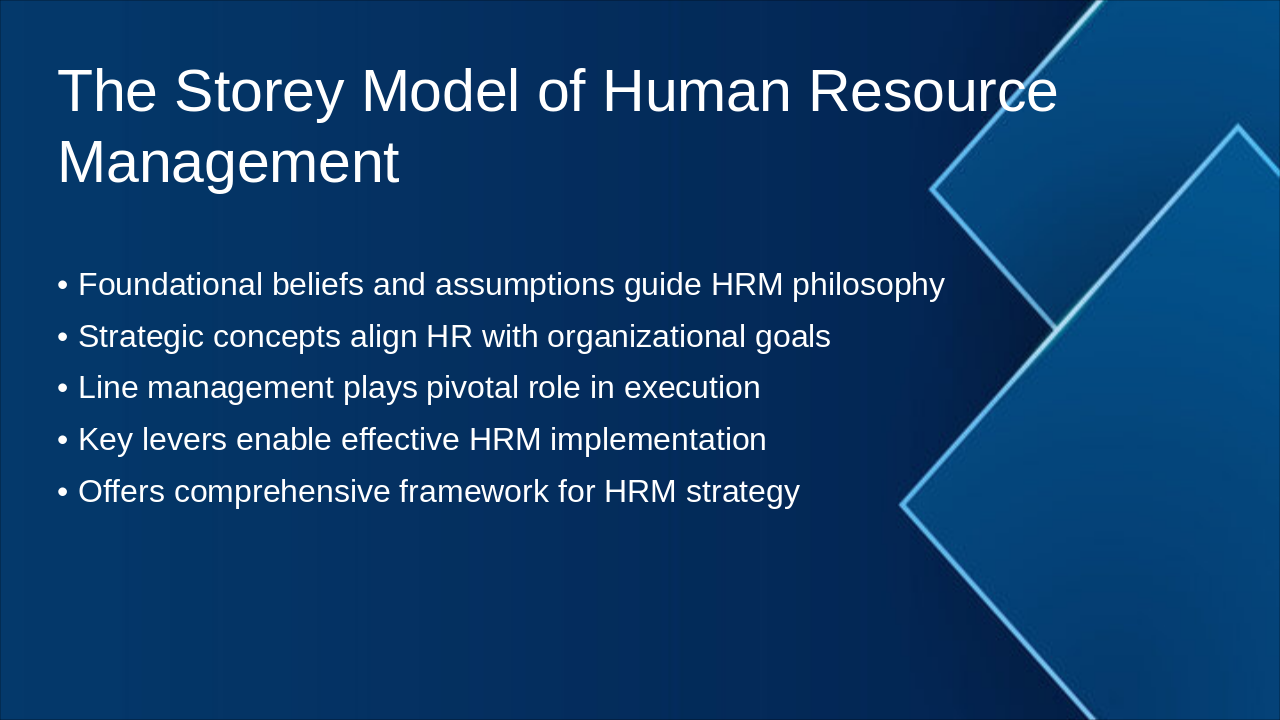
Slide 10 - The Storey Model of Human Resource Management

The Storey Model of Human Resource Management provides a comprehensive framework for aligning HRM strategy with organizational goals through foundational beliefs, strategic concepts, and key implementation levers. It emphasizes the pivotal role of line management in execution while guiding overall HRM philosophy.

The Storey Model of Human Resource Management

  • Foundational beliefs and assumptions guide HRM philosophy
  • Strategic concepts align HR with organizational goals
  • Line management plays pivotal role in execution
  • Key levers enable effective HRM implementation
  • Offers comprehensive framework for HRM strategy
Speaker Notes
Built around four elements: beliefs/assumptions, strategic concepts, line management role, and key levers. Provides framework for HRM implementation.
Slide 10 - The Storey Model of Human Resource Management
Slide 11 of 11

Slide 11 - The 5 Ps HR Model

The 5 Ps HR Model is a framework that centers on aligning HR strategy with business objectives through Purpose, establishing core ethical values via Principles, and streamlining talent management with efficient Processes. It further emphasizes developing and engaging the workforce under People while using metrics to measure and drive performance for sustainable growth.

The 5 Ps HR Model

  • Centers on Purpose: Aligns HR strategy with business objectives for clarity.
  • Establishes Principles: Defines core values guiding ethical HR decisions.
  • Implements Processes: Streamlines operations for efficient talent management.
  • Focuses on People: Develops and engages workforce for optimal performance.
  • Measures Performance: Uses metrics to drive sustainable growth and evaluation.
Slide 11 - The 5 Ps HR Model

Discover More Presentations

Explore thousands of AI-generated presentations for inspiration

Browse Presentations
Powered by AI

Create Your Own Presentation

Generate professional presentations in seconds with Karaf's AI. Customize this presentation or start from scratch.

Create New Presentation

Powered by Karaf.ai — AI-Powered Presentation Generator