Counseling Teens in Juvenile Justice

Generated from prompt:

Create a 7-slide PowerPoint presentation on 'Counselling Adolescents in the Juvenile Justice System'. Include the following: 1. Title Slide – Topic, name, and date 2. Introduction – Overview of juvenile justice and need for counseling 3. Psychological challenges faced by adolescents in the system 4. Role of counselors and counseling approaches 5. Ethical and cultural considerations 6. Case examples or success stories 7. Conclusion – Importance of counseling and future directions

Explores juvenile justice overview, psychological challenges like trauma/PTSD, counselor's role/approaches, ethical/cultural issues, case successes, and counseling's vital role in rehab. (147 chars)

January 7, 20267 slides
Slide 1 of 7

Slide 1 - Counselling Adolescents in the Juvenile Justice System

This title slide presents a professional session titled "Counselling Adolescents in the Juvenile Justice System." It includes a subtitle crediting the presentation to [Your Name] and dated [Insert Date].

Counselling Adolescents

in the Juvenile Justice System

Professional presentation by [Your Name] | Date: [Insert Date]

Speaker Notes
Professional presentation by [Your Name] | Date: [Insert Date]
Slide 1 - Counselling Adolescents in the Juvenile Justice System
Slide 2 of 7

Slide 2 - Introduction

This introductory slide provides an overview of the juvenile justice system, highlights key challenges facing adolescents in custody, and emphasizes the critical need for specialized counseling support. It sets the stage for discussing these essential topics in the context of youth justice.

Introduction

  • Overview of the juvenile justice system
  • Key challenges facing adolescents in custody
  • Critical need for specialized counseling support

Source: Overview of juvenile justice system, key challenges for adolescents, and critical need for counseling support.

Speaker Notes
This slide sets the stage by providing a high-level overview of the juvenile justice system, highlighting the unique challenges adolescents face, and emphasizing why counseling is essential for rehabilitation and positive outcomes.
Slide 2 - Introduction
Slide 3 of 7

Slide 3 - Psychological Challenges Faced by Adolescents

Adolescents face significant psychological challenges, including trauma and PTSD from offenses, mental health disorders like depression and anxiety, and identity struggles due to peer pressure. Additionally, they often experience emotional dysregulation, impulse control issues, and substance abuse linked to underlying trauma.

Psychological Challenges Faced by Adolescents

  • Trauma and PTSD from offenses and experiences
  • Mental health disorders like depression and anxiety
  • Identity struggles amid peer pressure influences
  • Emotional dysregulation and impulse control issues
  • Substance abuse linked to underlying trauma
Speaker Notes
Highlight the prevalence of these issues among justice-involved youth and the critical need for targeted interventions.
Slide 3 - Psychological Challenges Faced by Adolescents
Slide 4 of 7

Slide 4 - Role of Counselors and Counseling Approaches

Counselors play a vital role in the juvenile justice system by offering emotional support to adolescents, helping them process trauma, build coping skills, foster resilience, guide rehabilitation, reduce recidivism, and promote positive behavioral changes. Key counseling approaches include Cognitive Behavioral Therapy (CBT) to restructure negative thoughts, Family Therapy to strengthen support networks, and Trauma-Informed Care to sensitively address abuse histories for enhanced trust and recovery.

Role of Counselors and Counseling Approaches

Role of CounselorsKey Counseling Approaches
Counselors provide vital emotional support, helping adolescents process trauma, build coping skills, and foster resilience. They guide rehabilitation efforts, reduce recidivism, and promote positive behavioral changes within the juvenile justice system.Cognitive Behavioral Therapy (CBT) restructures negative thoughts; Family Therapy strengthens support networks; Trauma-Informed Care addresses abuse histories sensitively, enhancing trust and long-term recovery.
Speaker Notes
This slide outlines the essential roles counselors play in supporting juvenile offenders and key evidence-based counseling approaches tailored to adolescents in the justice system.
Slide 4 - Role of Counselors and Counseling Approaches
Slide 5 of 7

Slide 5 - Ethical and Cultural Considerations

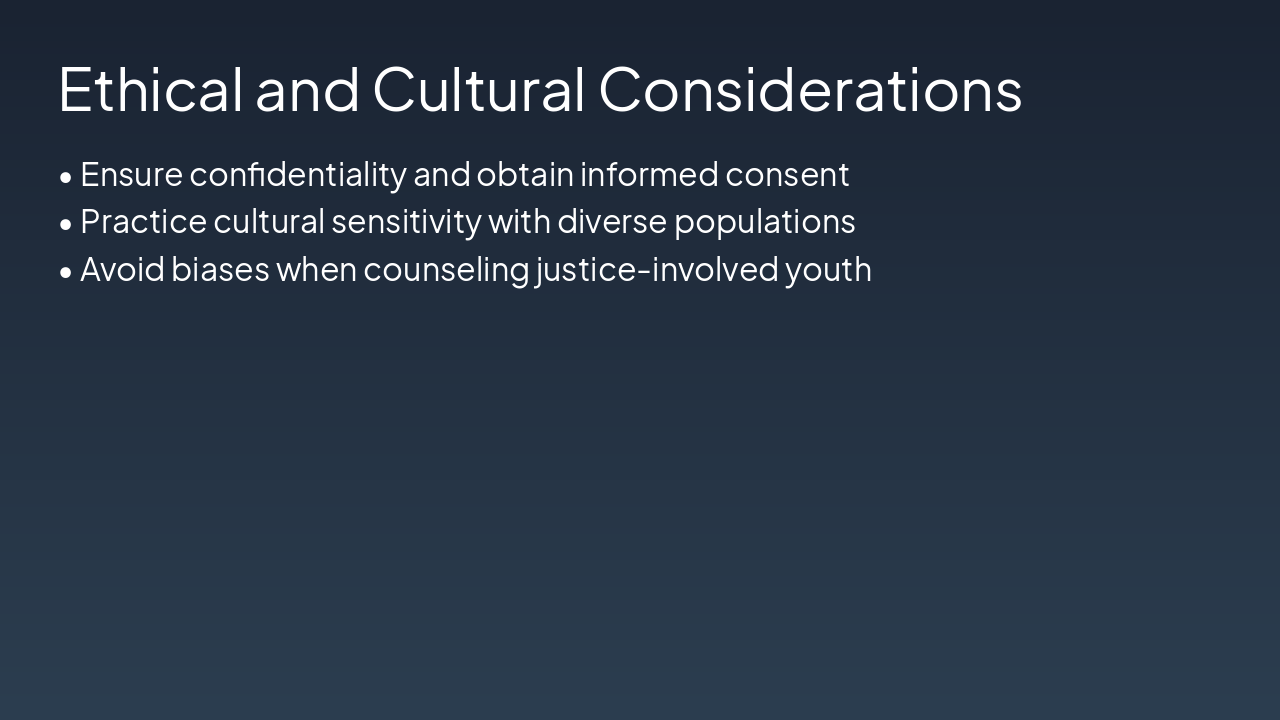
The slide "Ethical and Cultural Considerations" emphasizes ensuring confidentiality, obtaining informed consent, practicing cultural sensitivity with diverse populations, and avoiding biases when counseling justice-involved youth. These points highlight key ethical practices for working with vulnerable groups.

Ethical and Cultural Considerations

  • Ensure confidentiality and obtain informed consent
  • Practice cultural sensitivity with diverse populations
  • Avoid biases when counseling justice-involved youth
Slide 5 - Ethical and Cultural Considerations
Slide 6 of 7

Slide 6 - Case Examples and Success Stories

The slide titled "Case Examples and Success Stories" features a quote from Jamal Rivera, a reformed juvenile offender and CBT counseling success story. He states: "Through counseling, I found my path to a brighter future, breaking free from the cycle of crime."

Case Examples and Success Stories

> 'Through counseling, I found my path to a brighter future, breaking free from the cycle of crime.'

— Jamal Rivera, M.A., Reformed Juvenile Offender & CBT Counseling Success Story

Source: Real-world success story from CBT counseling in juvenile justice

Speaker Notes
Through counseling, I found my path. - Success story of reduced recidivism via CBT. Real-world examples of positive outcomes.
Slide 6 - Case Examples and Success Stories
Slide 7 of 7

Slide 7 - Conclusion

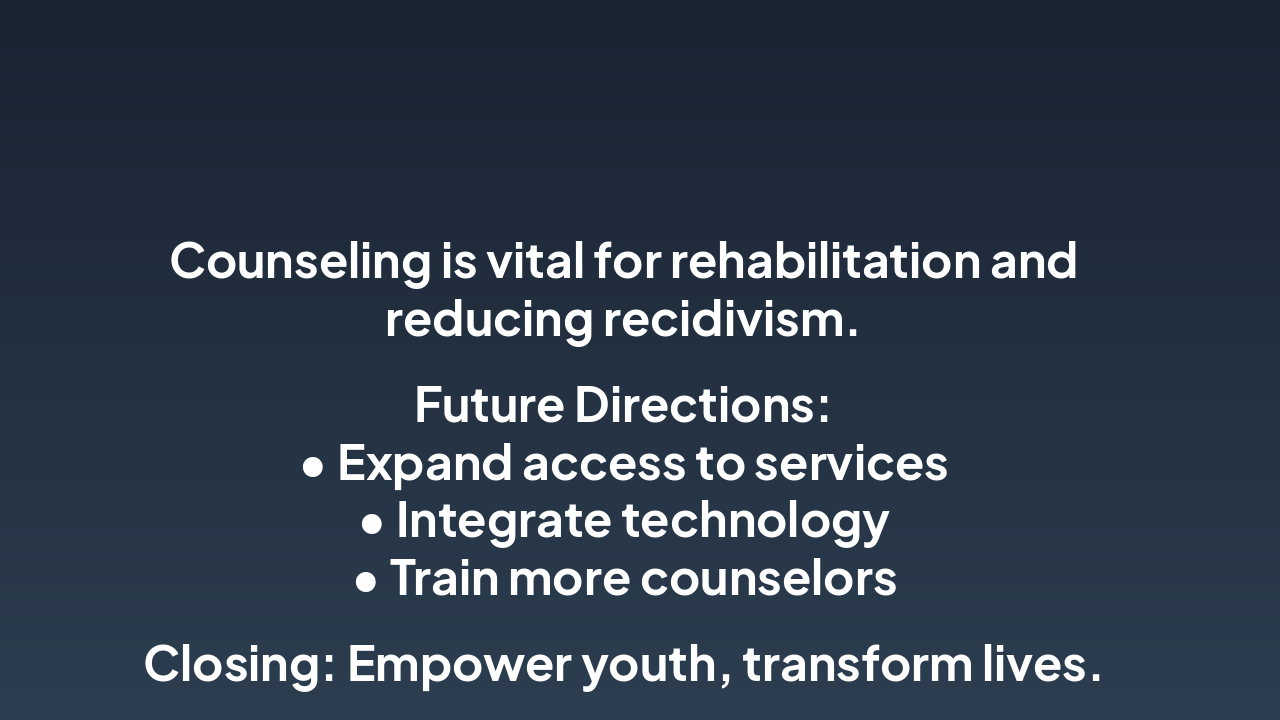
Counseling is vital for youth rehabilitation and reducing recidivism. The slide outlines future directions like expanding access, integrating technology, and training more counselors, ending with a call to advocate for expanded programs to empower youth and transform lives.

Conclusion

Counseling is vital for rehabilitation and reducing recidivism.

Future Directions:

  • Expand access to services
  • Integrate technology
  • Train more counselors

Closing: Empower youth, transform lives.

Call-to-Action: Advocate for expanded counseling programs today!

Speaker Notes
Summarize key points: counseling's vital role in rehabilitation, reducing recidivism, and future expansions. End with CTA to advocate for better support.
Slide 7 - Conclusion

Discover More Presentations

Explore thousands of AI-generated presentations for inspiration

Browse Presentations
Powered by AI

Create Your Own Presentation

Generate professional presentations in seconds with Karaf's AI. Customize this presentation or start from scratch.

Create New Presentation

Powered by Karaf.ai — AI-Powered Presentation Generator