RTT: Systemic Developmental Disruption

Generated from prompt:

Create a publicly accessible PowerPoint presentation titled 'RTT as a Systemic Disorder of Developmental Program Disruption', in English scientific style and a deep, visual tech theme (dark background with abstract neural network visuals). Slide 1: Cover Page - Title: RTT as a Systemic Disorder of Developmental Program Disruption - Subtitle: From Gene-Level Abnormalities to Developmental Program Failure - Author: (Leave blank) - Date: Auto-generated - Design: Dark background with neural network abstract visuals, light text, neon blue/purple highlights. Slide 2: RTT as a Systemic Disorder of Developmental Program Disruption - Key Sentence: RTT is not a single molecular defect, but a progressive imbalance of functional neural networks during development. - Page content: Rett Syndrome (neurodevelopmental disorder); Prefrontal Cortex (PFC) as a key functional area; Concept of developmental windows (early → mid → mature). - No methods or data figures. - Speaker Notes: RTT symptoms indicate failure of system-level maturation, not a broken pathway. Neurodevelopment is time-ordered. Disruption during key windows causes lasting imbalance. The question is not whether abnormalities exist, but when and how they are encoded into the brain. - Duration: ≈1.5 min. Slide 3: Reconstructing RTT Developmental Disruption via Single-Cell Modules - Key Sentence: Using single-cell omics, we elevate RTT abnormalities from the gene level to the developmental program level. - Page content: PFC single-nucleus transcriptome (multiple developmental stages); Stable developmental units (SEACells/meta-nuclei); Coordinated transcriptional modules; Abstract diagram (developmental timeline + module dynamics, no real data). - Speaker Notes: Single-cell data are complex; direct gene comparisons miss the developmental context. We focus on transcriptional programs co-varying during maturation. These modules act as biological subroutines driving functional maturation. In RTT, some programs deviate early; others lose coordination later — a dynamic accumulation of developmental disruption. - Duration: ≈2 min. Slide 4: From Developmental Modules to Circuits and Brain-Machine Integration - Key Sentence: Module disorganization manifests as circuit dysfunction; these modules themselves are potential regulatory targets. - Page content: Module ↔ cell type (excitatory/inhibitory/glial); Circuit maturation / E–I balance; Quantifiable state variables → intelligent regulation; Hierarchical diagram: module → cell → circuit → intervention. - Speaker Notes: Modules bridge molecular and circuit levels — potential entry points for therapeutic modulation and neural engineering. Ensure it is a deep, visual, tech-style design, publicly accessible, and downloadable as PPTX and PDF.

Explores Rett Syndrome as a progressive neural network imbalance, using single-cell omics to reveal developmental program failures from genes to circuits, with therapeutic implications. (147 chars)

December 27, 20254 slides
Slide 1 of 4

Slide 1 - RTT as a Systemic Disorder of Developmental Program Disruption

The slide presents Rett Syndrome (RTT) as a systemic disorder caused by disruption of developmental programs. Its subtitle elaborates on this progression from gene-level abnormalities to overall developmental program failure.

RTT as a Systemic Disorder

of Developmental Program Disruption

From Gene-Level Abnormalities to Developmental Program Failure

Source: Rett Syndrome Presentation

Speaker Notes
Cover page: Dark neural network background, neon blue/purple highlights, light text. Author blank, auto date.
Slide 1 - RTT as a Systemic Disorder of Developmental Program Disruption
Slide 2 of 4

Slide 2 - RTT as a Systemic Disorder of Developmental Program Disruption

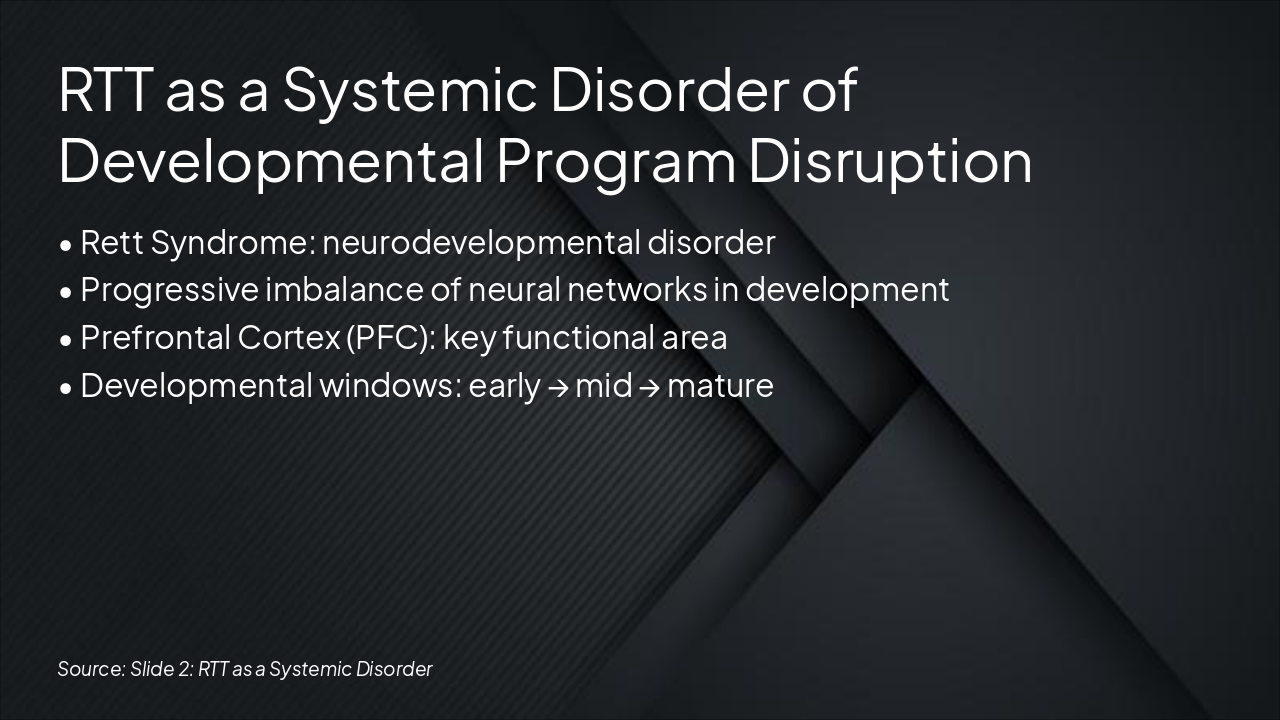
Rett Syndrome is a neurodevelopmental disorder characterized by a progressive imbalance in neural network development, with the Prefrontal Cortex as a key functional area. It involves distinct developmental windows from early to mid to mature stages.

RTT as a Systemic Disorder of Developmental Program Disruption

  • Rett Syndrome: neurodevelopmental disorder
  • Progressive imbalance of neural networks in development
  • Prefrontal Cortex (PFC): key functional area
  • Developmental windows: early → mid → mature

Source: Slide 2: RTT as a Systemic Disorder

Speaker Notes
RTT symptoms indicate failure of system-level maturation, not a broken pathway. Neurodevelopment is time-ordered. Disruption during key windows causes lasting imbalance. The question is not whether abnormalities exist, but when and how they are encoded into the brain.
Slide 2 - RTT as a Systemic Disorder of Developmental Program Disruption
Slide 3 of 4

Slide 3 - Reconstructing RTT Developmental Disruption via Single-Cell Modules

PFC single-nucleus RNA-seq analysis of the prefrontal cortex across developmental stages uses SEACells to identify cell states and coordinated transcriptional modules as core neurodevelopmental programs. The developmental timeline diagram tracks module activation, revealing early disruptions in RTT versus controls that amplify into later systemic imbalances.

Reconstructing RTT Developmental Disruption via Single-Cell Modules

PFC Single-Nucleus RNA-seq AnalysisDevelopmental Timeline & Module Dynamics
Prefrontal cortex (PFC) snRNA-seq across multiple developmental stages (early → mid → mature). Identifies cell states using SEACells (stable meta-nuclei). Reveals coordinated transcriptional modules as core units of neurodevelopmental programs.Abstract diagram: Time-ordered developmental trajectory. Tracks module activation, deviation in RTT vs control. Shows early disruptions amplifying into later imbalances — elevating analysis from genes to systemic program failure.

Source: RTT as a Systemic Disorder of Developmental Program Disruption

Speaker Notes
Single-cell data are complex; direct gene comparisons miss the developmental context. We focus on transcriptional programs co-varying during maturation. These modules act as biological subroutines driving functional maturation. In RTT, some programs deviate early; others lose coordination later — a dynamic accumulation of developmental disruption.
Slide 3 - Reconstructing RTT Developmental Disruption via Single-Cell Modules
Slide 4 of 4

Slide 4 - From Developmental Modules to Circuits and Brain-Machine Integration

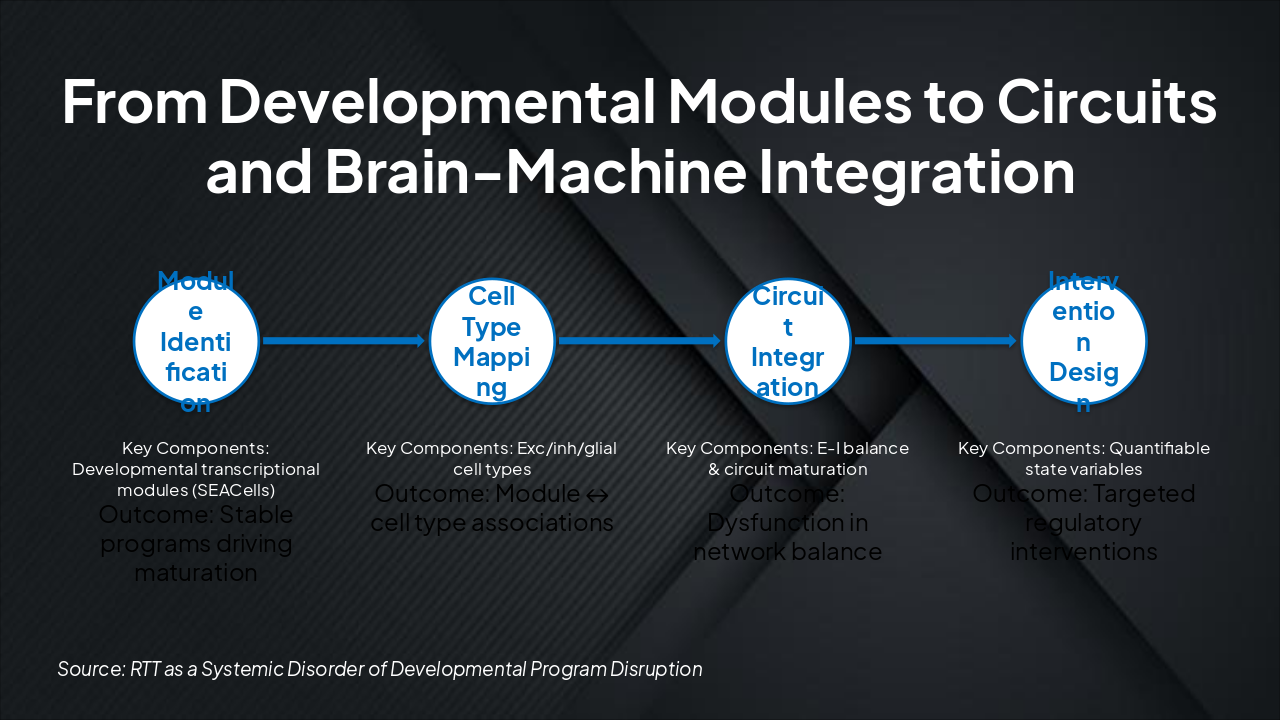
The workflow outlines a progression from identifying developmental transcriptional modules (using SEACells) to mapping them onto excitatory, inhibitory, and glial cell types, revealing stable maturation programs and their associations. It then advances to circuit integration analyzing E-I balance and network dysfunction, culminating in intervention design with quantifiable state variables for targeted regulations.

From Developmental Modules to Circuits and Brain-Machine Integration

Source: RTT as a Systemic Disorder of Developmental Program Disruption

Speaker Notes
Modules bridge molecular and circuit levels — potential entry points for therapeutic modulation and neural engineering.
Slide 4 - From Developmental Modules to Circuits and Brain-Machine Integration

Discover More Presentations

Explore thousands of AI-generated presentations for inspiration

Browse Presentations
Powered by AI

Create Your Own Presentation

Generate professional presentations in seconds with Karaf's AI. Customize this presentation or start from scratch.

Create New Presentation

Powered by Karaf.ai — AI-Powered Presentation Generator