Probability Theory and Random Variables: A Comprehensive 

Generated from prompt:

Create a PowerPoint presentation titled 'Probability Theory and Random Variables' using a UNIVERSITY STYLE theme (blue and white academic design with section divider slides). Keep ALL provided content exactly without removing information. 25 slides structured as given: 1 Introduction to Probability Theory (definition, probability scale 0 impossible 1 certain, rule sum=1). 2 Real World Applications (weather forecasting, insurance risk, networks/systems reliability, poll management). 3 Random Experiment definition, conditions, examples coin/die, defective bolts, bulb lifetime 0<t<4000. 4 Sample Space and Events with examples coin S={H,T}, die S={1..6}, sample point, event subset example two coins only one head. 5 Types of Events sure event S, impossible event empty set example rolling 7, simple event exactly 3 on die, compound event at least one head in three tosses. 6 Bayes Theorem heading only. 7 Random Variable definition purpose representation X,Y,Z example two coins mapping HH->2 HT->1 TH->1 TT->0 range {0,1,2}. 8 Mapping S to R with X:S→R examples die and two coins mapping. 9 Examples of Random Variables (heads in 3 tosses, customers per hour, bulb lifespan, defective items among 10). 10 Discrete Random Variable definition countable examples students class calls heads; mention binomial and poisson. 11 Continuous Random Variable definition examples height weight temperature race time mention uniform and normal. 12 Range of Random Variable examples two coins {0,1,2} and sum two dice {2..12}. 13 Probability Distribution Function properties and formula P(a≤X≤b)=∫ab f(x)dx. 14 Cumulative Distribution Function F(x)=P(X≤x) properties and relation to PDF. 15 Binomial Distribution criteria and formula P(X=k)=C(n,k)p^k q^{n-k}. 16 Binomial example defective bolts n=4 p=0.10 result 0.2916. 17 Poisson heading only. 18 Uniform Distribution definition f(x)=1/(b-a) for a≤x≤b probability formula (x2-x1)/(b-a) examples bus waiting time and ruler point. 19 Mean and Variance Uniform μ=(a+b)/2 variance (b-a)^2/12 explanation midpoint and interval length. 20 Uniform Problems: X uniform -2 to 6 mean=2 variance=64/12 P(X<4)=6/8 P(X>0)=6/8=3/4; Problem2 uniform 8–20 mean14 variance12 P(|X−6|≤15)=1 P(15≤X≤17)=1/6. 21 Normal/Gaussian Distribution pdf (1/(σ√(2π)))e^{-(x-μ)^2/(2σ^2)} bell-shaped symmetric examples heights IQ measurement errors include bell curve graphic. 22 Standard Normal Distribution Z=(X−μ)/σ Z~N(0,1) pdf φ(z)=(1/√(2π))e^{-z^2/2}. 23 Area Under Normal Curve properties total area1 P(μ−σ<X<μ+σ)=0.6826 explanation. 24 Standard Normal Table how to use steps examples Z=1.00 area0.3413 Z=1.96 area≈0.4750. 25 Compare Uniform vs Normal example uniform(8,20) probability 1/6 vs normal μ=14 σ²=12 ≈0.1937 conclusion different shapes different probabilities. Include simple diagrams for uniform flat line and normal bell curve where relevant.

This presentation offers a thorough introduction to probability theory fundamentals, including random experiments, sample spaces, events, types of events, discrete and continuous random variables, probability distributions, CDF, binomial, and Poisson

March 14, 202618 slides
Slide 1 of 18

Slide 1 - Probability Theory and Random Variables

Probability Theory and Random Variables

A Comprehensive Introduction to Foundational Concepts

---

Photo by Pawel Czerwinski on Unsplash
Slide 1 - Probability Theory and Random Variables
Slide 2 of 18

Slide 2 - 1. Introduction to Probability Theory

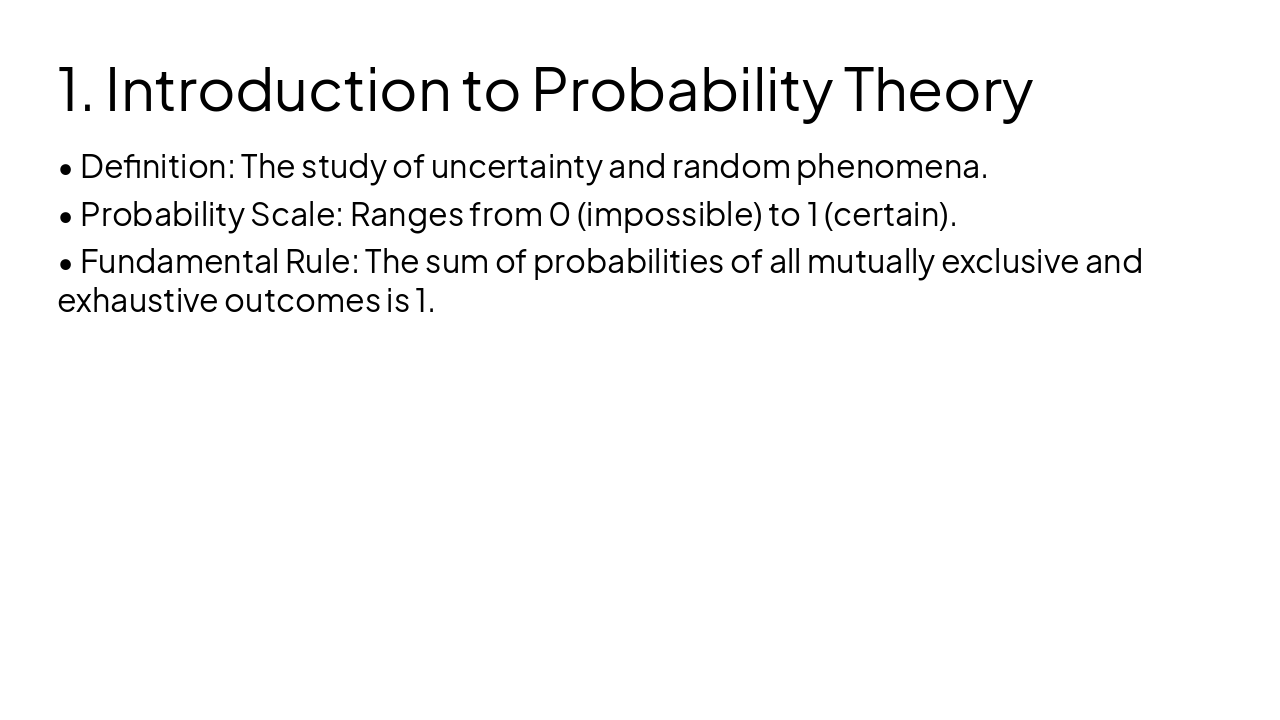
  • Definition: The study of uncertainty and random phenomena.
  • Probability Scale: Ranges from 0 (impossible) to 1 (certain).
  • Fundamental Rule: The sum of probabilities of all mutually exclusive and exhaustive outcomes is 1.
Slide 2 - 1. Introduction to Probability Theory
Slide 3 of 18

Slide 3 - 2. Real World Applications

  • Weather forecasting: Predicting future meteorological conditions.
  • Insurance risk: Assessing probability of claims/losses.
  • Networks/systems reliability: Estimating uptime and potential failures.
  • Poll management: Analyzing survey data and population trends.
Slide 3 - 2. Real World Applications
Slide 4 of 18

Slide 4 - 3. Random Experiment

  • Definition: An operation whose outcome cannot be predicted with certainty.
  • Conditions: Can be repeated under identical conditions, multiple outcomes possible.
  • Examples: Coin toss (H/T), Rolling a die (1-6), Counting defective bolts in a sample, Bulb lifetime (0 < t < 4000 hours).
Slide 4 - 3. Random Experiment
Slide 5 of 18

Slide 5 - 4. Sample Space and Events

  • Sample Space (S): The set of all possible outcomes. Examples: Coin S={H,T}, Die S={1,2,3,4,5,6}.
  • Sample Point: An individual outcome in the sample space.
  • Event: A subset of the sample space. Example: In two coin tosses, the event "exactly one head" is {HT, TH}.
Slide 5 - 4. Sample Space and Events
Slide 6 of 18

Slide 6 - 5. Types of Events

  • Sure Event: The sample space S itself.
  • Impossible Event: The empty set {}. Example: Rolling a 7 on a standard 6-sided die.
  • Simple Event: A single sample point. Example: Rolling exactly a 3 on a die.
  • Compound Event: Two or more sample points. Example: At least one head in three tosses.
Slide 6 - 5. Types of Events
Slide 7 of 18

Slide 7 - Section 6: Bayes Theorem

Bayes Theorem

Probability Theory Overview

---

Photo by Pawel Czerwinski on Unsplash
Slide 7 - Section 6: Bayes Theorem
Slide 8 of 18

Slide 8 - 7. Random Variable Definition

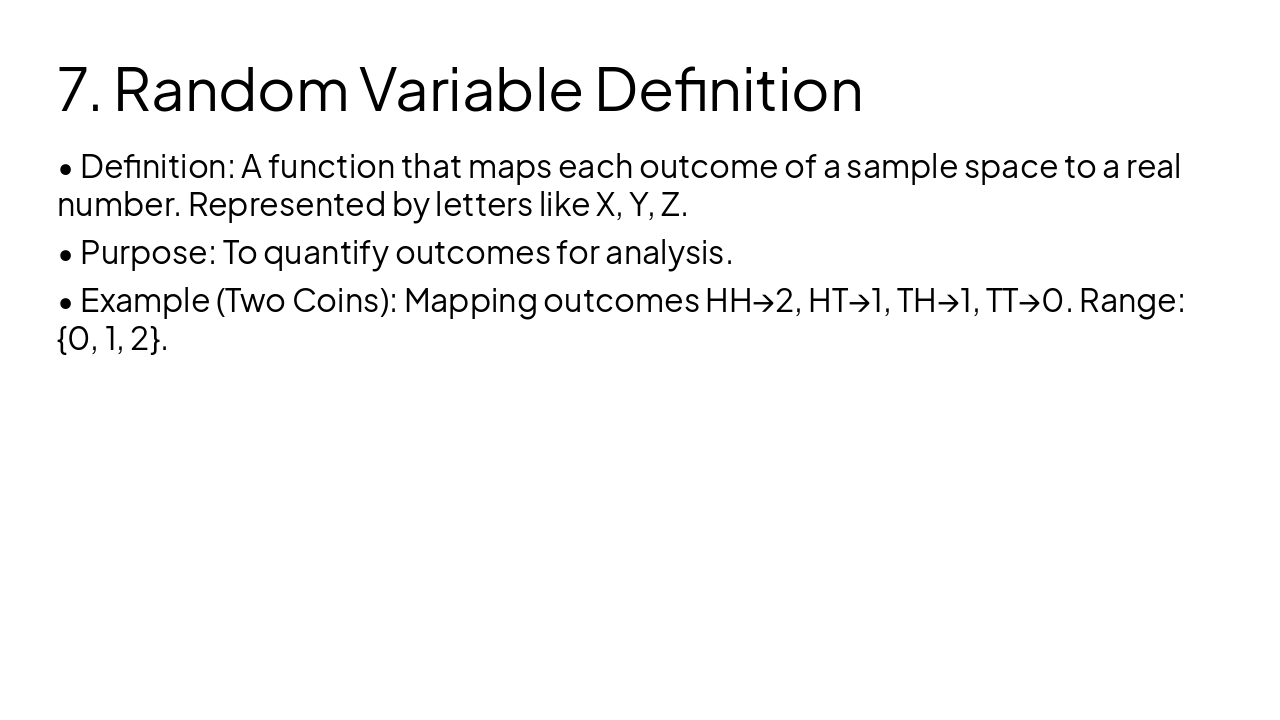
  • Definition: A function that maps each outcome of a sample space to a real number. Represented by letters like X, Y, Z.
  • Purpose: To quantify outcomes for analysis.
  • Example (Two Coins): Mapping outcomes HH→2, HT→1, TH→1, TT→0. Range: {0, 1, 2}.
Slide 8 - 7. Random Variable Definition
Slide 9 of 18

Slide 9 - 8. Mapping S to R

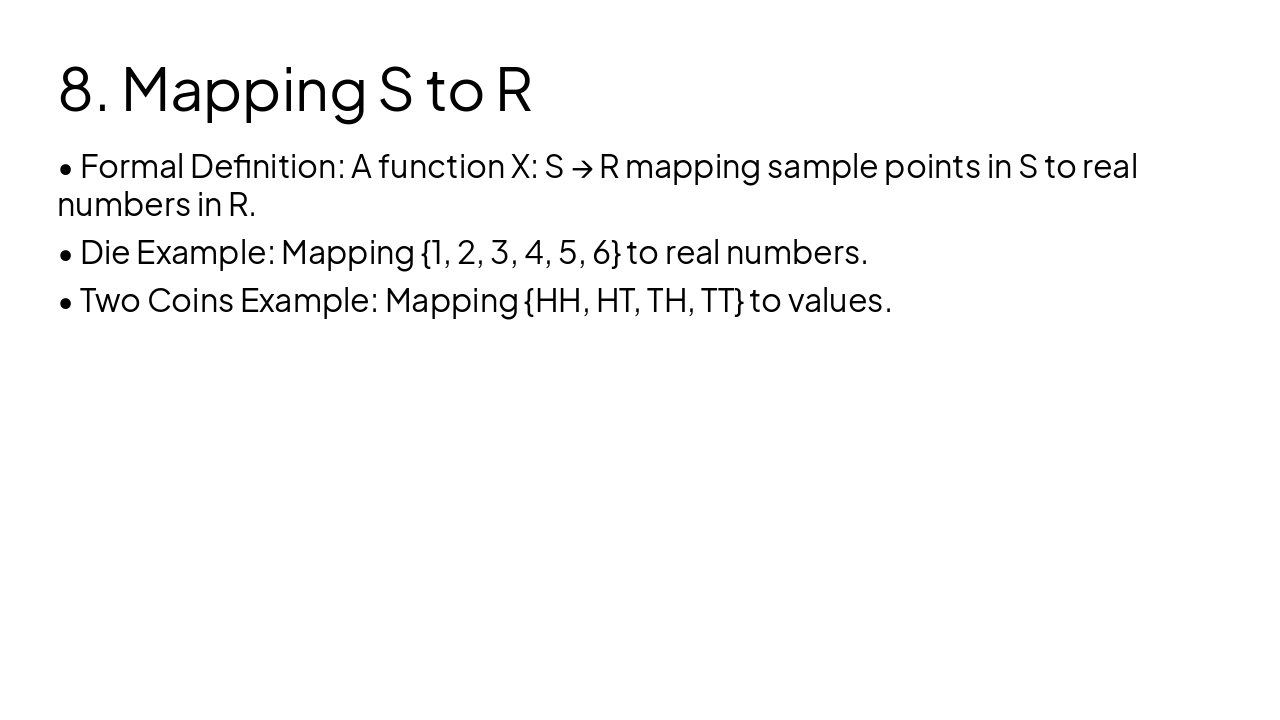
  • Formal Definition: A function X: S → R mapping sample points in S to real numbers in R.
  • Die Example: Mapping {1, 2, 3, 4, 5, 6} to real numbers.
  • Two Coins Example: Mapping {HH, HT, TH, TT} to values.
Slide 9 - 8. Mapping S to R
Slide 10 of 18

Slide 10 - 9. Examples of Random Variables

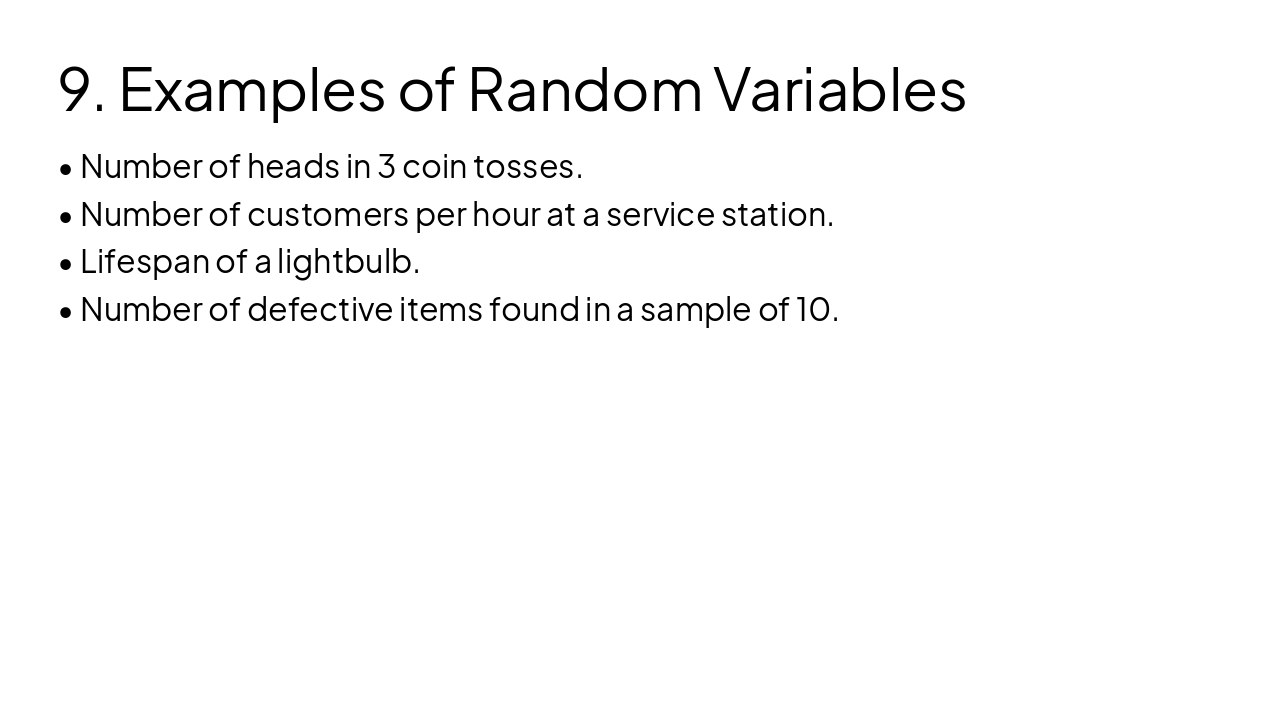
  • Number of heads in 3 coin tosses.
  • Number of customers per hour at a service station.
  • Lifespan of a lightbulb.
  • Number of defective items found in a sample of 10.
Slide 10 - 9. Examples of Random Variables
Slide 11 of 18

Slide 11 - 10. Discrete Random Variable

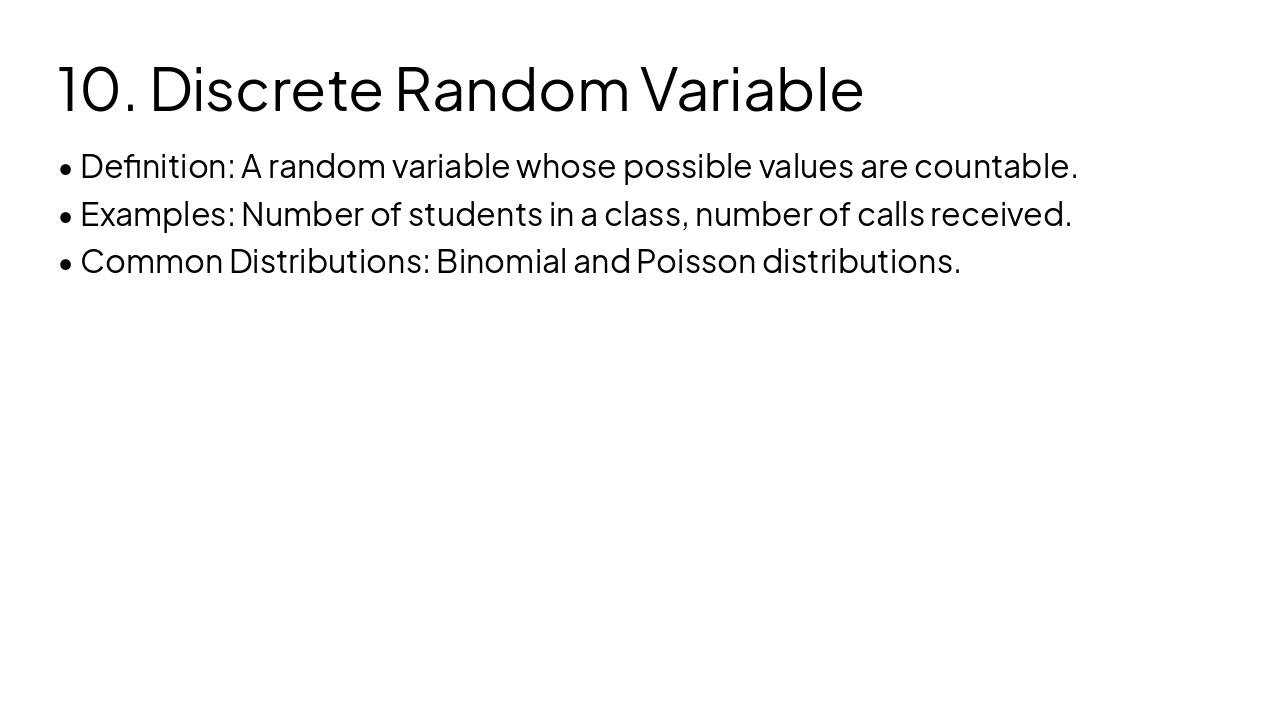
  • Definition: A random variable whose possible values are countable.
  • Examples: Number of students in a class, number of calls received.
  • Common Distributions: Binomial and Poisson distributions.
Slide 11 - 10. Discrete Random Variable
Slide 12 of 18

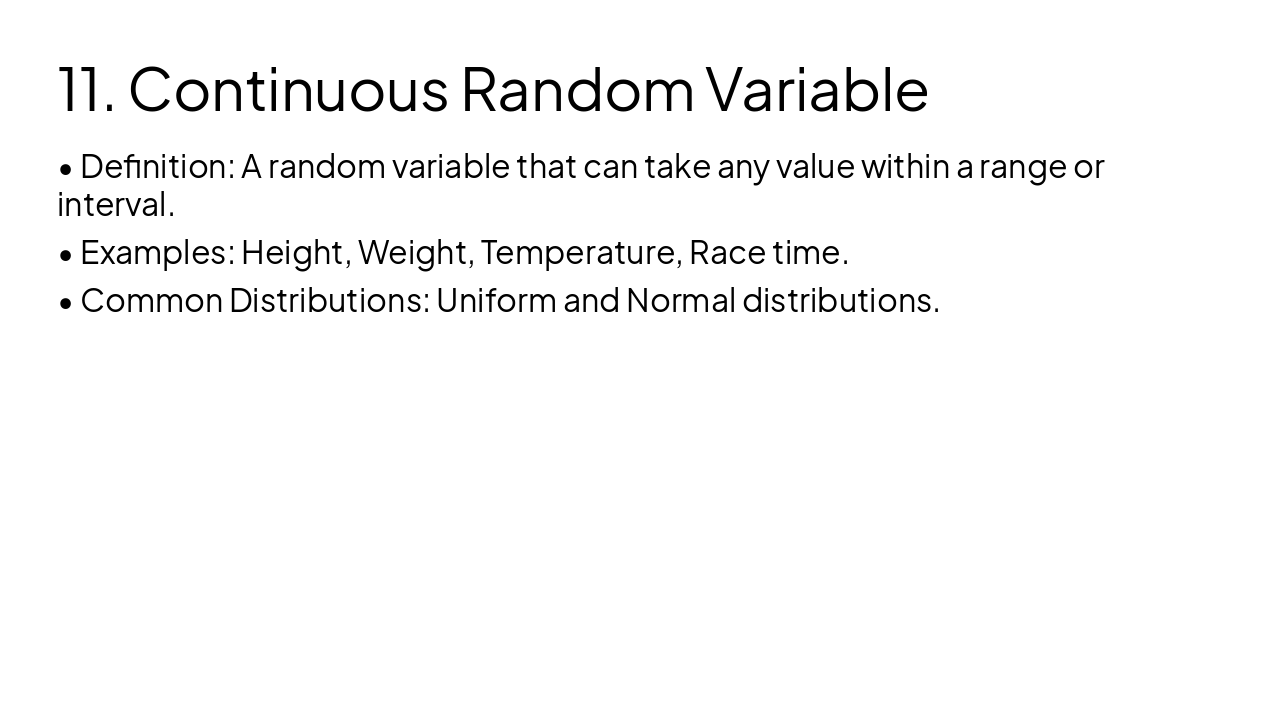
Slide 12 - 11. Continuous Random Variable

  • Definition: A random variable that can take any value within a range or interval.
  • Examples: Height, Weight, Temperature, Race time.
  • Common Distributions: Uniform and Normal distributions.
Slide 12 - 11. Continuous Random Variable
Slide 13 of 18

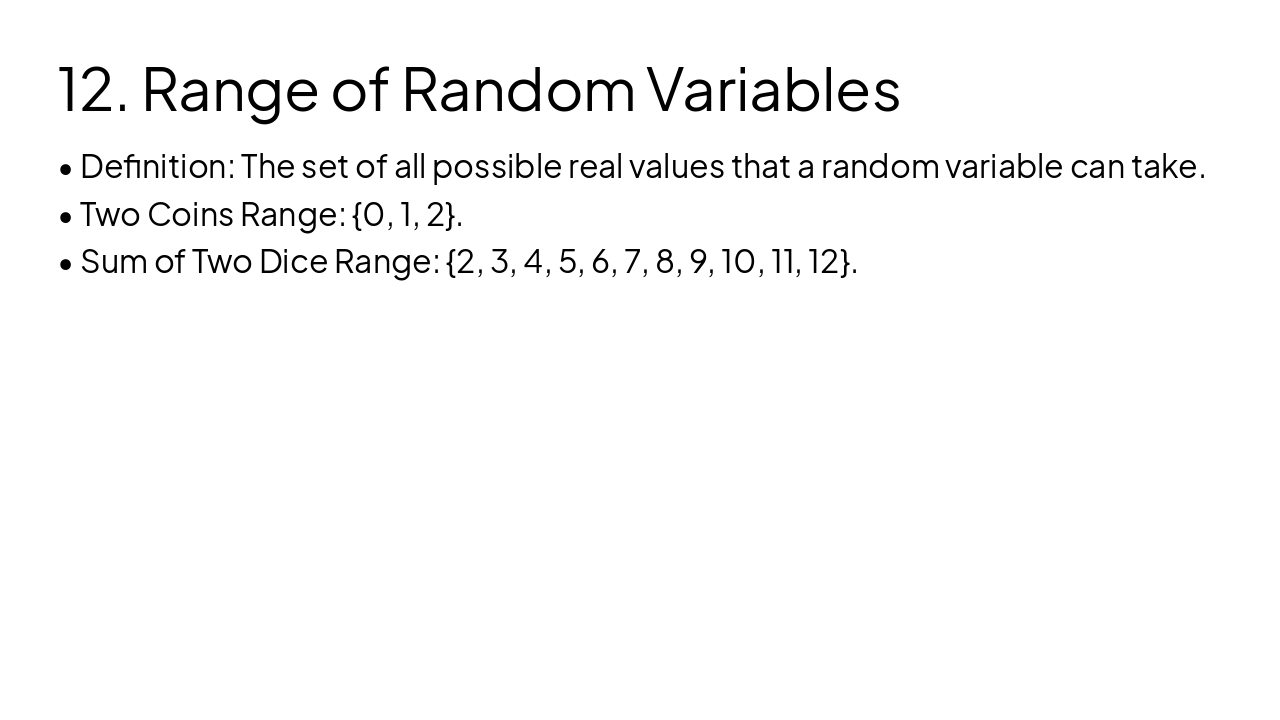
Slide 13 - 12. Range of Random Variables

  • Definition: The set of all possible real values that a random variable can take.
  • Two Coins Range: {0, 1, 2}.
  • Sum of Two Dice Range: {2, 3, 4, 5, 6, 7, 8, 9, 10, 11, 12}.
Slide 13 - 12. Range of Random Variables
Slide 14 of 18

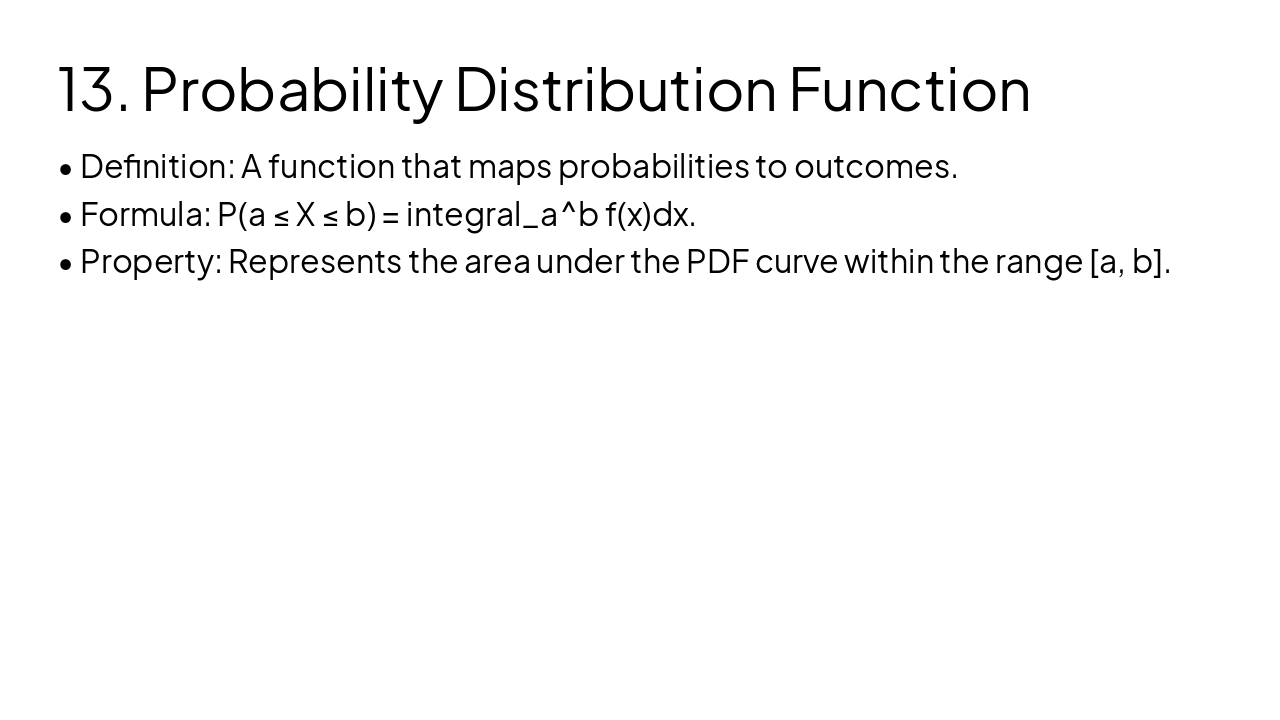
Slide 14 - 13. Probability Distribution Function

  • Definition: A function that maps probabilities to outcomes.
  • Formula: P(a ≤ X ≤ b) = integral_a^b f(x)dx.
  • Property: Represents the area under the PDF curve within the range [a, b].
Slide 14 - 13. Probability Distribution Function
Slide 15 of 18

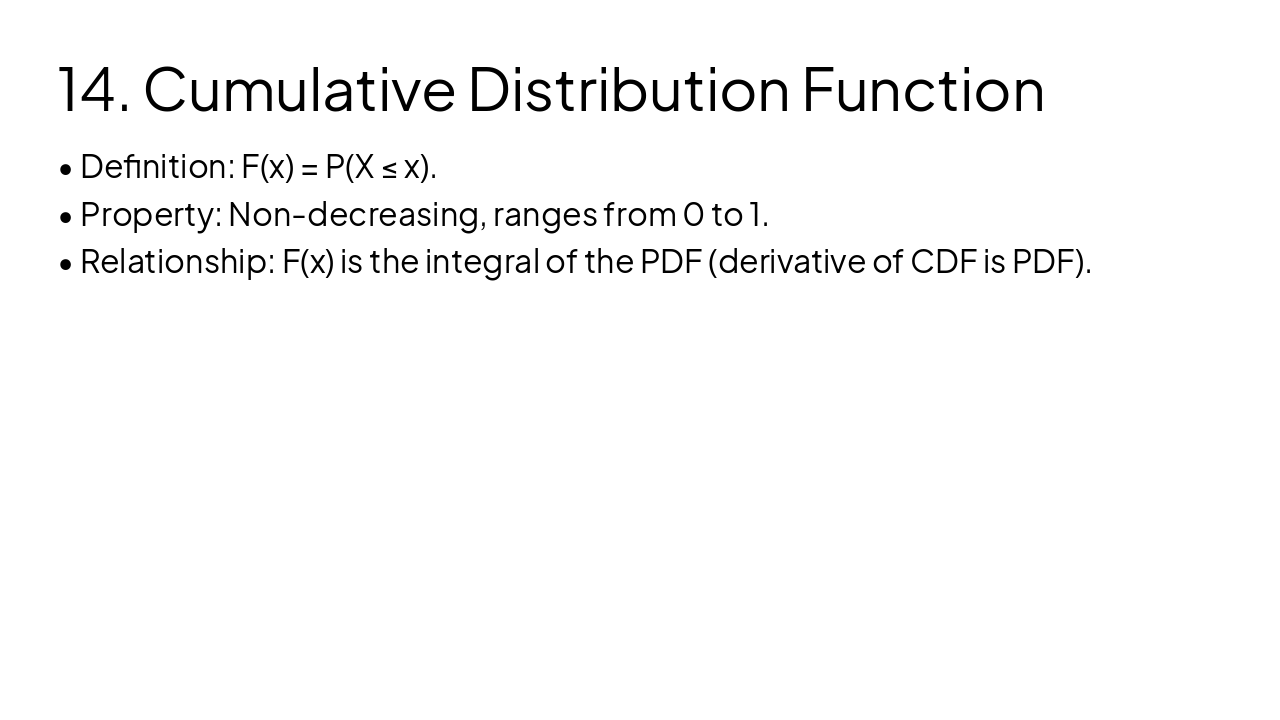
Slide 15 - 14. Cumulative Distribution Function

  • Definition: F(x) = P(X ≤ x).
  • Property: Non-decreasing, ranges from 0 to 1.
  • Relationship: F(x) is the integral of the PDF (derivative of CDF is PDF).
Slide 15 - 14. Cumulative Distribution Function
Slide 16 of 18

Slide 16 - 15. Binomial Distribution

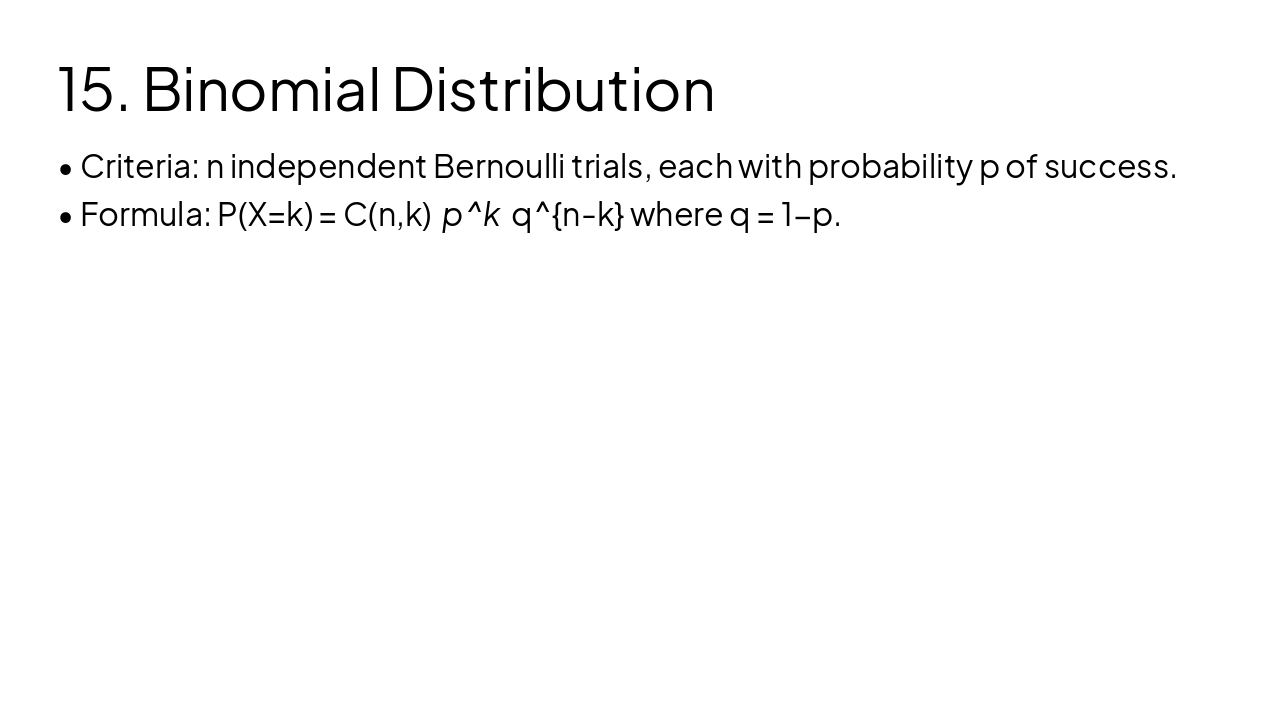
  • Criteria: n independent Bernoulli trials, each with probability p of success.
  • Formula: P(X=k) = C(n,k) p^k q^{n-k} where q = 1-p.
Slide 16 - 15. Binomial Distribution
Slide 17 of 18

Slide 17 - 16. Binomial Example: Defective Bolts

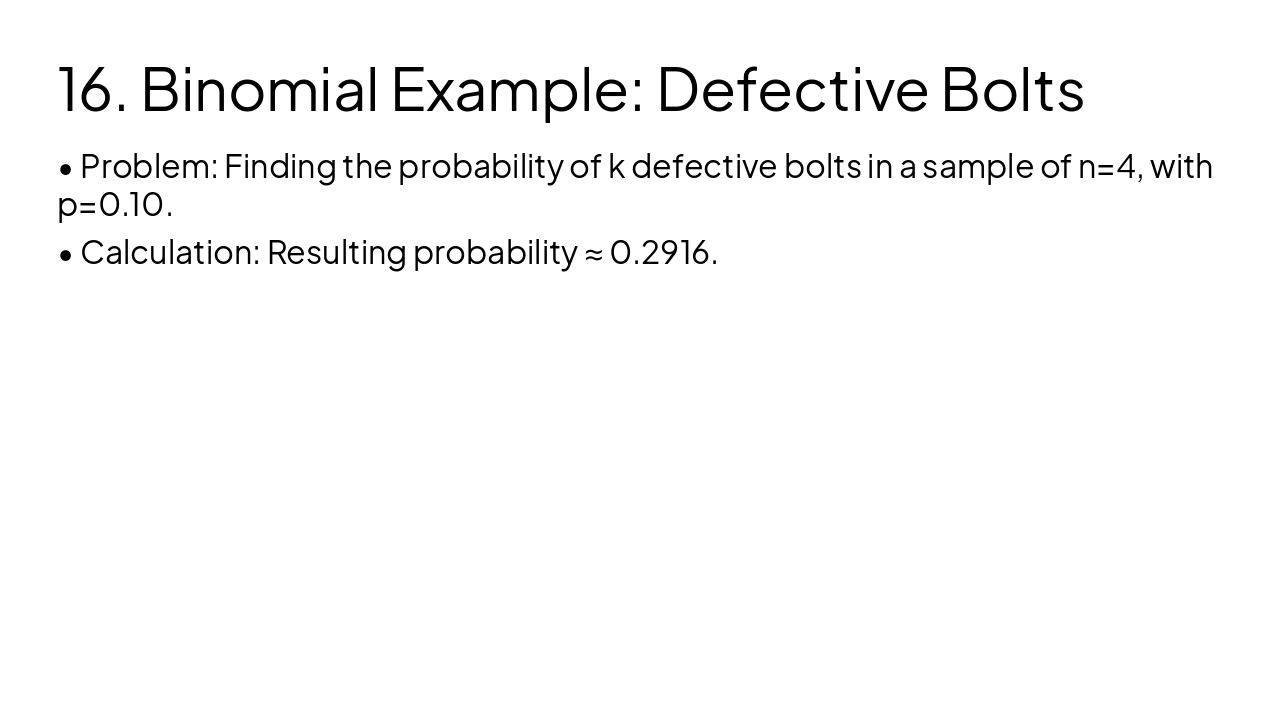
  • Problem: Finding the probability of k defective bolts in a sample of n=4, with p=0.10.
  • Calculation: Resulting probability ≈ 0.2916.
Slide 17 - 16. Binomial Example: Defective Bolts
Slide 18 of 18

Slide 18 - Section 17: Poisson Distribution

Poisson Distribution

Discrete Probability Distributions

Slide 18 - Section 17: Poisson Distribution

Discover More Presentations

Explore thousands of AI-generated presentations for inspiration

Browse Presentations
Powered by AI

Create Your Own Presentation

Generate professional presentations in seconds with Karaf's AI. Customize this presentation or start from scratch.

Create New Presentation

Powered by Karaf.ai — AI-Powered Presentation Generator