Mastering Agile: Principles to Practice

Generated from prompt:

Create a colorful and visually engaging PowerPoint presentation explaining the Agile Model in software development. Use a modern and professional design style with vibrant colors, clean layouts, and attractive visuals. Include slides on: 1. Introduction to Agile 2. Agile Principles 3. Agile Workflow 4. Advantages of Agile 5. Disadvantages of Agile 6. Real-world Applications 7. Summary and Key Takeaways.

Vibrant PPT on Agile software development: intro, principles, workflow, pros/cons, real-world apps like Spotify/Google, and key takeaways on iterative, collaborative adaptability. (148 chars)

January 17, 20267 slides
Slide 1 of 7

Slide 1 - Introduction to Agile

This title slide introduces "Introduction to Agile," highlighting its role in revolutionizing software development. The subtitle emphasizes flexibility and collaboration as key principles.

Introduction to Agile

Revolutionizing Software Development with Flexibility and Collaboration

Source: Welcome to Agile: Revolutionizing software development with flexibility and collaboration. Modern visuals and vibrant colors set the stage.

Slide 1 - Introduction to Agile
Slide 2 of 7

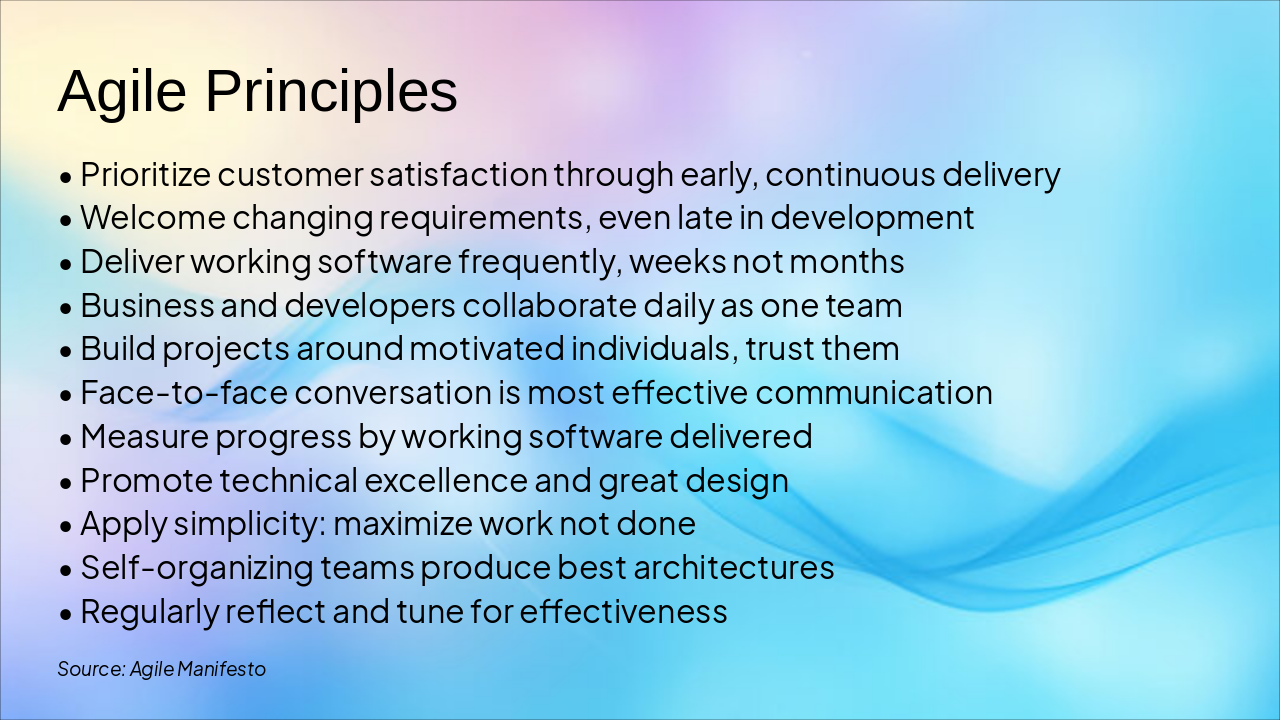
Slide 2 - Agile Principles

The slide outlines the core Agile Principles, emphasizing customer satisfaction through early and continuous delivery of working software, welcoming changing requirements, and frequent collaboration between business and developers. It further highlights building motivated self-organizing teams, prioritizing face-to-face communication, simplicity, technical excellence, and regular reflection for effectiveness.

Agile Principles

  • Prioritize customer satisfaction through early, continuous delivery
  • Welcome changing requirements, even late in development
  • Deliver working software frequently, weeks not months
  • Business and developers collaborate daily as one team
  • Build projects around motivated individuals, trust them
  • Face-to-face conversation is most effective communication
  • Measure progress by working software delivered
  • Promote technical excellence and great design
  • Apply simplicity: maximize work not done
  • Self-organizing teams produce best architectures
  • Regularly reflect and tune for effectiveness

Source: Agile Manifesto

Speaker Notes
These 12 core principles guide Agile practices, emphasizing customer value, adaptability, and continuous improvement.
Slide 2 - Agile Principles
Slide 3 of 7

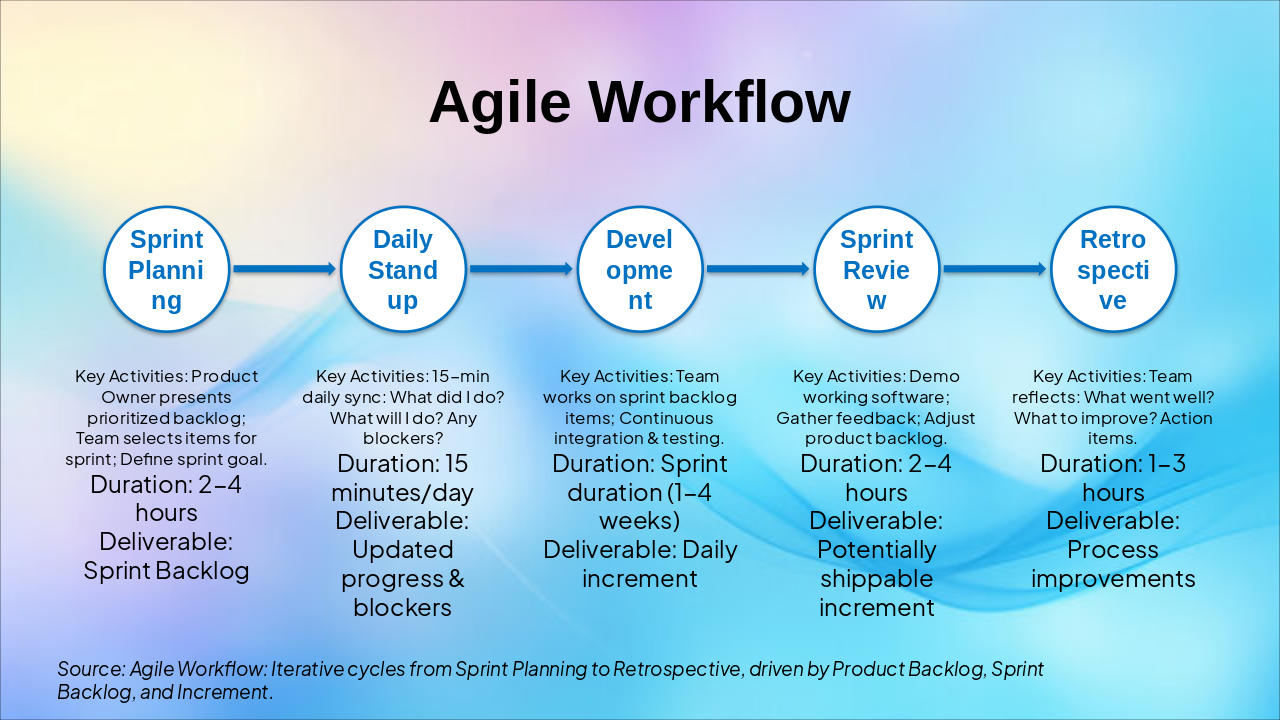
Slide 3 - Agile Workflow

The Agile Workflow slide outlines key phases of a sprint: Sprint Planning (backlog selection and goal definition), Daily Standups (quick progress syncs), Development (ongoing work with integration), Sprint Review (demo and feedback), and Retrospective (team reflection). Each phase includes key activities, typical duration, and main deliverables, from Sprint Backlog to process improvements.

Agile Workflow

Source: Agile Workflow: Iterative cycles from Sprint Planning to Retrospective, driven by Product Backlog, Sprint Backlog, and Increment.

Speaker Notes
The Agile Workflow is an iterative process consisting of key ceremonies: Sprint Planning, Daily Standup, Development, Sprint Review, and Retrospective. It starts with the Product Backlog refined into Sprint Backlog, leading to a potentially shippable Increment after each sprint cycle.
Slide 3 - Agile Workflow
Slide 4 of 7

Slide 4 - Advantages of Agile

Agile offers core delivery benefits like faster iterative sprints, adaptability to changes, customer focus, and higher quality via continuous testing and feedback. It also strengthens teams and processes by boosting morale through empowerment and collaboration, reducing risks with incremental progress, and ensuring transparency via regular demos and stakeholder visibility.

Advantages of Agile

Core Delivery BenefitsTeam & Process Strengths
Agile enables faster delivery with iterative sprints, superior adaptability to changes, unwavering customer focus, and consistently higher quality outputs through continuous testing and feedback.Boosts team morale via empowerment and collaboration, reduces risks with incremental progress, and ensures transparency through regular demos and stakeholder visibility.
Speaker Notes
Highlight how Agile accelerates delivery and fosters collaboration, reducing risks through iterative demos and customer involvement.
Slide 4 - Advantages of Agile
Slide 5 of 7

Slide 5 - Disadvantages of Agile

Agile faces planning and predictability issues, including less predictable timelines and budgets from iterative changes, the need for highly experienced teams, and risks of scope creep without strict controls. It also encounters team and process challenges, such as lighter documentation hindering onboarding and compliance, difficulties for distributed teams, and the demand for continuous customer involvement that strains resources.

Disadvantages of Agile

Planning & Predictability IssuesTeam & Process Challenges
Less predictable timelines and budgets due to iterative changes. Requires highly experienced teams to succeed. Prone to scope creep if priorities shift frequently without strict controls.Lighter documentation can hinder onboarding and compliance. Difficult for distributed or remote teams. Demands continuous customer involvement, which may strain resources.
Speaker Notes
Highlight how Agile's flexibility can introduce challenges like unpredictability and scope creep, especially without experienced teams or proper management.
Slide 5 - Disadvantages of Agile
Slide 6 of 7

Slide 6 - Real-world Applications

This slide highlights real-world applications of agile practices in tech giants, such as Spotify Squads boosting innovation by 40%, Google Projects cutting release time by 35%, and Microsoft Azure DevOps achieving 50% faster time-to-market. It emphasizes proven metrics demonstrating significant efficiency gains across these companies.

Real-world Applications

  • Spotify Squads: Autonomous teams boost innovation 40%.
  • Google Projects: Rapid iterations cut release time 35%.
  • Microsoft Azure DevOps: 50% faster time-to-market.
  • Proven metrics across tech giants.

Source: Case studies: Spotify squads, Google projects, Microsoft Azure DevOps. Success stories with metrics: 30-50% faster time-to-market.

Speaker Notes
Highlight how Agile drives real success in top companies with concrete metrics and visuals.
Slide 6 - Real-world Applications
Slide 7 of 7

Slide 7 - Summary and Key Takeaways

Agile is defined as iterative, collaborative, and adaptive, with its benefits outweighing challenges for dynamic projects. The slide urges adopting Agile for success and starting the journey now to iterate, adapt, and succeed.

Summary and Key Takeaways

**Agile: Iterative, Collaborative, Adaptive.

Benefits outweigh challenges for dynamic projects.

Adopt Agile for Success! 🚀**

Closing: Embrace Agile Today! Call-to-Action: Start your Agile journey now – iterate, adapt, succeed!

Source: Agile Presentation

Speaker Notes
Recap key points, emphasize benefits, and motivate adoption of Agile.
Slide 7 - Summary and Key Takeaways

Discover More Presentations

Explore thousands of AI-generated presentations for inspiration

Browse Presentations
Powered by AI

Create Your Own Presentation

Generate professional presentations in seconds with Karaf's AI. Customize this presentation or start from scratch.

Create New Presentation

Powered by Karaf.ai — AI-Powered Presentation Generator