GFK in Kindergärten: Emotionale Entwicklung

Generated from prompt:

Erstelle eine moderne, minimalistische PowerPoint-Präsentation (PPTX) für die Universität Graz basierend auf folgendem Thema: 'Implementierung der Gewaltfreien Kommunikation im Kindergarten und ihre Auswirkungen auf die emotionale Entwicklung sowie das friedvolle Miteinander'. Enthalten sein sollen: Titelfolie mit Angaben zu Leonie Hinteregger (Matrikelnummer 01615705, Betreuer Univ.-Prof. Dr.phil. Lars Eichen, Universität Graz, Institut für Bildungsforschung und PädagogInnenbildung, Datum 27.01.2026); anschließend alle Inhalte aus dem Exposé in Kurzfassung (Einleitung, theoretischer Hintergrund, Relevanz, Forschungsfrage, Ziele, Hypothese, Methodik, Zeitplan, erwartete Ergebnisse, Literaturverzeichnis) — mit APA7-Kurzangaben auf jeder Folie. Design: modern & clean, helle Farben, Akzentfarbe Petrol, Sans-Serif-Schrift, klare Struktur.

This modern PPTX presentation for the University of Graz explores implementing Nonviolent Communication (GFK) in kindergartens, its impacts on children's emotional development and peaceful interaction

December 1, 202511 slides
Slide 1 of 11

Slide 1 - Implementierung der Gewaltfreien Kommunikation im Kindergarten und ihre Auswirkungen

The slide's title, "Implementierung der Gewaltfreien Kommunikation im Kindergarten und ihre Auswirkungen," focuses on implementing non-violent communication in kindergarten settings. Its subtitle highlights the impacts on children's emotional development and fostering peaceful interactions.

Gewaltfreie Kommunikation im Kindergarten

Auswirkungen auf emotionale Entwicklung und friedvolles Miteinander

Speaker Notes
Präsentation von Leonie Hinteregger (Matrikelnummer 01615705) Betreuer: Univ.-Prof. Dr.phil. Lars Eichen Universität Graz, Institut für Bildungsforschung und PädagogInnenbildung Datum: 27.01.2026
Slide 1 - Implementierung der Gewaltfreien Kommunikation im Kindergarten und ihre Auswirkungen
Slide 2 of 11

Slide 2 - Einleitung

This slide serves as a section header titled "Einleitung" (Introduction), marked as section 01. It introduces Nonviolent Communication (GFK) as developed by Rosenberg, focusing on its application for empathetic interactions in kindergarten settings.

Einleitung

01

Einleitung

Einführung in Gewaltfreie Kommunikation (GFK) nach Rosenberg für empathische Interaktionen im Kindergarten.

Source: (Rosenberg, 2003)

Slide 2 - Einleitung
Slide 3 of 11

Slide 3 - Theoretischer Hintergrund

The slide titled "Theoretischer Hintergrund" outlines the core principles of Nonviolent Communication (GFK) as developed by Rosenberg (2003), including observation, feelings, needs, and requests. It also covers emotional development in children through attachment theory and social competencies, alongside peaceful conflict resolution without violence, drawing from Rogers (1951) and Rosenberg (2003).

Theoretischer Hintergrund

  • Grundlagen der GFK: Beobachtung, Gefühl, Bedürfnis, Bitte (Rosenberg, 2003).
  • Emotionale Entwicklung bei Kindern: Bindungstheorie und soziale Kompetenzen.
  • Friedvolles Miteinander: Konfliktlösung ohne Gewalt (Rogers, 1951; Rosenberg, 2003).
Speaker Notes
- Grundlagen der GFK: Beobachtung, Gefühl, Bedürfnis, Bitte. - Emotionale Entwicklung bei Kindern: Bindungstheorie und soziale Kompetenzen. - Friedvolles Miteinander: Konfliktlösung ohne Gewalt. (Rogers, 1951; Rosenberg, 2003)
Slide 3 - Theoretischer Hintergrund
Slide 4 of 11

Slide 4 - Relevanz

There is a growing demand for social-emotional education in kindergartens, with positive impacts on inclusion and conflict prevention. This topic holds high political and pedagogical relevance in Austria.

Relevanz

  • Steigender Bedarf an sozial-emotionaler Bildung in Kindergärten.
  • Positive Auswirkungen auf Inklusion und Konfliktprävention.
  • Hohe politische und pädagogische Relevanz in Österreich.

Source: BMFSFJ (2020)

Slide 4 - Relevanz
Slide 5 of 11

Slide 5 - Forschungsfrage

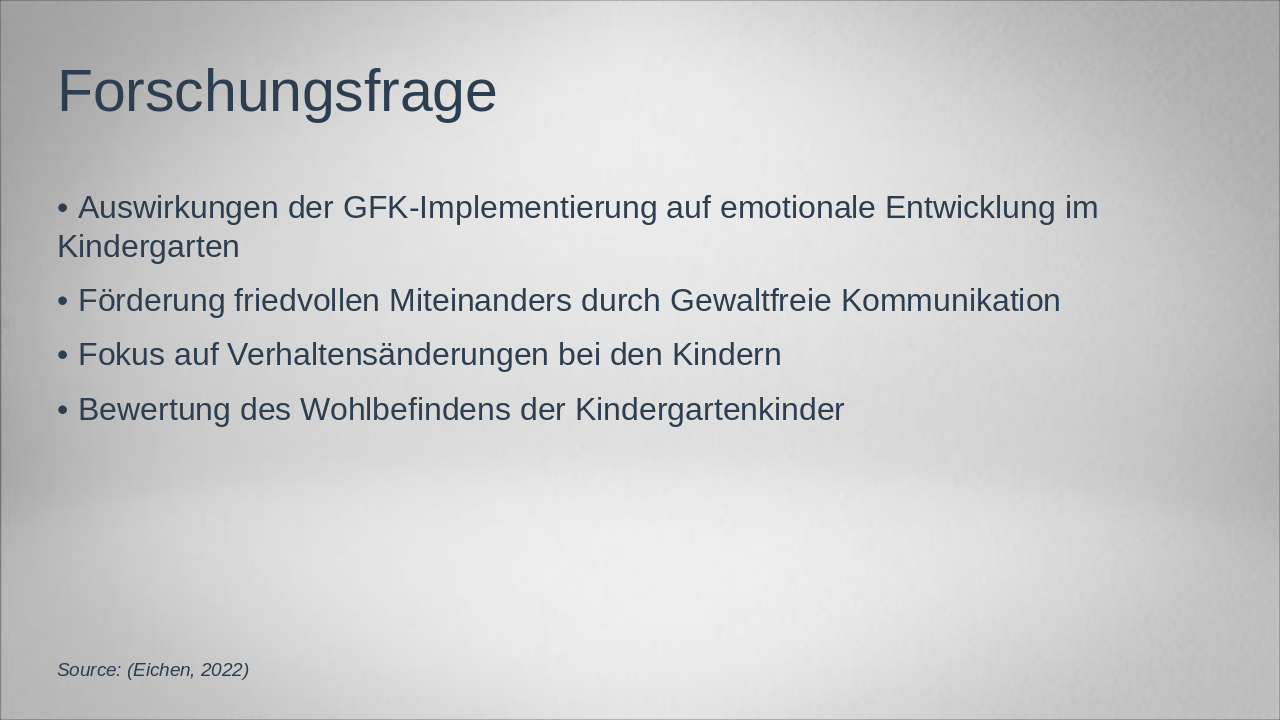
The slide titled "Forschungsfrage" outlines a research question centered on the impacts of implementing Nonviolent Communication (GFK) on children's emotional development in kindergarten. It emphasizes promoting peaceful interactions, focusing on behavioral changes in children, and evaluating their overall well-being.

Forschungsfrage

  • Auswirkungen der GFK-Implementierung auf emotionale Entwicklung im Kindergarten
  • Förderung friedvollen Miteinanders durch Gewaltfreie Kommunikation
  • Fokus auf Verhaltensänderungen bei den Kindern
  • Bewertung des Wohlbefindens der Kindergartenkinder

Source: (Eichen, 2022)

Speaker Notes
Erkläre die zentrale Forschungsfrage und ihre spezifischen Aspekte kurz.
Slide 5 - Forschungsfrage
Slide 6 of 11

Slide 6 - Ziele

The slide titled "Ziele" outlines three key objectives for integrating Gewaltfreie Kommunikation (GFK) into kindergarten routines. It aims to evaluate its impacts on children's emotional competencies and develop recommendations for educators.

Ziele

  • Ziel 1: GFK in Kindergartenroutinen integrieren.
  • Ziel 2: Auswirkungen auf emotionale Kompetenzen evaluieren.
  • Ziel 3: Empfehlungen für Pädagog:innen entwickeln.

Source: Hinteregger (2025)

Slide 6 - Ziele
Slide 7 of 11

Slide 7 - Hypothese

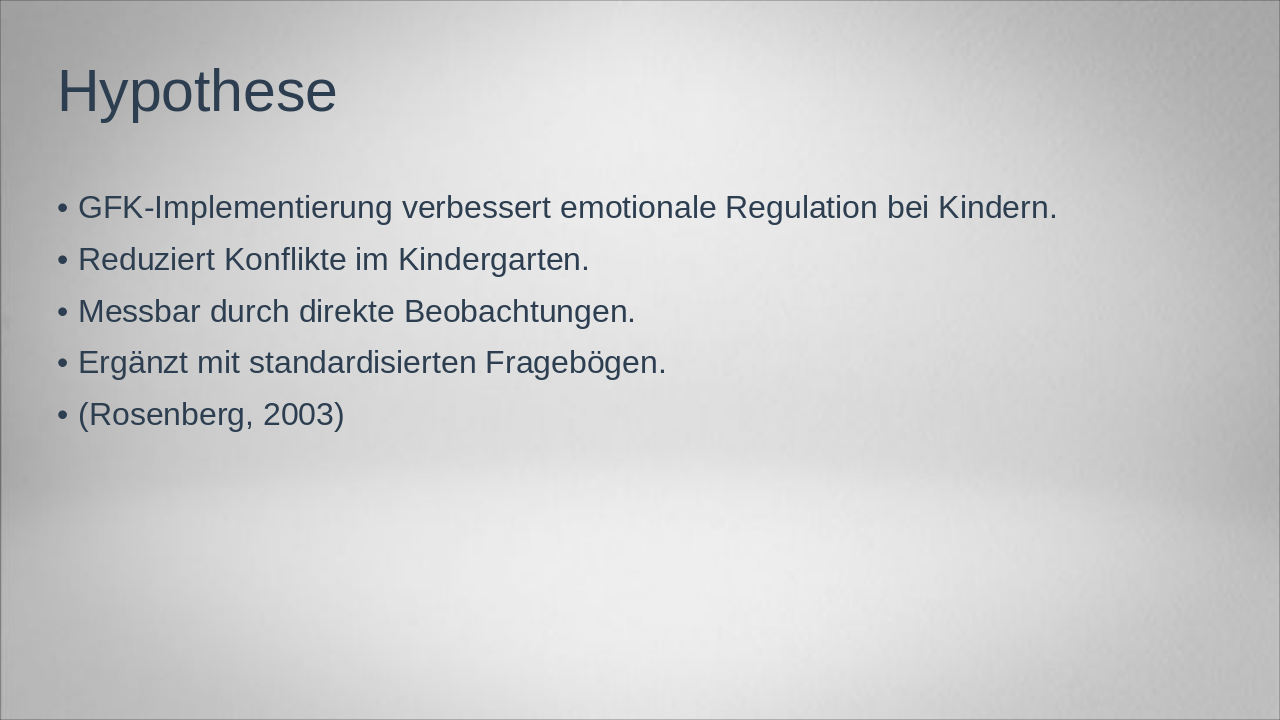
The slide hypothesizes that implementing GFK (Gewaltfreie Kommunikation) improves emotional regulation in children and reduces conflicts in kindergarten settings. This effect can be measured through direct observations, supplemented by standardized questionnaires, as cited in Rosenberg (2003).

Hypothese

  • GFK-Implementierung verbessert emotionale Regulation bei Kindern.
  • Reduziert Konflikte im Kindergarten.
  • Messbar durch direkte Beobachtungen.
  • Ergänzt mit standardisierten Fragebögen.
  • (Rosenberg, 2003)
Slide 7 - Hypothese
Slide 8 of 11

Slide 8 - Methodik

The slide outlines a mixed-methods approach using qualitative and quantitative techniques, including an observational study and interviews with educators. It specifies the sample as two kindergartens in Graz and emphasizes ethical compliance through parental consent as per APA (2020) guidelines.

Methodik

  • Qualitative und quantitative Ansätze: Beobachtungsstudie und Interviews mit Erzieher:innen.
  • Stichprobe: Zwei Kindergärten in Graz.
  • Ethik: Einwilligung der Eltern (APA, 2020).
Slide 8 - Methodik
Slide 9 of 11

Slide 9 - Zeitplan

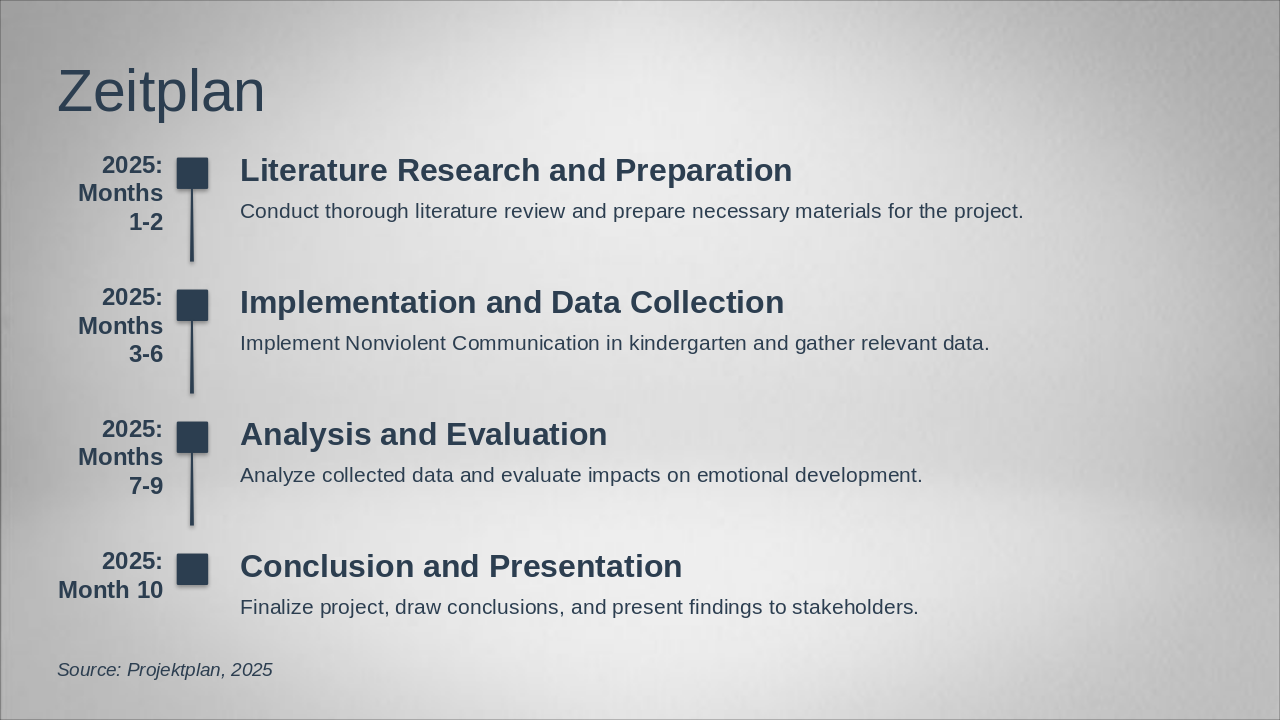
The timeline outlines a 2025 project on implementing Nonviolent Communication in kindergarten to assess its impact on emotional development. It begins with literature research and preparation in months 1-2, followed by implementation and data collection in months 3-6, analysis and evaluation in months 7-9, and concludes with finalization and presentation in month 10.

Zeitplan

2025: Months 1-2: Literature Research and Preparation Conduct thorough literature review and prepare necessary materials for the project. 2025: Months 3-6: Implementation and Data Collection Implement Nonviolent Communication in kindergarten and gather relevant data. 2025: Months 7-9: Analysis and Evaluation Analyze collected data and evaluate impacts on emotional development. 2025: Month 10: Conclusion and Presentation Finalize project, draw conclusions, and present findings to stakeholders.

Source: Projektplan, 2025

Slide 9 - Zeitplan
Slide 10 of 11

Slide 10 - Erwartete Ergebnisse

The slide titled "Erwartete Ergebnisse" outlines expected outcomes from an initiative focused on emotional development, including increased empathy and self-regulation. It also highlights the promotion of peaceful interactions through reduced aggression, along with practical implications for pedagogy as noted in Eichen (2022).

Erwartete Ergebnisse

  • Erhöhte Empathie und Selbstregulation in der emotionalen Entwicklung.
  • Förderung friedvollen Miteinanders durch reduzierte Aggressionen.
  • Praktische Implikationen für die Pädagogik (Eichen, 2022).
Slide 10 - Erwartete Ergebnisse
Slide 11 of 11

Slide 11 - Literaturverzeichnis

This slide, titled "Literaturverzeichnis" (Bibliography), lists key sources including Rosenberg's 2003 book on Nonviolent Communication, Rogers' 1951 work on Client-Centered Therapy, the 2020 BMFSFJ Kindergarten Education Plan, and additional references formatted in APA7 style, with the full list available in the exposé. It concludes with a thank-you for attention and an invitation for questions.

Literaturverzeichnis

- Rosenberg, M. B. (2003). Gewaltfreie Kommunikation.

  • Rogers, C. R. (1951). Client-Centered Therapy.
  • BMFSFJ. (2020). Bildungsplan Kindergarten.
  • Weitere Quellen nach APA7. Vollständige Liste im Exposé.

Vielen Dank für Ihre Aufmerksamkeit. Fragen?

Source: Rosenberg, M. B. (2003). Gewaltfreie Kommunikation. Rogers, C. R. (1951). Client-Centered Therapy. BMFSFJ. (2020). Bildungsplan Kindergarten. Weitere Quellen nach APA7. Vollständige Liste im Exposé.

Slide 11 - Literaturverzeichnis

Discover More Presentations

Explore thousands of AI-generated presentations for inspiration

Browse Presentations
Powered by AI

Create Your Own Presentation

Generate professional presentations in seconds with Karaf's AI. Customize this presentation or start from scratch.

Create New Presentation

Powered by Karaf.ai — AI-Powered Presentation Generator