Slide 1 of 12
Slide 1 - Radio Waves in the Electromagnetic Spectrum
Radio Waves in the Electromagnetic Spectrum
Physics Class Presentation Mr. Z
---
Photo by Marek Pavlík on Unsplash
Generated from prompt:
Name: Date: Period: Mr. Z Electromagnetic spectrum presentation The electromagnetic spectrum is an amazing part of our universe. It shows us how little we humans actually sense of the world around us. There are seven main types of electromagnetic waves. You and your partner will be exploring these and presenting your findings. The details of this are described below. Your presentation must be in PowerPoint format and you have 8 minutes to present. You may show a video if you would like, but do not make it excessively long. (1-2 mins max) You and your partner will be exploring the following: The history of the electromagnetic wave in question. Who discovered it? When was it discovered? How was it discovered? What the frequency range and wavelength range are for your specific part of the spectrum. What objects use or give off these electromagnetic waves. Also talk about a few applications of your part of the electromagnetic spectrum. Please be detailed in your explanation of the applications. Any interesting facts A conclusion The rubric for your grade is shown below. Category 2 4 6 8 10 Readability and aesthetic The PowerPoint was not easy to read at all and was formatted in a difficult to understand format There were many issues with readability and formatting There were some issues with readability and formatting There were very few issues with readability and formatting The PowerPoint was very easy to read and the formatting was very easy to understand Presentation skill Having 4 or more of the following: Little to no eye contact, reading off the slides, cannot hear the voice, only one person spoke, mostly only one person spoke, video too long Having 3 of the following: Little to no eye contact, reading off the slides, cannot hear the voice, only one person spoke, mostly only one person spoke, video too long Having 2 of the following: Little to no eye contact, reading off the slides, cannot hear the voice, only one person spoke, mostly only one person spoke, video too long Having 1 of the following: Little to no eye contact, reading off the slides, cannot hear the voice, only one person spoke, mostly only one person spoke, video too long Having none of the following: Little to no eye contact, reading off the slides, cannot hear the voice, only one person spoke, mostly only one person spoke, video too long Accuracy/depth of knowledge There were many inaccuracies (4 or more), including not having a citations page and/or The presentation did not at all have a deep level of understanding and depth There were many inaccuracies (3), including not having a citations page and/or the presentation had very little understanding of the wave type and depth There were a few inaccuracies (2), including not having a citations page and/or the presentation had some issues with depth of knowledge/understanding of the EM wave There was an inaccurate piece of information, including not having a citations page, and the depth of knowledge and understanding of the EM wave type was good All information was accurate, and the depth of knowledge and understanding of the EM wave type was excellent Time Presentation was under or over by about 5 minutes Presentation was under or over by about 4 minutes Presentation was under or over by about 3 minutes Presentation was under or over by about 2 minutes Presentation was done within the time allotted Presentation format 4 parts of the presentation are missing. 3 parts of the presentation are missing. 2 parts of the presentation are missing. 1 part of the presentation is missing. All of the required parts of the presentation are there. Worked with: Readability and aesthetic: Presentation skills: Accuracy/Depth of Knowledge: Time: Presentation format: Total score:
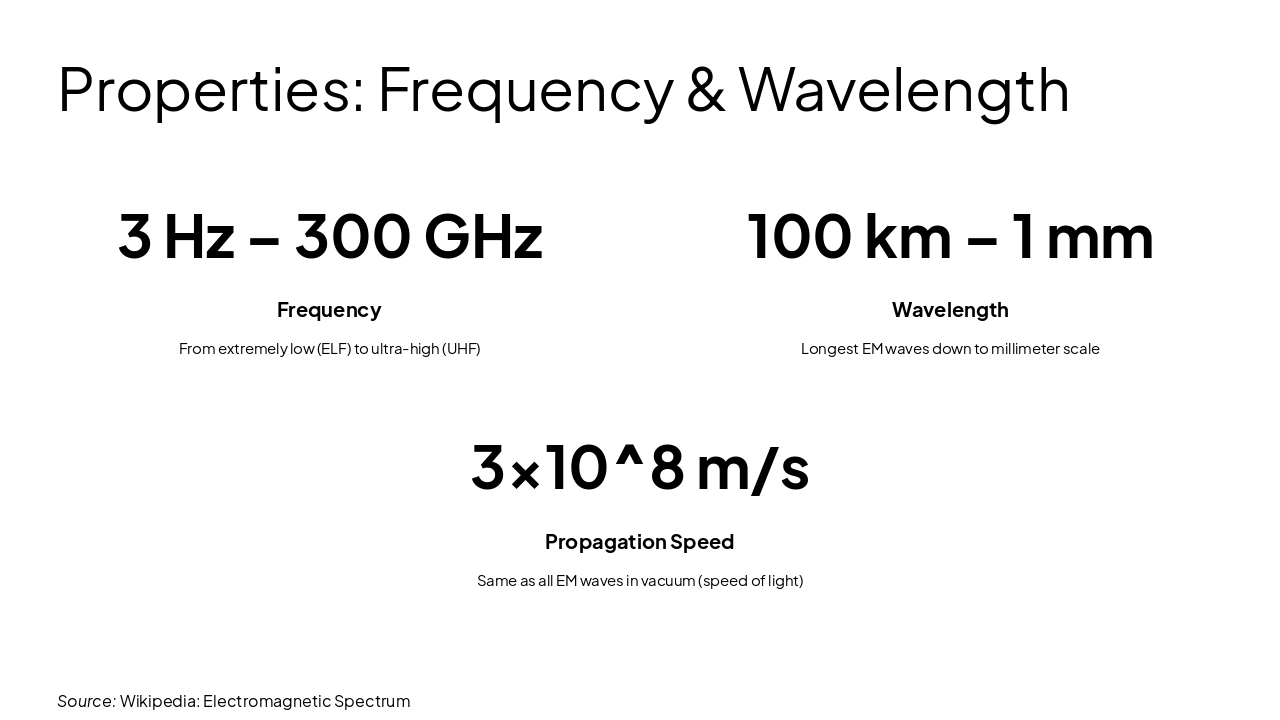
This physics class presentation explores radio waves as part of the electromagnetic spectrum. It covers their history from Maxwell's predictions and Hertz's discovery to Marconi's transatlantic signal, key properties including frequency ranges from 3 Hz to 300 GHz and wavelengths from 100 km to 1 mm, sources like natural lightning and applications in broadcasting, wireless communications, satellite GPS, radar, and radio astronomy. Interesting facts highlight diffraction, ELF submarine communication, and wireless charging, concluding with their foundational role in modern wireless technology.
Radio Waves in the Electromagnetic Spectrum
Physics Class Presentation Mr. Z
---
Photo by Marek Pavlík on Unsplash
---
Photo by Lucia Sorrentino on Unsplash
1
From theory to experiment
---
Photo by Provincial Archives of Alberta on Unsplash
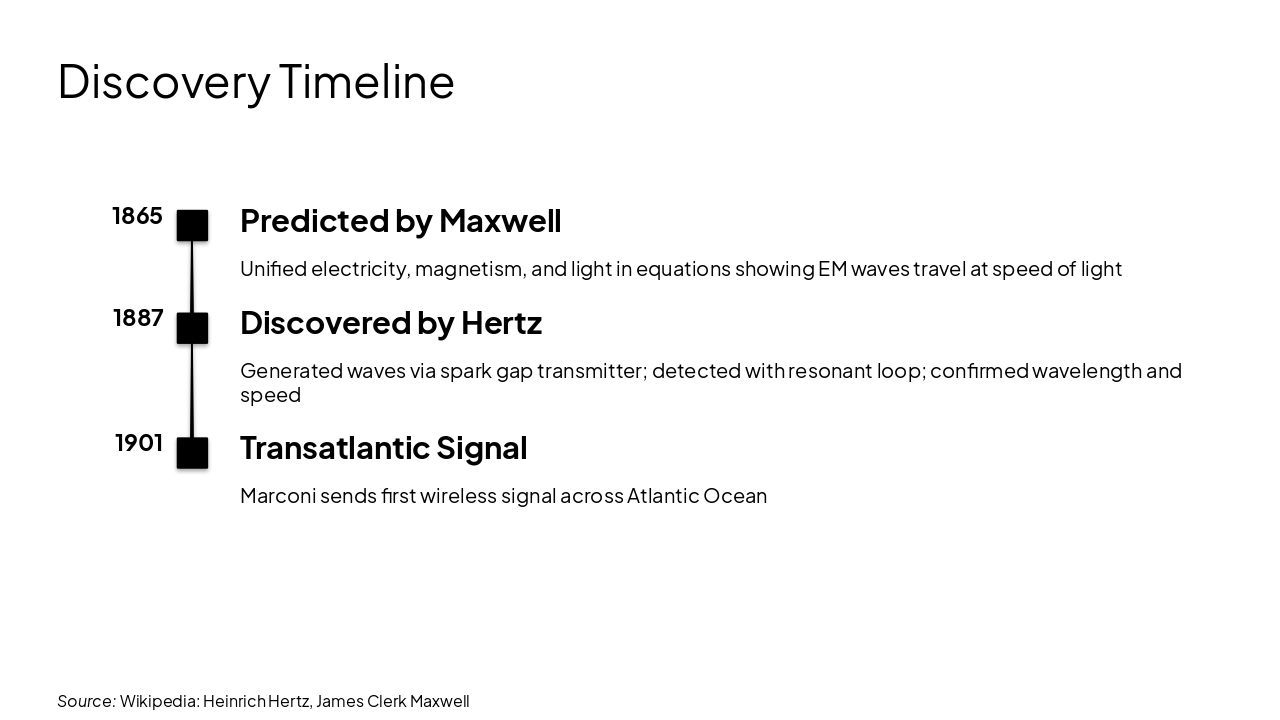
1865: Predicted by Maxwell Unified electricity, magnetism, and light in equations showing EM waves travel at speed of light 1887: Discovered by Hertz Generated waves via spark gap transmitter; detected with resonant loop; confirmed wavelength and speed 1901: Transatlantic Signal Marconi sends first wireless signal across Atlantic Ocean
Source: Wikipedia: Heinrich Hertz, James Clerk Maxwell
Source: Wikipedia: Electromagnetic Spectrum
2
From natural phenomena to modern tech
---
Photo by Kilian Karger on Unsplash
---
Photo by Lucia Sorrentino on Unsplash
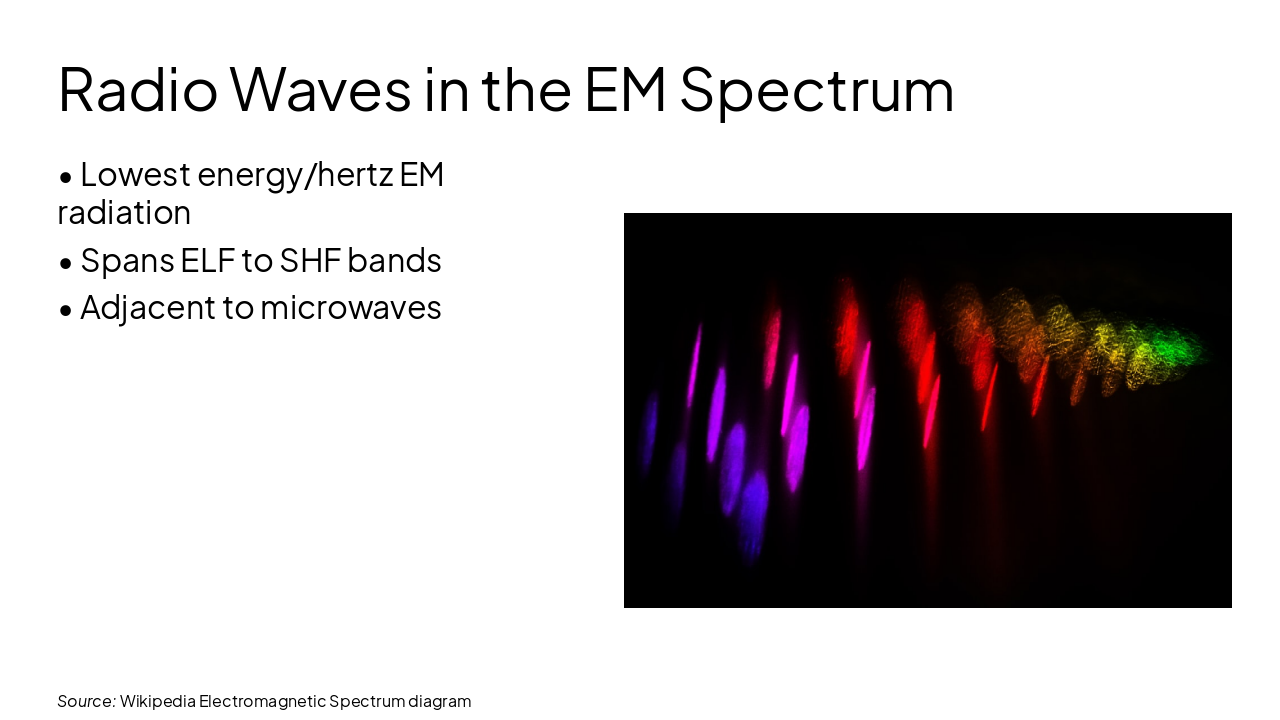
Source: Wikipedia Electromagnetic Spectrum diagram
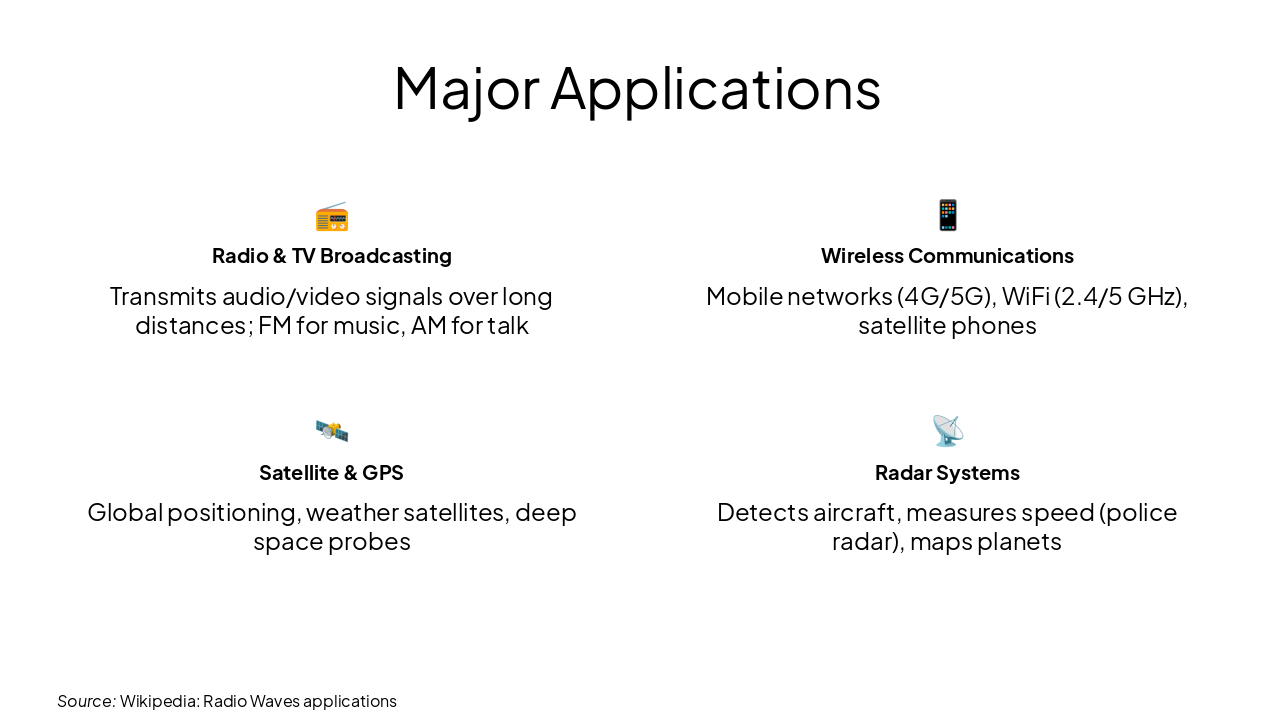
📻 Radio & TV Broadcasting Transmits audio/video signals over long distances; FM for music, AM for talk
📱 Wireless Communications Mobile networks (4G/5G), WiFi (2.4/5 GHz), satellite phones
🛰️ Satellite & GPS Global positioning, weather satellites, deep space probes
📡 Radar Systems Detects aircraft, measures speed (police radar), maps planets
Source: Wikipedia: Radio Waves applications
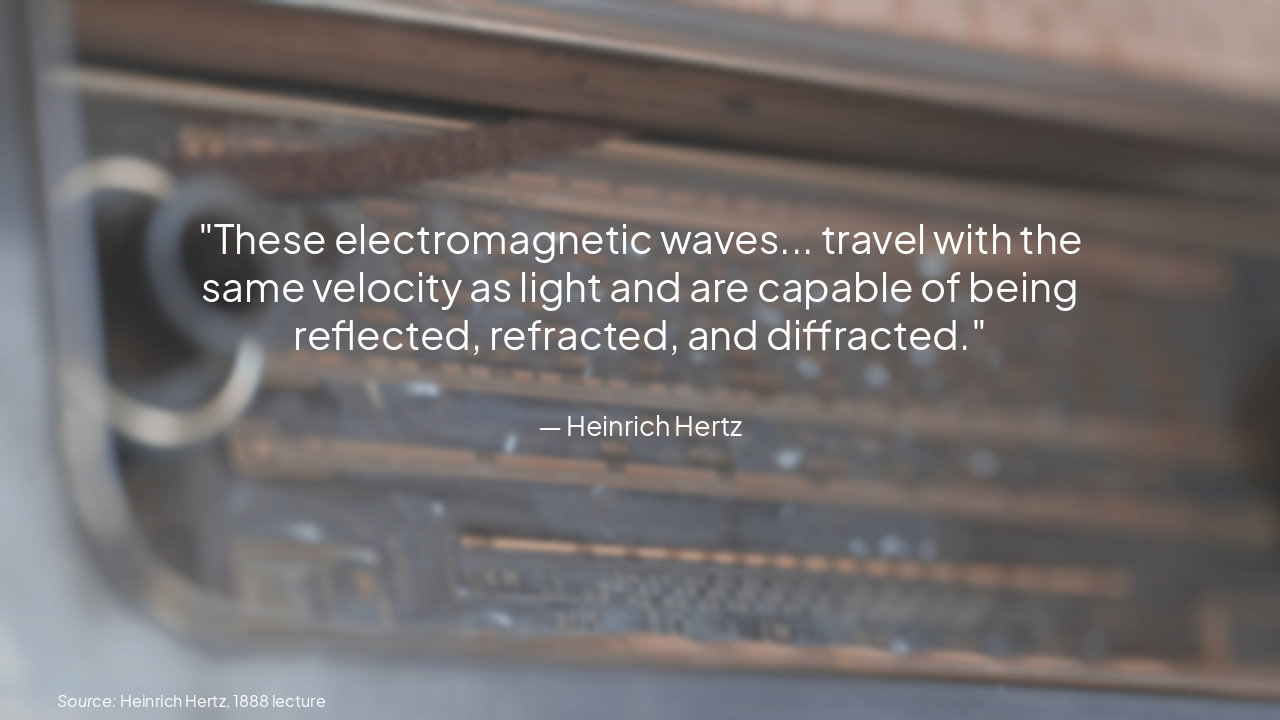
> These electromagnetic waves... travel with the same velocity as light and are capable of being reflected, refracted, and diffracted.
— Heinrich Hertz
---
Photo by Alexandr Popadin on Unsplash
Source: Heinrich Hertz, 1888 lecture
Source: Wikipedia: Radio Waves
Explore thousands of AI-generated presentations for inspiration
Generate professional presentations in seconds with Karaf's AI. Customize this presentation or start from scratch.
