HTML: The Backbone of the Web

Generated from prompt:

Create a presentation about the document I uploaded

This presentation explores HTML as the standard markup language for web documents, covering its definition, structure role, historical development through versions like HTML 2 and 3, practical example

November 10, 202510 slides
Slide 1 of 10

Slide 1 - HTML: The Standard Markup Language

The slide is a title presentation introducing HTML as the standard markup language for web development. Its subtitle provides an overview, describing HTML as the backbone of web content.

HTML: The Standard Markup Language

Overview of HTML: The Backbone of Web Content

--- Speaker Notes: Welcome to this overview of Hypertext Markup Language (HTML), the backbone of web content structure and display in browsers.

Slide 1
Slide 2 of 10

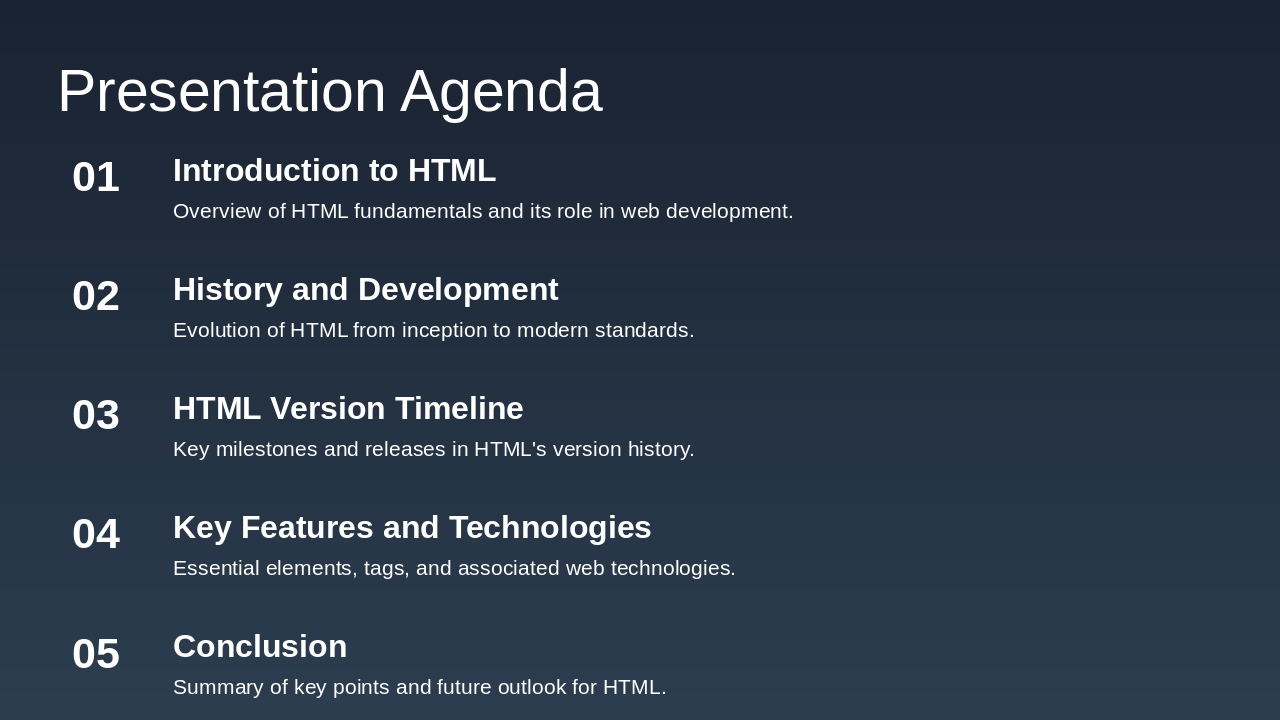
Slide 2 - Presentation Agenda

The presentation agenda outlines a structured overview of HTML, starting with an introduction to its fundamentals and role in web development, followed by its history and evolution from inception to modern standards. It then covers the HTML version timeline with key milestones, essential features like elements and tags alongside associated technologies, and concludes with a summary of key points and future outlook.

Presentation Agenda

  1. Introduction to HTML

Overview of HTML fundamentals and its role in web development.

  1. History and Development

Evolution of HTML from inception to modern standards.

  1. HTML Version Timeline

Key milestones and releases in HTML's version history.

  1. Key Features and Technologies

Essential elements, tags, and associated web technologies.

  1. Conclusion

Summary of key points and future outlook for HTML.

Slide 2
Slide 3 of 10

Slide 3 - What is HTML?

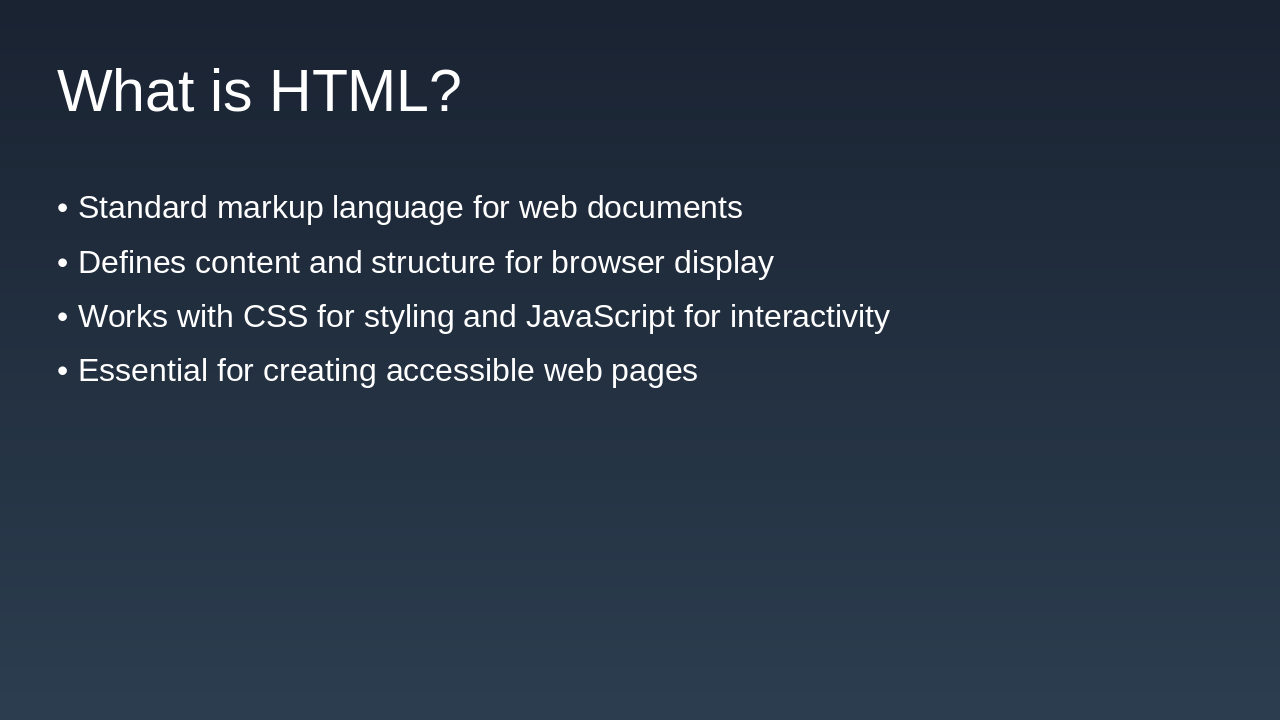
HTML is the standard markup language used to define the content and structure of web documents for display in browsers. It works alongside CSS for styling and JavaScript for interactivity, making it essential for creating accessible web pages.

What is HTML?

  • Standard markup language for web documents
  • Defines content and structure for browser display
  • Works with CSS for styling and JavaScript for interactivity
  • Essential for creating accessible web pages
Slide 3
Slide 4 of 10

Slide 4 - History and Development

This section header slide introduces the topic "History and Development" of HTML. It notes that HTML originated in the late 1980s, created by Tim Berners-Lee at CERN, and has since evolved through W3C standards to meet modern web requirements.

History and Development

HTML originated in the late 1980s by Tim Berners-Lee at CERN, evolving via W3C standards for modern web needs.

Slide 4
Slide 5 of 10

Slide 5 - HTML Version Timeline

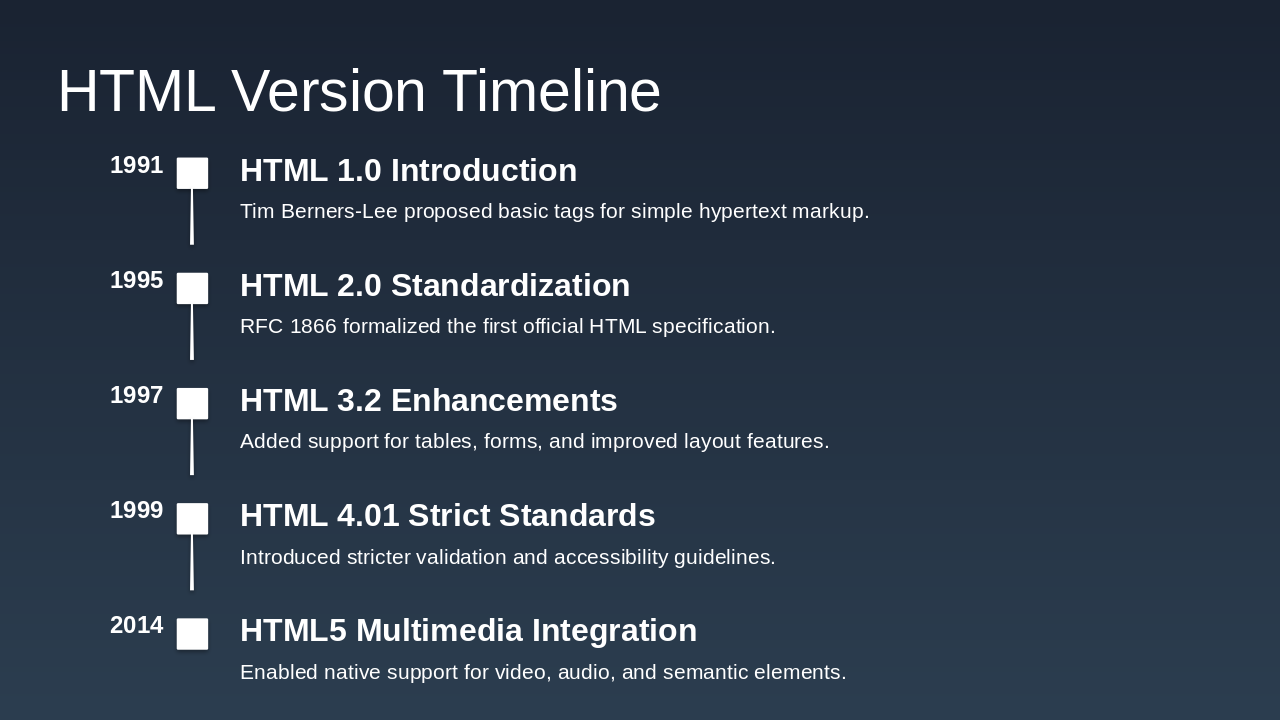
The HTML Version Timeline slide outlines the evolution of HTML from its inception in 1991, when Tim Berners-Lee proposed basic hypertext tags, to its formal standardization as HTML 2.0 in 1995 via RFC 1866. It continues with key enhancements in HTML 3.2 (1997) for tables and forms, stricter standards in HTML 4.01 (1999), and modern multimedia integration in HTML5 (2014).

HTML Version Timeline

1991: HTML 1.0 Introduction Tim Berners-Lee proposed basic tags for simple hypertext markup. 1995: HTML 2.0 Standardization RFC 1866 formalized the first official HTML specification. 1997: HTML 3.2 Enhancements Added support for tables, forms, and improved layout features. 1999: HTML 4.01 Strict Standards Introduced stricter validation and accessibility guidelines. 2014: HTML5 Multimedia Integration Enabled native support for video, audio, and semantic elements.

Slide 5
Slide 6 of 10

Slide 6 - HTML 2 and HTML 3

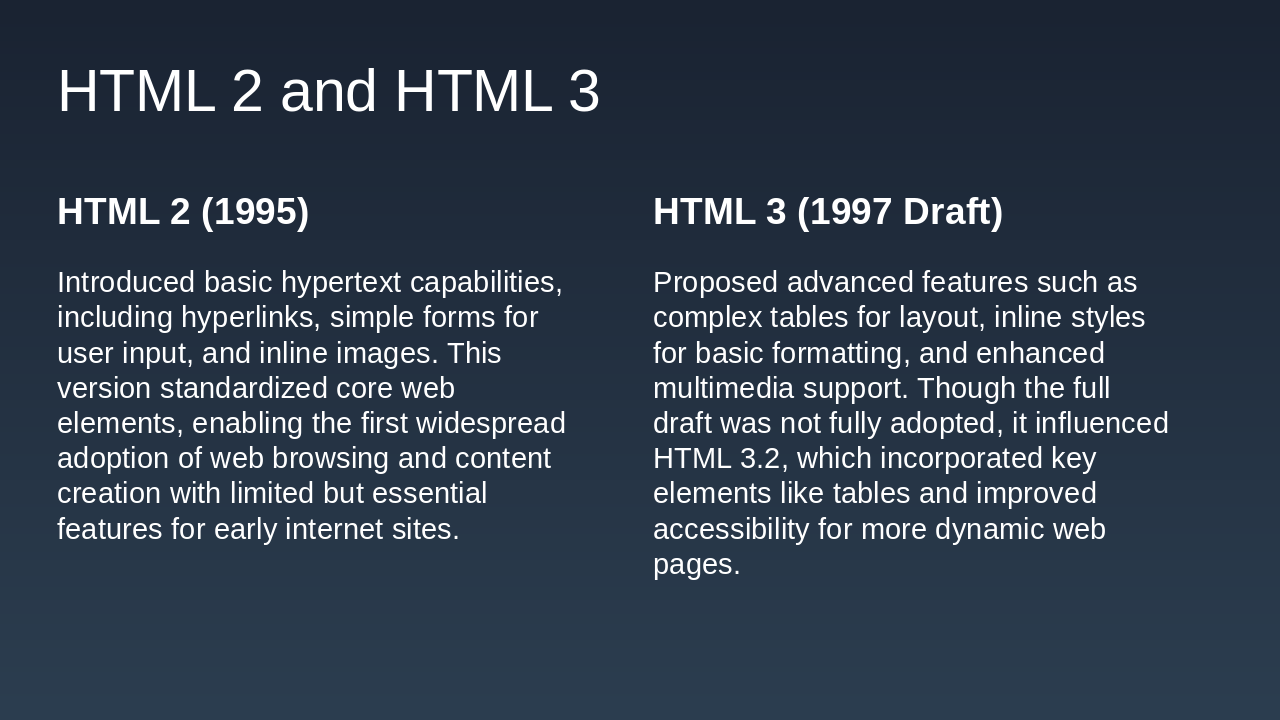
HTML 2, released in 1995, introduced foundational web features like hyperlinks, simple forms, and inline images, standardizing core elements for early internet browsing and content creation. The 1997 HTML 3 draft proposed advancements such as complex tables, inline styles, and better multimedia support, influencing the adopted HTML 3.2 version with improved layout and accessibility for dynamic pages.

HTML 2 and HTML 3

HTML 2 (1995)HTML 3 (1997 Draft)
Introduced basic hypertext capabilities, including hyperlinks, simple forms for user input, and inline images. This version standardized core web elements, enabling the first widespread adoption of web browsing and content creation with limited but essential features for early internet sites.Proposed advanced features such as complex tables for layout, inline styles for basic formatting, and enhanced multimedia support. Though the full draft was not fully adopted, it influenced HTML 3.2, which incorporated key elements like tables and improved accessibility for more dynamic web pages.
Slide 6
Slide 7 of 10

Slide 7 - HTML in Action

The slide titled "HTML in Action" illustrates how HTML structures web content using tags. It highlights key examples, including the <h1> tag for main headings, <p> for paragraph text, and <img> for inserting images.

HTML in Action

!Image

  • HTML uses tags to structure web content.
  • <h1> tag defines the main heading.
  • <p> tag creates paragraph text blocks.
  • <img> tag inserts images into pages.

Source: Image from Wikipedia article "HTML"

Slide 7
Slide 8 of 10

Slide 8 - The Power of HTML

This slide, titled "The Power of HTML," features a quote from Tim Berners-Lee, the inventor of the World Wide Web. The quote describes HTML as the foundational skeleton of the web, offering essential structure that animates the digital realm and unlocks its infinite potential.

The Power of HTML

> HTML forms the very skeleton of the web, providing the essential structure that brings the digital world to life and enables its boundless possibilities.

— Tim Berners-Lee, Inventor of the World Wide Web

Source: Presentation on HTML Fundamentals

Slide 8
Slide 9 of 10

Slide 9 - HTML Impact Stats

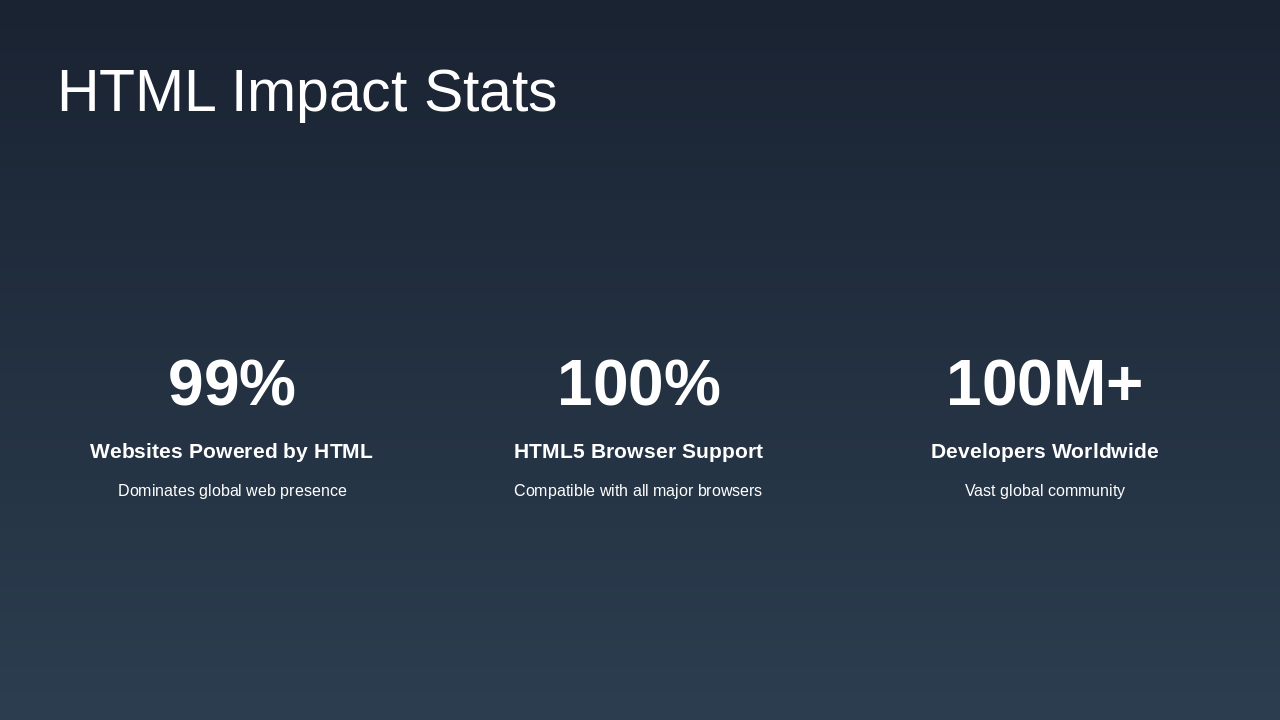
The HTML Impact Stats slide highlights HTML's dominance in powering 99% of websites worldwide, with full compatibility across all major browsers via HTML5. It also notes the vast global community of over 100 million developers supporting its ecosystem.

HTML Impact Stats

  • 99%: Websites Powered by HTML

Dominates global web presence

  • 100%: HTML5 Browser Support

Compatible with all major browsers

  • 100M+: Developers Worldwide

Vast global community

Slide 9
Slide 10 of 10

Slide 10 - Conclusion: HTML's Enduring Role

HTML remains a crucial foundation for web structure, with upcoming updates poised to boost accessibility and performance. The slide encourages exploring further with CSS and JavaScript to deepen understanding of web technologies.

Conclusion: HTML's Enduring Role

HTML remains crucial for web structure. Future updates will enhance accessibility and performance. Explore more with CSS and JavaScript!

Closing: HTML: Timeless Web Foundation. Call-to-Action: Dive deeper into web technologies today!

Slide 10
Powered by AI

Create Your Own Presentation

Generate professional presentations in seconds with Karaf's AI. Customize this presentation or start from scratch.

Create New Presentation

Powered by Karaf.ai — AI-Powered Presentation Generator