PLC PID Constant Pressure Water Supply Design (42 chars)

Generated from prompt:

请根据以下内容生成一个中文的20页PPT,主题为“基于PLC的PID控制恒压供水系统设计”。风格要求:简约科技风,主色调为蓝色。 目录与内容概览: 1. 封面:题目、姓名、指导教师、学院、日期。 2. 摘要:介绍系统设计目标、PID控制与恒压供水的核心思想。 3. 关键词:恒压供水;PID;PLC;液位检测。 4. 研究背景:传统供水系统存在的问题及恒压系统的需求。 5. 研究目的与意义:PLC控制技术对供水系统的改进作用。 6. 国内研究现状:PLC与单片机方案分析。 7. 国外研究现状:国外变频与PID集成应用情况。 8. 系统总体方案:CTH200系列PLC、变频器、水泵等构成及工作原理。 9. 系统功能:恒压控制、上下限报警、手动启动/停止。 10. 硬件系统结构:控制部分、检测部分、报警部分、水泵与管道结构示意。 11. 软件系统结构:五大程序模块及其逻辑关系。 12. PID运算程序:PID算法原理与系统实现方式。 13. 启动与停止程序:程序逻辑与控制流程。 14. 液位检测与报警程序:上限与下限检测逻辑说明。 15. 系统I/O分配:输入输出端口配置表。 16. 程序运行流程图:系统上电到PID调节闭环的流程。 17. 系统软硬件调试:常见问题与解决方法。 18. 系统运行效果:恒压实现与节能效果分析。 19. 结论与改进方向:成果总结与未来展望。 20. 致谢:感谢指导教师、同学与家人支持。

20-slide PPT on designing a PLC-based PID constant pressure water supply system. Covers background, hardware/software structures, PID algorithms, I/O config, debugging, results (stable pressure, energ

December 15, 202520 slides
Slide 1 of 20

Slide 1 - Design of PLC-Based PID Constant Pressure Water Supply System

Design of PLC-Based PID Constant Pressure Water Supply System

Student: XXX Supervisor: XXX College: XXX Date: 2023.X

Slide 1 - Design of PLC-Based PID Constant Pressure Water Supply System
Slide 2 of 20

Slide 2 - Summary

  • Design Goal: Constant Pressure Water Supply
  • Core Concept: PLC Executes PID Algorithm
  • Control VFD to Regulate Pump Speed
  • Maintain Stable Pipeline Pressure
Slide 2 - Summary
Slide 3 of 20

Slide 3 - Key Metrics

Slide 3 - Key Metrics
Slide 4 of 20

Slide 4 - Research Background

  • Traditional supply: Significant pressure fluctuations
  • Traditional supply: High energy consumption
  • Constant pressure needs: Stable water supply
  • Constant pressure needs: Energy savings
  • Constant pressure needs: Intelligent control
Slide 4 - Research Background
Slide 5 of 20

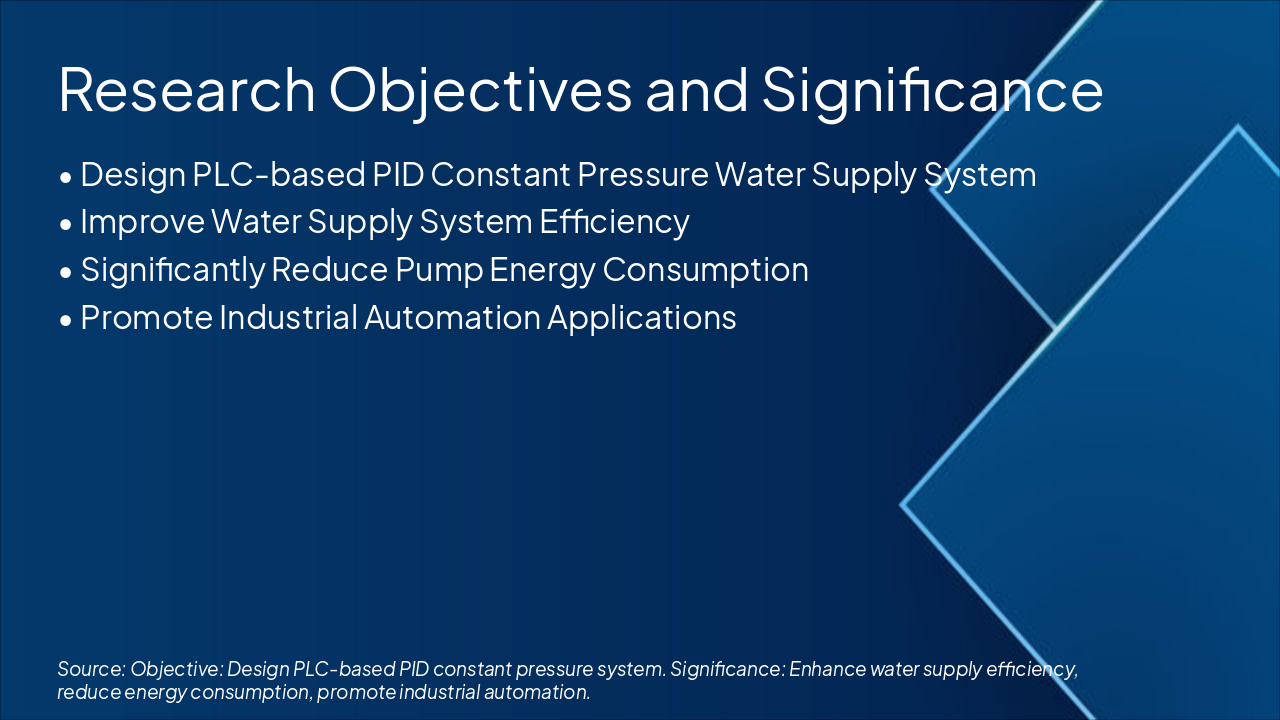
Slide 5 - Research Objectives and Significance

  • Design PLC-based PID Constant Pressure Water Supply System
  • Improve Water Supply System Efficiency
  • Significantly Reduce Pump Energy Consumption
  • Promote Industrial Automation Applications
Slide 5 - Research Objectives and Significance
Slide 6 of 20

Slide 6 - Domestic Research Status

PLC Solution Advantages Stable, reliable; strong anti-interference; modular design enables easy expansion and maintenance. Ideal for industrial constant pressure water systems; ensures long-term efficiency, low failure rate.

Microcontroller Solution Features Low cost, compact; poor scalability, weak anti-interference. Unsuitable for complex control; high programming/maintenance difficulty, insufficient industrial reliability.

Slide 6 - Domestic Research Status
Slide 7 of 20

Slide 7 - Current State of International Research

Mature VFD + PID Integration International research integrates VFDs with PID controllers into standardized solutions. Enables precise motor speed control and closed-loop pressure regulation, widely used in industrial automation for enhanced stability and response.

Europe/US Water System Applications VFD-PID constant pressure solutions in Europe/US water systems achieve 30%+ energy savings. Reduces consumption, boosts reliability, minimizes wear—proving high maturity.

Slide 7 - Current State of International Research
Slide 8 of 20

Slide 8 - Overall System Solution

  • CTH200 series PLC, inverter, water pump form system
  • Sensors provide real-time pressure feedback
  • PLC executes PID algorithm calculations
  • Inverter regulates pump speed for constant pressure
Slide 8 - Overall System Solution
Slide 9 of 20

Slide 9 - System Features

Slide 9 - System Features
Slide 10 of 20

Slide 10 - Hardware System Architecture

Control, Detection & Alarm Components Control: CTH200 PLC handles PID algorithm, logic control. Detection: Pressure sensors monitor network pressure; level sensors track tank levels. Alarm: Over/low pressure, level limits ensure safe, stable operation.

Water Pump & Pipeline Schematic Features main/auxiliary pumps, tank, pipeline network. Supply flow: Tank storage → Pump boost → Pipeline delivery → End user; variable frequency constant pressure closed-loop control.

Slide 10 - Hardware System Architecture
Slide 11 of 20

Slide 11 - Software System Architecture

Slide 11 - Software System Architecture
Slide 12 of 20

Slide 12 - PID Control Program

  • PID Principles: Proportional (P), Integral (I), Derivative (D) Control
  • P Control: Output proportional to error magnitude
  • I Control: Integrates error to eliminate steady-state offset
  • D Control: Predicts changes to suppress overshoot oscillation
  • PLC Implementation: Ladder logic for real-time output
  • Drives VFD: Regulates pump speed for constant pressure
Slide 12 - PID Control Program
Slide 13 of 20

Slide 13 - Start and Stop Procedures

Slide 13 - Start and Stop Procedures
Slide 14 of 20

Slide 14 - Liquid Level Detection and Alarm Program

  • Real-time tank level monitoring with upper/lower thresholds.
  • Upper limit: Close inlet valve and trigger alarm.
  • Lower limit: Start pump and execute alarm logic.
  • Alarm reset: Automatic when level normalizes.
Slide 14 - Liquid Level Detection and Alarm Program
Slide 15 of 20

Slide 15 - System I/O Allocation

Slide 15 - System I/O Allocation
Slide 16 of 20

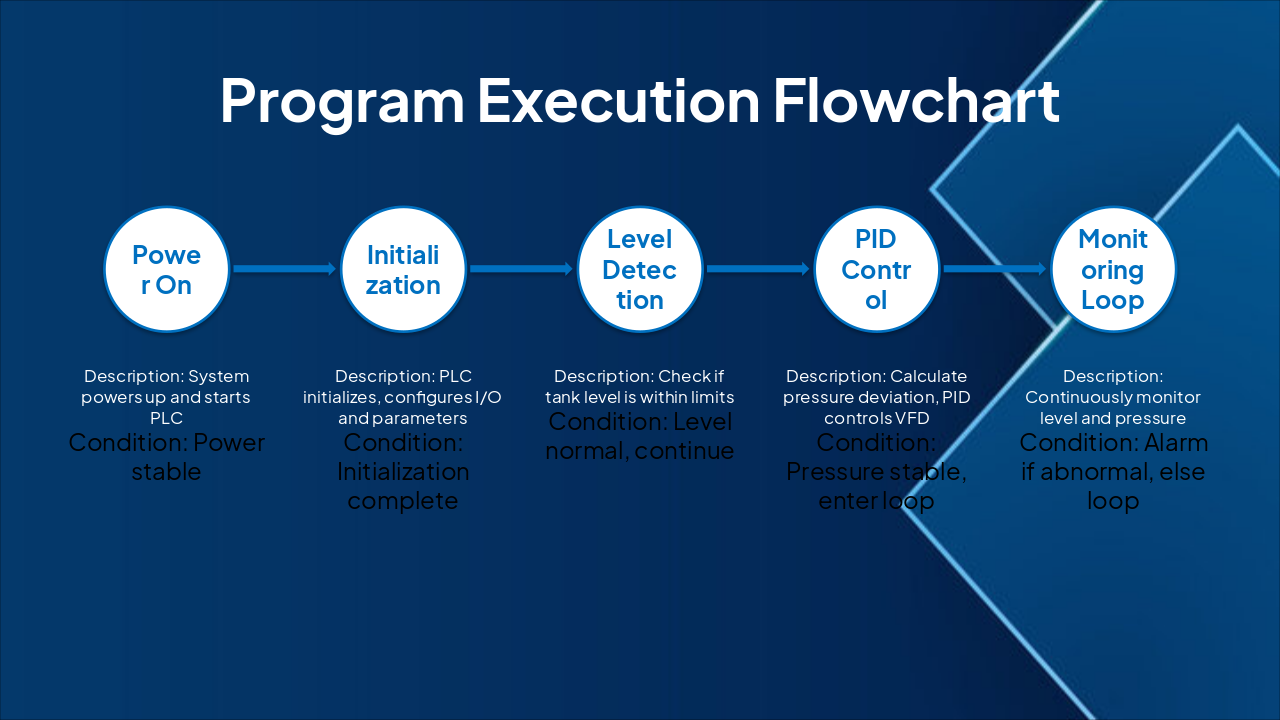
Slide 16 - Program Execution Flowchart

Slide 16 - Program Execution Flowchart
Slide 17 of 20

Slide 17 - System Hardware & Software Debugging

  • Sensor Drift → Recalibrate Sensor.
  • Communication Failure → Check Cables & Interfaces.
  • PID Oscillation → Optimize Proportional/Integral Parameters.
  • Liquid Level Alarm Failure → Verify Switch Status.
  • Water Pump Not Starting → Check Power Control Signal.
Slide 17 - System Hardware & Software Debugging
Slide 18 of 20

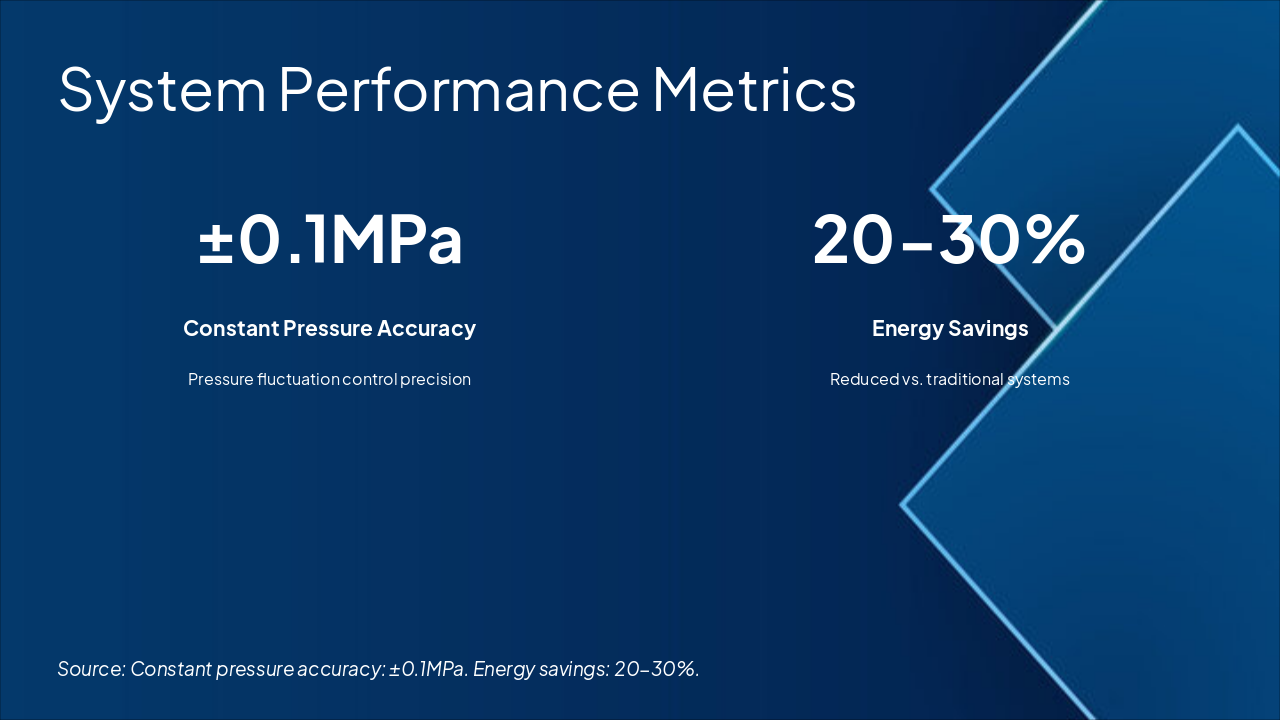
Slide 18 - System Performance Metrics

Slide 18 - System Performance Metrics
Slide 19 of 20

Slide 19 - Conclusions and Improvement Directions

**Achievements

  • Successfully built stable constant pressure water supply system
  • Precise PID control enables energy efficiency

Improvement Directions

  • Integrate wireless monitoring module
  • Introduce AI algorithms for parameter optimization

Closing Remarks: Project successfully concluded, prospects unlimited!**

Welcome Questions and In-Depth Discussion

Slide 19 - Conclusions and Improvement Directions
Slide 20 of 20

Slide 20 - Acknowledgements

> Heartfelt thanks to my advisor for guidance and advice, classmates for help and discussions, and family for support and encouragement. This achievement is due to your contributions. 🙏

— Li Ming, Undergraduate, School of Automation

Slide 20 - Acknowledgements

Discover More Presentations

Explore thousands of AI-generated presentations for inspiration

Browse Presentations
Powered by AI

Create Your Own Presentation

Generate professional presentations in seconds with Karaf's AI. Customize this presentation or start from scratch.

Create New Presentation

Powered by Karaf.ai — AI-Powered Presentation Generator