Tumour Markers: From Diagnosis to Therapy (38 chars)

Generated from prompt:

Create a PowerPoint presentation in English about Tumour Markers, based on the provided PDF content. The presentation should have 9 slides with a calm blue theme and a clean, professional design. Slide 1: Title - Tumour Markers (Definition and Importance) Slide 2: Introduction - Definition and role in cancer diagnosis and monitoring. Slide 3: Determination Types - Qualitative (histopathologic) and Quantitative (serum/fluids). Slide 4: Ideal Characteristics - High specificity, sensitivity, and organ specificity. Slide 5: Specific Tumour Markers (Part 1) - CEA, AFP, HCG. Slide 6: Specific Tumour Markers (Part 2) - CA 19-9, CA 15-3, CA 27-29. Slide 7: Additional Markers - LDH, NSE. Slide 8: Therapeutic Aspects - Strategy and treatment selection. Slide 9: Main Treatment Modalities - Chemotherapy, Radiotherapy, Surgery; conclusion emphasizing importance of tumour markers. Use soft blue tones for background and white text accents with minimal icons and clean fonts.

9-slide presentation on tumour markers: definition, importance in cancer diagnosis/monitoring, types, ideal traits, key markers (CEA, AFP, HCG, CA19-9, etc.), therapeutic roles, and treatments (chemo,

December 16, 20259 slides
Slide 1 of 9

Slide 1 - Tumour Markers (Definition and Importance)

This title slide is headed "Tumour Markers (Definition and Importance)." Its subtitle reads "Exploring definition, clinical significance in oncology."

Tumour Markers (Definition and Importance)

Exploring definition, clinical significance in oncology.

Slide 1 - Tumour Markers (Definition and Importance)
Slide 2 of 9

Slide 2 - Introduction

This introductory slide outlines biochemical indicators of malignant diseases. They aid early cancer diagnosis, monitor treatment efficacy and response, and detect recurrence at early stages.

Introduction

  • Biochemical indicators of malignant diseases
  • Aid in early cancer diagnosis
  • Monitor treatment efficacy and response
  • Detect recurrence at early stages

Source: PDF content on Tumour Markers

Speaker Notes
Introduce tumour markers as key biochemical tools in oncology for diagnosis, monitoring, and recurrence detection.
Slide 2 - Introduction
Slide 3 of 9

Slide 3 - Determination Types

The slide contrasts qualitative and quantitative determination types for tumor markers. Qualitative methods use histopathologic analysis of tissue biopsies for initial diagnosis and histology insights, while quantitative assays measure exact levels in serum via ELISA for monitoring progression and treatment response.

Determination Types

QualitativeQuantitative
Histopathologic analysis based on tissue samples. Involves microscopic examination of tumor biopsies to detect the presence or absence of specific markers. Provides insights into tumor histology and type but lacks precise quantification. Ideal for initial diagnosis and confirmation.Serum or fluid-based assays measuring exact marker levels. Uses techniques like ELISA or immunoassays for numerical results. Enables monitoring disease progression, treatment response, and early recurrence detection through serial measurements.
Slide 3 - Determination Types
Slide 4 of 9

Slide 4 - Ideal Characteristics

The slide "Ideal Characteristics" lists key qualities for effective tumor markers. These include high specificity (cancer-specific) and sensitivity (detecting most cases), organ specificity, and production solely by tumor—not normal—tissue.

Ideal Characteristics

  • High specificity (cancer-specific)
  • High sensitivity (detects most cases)
  • Organ specificity
  • Produced by tumour, not normal tissue
Slide 4 - Ideal Characteristics
Slide 5 of 9

Slide 5 - Specific Tumour Markers (Part 1)

This slide, titled "Specific Tumour Markers (Part 1)," presents a table linking tumor markers to associated cancers. It lists CEA with colorectal cancer, AFP with liver and germ cell cancers, and HCG with germ cell and trophoblastic cancers.

Specific Tumour Markers (Part 1)

{ "headers": [ "Marker", "Associated Cancers" ], "rows": [ [ "CEA", "Colorectal" ], [ "AFP", "Liver, Germ cell" ], [ "HCG", "Germ cell, Trophoblastic" ] ] }

Slide 5 - Specific Tumour Markers (Part 1)
Slide 6 of 9

Slide 6 - Specific Tumour Markers (Part 2)

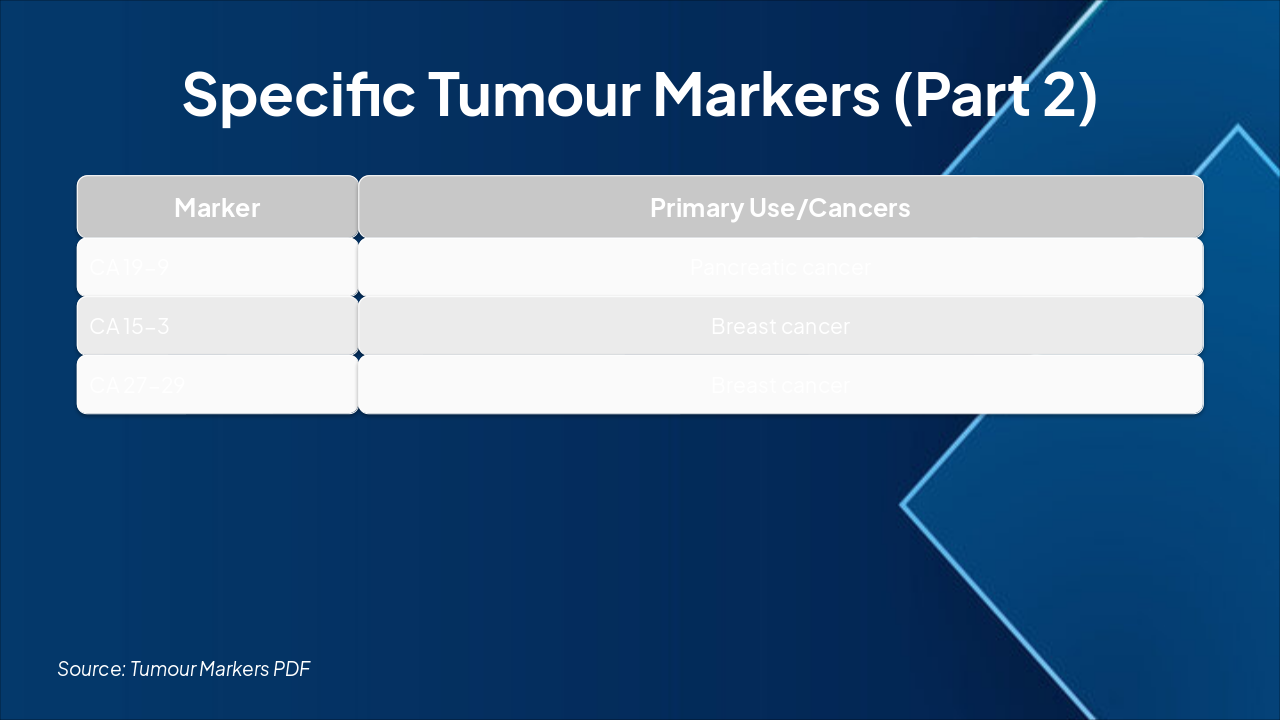
This slide, titled "Specific Tumour Markers (Part 2)," presents a table of tumour markers and their primary associated cancers. It lists CA 19-9 for pancreatic cancer, and CA 15-3 and CA 27-29 for breast cancer.

Specific Tumour Markers (Part 2)

{ "headers": [ "Marker", "Primary Use/Cancers" ], "rows": [ [ "CA 19-9", "Pancreatic cancer" ], [ "CA 15-3", "Breast cancer" ], [ "CA 27-29", "Breast cancer" ] ] }

Source: Tumour Markers PDF

Slide 6 - Specific Tumour Markers (Part 2)
Slide 7 of 9

Slide 7 - Additional Markers

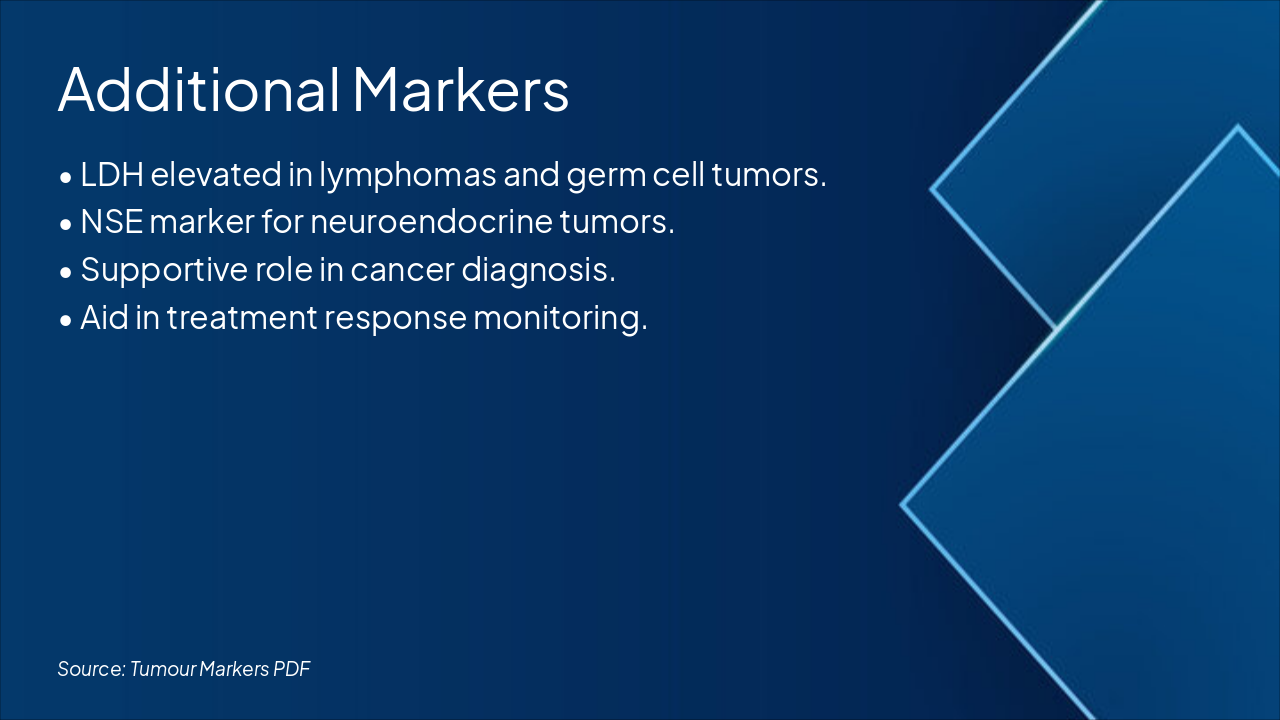
This slide on Additional Markers highlights LDH elevation in lymphomas and germ cell tumors, plus NSE as a marker for neuroendocrine tumors. These markers support cancer diagnosis and monitor treatment response.

Additional Markers

  • LDH elevated in lymphomas and germ cell tumors.
  • NSE marker for neuroendocrine tumors.
  • Supportive role in cancer diagnosis.
  • Aid in treatment response monitoring.

Source: Tumour Markers PDF

Speaker Notes
Highlight supportive diagnostic and monitoring roles of LDH and NSE.
Slide 7 - Additional Markers
Slide 8 of 9

Slide 8 - Therapeutic Aspects

The slide on Therapeutic Aspects outlines establishing baseline marker levels before treatment and monitoring changes to assess therapeutic response. It also covers selecting targeted therapies based on markers to guide personalized treatment strategies.

Therapeutic Aspects

  • Establish baseline marker levels pre-treatment
  • Monitor changes to assess therapeutic response
  • Select targeted therapies based on markers
  • Guide personalized treatment strategies
Slide 8 - Therapeutic Aspects
Slide 9 of 9

Slide 9 - Main Treatment Modalities

The slide outlines the main oncology treatment modalities: chemotherapy, radiotherapy, and surgery. It concludes that tumour markers are essential for guiding personalized care and improving outcomes.

Main Treatment Modalities

• Chemotherapy

  • Radiotherapy
  • Surgery

Tumour markers essential for personalized oncology care and outcomes.

Tumour Markers: Guiding Personalized Oncology Care

Source: Tumour Markers PDF Content

Speaker Notes
Highlight primary treatments: Chemotherapy, Radiotherapy, Surgery. Emphasize tumour markers' role in personalization. Closing: 'Tumour Markers: Guiding Personalized Oncology Care.' CTA: 'Adopt tumour marker-guided strategies for optimal outcomes.'
Slide 9 - Main Treatment Modalities

Discover More Presentations

Explore thousands of AI-generated presentations for inspiration

Browse Presentations
Powered by AI

Create Your Own Presentation

Generate professional presentations in seconds with Karaf's AI. Customize this presentation or start from scratch.

Create New Presentation

Powered by Karaf.ai — AI-Powered Presentation Generator