Egypt's Climate & Carbon Emissions

Generated from prompt:

Create a presentation about the weather in Egypt and carbon emissions, covering Egypt's climate patterns, impacts of global warming, sources of carbon emissions in Egypt, renewable energy initiatives, and strategies for reducing emissions.

Examines Egypt's arid climate, global warming impacts, emission sources, renewable energy initiatives, and strategies for reduction toward sustainability.

December 8, 202513 slides
Slide 1 of 13

Slide 1 - Egypt's Weather, Climate, and Carbon Emissions

This title slide is titled "Egypt's Weather, Climate, and Carbon Emissions." Its subtitle outlines explorations of weather patterns, global warming, emission sources, renewables, and reduction strategies.

Egypt's Weather, Climate, and Carbon Emissions

Exploring Patterns, Global Warming, Emission Sources, Renewables, and Reduction Strategies

Speaker Notes
Introduction slide for presentation on Egypt's climate and emissions.
Slide 1 - Egypt's Weather, Climate, and Carbon Emissions
Slide 2 of 13

Slide 2 - Presentation Agenda

This agenda slide outlines a presentation on Egypt's climate and carbon challenges. It covers Egypt's climate overview, global warming impacts, emission sources, renewable energy initiatives, and reduction strategies.

Presentation Agenda

  1. Egypt's Climate Overview
  2. Overview of Egypt's climate patterns and weather trends.

  3. Global Warming Impacts
  4. Effects of global warming on Egypt's environment.

  5. Carbon Emission Sources
  6. Primary sources of carbon emissions in Egypt.

  7. Renewable Energy Initiatives
  8. Key renewable energy projects and initiatives in Egypt.

  9. Reduction Strategies

Policies and strategies to cut carbon emissions. Source: Egypt Climate and Emissions Presentation

Slide 2 - Presentation Agenda
Slide 3 of 13

Slide 3 - Egypt's Climate Patterns

This slide is a section header for "Egypt's Climate Patterns" (Section 02). Its subtitle highlights Egypt's hot desert climate with mild winters, extreme summers, low rainfall, and temperature moderation by the Nile.

Egypt's Climate Patterns

02

Egypt's Climate Patterns

Hot desert climate with mild winters, extreme summers, low rainfall; Nile moderates temperatures.

Speaker Notes
Hot desert climate with mild winters, extreme summers, low rainfall; Nile Valley moderates temps.
Slide 3 - Egypt's Climate Patterns
Slide 4 of 13

Slide 4 - Key Climate Features

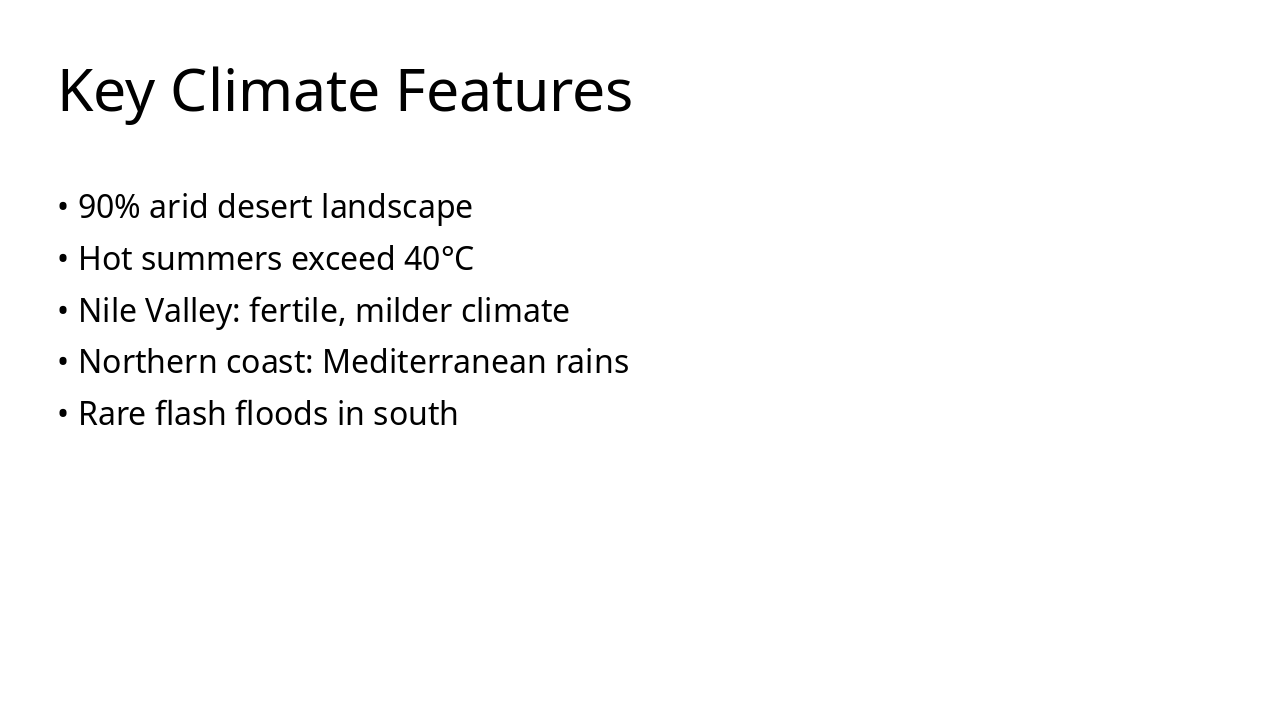
The region is dominated by a 90% arid desert landscape with hot summers exceeding 40°C. Exceptions include the fertile, milder Nile Valley, Mediterranean rains on the northern coast, and rare flash floods in the south.

Key Climate Features

  • 90% arid desert landscape
  • Hot summers exceed 40°C
  • Nile Valley: fertile, milder climate
  • Northern coast: Mediterranean rains
  • Rare flash floods in south
Slide 4 - Key Climate Features
Slide 5 of 13

Slide 5 - Egyptian Landscapes & Weather

The slide "Egyptian Landscapes & Weather" showcases vast Sahara dunes representing extreme desert aridity and the Nile River carving a fertile valley amid barren sands. It also highlights Cairo's intense summer heat haze contrasted with Alexandria's mild Mediterranean coastal influences.

Egyptian Landscapes & Weather

!Image

  • Vast Sahara dunes embody extreme desert aridity (4 words wait, Vast(1) Sahara(2) dunes(3) embody(4) extreme(5) desert(6) aridity(7).
  • Nile River carves fertile valley amid barren sands.
  • Cairo suffers intense heat haze in summers.
  • Alexandria coast provides mild Mediterranean influences.

Source: Wikipedia

Speaker Notes
Visuals of Sahara dunes, Nile River, Cairo heat haze, Alexandria coast to illustrate diverse climate.
Slide 5 - Egyptian Landscapes & Weather
Slide 6 of 13

Slide 6 - Impacts of Global Warming

This section header slide is titled "Impacts of Global Warming." Its subtitle lists key effects: rising temperatures, sea-level rise threatening the Nile Delta, water scarcity, and extreme weather.

Impacts of Global Warming

Impacts of Global Warming

Rising temperatures, sea-level rise threatening Nile Delta, water scarcity, extreme weather.

Slide 6 - Impacts of Global Warming
Slide 7 of 13

Slide 7 - Global Warming Stats in Egypt

Egypt has seen a +1.5°C temperature rise since 1900, with drought frequency doubling. Projections indicate a +20cm sea level rise by 2050 and a -10-20% Nile flow reduction by 2100.

Global Warming Stats in Egypt

  • +1.5°C: Temperature Rise
  • since 1900

  • +20cm: Sea Level Rise
  • projected by 2050

  • -10-20%: Nile Flow Reduction
  • by 2100

  • 2x: Drought Frequency
  • has doubled

Slide 7 - Global Warming Stats in Egypt
Slide 8 of 13

Slide 8 - Sources of Carbon Emissions

This section header slide is titled "Sources of Carbon Emissions." In Egypt, the energy sector (oil/gas) dominates, followed by transport, industry, and agriculture.

Sources of Carbon Emissions

Sources of Carbon Emissions

In Egypt: energy sector (oil/gas) dominant, followed by transport, industry, agriculture.

Speaker Notes
Energy sector dominant (oil/gas), followed by transport, industry, agriculture.
Slide 8 - Sources of Carbon Emissions
Slide 9 of 13

Slide 9 - Emission Sources Breakdown

Egypt's annual carbon emissions total about 250 MtCO2, with the energy sector—dominated by power plants and fossil fuel combustion—accounting for 60%. The remaining 40% comes from transport (20%), industry (15%), and other sources (5%).

Emission Sources Breakdown

Energy Sector (60%)Other Sectors (40%)
Power plants and fossil fuel combustion dominate Egypt's carbon emissions, contributing 60% of approximately 250 MtCO2 per year.Transport accounts for 20%, industry 15%, and other sources 5%, totaling Egypt's ~250 MtCO2/year emissions.
Slide 9 - Emission Sources Breakdown
Slide 10 of 13

Slide 10 - Renewable Energy Initiatives

This slide features a section header titled "Renewable Energy Initiatives." The subtitle highlights the Benban Solar Park (world's largest), Gulf of Suez wind farms, and a goal of 42% renewables by 2035.

Renewable Energy Initiatives

Benban Solar Park (world's largest), Gulf of Suez wind farms, 42% renewables by 2035.

Slide 10 - Renewable Energy Initiatives
Slide 11 of 13

Slide 11 - Renewable Milestones

The slide outlines Egypt's renewable energy milestones in a timeline from 2014 to 2035. Highlights include joining IRENA in 2014, launching the 1.8GW Benban Solar Park in 2018, expanding wind capacity in 2020, initiating green hydrogen projects in 2023, and targeting 42% renewables by 2035.

Renewable Milestones

2014: IRENA Framework Established Egypt joins IRENA, laying groundwork for renewable energy policies and cooperation. 2018: Benban Solar Park Online 1.8GW Benban solar complex operational, Africa's largest boosting clean energy. 2020: Wind Power Capacity Expanded Major wind farm projects initiated to enhance Egypt's renewable energy mix. 2023: Green Hydrogen Projects Launched Initiatives for green H2 production position Egypt as a global exporter. 2035: 42% Renewables Target National strategy aims for 42% of electricity from renewables by 2035.

Slide 11 - Renewable Milestones
Slide 12 of 13

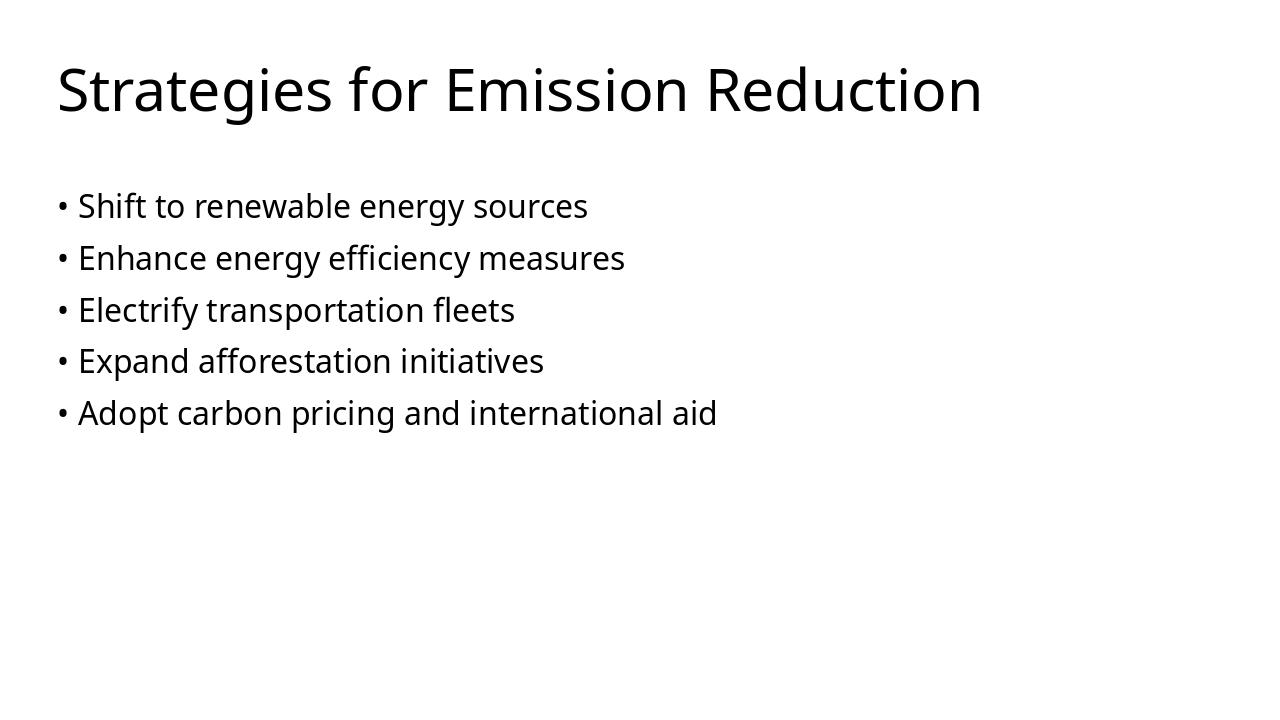
Slide 12 - Strategies for Emission Reduction

The slide "Strategies for Emission Reduction" lists key tactics like shifting to renewable energy, enhancing efficiency, and electrifying transportation fleets. It also highlights expanding afforestation and adopting carbon pricing with international aid.

Strategies for Emission Reduction

  • Shift to renewable energy sources
  • Enhance energy efficiency measures
  • Electrify transportation fleets
  • Expand afforestation initiatives
  • Adopt carbon pricing and international aid
Slide 12 - Strategies for Emission Reduction
Slide 13 of 13

Slide 13 - Path Forward

The "Path Forward" conclusion slide urges viewers to "Act Now for Sustainable Future!" with a plant emoji. Its subtitle calls to "Embrace renewables and strategies to secure Egypt's tomorrow."

Path Forward

Act Now for Sustainable Future! 🌱

Embrace renewables and strategies to secure Egypt's tomorrow.

Speaker Notes
Egypt can mitigate climate risks through renewables and strategies. Summarize key points: climate patterns, warming impacts, emission sources, renewables, and reduction strategies.
Slide 13 - Path Forward

Discover More Presentations

Explore thousands of AI-generated presentations for inspiration

Browse Presentations
Powered by AI

Create Your Own Presentation

Generate professional presentations in seconds with Karaf's AI. Customize this presentation or start from scratch.

Create New Presentation

Powered by Karaf.ai — AI-Powered Presentation Generator