DBMS Essentials from Class 12 CS

Generated from prompt:

Make a presentation about database management system , the topic from karachi board book of 12 class computer science

Explore Database Management Systems (DBMS) from Karachi Board Class 12: intro, data models, types, components, operations (DDL/DML), and key takeaways in an 8-slide overview.

February 1, 20268 slides
Slide 1 of 8

Slide 1 - Database Management System (DBMS)

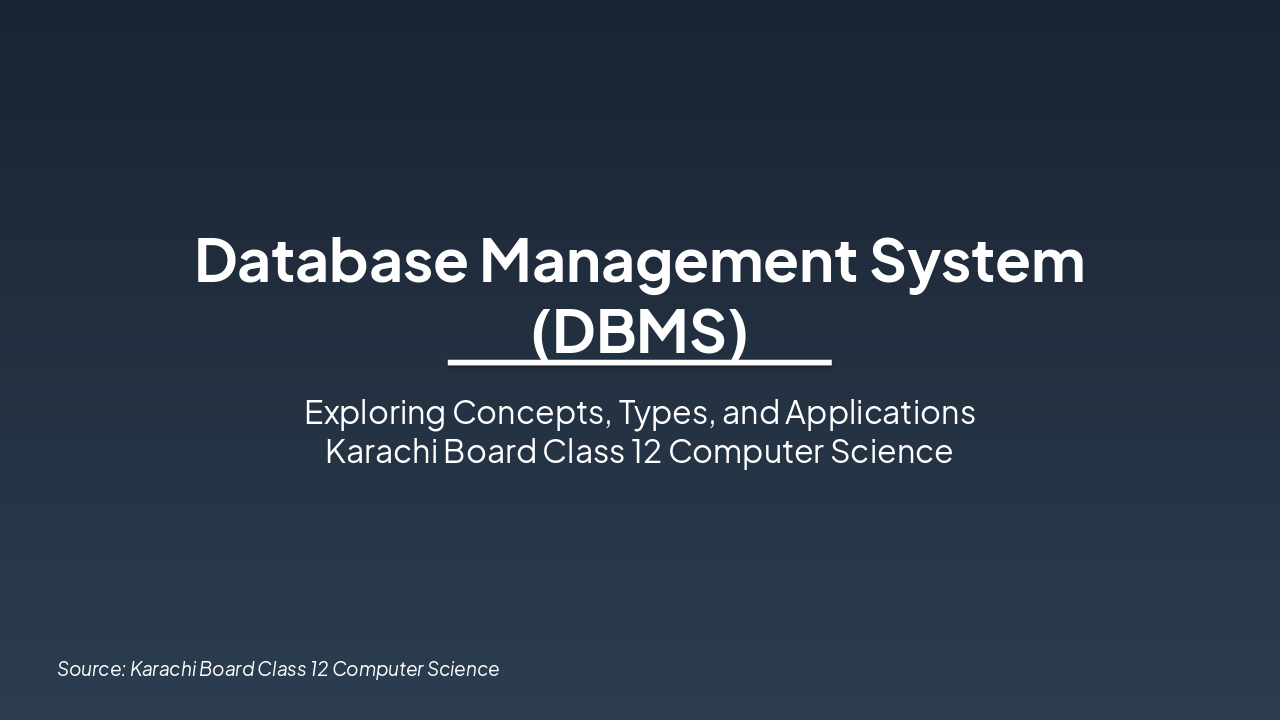
This title slide introduces "Database Management System (DBMS)" as the main topic. It features a subtitle on exploring concepts, types, and applications for Karachi Board Class 12 Computer Science.

Database Management System

(DBMS)

Exploring Concepts, Types, and Applications Karachi Board Class 12 Computer Science

Source: Karachi Board Class 12 Computer Science

Speaker Notes
Introduction to DBMS concepts, types, and applications from the syllabus.
Slide 1 - Database Management System (DBMS)
Slide 2 of 8

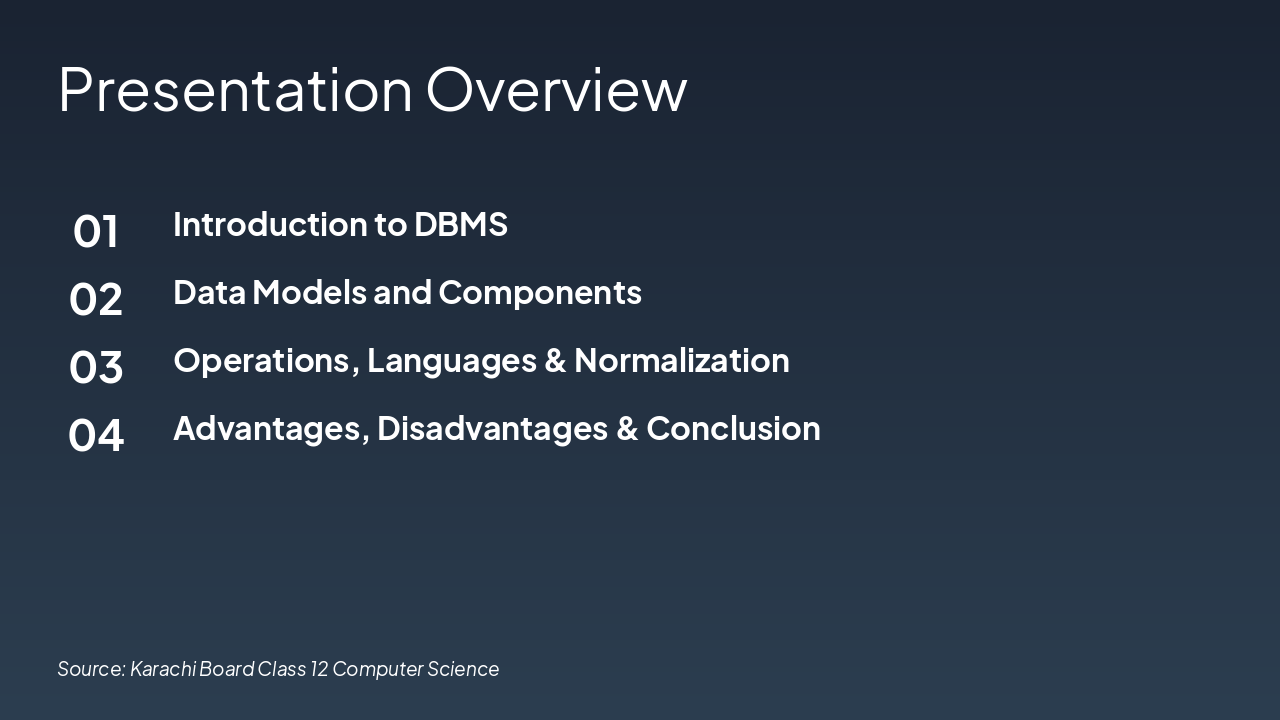
Slide 2 - Presentation Overview

This agenda slide, titled "Presentation Overview," outlines the key topics of the presentation. The items include: Introduction to DBMS, Data Models and Components, Operations, Languages & Normalization, and Advantages, Disadvantages & Conclusion.

Presentation Overview

  1. Introduction to DBMS
  2. Data Models and Components
  3. Operations, Languages & Normalization
  4. Advantages, Disadvantages & Conclusion

Source: Karachi Board Class 12 Computer Science

Speaker Notes
Agenda outlining the key sections of the DBMS presentation.
Slide 2 - Presentation Overview
Slide 3 of 8

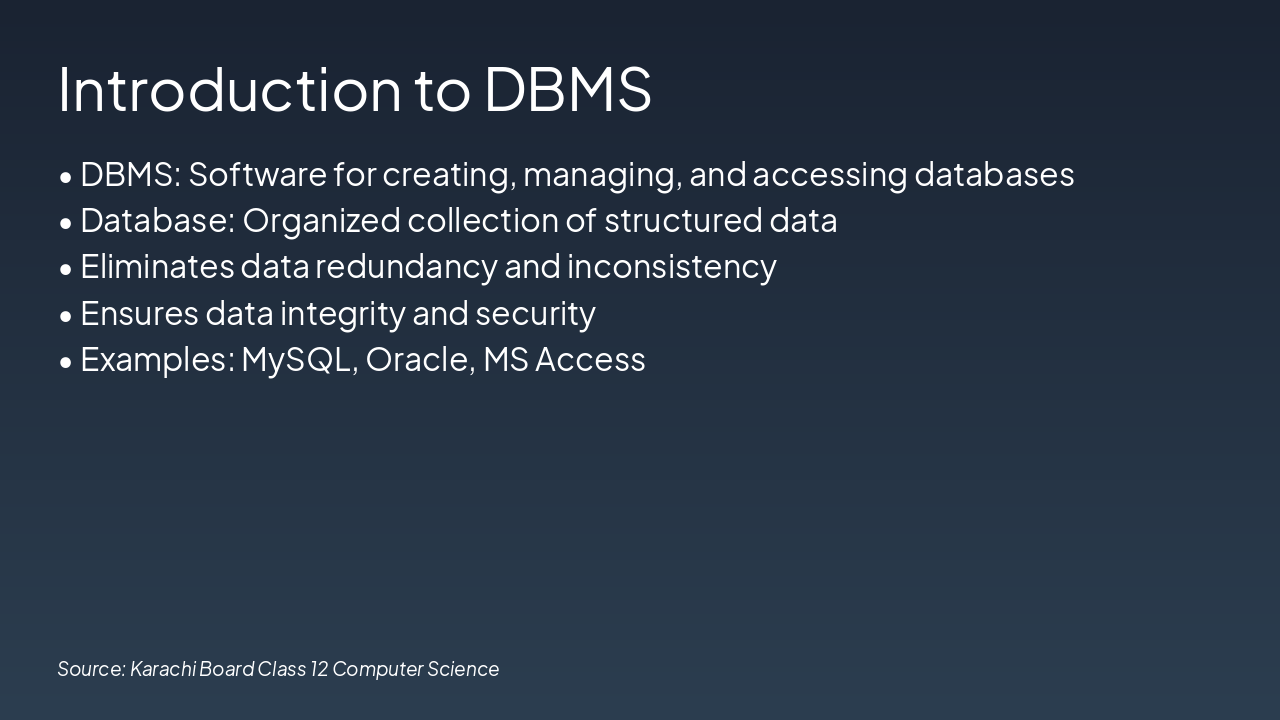
Slide 3 - Introduction to DBMS

A DBMS is software for creating, managing, and accessing databases, which are organized collections of structured data. It eliminates data redundancy and inconsistency, ensures data integrity and security, with examples like MySQL, Oracle, and MS Access.

Introduction to DBMS

  • DBMS: Software for creating, managing, and accessing databases
  • Database: Organized collection of structured data
  • Eliminates data redundancy and inconsistency
  • Ensures data integrity and security
  • Examples: MySQL, Oracle, MS Access

Source: Karachi Board Class 12 Computer Science

Slide 3 - Introduction to DBMS
Slide 4 of 8

Slide 4 - Data Models in DBMS

This section header slide introduces "Data Models in DBMS" as section 03. It features the subtitle "Exploring Hierarchical, Network, Relational, and Object-Oriented Models."

Data Models in DBMS

03

Data Models in DBMS

Exploring Hierarchical, Network, Relational, and Object-Oriented Models

Source: Karachi Board Class 12 Computer Science

Speaker Notes
Introduce key data models: Hierarchical, Network, Relational, Object-Oriented from the textbook.
Slide 4 - Data Models in DBMS
Slide 5 of 8

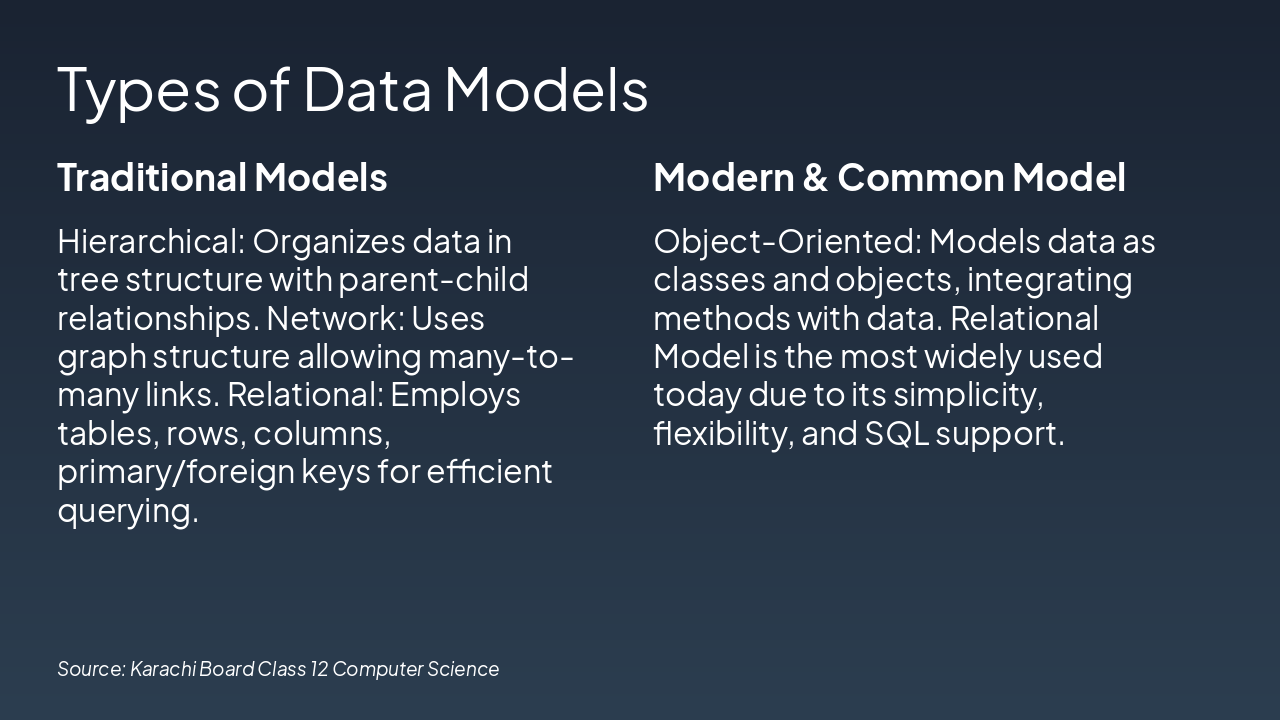
Slide 5 - Types of Data Models

Traditional data models include Hierarchical (tree structure with parent-child relationships), Network (graph with many-to-many links), and Relational (tables with keys for querying). Modern models feature Object-Oriented (classes and objects with methods), but Relational remains the most widely used due to its simplicity, flexibility, and SQL support.

Types of Data Models

Traditional ModelsModern & Common Model
Hierarchical: Organizes data in tree structure with parent-child relationships. Network: Uses graph structure allowing many-to-many links. Relational: Employs tables, rows, columns, primary/foreign keys for efficient querying.Object-Oriented: Models data as classes and objects, integrating methods with data. Relational Model is the most widely used today due to its simplicity, flexibility, and SQL support.

Source: Karachi Board Class 12 Computer Science

Speaker Notes
Explain each model briefly: Hierarchical for tree-like data, Network for complex relationships, Relational dominant today with tables and keys, Object-Oriented for modern apps with classes/objects.
Slide 5 - Types of Data Models
Slide 6 of 8

Slide 6 - DBMS Components

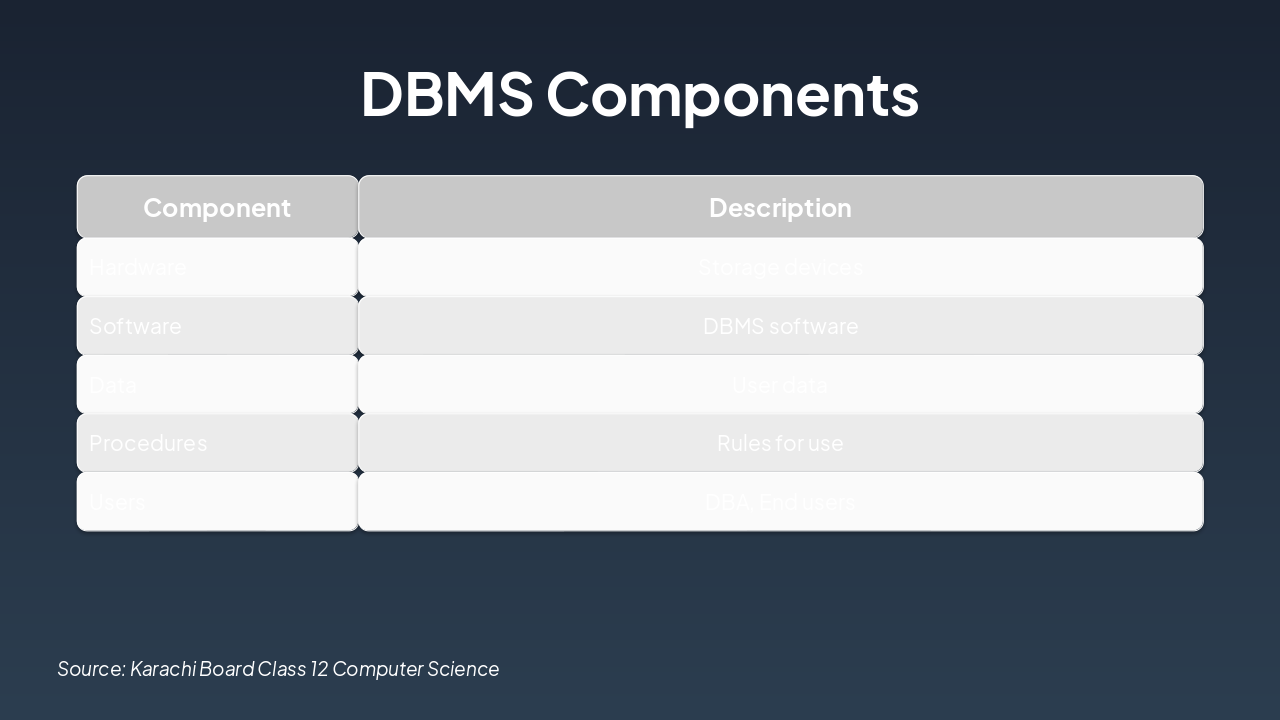
The slide titled "DBMS Components" presents a table outlining key elements of a Database Management System. It lists Hardware (storage devices), Software (DBMS software), Data (user data), Procedures (rules for use), and Users (DBA and end users) with their descriptions.

DBMS Components

ComponentDescription
HardwareStorage devices
SoftwareDBMS software
DataUser data
ProceduresRules for use
UsersDBA, End users

Source: Karachi Board Class 12 Computer Science

Slide 6 - DBMS Components
Slide 7 of 8

Slide 7 - DBMS Operations & Languages

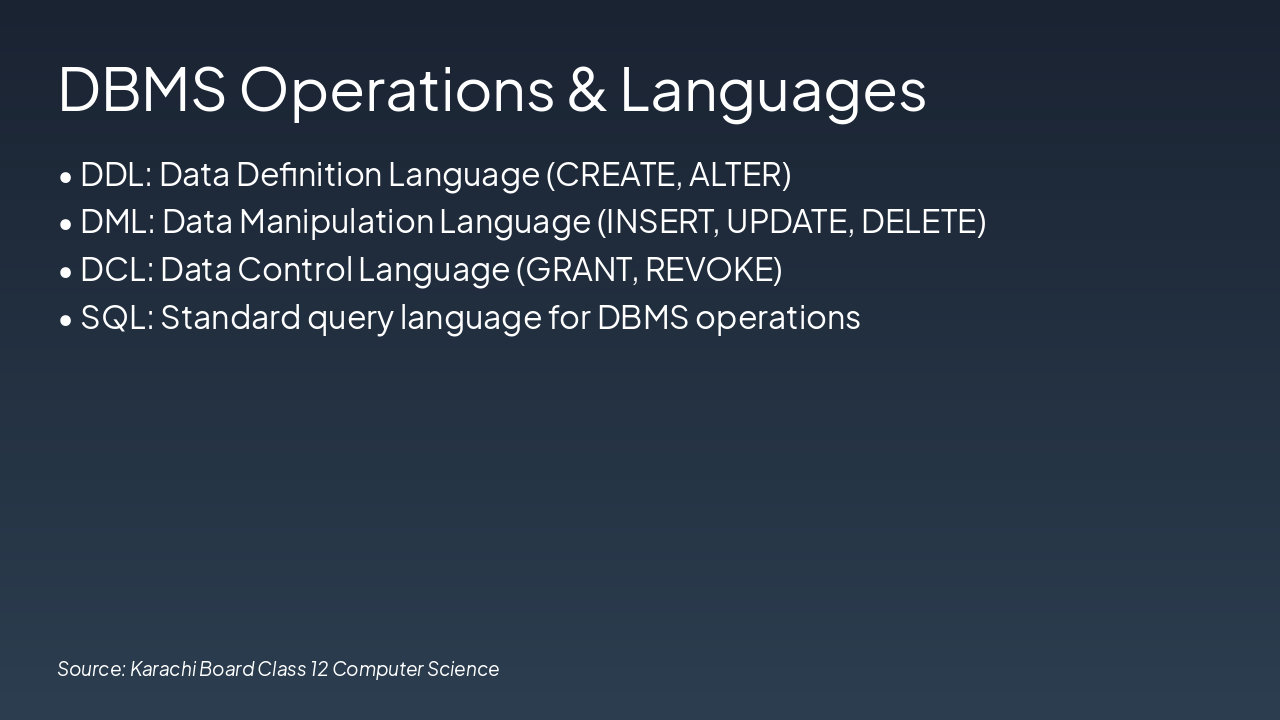
DBMS operations rely on key languages like DDL for defining data structures (CREATE, ALTER), DML for manipulating data (INSERT, UPDATE, DELETE), and DCL for controlling access (GRANT, REVOKE). SQL serves as the standard query language for all these DBMS operations.

DBMS Operations & Languages

  • DDL: Data Definition Language (CREATE, ALTER)
  • DML: Data Manipulation Language (INSERT, UPDATE, DELETE)
  • DCL: Data Control Language (GRANT, REVOKE)
  • SQL: Standard query language for DBMS operations

Source: Karachi Board Class 12 Computer Science

Slide 7 - DBMS Operations & Languages
Slide 8 of 8

Slide 8 - Key Takeaways

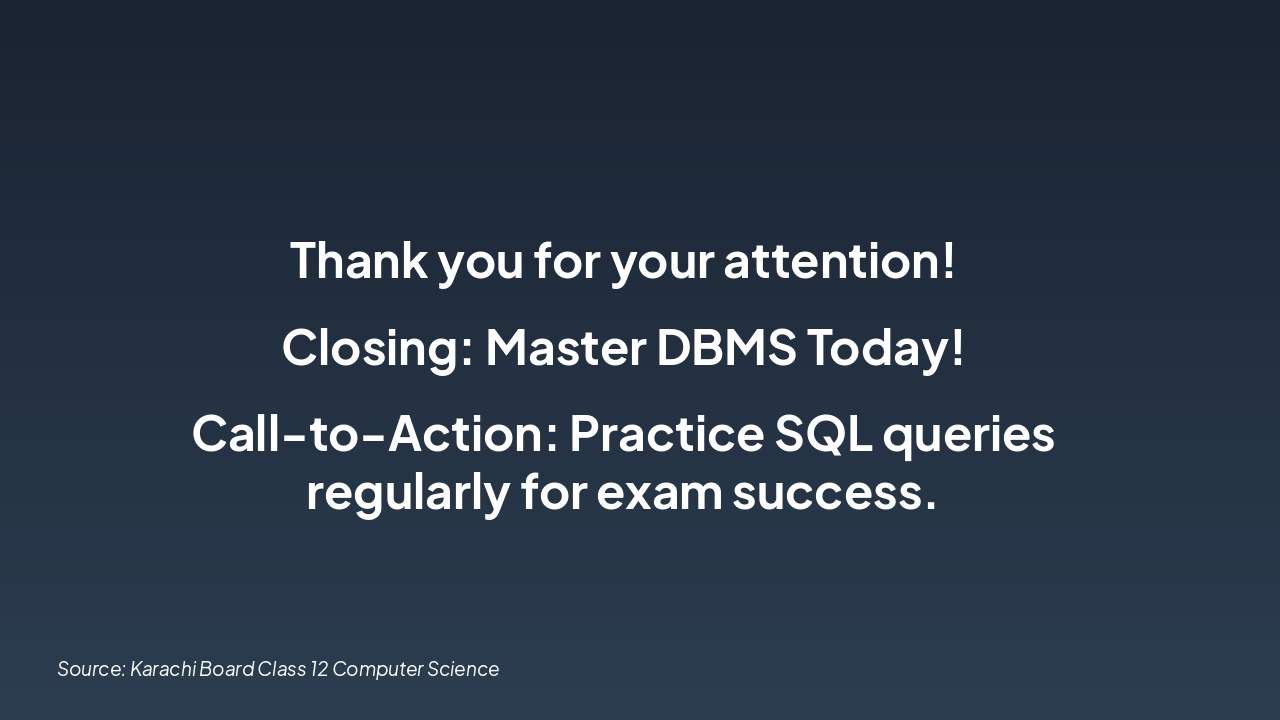
The slide thanks the audience for their attention and closes with the message "Master DBMS Today!" It includes a call-to-action to practice SQL queries regularly for exam success.

Key Takeaways

**Thank you for your attention!

Closing: Master DBMS Today!

Call-to-Action: Practice SQL queries regularly for exam success.**

Source: Karachi Board Class 12 Computer Science

Speaker Notes
Summarize main points: DBMS efficiency, Relational Model, Normalization, advantages, SQL practice. End with thanks.
Slide 8 - Key Takeaways

Discover More Presentations

Explore thousands of AI-generated presentations for inspiration

Browse Presentations
Powered by AI

Create Your Own Presentation

Generate professional presentations in seconds with Karaf's AI. Customize this presentation or start from scratch.

Create New Presentation

Powered by Karaf.ai — AI-Powered Presentation Generator