Turtles: Anatomy, Habitats & Conservation

Generated from prompt:

Create a Google Slides-style presentation about turtles, including their anatomy, habitat, diet, species diversity, threats, and conservation efforts.

Explore turtle anatomy, diverse habitats, diets, species, threats, and conservation efforts. Learn how to join in protecting these remarkable reptiles from extinction. (138 characters)

January 19, 20268 slides
Slide 1 of 8

Slide 1 - Turtles: Anatomy, Habitats, Conservation

This title slide introduces the topic "Turtles: Anatomy, Habitats, and Conservation." The subtitle highlights discovering their biology, diversity, threats, and conservation efforts.

Turtles: Anatomy, Habitats, and Conservation

Discovering biology, diversity, threats, and conservation efforts

Speaker Notes
Introduction to the presentation on turtles covering anatomy, habitats, diet, species diversity, threats, and conservation.
Slide 1 - Turtles: Anatomy, Habitats, Conservation
Slide 2 of 8

Slide 2 - Presentation Agenda

This agenda slide outlines the key topics of a presentation, including Anatomy, Habitats, Diet, Species Diversity, Threats, and Conservation. It concludes with a summary section.

Presentation Agenda

  1. Anatomy
  2. Habitats
  3. Diet
  4. Species Diversity
  5. Threats
  6. Conservation
  7. Conclusion

Source: Turtle Presentation

Speaker Notes
Overview of the presentation structure on turtles.
Slide 2 - Presentation Agenda
Slide 3 of 8

Slide 3 - Turtle Anatomy

This section header slide, titled "Turtle Anatomy" as section 02, introduces the topic. Its subtitle highlights exploring the unique structure and key features of turtles.

Turtle Anatomy

02

Turtle Anatomy

Exploring the unique structure and key features of turtles

Speaker Notes
Key features: hard shell (carapace & plastron), retractable head/limbs, powerful jaws, slow metabolism.
Slide 3 - Turtle Anatomy
Slide 4 of 8

Slide 4 - Turtle Habitats

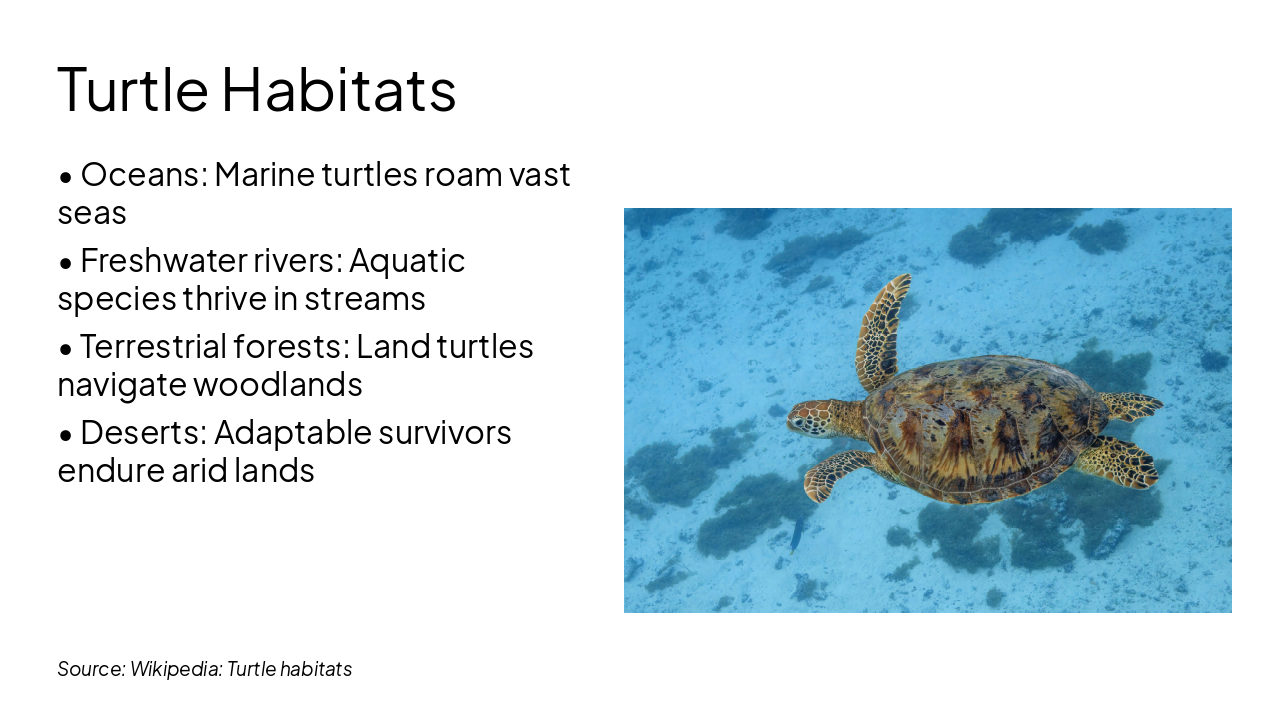
Turtle habitats are diverse, spanning oceans where marine turtles roam vast seas, freshwater rivers where aquatic species thrive in streams, terrestrial forests navigated by land turtles, and deserts endured by adaptable survivors. This slide highlights these varied environments through key points and an accompanying image.

Turtle Habitats

!Image

  • Oceans: Marine turtles roam vast seas
  • Freshwater rivers: Aquatic species thrive in streams
  • Terrestrial forests: Land turtles navigate woodlands
  • Deserts: Adaptable survivors endure arid lands

Source: Wikipedia: Turtle habitats

Slide 4 - Turtle Habitats
Slide 5 of 8

Slide 5 - Diet and Feeding

Omnivores consume a varied diet including algae, jellyfish, plants, and insects, while herbivores primarily eat seagrass. Carnivores hunt fish and crabs, and filter feeders consume plankton.

Diet and Feeding

  • Omnivores eat algae, jellyfish, plants, insects
  • Herbivores consume seagrass
  • Carnivores hunt fish and crabs
  • Filter feeders consume plankton
Slide 5 - Diet and Feeding
Slide 6 of 8

Slide 6 - Species Diversity

There are over 350 turtle species across 7 families, with 50% of them facing extinction risk. The oldest turtle fossils discovered date back 220 million years.

Species Diversity

  • 350+: Turtle Species
  • Across 7 families

  • 50%: Endangered Species
  • Half face extinction risk

  • 220M: Oldest Fossils
  • Years ago discovered

Speaker Notes
Over 350 turtle species across 7 families: sea, freshwater, and tortoises. 50% are endangered, with fossils dating back 220 million years.
Slide 6 - Species Diversity
Slide 7 of 8

Slide 7 - Threats and Conservation

Turtles face severe threats such as habitat loss from development and agriculture, illegal poaching for meat and shells, pollution affecting reproduction, and climate change disrupting nesting beaches and sex ratios. Conservation efforts include protected areas and marine sanctuaries, captive breeding programs, international CITES bans on turtle trade, and community education initiatives.

Threats and Conservation

ThreatsConservation Efforts
Turtles face severe threats including habitat loss from development and agriculture, illegal poaching for meat and shells, water and soil pollution harming reproduction, and climate change disrupting nesting beaches and sex ratios.Protection through established protected areas and marine sanctuaries, captive breeding programs for endangered species, international bans on turtle trade via CITES, and community education initiatives.
Speaker Notes
Highlight key threats to turtles and ongoing conservation efforts to protect them.
Slide 7 - Threats and Conservation
Slide 8 of 8

Slide 8 - Protect Our Turtles

The slide titled "Protect Our Turtles" urges viewers to "Save Turtles Today!" by joining conservation efforts to protect ecosystems and act now, with a turtle and globe emoji. It ends with a "Thank you!" subtitle.

Protect Our Turtles

Save Turtles Today! Join conservation efforts to protect our ecosystems. Act now! šŸ¢šŸŒ

Thank you!

Speaker Notes
Summarize key points and inspire action for turtle conservation.
Slide 8 - Protect Our Turtles

Discover More Presentations

Explore thousands of AI-generated presentations for inspiration

Browse Presentations
Powered by AI

Create Your Own Presentation

Generate professional presentations in seconds with Karaf's AI. Customize this presentation or start from scratch.

Create New Presentation

Powered by Karaf.ai — AI-Powered Presentation Generator