Intelligent ML Bug Triage for Agile Teams

Generated from prompt:

Create a 15–18 slide modern AI/ML-themed presentation for a research proposal DRC titled 'Intelligent Bug Triage using Machine Learning for Agile Teams'. Include these sections: 1. Title Slide – project title, student name, supervisor, department, university 2. Introduction – background of agile issue tracking and triage challenges 3. Problem Statement – manual triage limitations (time, scalability, inconsistency) 4. Research Questions – RQ1 (Accuracy), RQ2 (Feature Importance), RQ3 (Explainability) 5. Research Objectives – target accuracy, model comparisons, explainability goals, prototype 6. Research Significance – practical benefits, automation impact 7. Literature Review Overview – evolution from classic ML to transformers 8. Literature Review (Table Summary) – major authors, methods, datasets, gaps 9. Identified Research Gaps – data size, model limitations, explainability, integration 10. Proposed Methodology – stepwise plan (dataset, preprocessing, modeling, evaluation) 11. Dataset Details – sources, attributes, split 12. Model Development – classical ML vs DistilBERT, explainability (SHAP) 13. Evaluation Metrics – Top-K accuracy, precision, recall, etc. 14. Expected Results – comparative accuracy table (Classical ML vs DistilBERT) 15. System Prototype – Jira/GitHub integration overview 16. Timeline – 6-month research plan 17. Expected Contributions – academic & industrial relevance 18. References / Acknowledgement slide. Style: Modern tech theme with clean visuals, subtle AI icons, blue-cyber color palette, clear readable text, professional layout.

18-slide research proposal on ML-driven bug triage for agile teams. Covers challenges, RQs/objectives, lit review gaps, DistilBERT+SHAP methodology, Jira prototype, >85% accuracy goals, timeline, and

December 16, 202518 slides
Slide 1 of 18

Slide 1 - Intelligent Bug Triage using Machine Learning for Agile Teams

This title slide features the project title "Intelligent Bug Triage using Machine Learning for Agile Teams." The subtitle lists the student name, supervisor name, department, and university.

Intelligent Bug Triage using Machine Learning for Agile Teams

[Student Name], [Supervisor Name], [Department], [University]

Source: Title slide for DRC research proposal presentation

Slide 1 - Intelligent Bug Triage using Machine Learning for Agile Teams
Slide 2 of 18

Slide 2 - Introduction

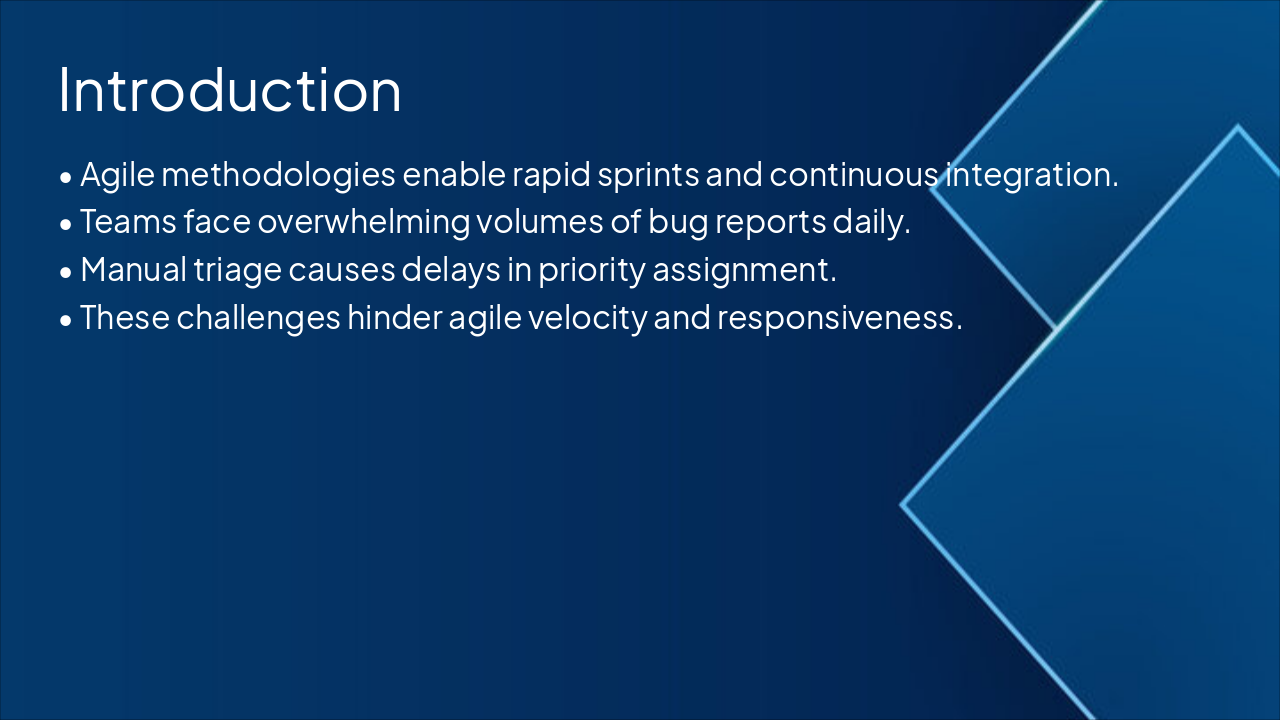
Agile methodologies enable rapid sprints and continuous integration, but teams face overwhelming daily volumes of bug reports. Manual triage delays priority assignment, hindering overall agile velocity and responsiveness.

Introduction

  • Agile methodologies enable rapid sprints and continuous integration.
  • Teams face overwhelming volumes of bug reports daily.
  • Manual triage causes delays in priority assignment.
  • These challenges hinder agile velocity and responsiveness.
Slide 2 - Introduction
Slide 3 of 18

Slide 3 - Problem Statement

The current manual triage process is time-consuming, poorly scalable for growing teams, and results in inconsistent prioritization. This leads to delays in issue resolution and overwhelms agile development workflows.

Problem Statement

  • Time-consuming manual triage process
  • Poor scalability with growing teams
  • Inconsistent prioritization decisions
  • Leads to delays in issue resolution
  • Overwhelms agile development workflows
Slide 3 - Problem Statement
Slide 4 of 18

Slide 4 - Research Questions

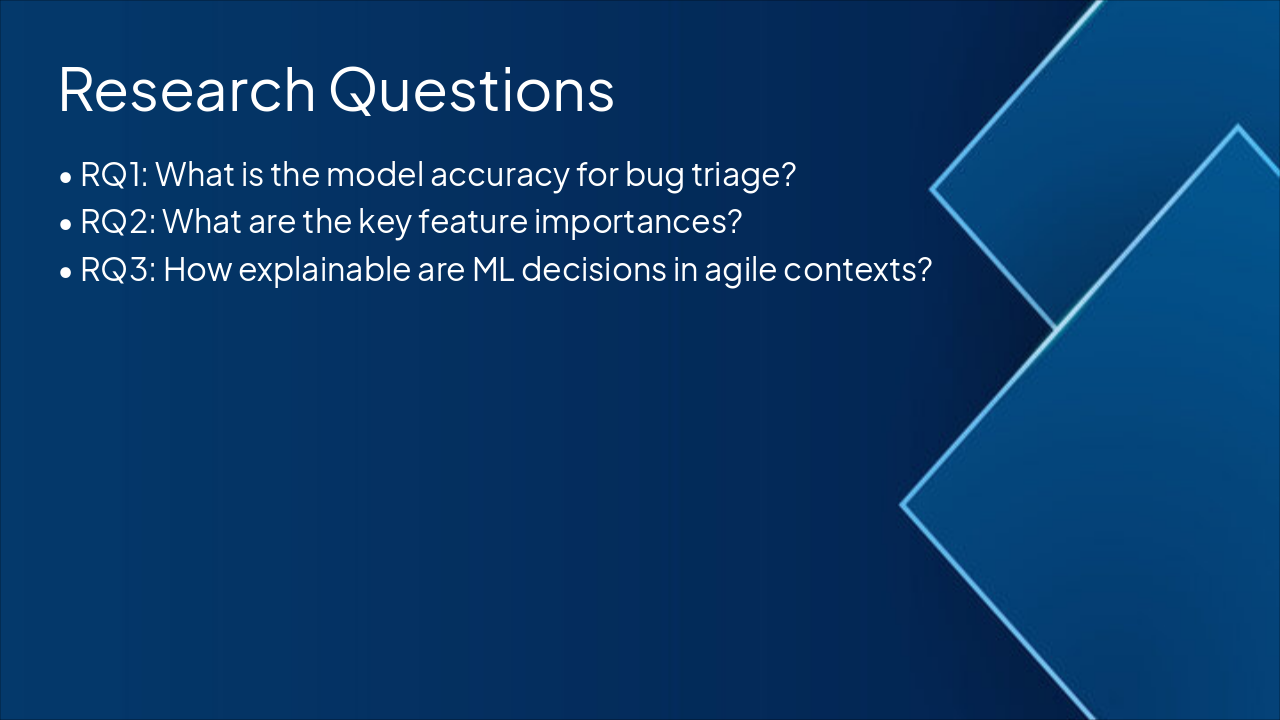
The slide titled "Research Questions" lists three key inquiries in bullet form. They cover model accuracy for bug triage (RQ1), key feature importances (RQ2), and explainability of ML decisions in agile contexts (RQ3).

Research Questions

  • RQ1: What is the model accuracy for bug triage?
  • RQ2: What are the key feature importances?
  • RQ3: How explainable are ML decisions in agile contexts?
Slide 4 - Research Questions
Slide 5 of 18

Slide 5 - Research Objectives

This slide outlines research objectives to achieve over 85% accuracy in automated bug triage and compare classical ML models against DistilBERT performance. It also targets providing SHAP explainability for predictions and developing a Jira/GitHub integration prototype.

Research Objectives

  • Achieve >85% accuracy in automated bug triage
  • Compare classical ML models vs. DistilBERT performance
  • Provide SHAP explainability for model predictions
  • Develop Jira/GitHub integration prototype
Slide 5 - Research Objectives
Slide 6 of 18

Slide 6 - Research Significance

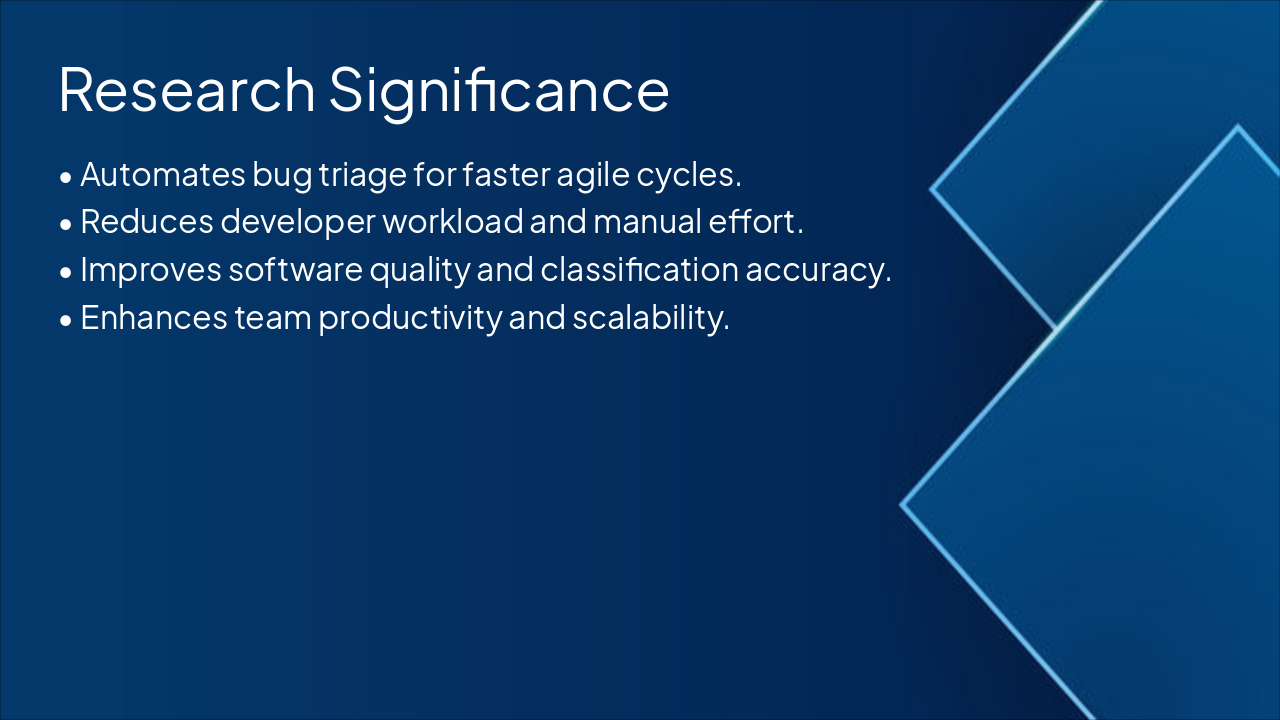
This research automates bug triage to speed up agile cycles and cut developer workload. It boosts software quality, classification accuracy, team productivity, and scalability.

Research Significance

  • Automates bug triage for faster agile cycles.
  • Reduces developer workload and manual effort.
  • Improves software quality and classification accuracy.
  • Enhances team productivity and scalability.
Slide 6 - Research Significance
Slide 7 of 18

Slide 7 - Literature Review Overview

This slide serves as the section header for Section 07: Literature Review Overview. It highlights the progression from classic ML methods (SVM, RF) to deep learning and transformers for bug report classification.

Literature Review Overview

07

Literature Review Overview

From Classic ML (SVM, RF) to Deep Learning and Transformers for Bug Report Classification

Speaker Notes
Evolution: Classic ML (SVM, RF) to deep learning and transformers for text classification in bug reports.
Slide 7 - Literature Review Overview
Slide 8 of 18

Slide 8 - Literature Review Summary

The "Literature Review Summary" slide presents a table reviewing four studies on bug classification, listing authors, methods (TF-IDF+SVM, Random Forest, BERT, Naive Bayes), datasets (Eclipse, Mozilla, Jira), and gaps (scalability, explainability, integration, data size). It highlights limitations in prior work to contextualize the current research.

Literature Review Summary

{ "headers": [ "Authors", "Methods", "Datasets", "Gaps" ], "rows": [ [ "Zhou et al.", "TF-IDF + SVM", "Eclipse", "Scalability" ], [ "Youm et al.", "Random Forest", "Mozilla", "Explainability" ], [ "Zhang et al.", "BERT", "Jira", "Integration" ], [ "Lamkanfi et al.", "Naive Bayes", "Eclipse", "Data size" ] ] }

Speaker Notes
Summarizes major works on bug triage: authors, methods, datasets used, and key gaps identified.
Slide 8 - Literature Review Summary
Slide 9 of 18

Slide 9 - Identified Research Gaps

The "Identified Research Gaps" slide outlines key challenges in bug triage research. It highlights limited large-scale datasets, poor model generalization across projects, lack of explainable AI, and inadequate integration with tools like Jira.

Identified Research Gaps

  • Limited availability of large-scale bug triage datasets
  • Model generalization issues across diverse projects
  • Lack of explainable AI for triage decisions
  • Poor integration with agile tools like Jira
Speaker Notes
Highlight key gaps: data scarcity, generalization, explainability, and integration challenges driving this research.
Slide 9 - Identified Research Gaps
Slide 10 of 18

Slide 10 - Proposed Methodology

The slide outlines a four-phase methodology workflow for bug report analysis: Dataset Collection from sources like Eclipse and GitHub, Preprocessing with NLTK and spaCy, Modeling using Scikit-learn and DistilBERT, and Evaluation with metrics like Top-K accuracy and SHAP. Each phase details key activities and corresponding tools for implementation.

Proposed Methodology

{ "headers": [ "Phase", "Key Activities", "Methods/Tools" ], "rows": [ [ "1. Dataset Collection", "Gather bug reports from public sources", "Eclipse, Mozilla, Jira/GitHub datasets" ], [ "2. Preprocessing", "Tokenization, cleaning, feature engineering", "NLTK, spaCy, tokenizers" ], [ "3. Modeling", "Train Classical ML and DistilBERT models", "Scikit-learn, Hugging Face Transformers" ], [ "4. Evaluation & Explainability", "Performance metrics and model interpretation", "Top-K accuracy, Precision/Recall, SHAP" ] ] }

Source: DRC Research Proposal: Intelligent Bug Triage using Machine Learning for Agile Teams

Speaker Notes
Stepwise: 1. Dataset collection, 2. Preprocessing (tokenization), 3. Modeling (ML vs BERT), 4. Evaluation & SHAP.
Slide 10 - Proposed Methodology
Slide 11 of 18

Slide 11 - Dataset Details

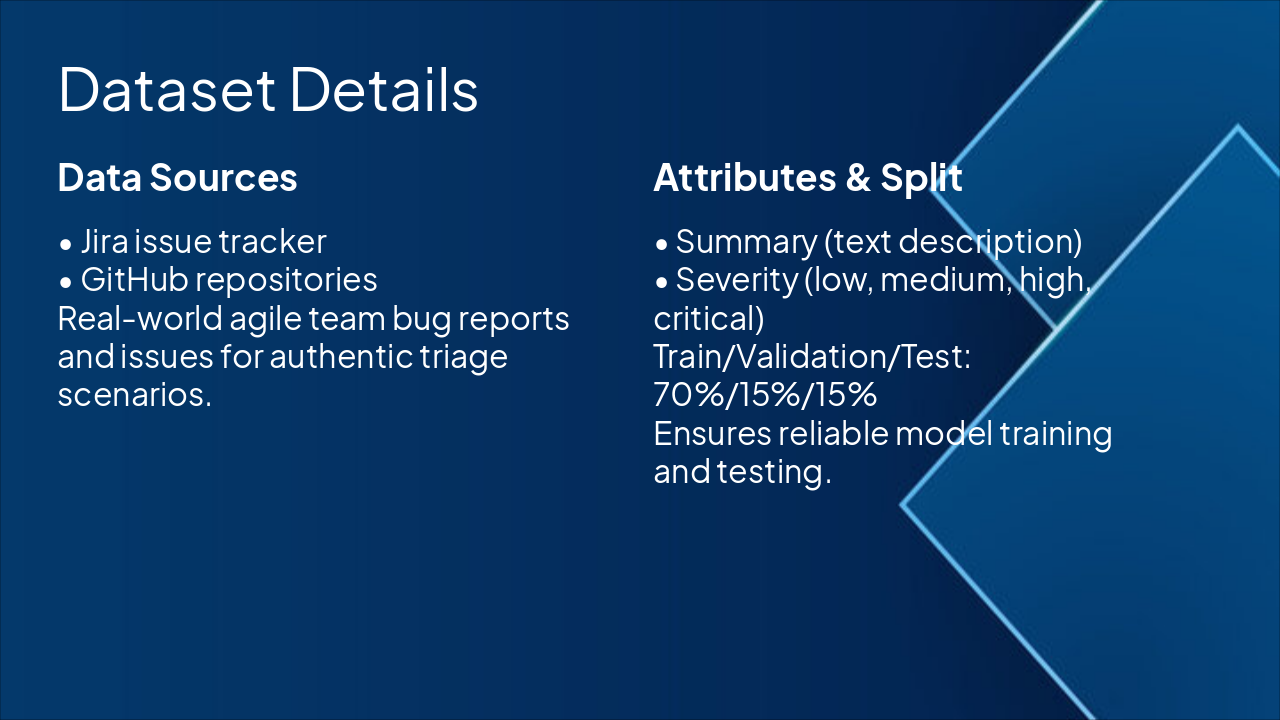
The slide details a dataset sourced from Jira issue trackers and GitHub repositories, featuring real-world agile team bug reports for authentic triage scenarios. It includes attributes like summary text and severity levels (low, medium, high, critical), split as 70%/15%/15% for train/validation/test to ensure reliable model training.

Dataset Details

Data SourcesAttributes & Split

| • Jira issue tracker

  • GitHub repositories

Real-world agile team bug reports and issues for authentic triage scenarios. | • Summary (text description)

  • Severity (low, medium, high, critical)

Train/Validation/Test: 70%/15%/15% Ensures reliable model training and testing. |

Speaker Notes
Highlight real-world relevance of Jira and GitHub data. Emphasize balanced split for robust evaluation.
Slide 11 - Dataset Details
Slide 12 of 18

Slide 12 - Model Development

The slide on Model Development contrasts classical ML models like Random Forest and SVM, which use engineered features from bug descriptions for interpretable classification but struggle with complex text semantics. It also highlights DistilBERT—a fine-tuned lightweight transformer for advanced NLP that captures contextual embeddings—paired with SHAP for explainable triage via feature contribution visualizations.

Model Development

Classical ML (RF, SVM)DistilBERT + SHAP
Traditional models: Random Forest and Support Vector Machines. Uses engineered features from bug descriptions, metadata for classification. Simple, interpretable, but limited on complex text semantics.Fine-tuned lightweight transformer for advanced NLP. Captures contextual embeddings from issues. SHAP ensures explainability by visualizing feature contributions to triage decisions.
Slide 12 - Model Development
Slide 13 of 18

Slide 13 - Evaluation Metrics

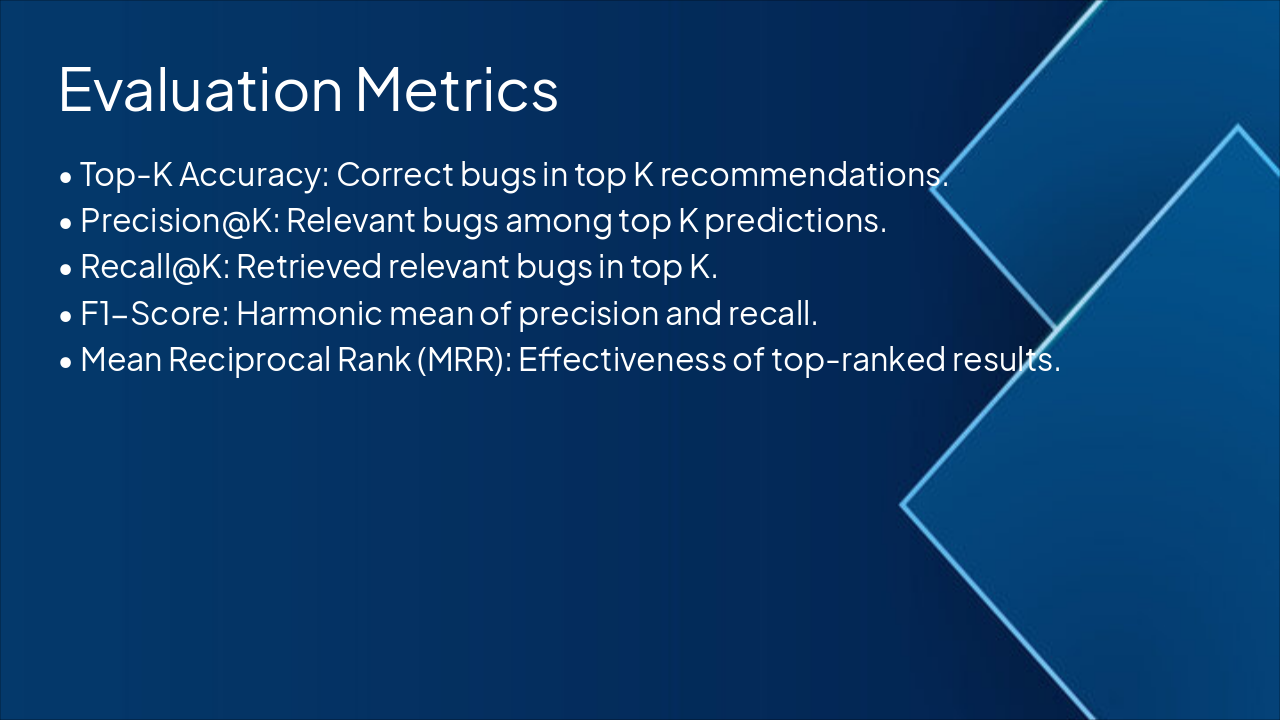
The "Evaluation Metrics" slide outlines five key metrics for bug recommendation systems: Top-K Accuracy, Precision@K, Recall@K, F1-Score, and Mean Reciprocal Rank (MRR). These measure aspects like correct predictions in top K results, relevance of retrieved bugs, their harmonic mean, and ranking effectiveness.

Evaluation Metrics

  • Top-K Accuracy: Correct bugs in top K recommendations.
  • Precision@K: Relevant bugs among top K predictions.
  • Recall@K: Retrieved relevant bugs in top K.
  • F1-Score: Harmonic mean of precision and recall.
  • Mean Reciprocal Rank (MRR): Effectiveness of top-ranked results.
Speaker Notes
Highlight metrics tailored for bug prioritization and ranking performance in triage.
Slide 13 - Evaluation Metrics
Slide 14 of 18

Slide 14 - Expected Results

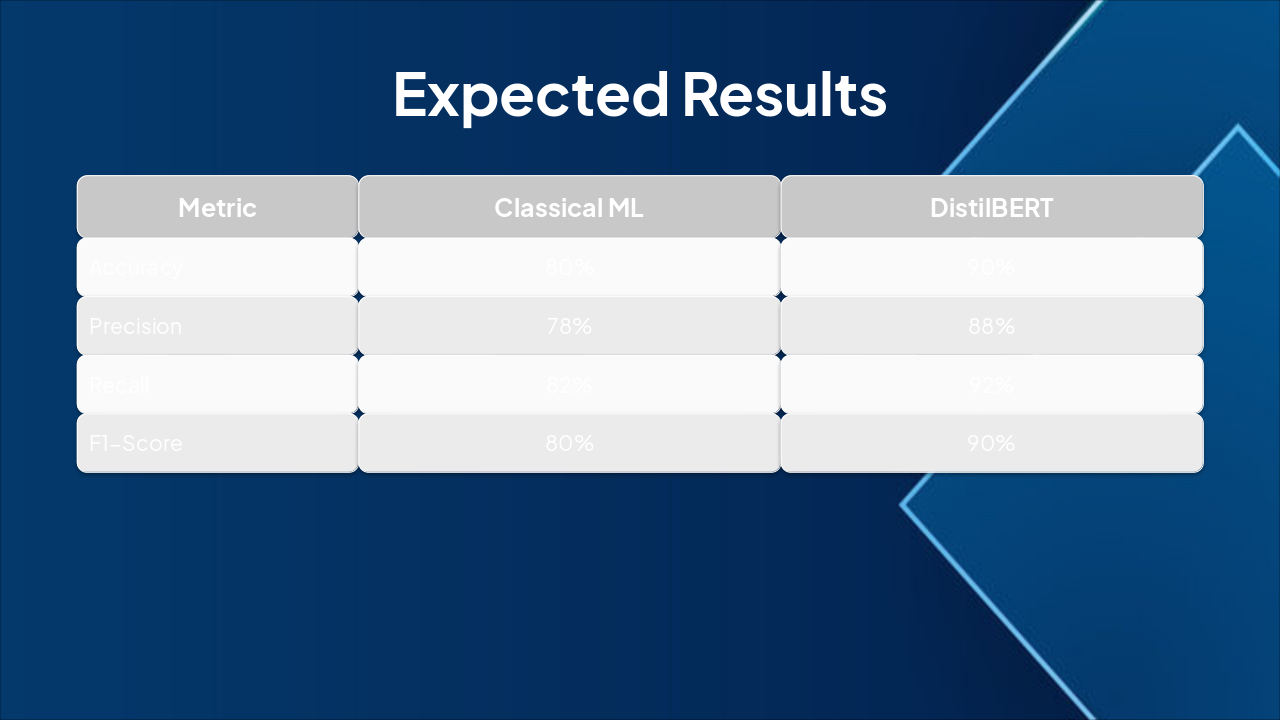
The "Expected Results" slide features a table comparing Classical ML and DistilBERT on key metrics. DistilBERT outperforms Classical ML across all, achieving 90% accuracy and F1-score, 88% precision, and 92% recall versus 80%, 80%, 78%, and 82%.

Expected Results

{ "headers": [ "Metric", "Classical ML", "DistilBERT" ], "rows": [ [ "Accuracy", "80%", "90%" ], [ "Precision", "78%", "88%" ], [ "Recall", "82%", "92%" ], [ "F1-Score", "80%", "90%" ] ] }

Slide 14 - Expected Results
Slide 15 of 18

Slide 15 - System Prototype

The "System Prototype" slide presents a visual prototype integrating real-time Jira/GitHub issue synchronization and ML-powered automated bug triage with SHAP explainability. It also features a dashboard delivering actionable insights for triage decisions.

System Prototype

!Image

  • Jira/GitHub real-time issue synchronization
  • ML-powered automated bug triage
  • SHAP explainability for triage decisions
  • Prototype dashboard with actionable insights

Source: Wikipedia

Speaker Notes
Overview diagram: Jira/GitHub integration for real-time ML triage with explainable outputs.
Slide 15 - System Prototype
Slide 16 of 18

Slide 16 - Research Timeline

The slide presents a 6-month research timeline for bug triage using ML models. It covers data collection and literature review (Months 1-2), model development/training (Months 3-4), evaluation/analysis (Month 5), and prototype/reporting (Month 6).

Research Timeline

Months 1-2: Data Collection & Literature Review Gather datasets from Jira/GitHub and conduct comprehensive literature review on bug triage. Months 3-4: Model Development & Training Implement classical ML models and DistilBERT, perform preprocessing and training. Month 5: Evaluation & Analysis Assess models with Top-K accuracy, precision, recall, and SHAP explainability techniques. Month 6: Prototype & Final Reporting Develop Jira/GitHub integration prototype and compile research report.

Slide 16 - Research Timeline
Slide 17 of 18

Slide 17 - Expected Contributions

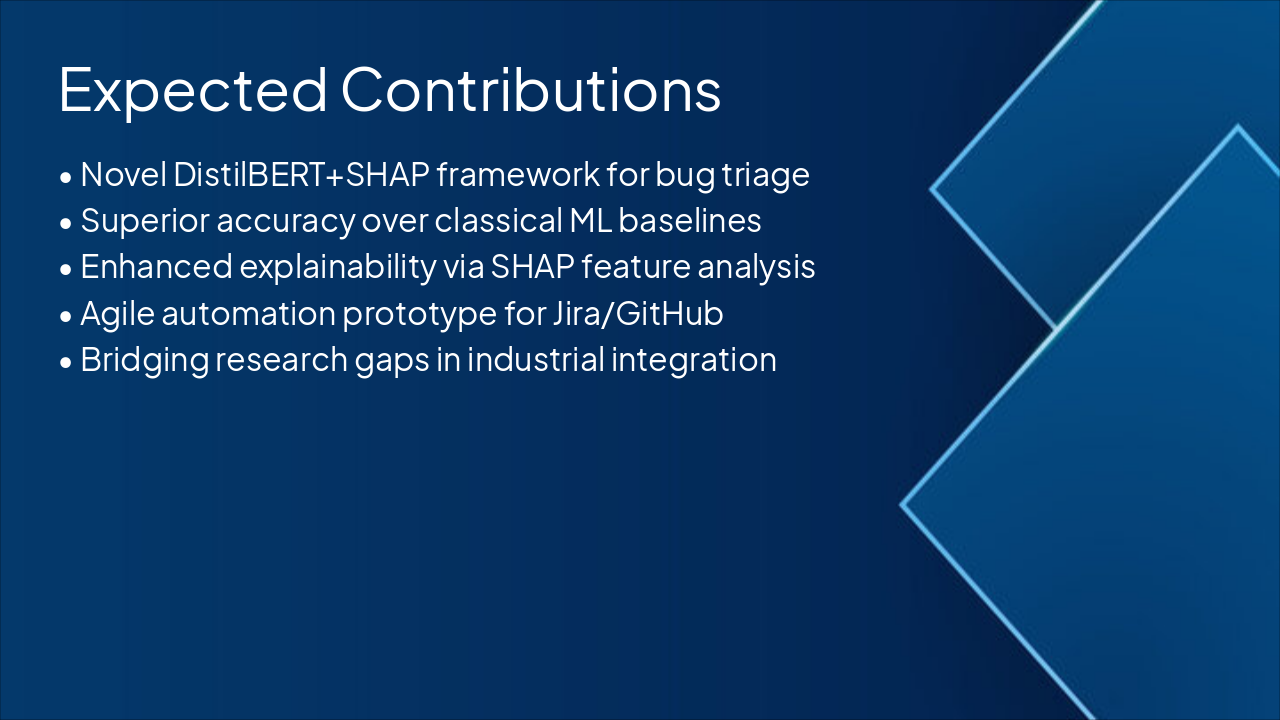
The slide lists expected contributions, including a novel DistilBERT+SHAP framework for bug triage that achieves superior accuracy over classical ML baselines and enhanced explainability via SHAP analysis. It also highlights an agile automation prototype for Jira/GitHub and bridges research gaps in industrial integration.

Expected Contributions

  • Novel DistilBERT+SHAP framework for bug triage
  • Superior accuracy over classical ML baselines
  • Enhanced explainability via SHAP feature analysis
  • Agile automation prototype for Jira/GitHub
  • Bridging research gaps in industrial integration
Slide 17 - Expected Contributions
Slide 18 of 18

Slide 18 - References & Acknowledgements

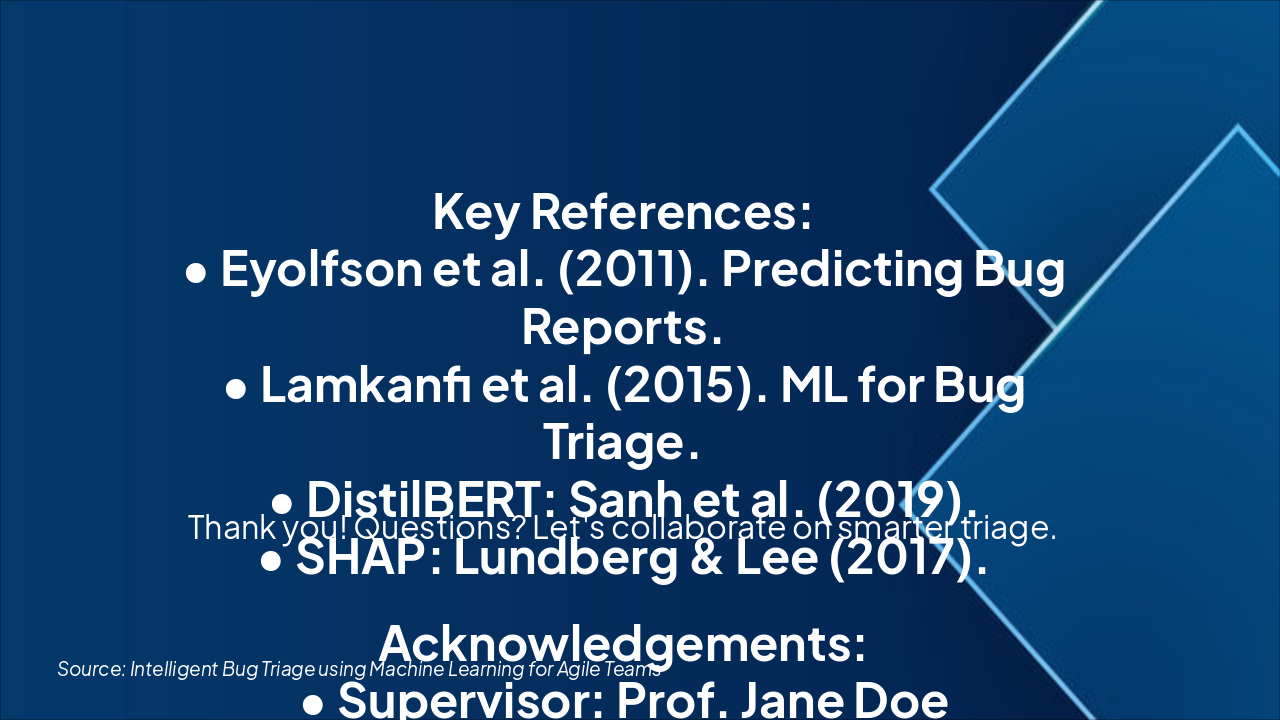
The slide lists key references on bug prediction, ML triage, DistilBERT, and SHAP. It acknowledges the supervisor, Agile AI Lab team, NSF funding, and invites questions for collaboration on smarter triage.

References & Acknowledgements

**Key References:

  • Eyolfson et al. (2011). Predicting Bug Reports.
  • Lamkanfi et al. (2015). ML for Bug Triage.
  • DistilBERT: Sanh et al. (2019).
  • SHAP: Lundberg & Lee (2017).

Acknowledgements:

  • Supervisor: Prof. Jane Doe
  • Research Team: Agile AI Lab
  • Funding: NSF Grant #12345**

Thank you! Questions? Let's collaborate on smarter triage.

Source: Intelligent Bug Triage using Machine Learning for Agile Teams

Speaker Notes
Briefly highlight 2-3 key citations. Express genuine thanks. Pause for questions.
Slide 18 - References & Acknowledgements

Discover More Presentations

Explore thousands of AI-generated presentations for inspiration

Browse Presentations
Powered by AI

Create Your Own Presentation

Generate professional presentations in seconds with Karaf's AI. Customize this presentation or start from scratch.

Create New Presentation

Powered by Karaf.ai — AI-Powered Presentation Generator