Metabolic Drivers of Ovarian Dysfunction

Generated from prompt:

Single-slide presentation titled 'The Biological Drivers Behind Disrupted Ovarian Function' summarizing: 1. Insulin Resistance & Hyperinsulinemia: Excess insulin stimulates theca cell androgen production, reduces SHBG, increases free androgens, and impairs granulosa cell mitochondria. 2. Chronic Low-Grade Inflammation: Elevated TNF-α, IL-6, CRP, disrupts folliculogenesis and promotes oxidative injury. 3. Oxidative Stress & ROS Accumulation: High ROS damages mitochondrial potential, ooplasmic maturation, and meiotic spindle, leading to abnormal oocytes. 4. Dyslipidemia & Lipotoxicity: High free fatty acids cause mitochondrial overload, apoptosis of granulosa cells, and lipid peroxidation (MDA) leading to poor oocyte quality. 5. Altered Energy Metabolism: Reduced NAD⁺ and disrupted AMPK pathways impair mitochondrial biogenesis and follicle recruitment. Clinical insight: Reproductive dysfunction is fundamentally a metabolic disorder mediated by inflammation, oxidative stress, and mitochondrial damage — not purely hormonal.

This presentation outlines key biological factors like insulin resistance, chronic inflammation, oxidative stress, dyslipidemia, and altered energy metabolism disrupting ovarian function, emphasizing

November 26, 20251 slides
Slide 1 of 1

Slide 1 - Key Biological Drivers

The slide outlines key biological drivers of reproductive issues, including insulin resistance that elevates androgens and impairs granulosa cell mitochondria, alongside chronic inflammation from cytokines like TNF-α and IL-6 that disrupts folliculogenesis and causes oxidative injury. It also covers oxidative stress damaging oocytes and meiotic structures, dyslipidemia leading to granulosa apoptosis and poor oocyte quality, and altered energy metabolism with low NAD⁺ and AMPK issues hindering mitochondrial biogenesis.

Key Biological Drivers

  • Insulin Resistance: Excess insulin boosts androgens, impairs granulosa cell mitochondria.
  • Chronic Inflammation: TNF-α, IL-6, CRP disrupt folliculogenesis and promote oxidative injury.
  • Oxidative Stress: ROS damages oocytes, meiotic spindle, and mitochondrial potential.
  • Dyslipidemia: Fatty acids induce granulosa apoptosis, reduce oocyte quality.
  • Altered Energy Metabolism: Low NAD⁺, AMPK disruption hinders mitochondrial biogenesis.
Speaker Notes
Reproductive dysfunction is fundamentally a metabolic disorder mediated by inflammation, oxidative stress, and mitochondrial damage—not purely hormonal.
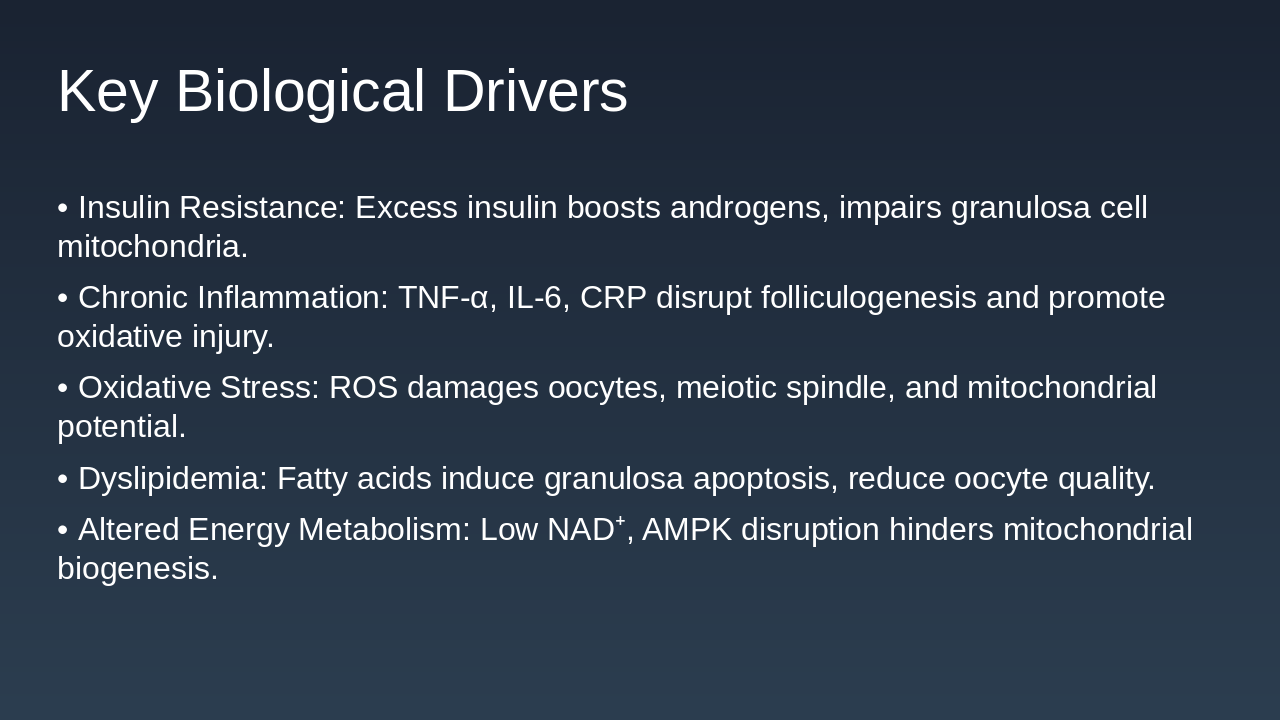
Slide 1 - Key Biological Drivers

Discover More Presentations

Explore thousands of AI-generated presentations for inspiration

Browse Presentations
Powered by AI

Create Your Own Presentation

Generate professional presentations in seconds with Karaf's AI. Customize this presentation or start from scratch.

Create New Presentation

Powered by Karaf.ai — AI-Powered Presentation Generator