Crafting Effective Research Questions in Critical Care
Generated from prompt:
Redesign the uploaded presentation titled "Selecting and Framing the Right Research Question – 20 min" without changing any wording. Improve visual design only. Use a muted academic color palette (teal, soft blue-green, indigo, warm grey, terracotta, sage). Add clean flat vector medical and research-themed icons (no AI human hospital photos). Improve layout, spacing, and visual hierarchy. Create visual frameworks for FINER and PICOT (horizontal flow for PICOT, boxed letters for FINER). Add subtle background graphics like question marks, light bulbs, checklists, targets where appropriate. Maintain professional academic tone suitable for critical care workshop. Keep all original slide text exactly as written. Approx. 18-22 slides. Modern conference-ready design with white space and subtle iconography.
20-min Critical Care Workshop on selecting and framing research questions using FINER criteria (Feasible, Interesting, Novel, Ethical, Relevant) and PICOT framework (Population, Intervention, Comparison, Outcome, Time). Covers ICU overview, practical

Slide 2 - Presentation Agenda
- Introduction to Critical Care Research
- What is a Research Question?
- FINER Criteria for Feasibility
- PICOT Framework for Clinical Studies
- Applying FINER and PICOT in Critical Care
- Practical Examples
- Common Pitfalls
- Conclusion and Q&A
---
Photo by Logan Voss on Unsplash

Slide 3 - Introduction
1
Introduction
Importance of Research Questions in Critical Care
Slide 4 - Critical Care Medicine Overview
- Deals with seriously or critically ill patients at risk of life-threatening conditions
- Provides life support, invasive monitoring, resuscitation, and end-of-life care
- Relies on multidisciplinary teams: doctors, nurses, physical therapists, respiratory therapists, pharmacists
Source: Wikipedia: Intensive care medicine
Slide 5 - Intensive Care Unit (ICU)
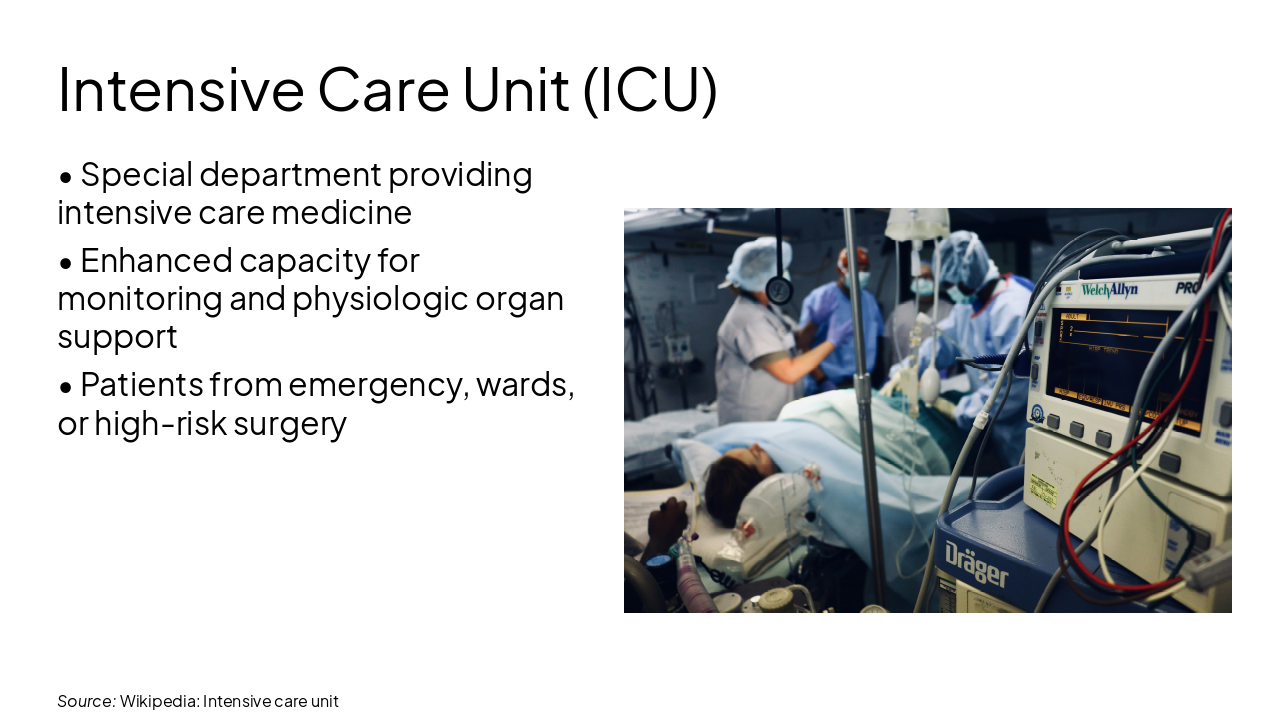
- Special department providing intensive care medicine
- Enhanced capacity for monitoring and physiologic organ support
- Patients from emergency, wards, or high-risk surgery
---
Photo by Richard Catabay on Unsplash
Source: Wikipedia: Intensive care unit
Slide 6 - Defining the ICU
> an organized system for the provision of care to critically ill patients that provides intensive and specialized medical and nursing care, an enhanced capacity for monitoring, and multiple modalities of physiologic organ support to sustain life during a period of life-threatening organ system insufficiency.
— World Federation of Societies of Intensive and Critical Care Medicine
Source: Wikipedia: Intensive care unit
Slide 7 - Research Questions
2
Research Questions
Foundation for Critical Care Studies
Slide 8 - What is a Research Question?
> A research question is "a question that a research project sets out to answer".
— Wikipedia: Research question
Source: Wikipedia: Research question
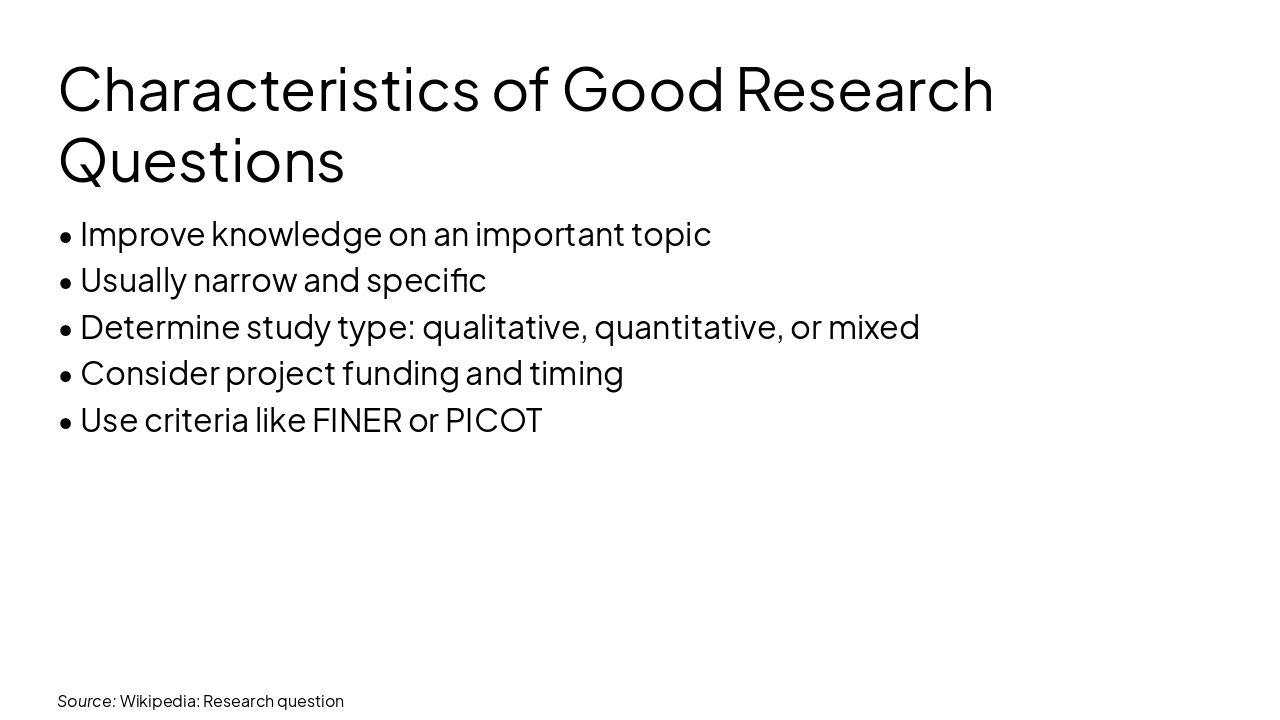
Slide 9 - Characteristics of Good Research Questions
- Improve knowledge on an important topic
- Usually narrow and specific
- Determine study type: qualitative, quantitative, or mixed
- Consider project funding and timing
- Use criteria like FINER or PICOT
Source: Wikipedia: Research question
Slide 10 - FINER Criteria
3
FINER Criteria
Feasible • Interesting • Novel • Ethical • Relevant
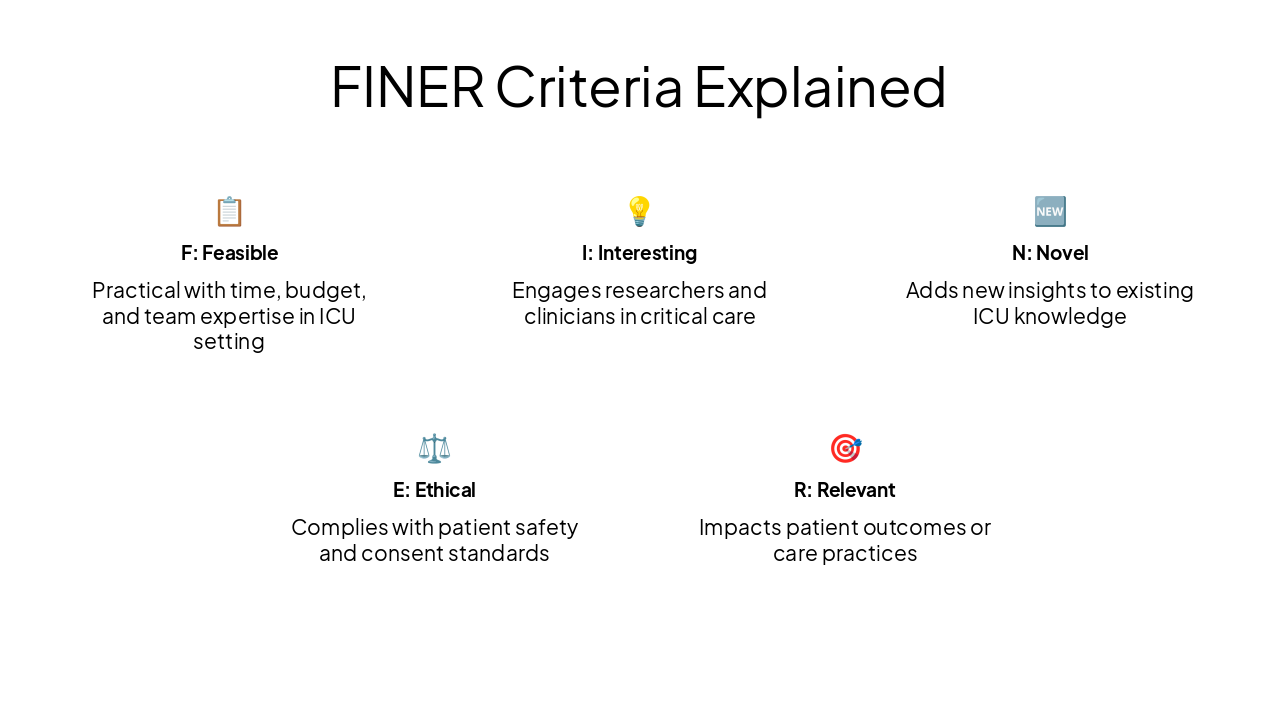
Slide 11 - FINER Criteria Explained
📋 F: Feasible Practical with time, budget, and team expertise in ICU setting
💡 I: Interesting Engages researchers and clinicians in critical care
🆕 N: Novel Adds new insights to existing ICU knowledge
⚖️ E: Ethical Complies with patient safety and consent standards
🎯 R: Relevant Impacts patient outcomes or care practices
Slide 12 - PICOT Framework
4
PICOT Framework
Population • Intervention • Comparison • Outcome • Time
Slide 13 - PICOT Framework
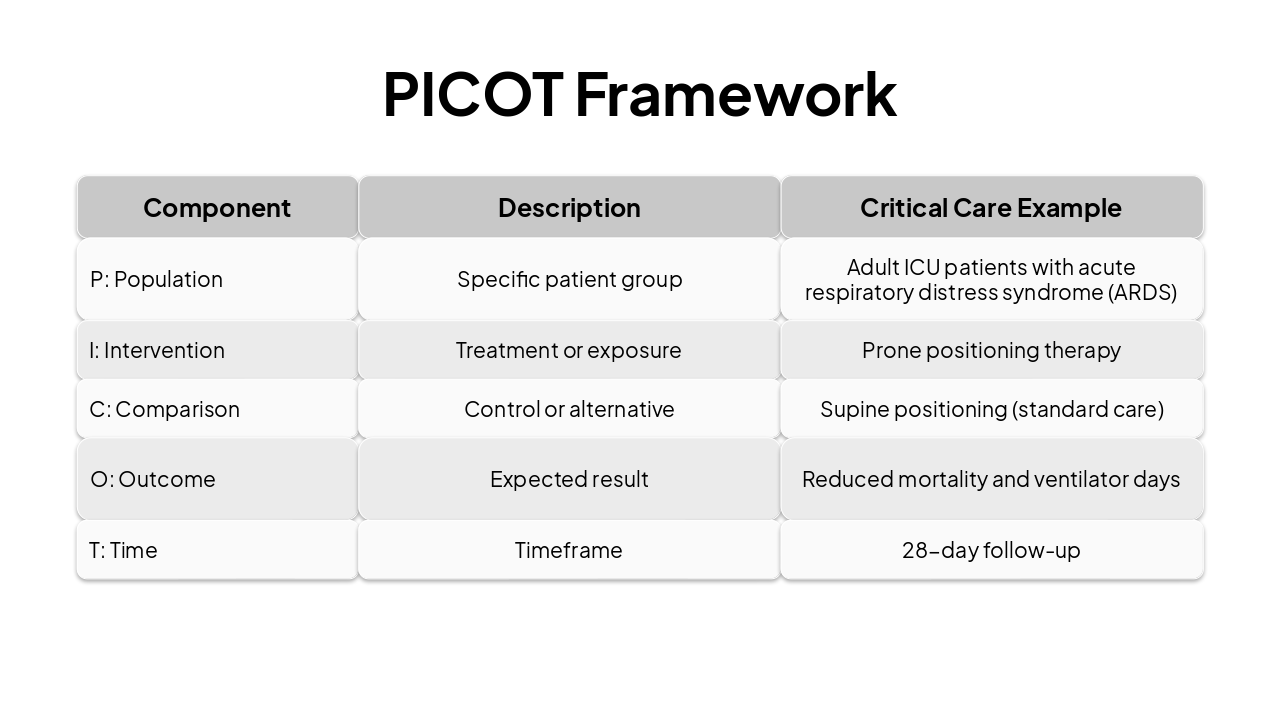
| Component | Description | Critical Care Example |
|---|---|---|
| P: Population | Specific patient group | Adult ICU patients with acute respiratory distress syndrome (ARDS) |
| I: Intervention | Treatment or exposure | Prone positioning therapy |
| C: Comparison | Control or alternative | Supine positioning (standard care) |
| O: Outcome | Expected result | Reduced mortality and ventilator days |
| T: Time | Timeframe | 28-day follow-up |
Slide 14 - PICOT as Horizontal Flow
- P → I → C → O → T sequence
- Tailored for clinical trials in critical care
- Builds precise, answerable questions
---
Photo by Cedrik Wesche on Unsplash
Slide 15 - Application in Critical Care
5
Application in Critical Care
Practical Use of FINER and PICOT
---
Photo by Louis Reed on Unsplash
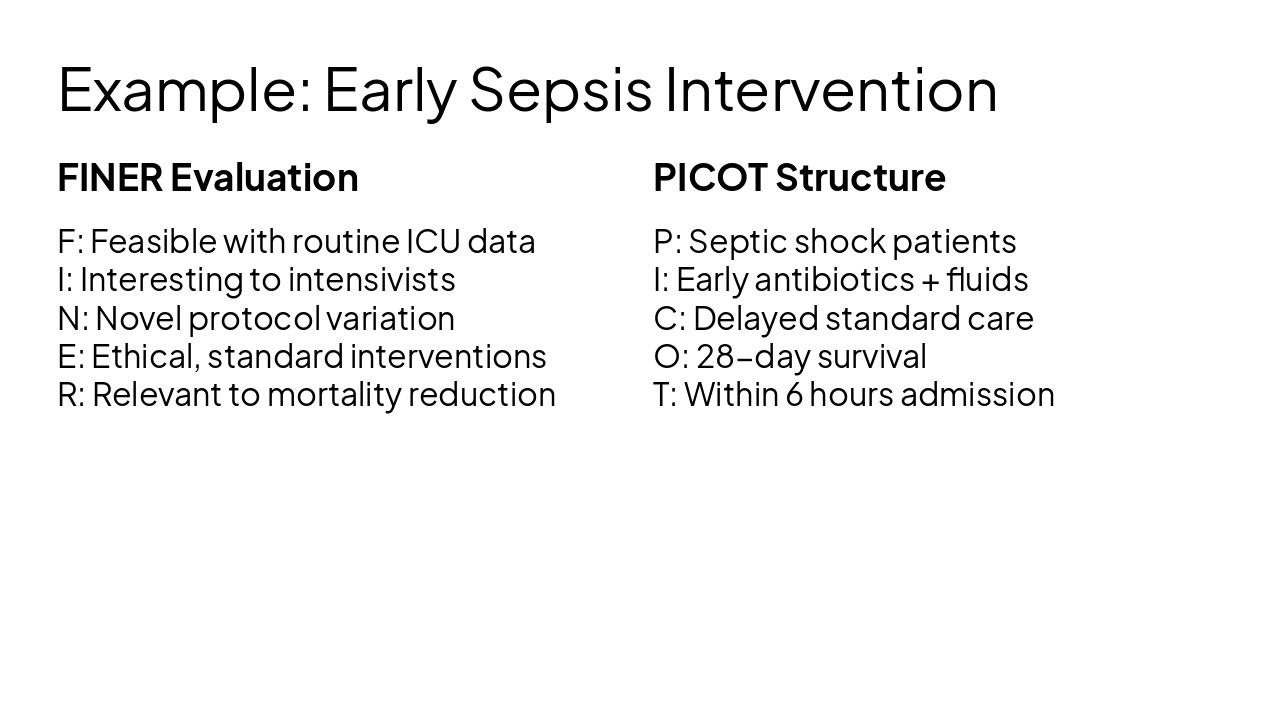
Slide 16 - Example: Early Sepsis Intervention
FINER Evaluation F: Feasible with routine ICU data I: Interesting to intensivists N: Novel protocol variation E: Ethical, standard interventions R: Relevant to mortality reduction
PICOT Structure P: Septic shock patients I: Early antibiotics + fluids C: Delayed standard care O: 28-day survival T: Within 6 hours admission
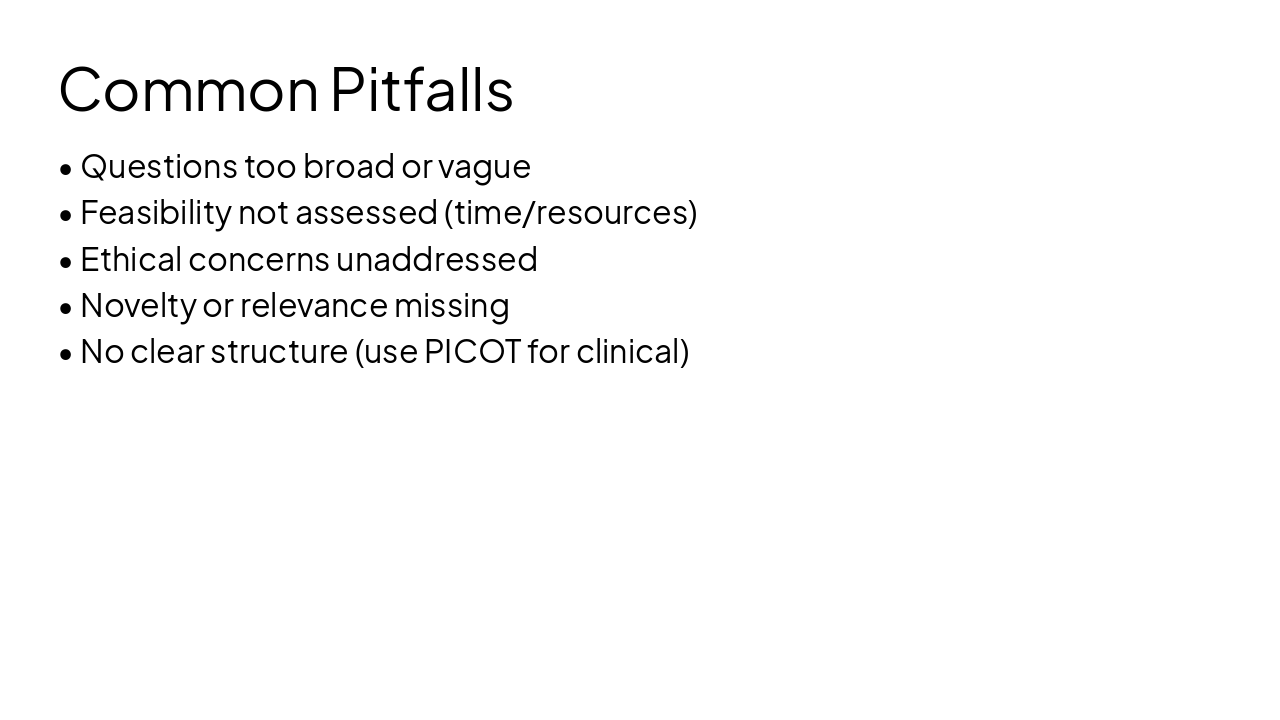
Slide 17 - Common Pitfalls
- Questions too broad or vague
- Feasibility not assessed (time/resources)
- Ethical concerns unaddressed
- Novelty or relevance missing
- No clear structure (use PICOT for clinical)
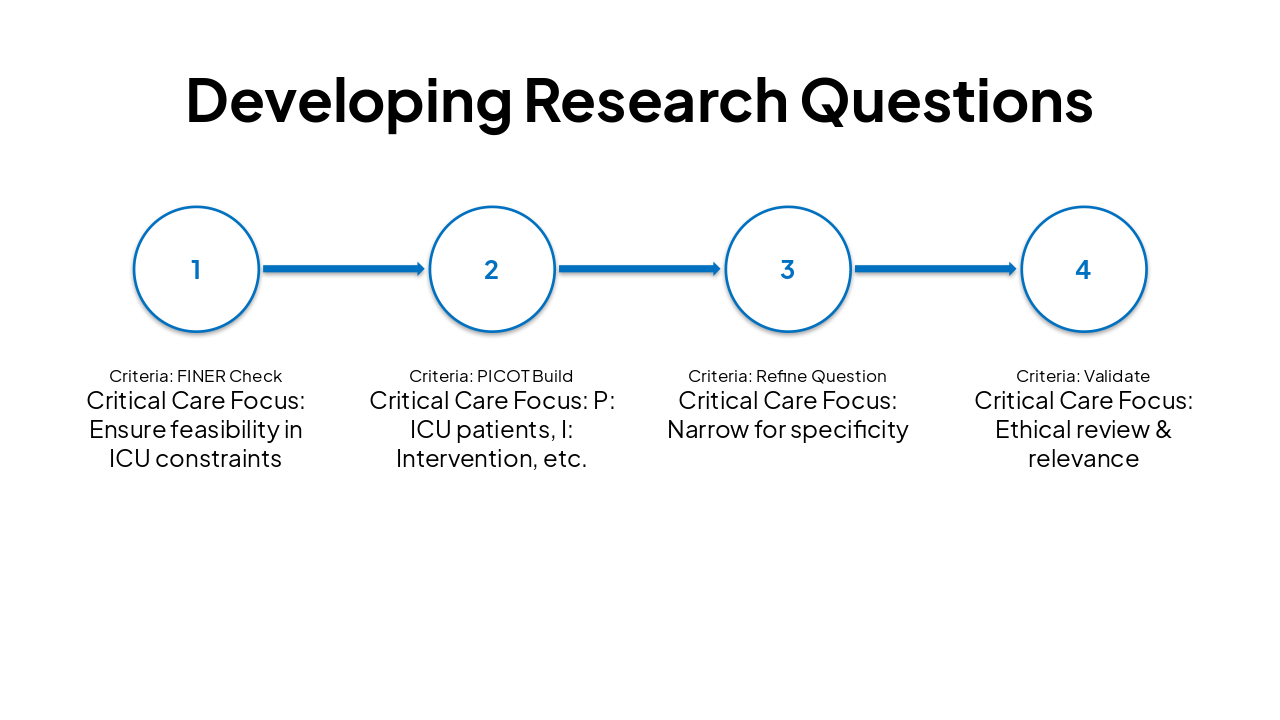
Slide 18 - Developing Research Questions
| Step | Criteria | Critical Care Focus |
|---|---|---|
| 1 | FINER Check | Ensure feasibility in ICU constraints |
| 2 | PICOT Build | P: ICU patients, I: Intervention, etc. |
| 3 | Refine Question | Narrow for specificity |
| 4 | Validate | Ethical review & relevance |
Slide 19 - Conclusion
Select and frame research questions using FINER and PICOT Ensure they are feasible, ethical, and relevant for critical care
Thank you! Questions? Contact for workshop materials

Discover More Presentations
Explore thousands of AI-generated presentations for inspiration
Create Your Own Presentation
Generate professional presentations in seconds with Karaf's AI. Customize this presentation or start from scratch.