Mastering GenAI and Transformers

Generated from prompt:

Create a PowerPoint presentation for internal training titled 'Generative AI and Transformer Architecture'. The presentation should be technical and cover in detail how GenAI models work, with sections on Transformer architecture, attention mechanism, embeddings, training process, and key model variants (GPT, BERT, T5, etc.). Include diagrams, architecture flow visuals, and corporate-style dark theme design. Add a section on enterprise applications and limitations.

This technical training presentation explores Generative AI fundamentals, delving into Transformer architecture, attention mechanisms, embeddings, training processes, and variants like GPT, BERT, and

November 26, 202515 slides
Slide 1 of 15

Slide 1 - Generative AI and Transformer Architecture

The slide's title is "Generative AI and Transformer Architecture," introducing a presentation on these topics. It includes the presenter's name, space for a company logo, and a subtitle indicating it's for internal training.

Generative AI and Transformer Architecture

Presenter: [Your Name]

[Company Logo Space]

Internal Training

Source: Internal Training Presentation

Speaker Notes
Welcome slide with title, subtitle 'Internal Training', presenter name placeholder, and company logo space. Dark background with white text.
Slide 1 - Generative AI and Transformer Architecture
Slide 2 of 15

Slide 2 - Presentation Agenda

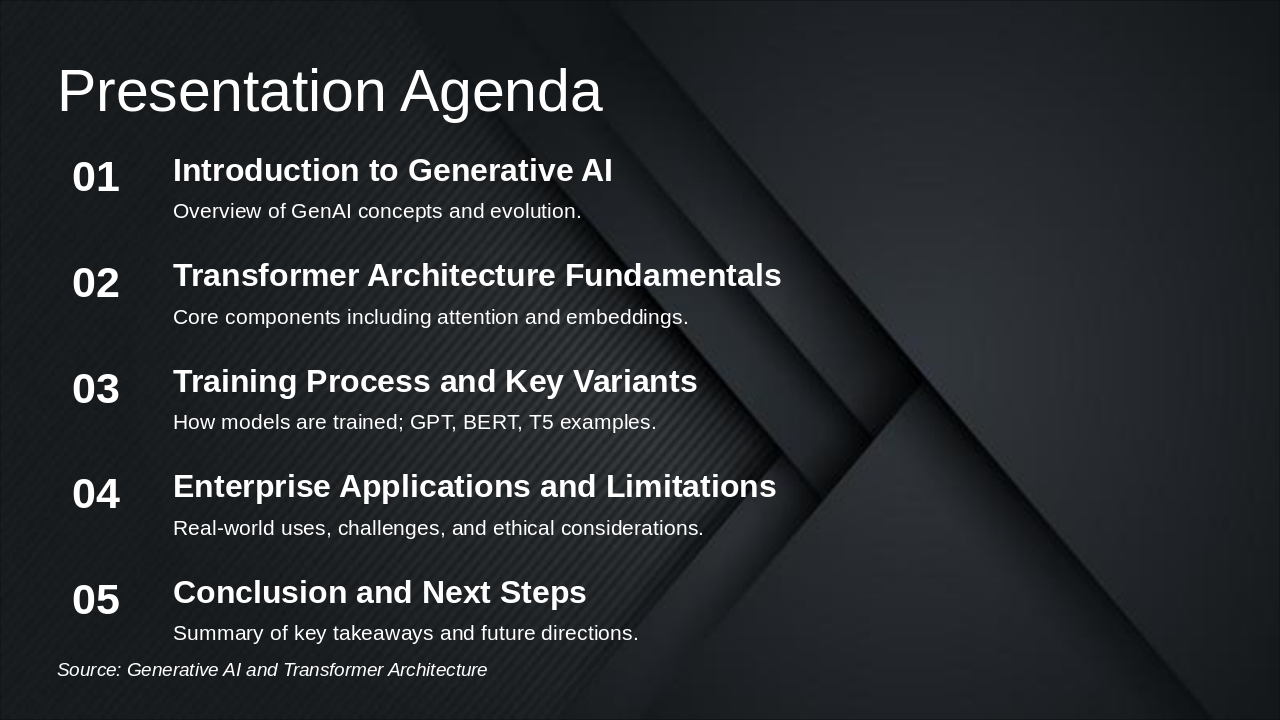
The Presentation Agenda slide outlines a structured overview of generative AI, starting with an introduction to its concepts and evolution. It then covers transformer architecture fundamentals, training processes with key variants like GPT and BERT, enterprise applications including challenges and ethics, and concludes with key takeaways and next steps.

Presentation Agenda

  1. Introduction to Generative AI
  2. Overview of GenAI concepts and evolution.

  3. Transformer Architecture Fundamentals
  4. Core components including attention and embeddings.

  5. Training Process and Key Variants
  6. How models are trained; GPT, BERT, T5 examples.

  7. Enterprise Applications and Limitations
  8. Real-world uses, challenges, and ethical considerations.

  9. Conclusion and Next Steps

Summary of key takeaways and future directions. Source: Generative AI and Transformer Architecture

Slide 2 - Presentation Agenda
Slide 3 of 15

Slide 3 - Introduction to Generative AI

This section header slide introduces Generative AI, numbered as 01, focusing on models that create text and images by learning patterns from data. It covers the core principles and historical evolution from recurrent neural networks (RNNs) to transformers.

Introduction to Generative AI

01

Introduction to Generative AI

Models generating text, images from data patterns; core principles and evolution from RNNs to transformers.

Speaker Notes
Overview of Generative AI: Models that generate new content like text and images from patterns in data. Explain core principles and evolution from RNNs to transformers. This section sets the foundation for the technical deep dive into Transformer architecture and related topics in the presentation.
Slide 3 - Introduction to Generative AI
Slide 4 of 15

Slide 4 - How GenAI Models Work

Generative AI models operate by probabilistically generating outputs, such as text completions or image syntheses, based on patterns learned from data distributions, with a focus on autoregressive architectures like GPT for text and diffusion models for images. However, these models face challenges including hallucinations and inherent biases that can affect their reliability.

How GenAI Models Work

  • Probabilistic generation from learned data distributions
  • Applications: text completion and image synthesis
  • Challenges: hallucinations and inherent biases
  • Focus: autoregressive models like GPT
  • Focus: diffusion models for image generation
Slide 4 - How GenAI Models Work
Slide 5 of 15

Slide 5 - Generative AI and Transformer Architecture

This section header slide introduces Transformer Architecture as the foundational model powering generative AI. It highlights the encoder-decoder structure, self-attention layers, and positional encodings that enable handling of long-range dependencies.

Generative AI and Transformer Architecture

04

Transformer Architecture

Breakdown of foundational model: encoder-decoder structure, self-attention layers, positional encodings for long-range dependencies.

Source: Internal Training Presentation

Speaker Notes
Introduce the core components of the Transformer model, emphasizing its role in modern GenAI.
Slide 5 - Generative AI and Transformer Architecture
Slide 6 of 15

Slide 6 - Transformer Architecture Diagram

The Transformer Architecture Diagram illustrates the core components of the model, featuring encoder stacks that process input sequences via self-attention to capture contextual dependencies. Complementing this, decoder stacks generate outputs using encoder-decoder attention, multi-head mechanisms, and feed-forward networks for non-linear transformations.

Transformer Architecture Diagram

!Image

  • Encoder stacks process input sequences with self-attention
  • Decoder stacks generate outputs using encoder-decoder attention
  • Multi-head attention mechanisms capture contextual dependencies
  • Feed-forward networks apply non-linear transformations to representations

Source: Image from Wikipedia article "Transformer (deep learning)"

Slide 6 - Transformer Architecture Diagram
Slide 7 of 15

Slide 7 - Attention Mechanism

The Attention Mechanism slide explains self-attention, which computes relevance among all elements in a sequence, and multi-head attention, which uses parallel layers to capture diverse representations. It highlights the scaled dot-product approach for weighting importance based on query-key similarity, along with key benefits like high parallelizability and effective handling of long-range context.

Attention Mechanism

  • Self-attention computes relevance between all sequence elements
  • Multi-head attention enables parallel layers for diverse representations
  • Scaled dot-product weights importance using query-key similarity formula
  • Benefits: highly parallelizable and captures long-range context effectively
Slide 7 - Attention Mechanism
Slide 8 of 15

Slide 8 - Attention Mechanism Flow

The slide illustrates the attention mechanism flow in neural networks, starting with the creation of query, key, and value matrices derived from input embeddings. It then outlines the process of computing attention scores through query-key dot products, normalizing them via softmax into weights, and enabling dynamic focus on relevant elements in the sequence.

Attention Mechanism Flow

!Image

  • Query, key, value matrices from input embeddings.
  • Attention scores via query-key dot products.
  • Softmax normalizes scores into attention weights.
  • Dynamic focus on relevant sequence elements.

Source: Attention (machine learning)

Speaker Notes
Illustration of query-key-value matrices, attention scores computation, and softmax application. Show how it enables dynamic focus in sequences.
Slide 8 - Attention Mechanism Flow
Slide 9 of 15

Slide 9 - Embeddings in Transformers

Embeddings in Transformers convert input tokens into dense vectors and incorporate sequence order using sinusoidal or learned positional embeddings to capture positional information. These embeddings employ layer normalization and residuals for stable training, often utilizing high dimensions like 512-4096 to enable rich, expressive representations.

Embeddings in Transformers

  • Convert tokens to dense vectors via token embeddings.
  • Encode sequence order with sinusoidal or learned positional embeddings.
  • Apply layer normalization and residuals for stable training.
  • Utilize high dimensions (512-4096) for rich representations.
Slide 9 - Embeddings in Transformers
Slide 10 of 15

Slide 10 - Training Process

The training process timeline begins with pre-training on massive corpora through unsupervised learning to build general language representations, followed by fine-tuning for specific tasks like classification or generation using supervised adaptation. It concludes with optimization via the AdamW optimizer and gradient clipping for stability, and evaluation using metrics such as perplexity for fluency and BLEU for quality, which requires substantial compute resources like GPUs or TPUs.

Training Process

Step 1: Pre-training on Massive Corpora Unsupervised learning on vast text datasets to acquire general language representations and patterns. Step 2: Fine-tuning for Specific Tasks Supervised adaptation of the pre-trained model to perform targeted tasks like classification or generation. Step 3: Optimization with AdamW and Clipping Employ AdamW optimizer and gradient clipping to enhance training stability and efficiency. Step 4: Evaluation Using Key Metrics Measure performance via perplexity for fluency and BLEU for quality; demands high compute resources like GPUs/TPUs.

Slide 10 - Training Process
Slide 11 of 15

Slide 11 - Key Model Variants

The slide "Key Model Variants" outlines decoder-only models like GPT, which generate text autoregressively by predicting sequential tokens, and encoder-only models like BERT, which use bidirectional masking for tasks such as classification and understanding. It also covers encoder-decoder models like T5, which handle diverse tasks as text-to-text conversions, alongside scaling variants of GPT-3/4 that leverage massive parameters for emergent abilities and enhanced performance.

Key Model Variants

Decoder-Only & Encoder-Only ModelsEncoder-Decoder & Scaling Variants
GPT: Decoder-only architecture, generative and autoregressive, predicts next tokens sequentially. BERT: Encoder-only, bidirectional context via masking, excels in understanding tasks like classification.T5: Encoder-decoder framework treats all tasks as text-to-text, versatile for generation and comprehension. GPT-3/4 variants scale parameters massively (billions to trillions) for emergent capabilities and superior performance.
Slide 11 - Key Model Variants
Slide 12 of 15

Slide 12 - Generative AI and Transformer Architecture

This section header slide introduces Section 11 on Enterprise Applications of Generative AI and Transformer Architecture. It highlights key use cases such as content generation, chatbots, code assistance, and data augmentation, along with integration methods using APIs like OpenAI and custom fine-tuning on proprietary data.

Generative AI and Transformer Architecture

11

Enterprise Applications

Use cases: content generation, chatbots, code assistance, data augmentation. Integration via APIs like OpenAI and custom fine-tuning on proprietary data.

Slide 12 - Generative AI and Transformer Architecture
Slide 13 of 15

Slide 13 - Limitations of GenAI

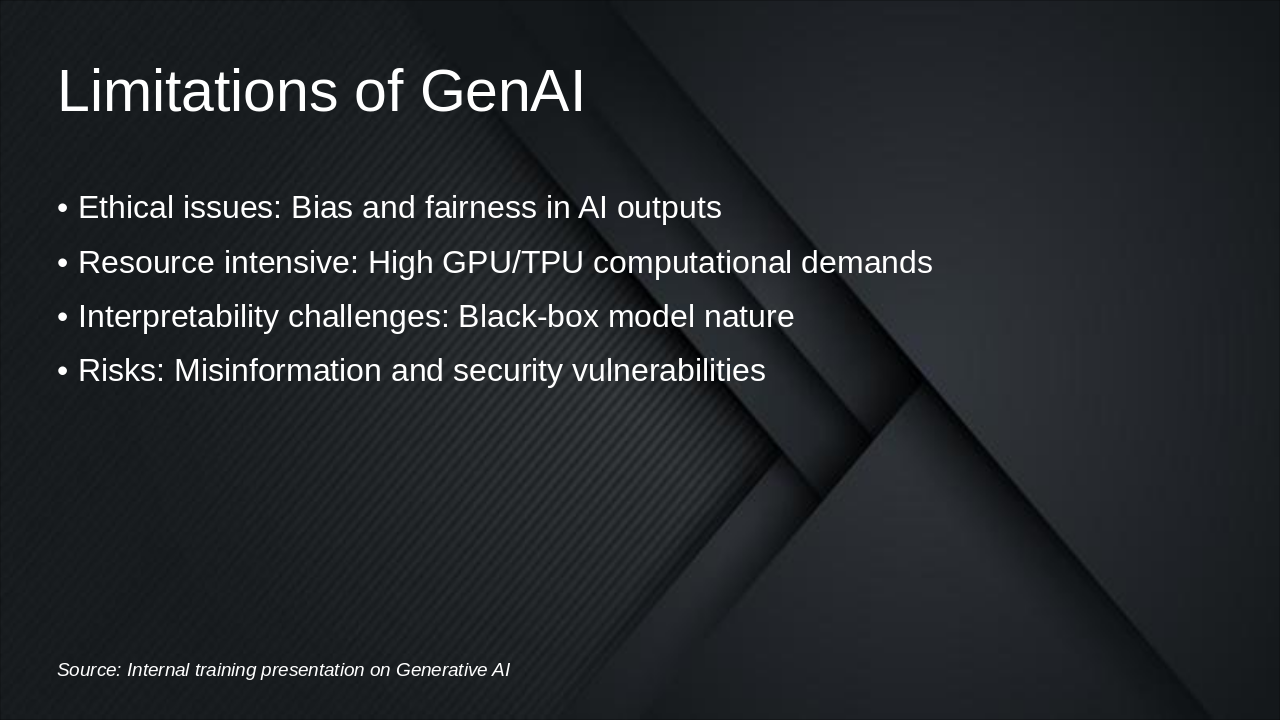
Generative AI faces significant ethical challenges, including biases and fairness issues in its outputs. Additionally, it demands substantial computational resources like GPUs and TPUs, suffers from black-box interpretability problems, and poses risks such as misinformation and security vulnerabilities.

Limitations of GenAI

  • Ethical issues: Bias and fairness in AI outputs
  • Resource intensive: High GPU/TPU computational demands
  • Interpretability challenges: Black-box model nature
  • Risks: Misinformation and security vulnerabilities

Source: Internal training presentation on Generative AI

Speaker Notes
Discuss real-world examples of each limitation and mitigation strategies in enterprise contexts.
Slide 13 - Limitations of GenAI
Slide 14 of 15

Slide 14 - GenAI Impact Stats

The GenAI Impact Stats slide projects the market to grow from $10B in 2023 to $100B by 2030, highlighting a 10x speed advantage of transformers over LSTMs and 70% enterprise AI piloting by 2024. It also compares model sizes, noting GPT-4's 1.7 trillion parameters versus BERT's 110 million.

GenAI Impact Stats

  • $10B to $100B: Market Growth Projection
  • 2023 to 2030 forecast

  • 1.7T vs 110M: GPT-4 vs BERT Parameters
  • Model size comparison

  • 10x: Transformers Speed Gain
  • Faster than LSTMs

  • 70%: Enterprise AI Piloting
  • By 2024 adoption rate

Slide 14 - GenAI Impact Stats
Slide 15 of 15

Slide 15 - Conclusion and Q&A

The slide concludes that transformers drive modern generative AI, enabling innovations when managed carefully, with a key takeaway emphasizing the need to understand their architecture for effective use. It closes with a message to embrace transformers wisely and invites questions to deepen understanding.

Conclusion and Q&A

Transformers Power Modern GenAI

Enabling Innovations with Careful Management

Key Takeaways:

  • Understand Architecture for Effective Use

Closing Message: Embrace Transformers Wisely

Call-to-Action: Share your questions now to deepen understanding.

Speaker Notes
Summarize key points: Transformers enable GenAI innovations but need careful management. Emphasize understanding architecture for effective use. Open floor for questions.
Slide 15 - Conclusion and Q&A

Discover More Presentations

Explore thousands of AI-generated presentations for inspiration

Browse Presentations
Powered by AI

Create Your Own Presentation

Generate professional presentations in seconds with Karaf's AI. Customize this presentation or start from scratch.

Create New Presentation

Powered by Karaf.ai — AI-Powered Presentation Generator