Evolution of Climate Change Science

Generated from prompt:

Create a presentation about climate change

This presentation traces the history of climate change science from 19th-century greenhouse effect discoveries by Fourier and Foote to 20th-century insights on natural vs. human causes, key stats, and

November 28, 202511 slides
Slide 1 of 11

Slide 1 - The History of Climate Change Science

The slide is titled "The History of Climate Change Science" and serves as an introductory title slide. Its subtitle highlights key scientific discoveries in the field starting from the 19th century onward.

The History of Climate Change Science

Scientific Discoveries from the 19th Century Onward

Source: presentation about climate change

Speaker Notes
Welcome slide introducing the topic of scientific discoveries in climate change from the 19th century onward.
Slide 1 - The History of Climate Change Science
Slide 2 of 11

Slide 2 - Presentation Agenda

The presentation agenda outlines the historical progression of climate science understanding, starting with early suspicions of ice ages based on observations of past glacial periods. It then covers 19th-century calculations on the greenhouse effect linking CO2 to warming, 20th-century advancements in atmospheric science and data, and modern implications including climate change impacts, predictions, and policy responses.

Presentation Agenda

  1. Early Suspicions of Ice Ages
  2. Historical observations hinting at past glacial periods.

  3. 19th-Century Greenhouse Effect Calculations
  4. Pioneering models linking CO2 to global warming.

  5. 20th-Century Climate Advancements
  6. Key discoveries in atmospheric science and data.

  7. Modern Implications for Climate Change
  8. Current impacts, predictions, and policy responses.

Slide 2 - Presentation Agenda
Slide 3 of 11

Slide 3 - Early Suspicions and Natural Changes

This section header slide introduces the topic of "Early Suspicions and Natural Changes," focusing on pre-20th century perspectives. It explores historical ideas about paleoclimate, ice ages, and the initial theories attributing them to natural causes.

Early Suspicions and Natural Changes

Early Suspicions and Natural Changes

Explores pre-20th century ideas on paleoclimate, ice ages, and initial theories of natural causes.

Slide 3 - Early Suspicions and Natural Changes
Slide 4 of 11

Slide 4 - 19th Century Discoveries

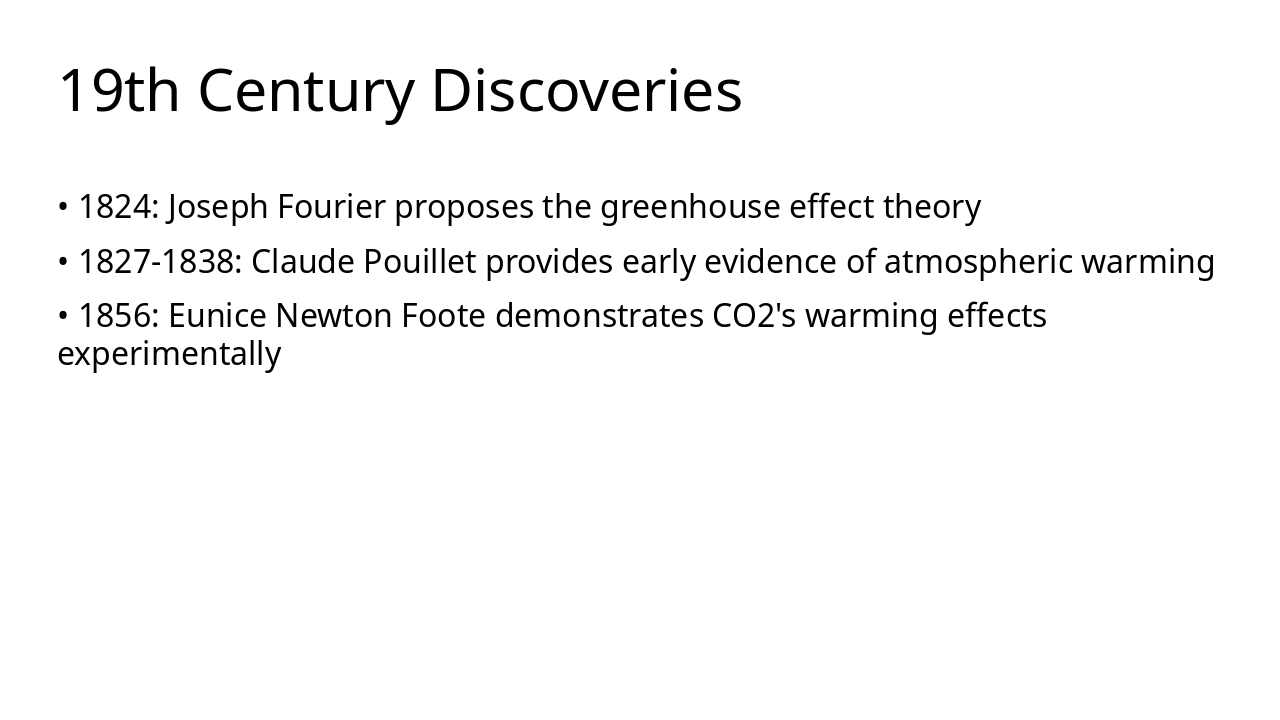
In the 19th century, Joseph Fourier proposed the greenhouse effect theory in 1824, followed by Claude Pouillet's early evidence of atmospheric warming from 1827 to 1838. Eunice Newton Foote then experimentally demonstrated CO2's warming effects in 1856.

19th Century Discoveries

  • 1824: Joseph Fourier proposes the greenhouse effect theory
  • 1827-1838: Claude Pouillet provides early evidence of atmospheric warming
  • 1856: Eunice Newton Foote demonstrates CO2's warming effects experimentally
Slide 4 - 19th Century Discoveries
Slide 5 of 11

Slide 5 - Milestones in Climate Science

The timeline slide "Milestones in Climate Science" outlines key developments starting in 1824, when Joseph Fourier proposed the greenhouse effect by theorizing that Earth's atmosphere traps heat like a greenhouse. It continues with Eunice Foote's 1856 experiment demonstrating CO2's heat-absorbing properties, Svante Arrhenius's 1896 calculations on human-induced CO2 warming, and the accumulation of 20th-century evidence confirming global warming patterns.

Milestones in Climate Science

1824: Fourier Proposes Greenhouse Effect Joseph Fourier theorizes Earth's atmosphere traps heat like a greenhouse. 1856: Foote Demonstrates CO2 Heating Eunice Foote's experiment shows CO2 absorbs sunlight and warms air. 1896: Arrhenius Calculates Human Impact Svante Arrhenius estimates CO2 from humans could raise global temperatures. 20th Century: Evidence of Climate Changes Builds Regional observations accumulate, confirming patterns of global warming.

Slide 5 - Milestones in Climate Science
Slide 6 of 11

Slide 6 - Eunice Newton Foote's Insight

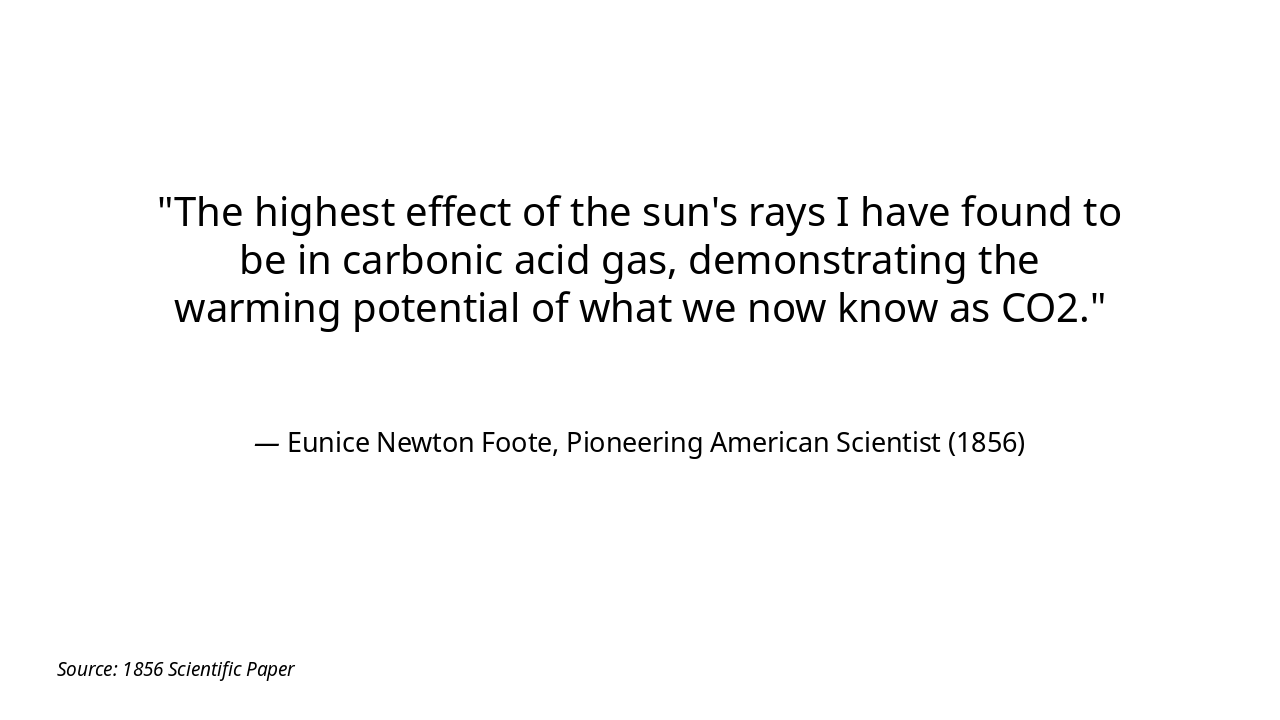
The slide, titled "Eunice Newton Foote's Insight," features a quote from pioneering American scientist Eunice Newton Foote in 1856. In it, she states that carbonic acid gas—now known as CO2—exhibits the highest warming effect from the sun's rays, highlighting its heat-trapping potential.

Eunice Newton Foote's Insight

> The highest effect of the sun's rays I have found to be in carbonic acid gas, demonstrating the warming potential of what we now know as CO2.

— Eunice Newton Foote, Pioneering American Scientist (1856)

Source: 1856 Scientific Paper

Speaker Notes
'The highest effect of the sun's rays I have found to be in carbonic acid gas.' - Eunice Newton Foote, 1856, highlighting CO2's warming potential.
Slide 6 - Eunice Newton Foote's Insight
Slide 7 of 11

Slide 7 - Visualizing the Greenhouse Effect

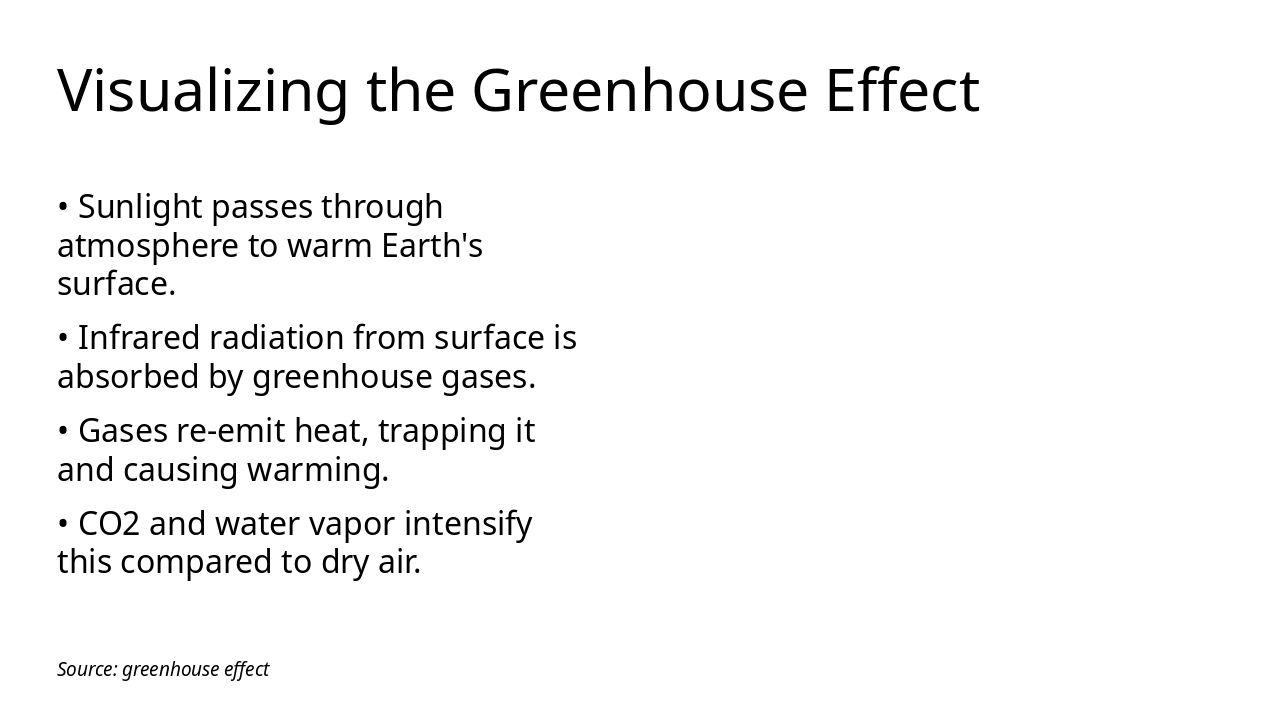
The slide illustrates the greenhouse effect, showing how sunlight penetrates the atmosphere to heat Earth's surface, which then emits infrared radiation absorbed by greenhouse gases. These gases re-emit the heat, trapping it in the atmosphere and causing global warming, with CO2 and water vapor enhancing the process more than dry air.

Visualizing the Greenhouse Effect

!Image

  • Sunlight passes through atmosphere to warm Earth's surface.
  • Infrared radiation from surface is absorbed by greenhouse gases.
  • Gases re-emit heat, trapping it and causing warming.
  • CO2 and water vapor intensify this compared to dry air.

Source: greenhouse effect

Speaker Notes
Image of Earth's atmosphere trapping heat, illustrating how greenhouse gases like CO2 and water vapor enhance warming compared to dry air.
Slide 7 - Visualizing the Greenhouse Effect
Slide 8 of 11

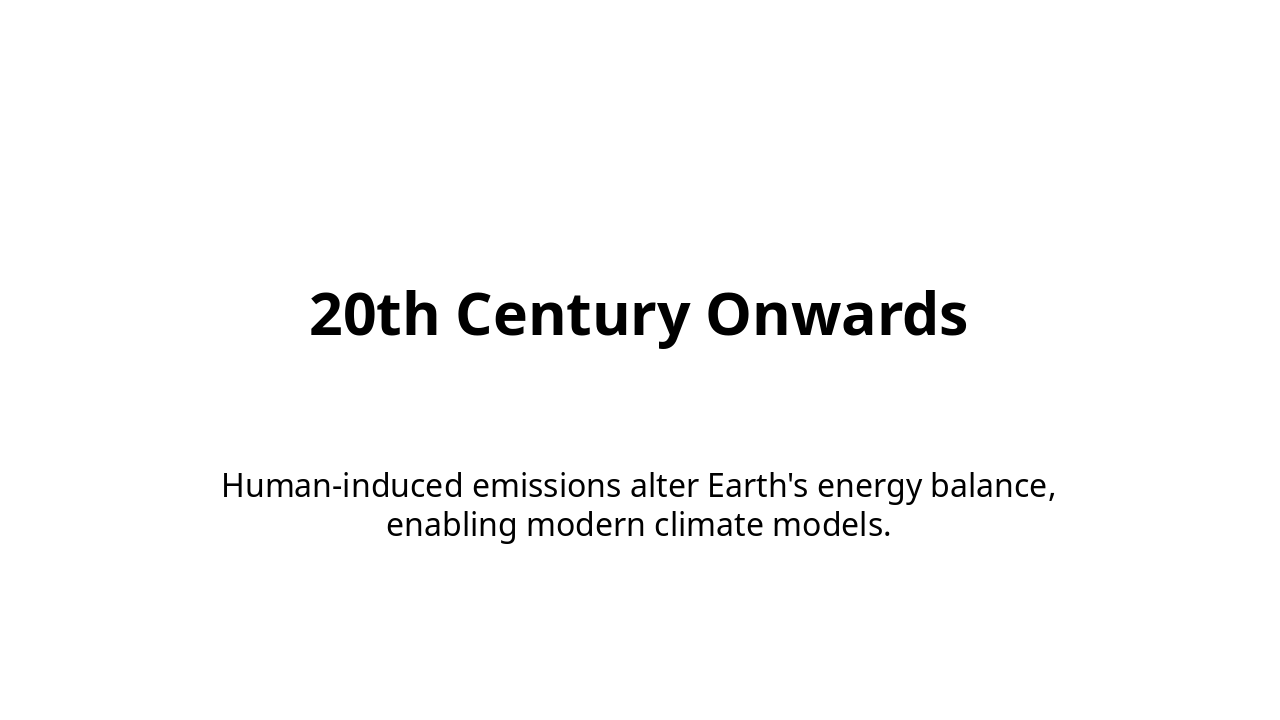
Slide 8 - 20th Century Onwards

This section header slide introduces the topic "20th Century Onwards," focusing on the period from the 20th century to the present. It highlights how human-induced emissions have disrupted Earth's energy balance, paving the way for the development of modern climate models.

20th Century Onwards

Human-induced emissions alter Earth's energy balance, enabling modern climate models.

Slide 8 - 20th Century Onwards
Slide 9 of 11

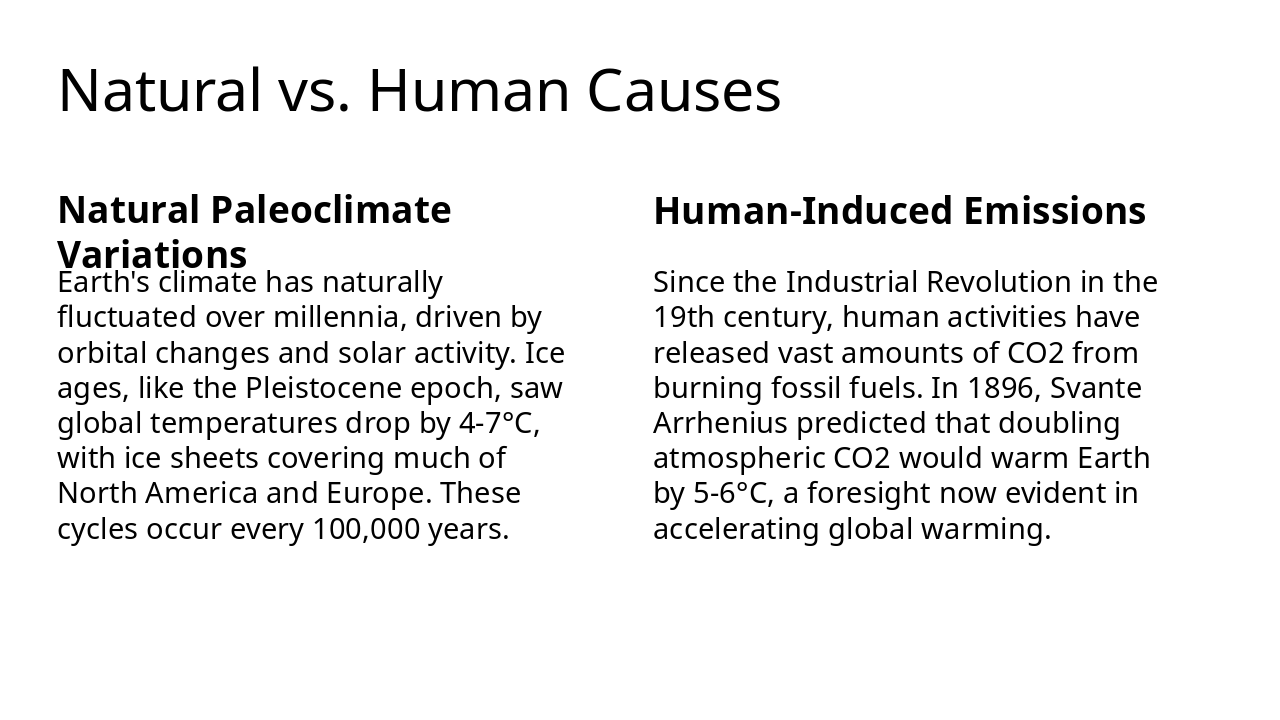
Slide 9 - Natural vs. Human Causes

The slide contrasts natural paleoclimate variations, such as ice ages driven by orbital changes and solar activity that occur every 100,000 years and lowered global temperatures by 4-7°C, with human-induced emissions from fossil fuel burning since the Industrial Revolution. It highlights Svante Arrhenius's 1896 prediction that doubling atmospheric CO2 would warm Earth by 5-6°C, a forecast now reflected in accelerating global warming.

Natural vs. Human Causes

Natural Paleoclimate VariationsHuman-Induced Emissions
Earth's climate has naturally fluctuated over millennia, driven by orbital changes and solar activity. Ice ages, like the Pleistocene epoch, saw global temperatures drop by 4-7°C, with ice sheets covering much of North America and Europe. These cycles occur every 100,000 years.Since the Industrial Revolution in the 19th century, human activities have released vast amounts of CO2 from burning fossil fuels. In 1896, Svante Arrhenius predicted that doubling atmospheric CO2 would warm Earth by 5-6°C, a foresight now evident in accelerating global warming.
Slide 9 - Natural vs. Human Causes
Slide 10 of 11

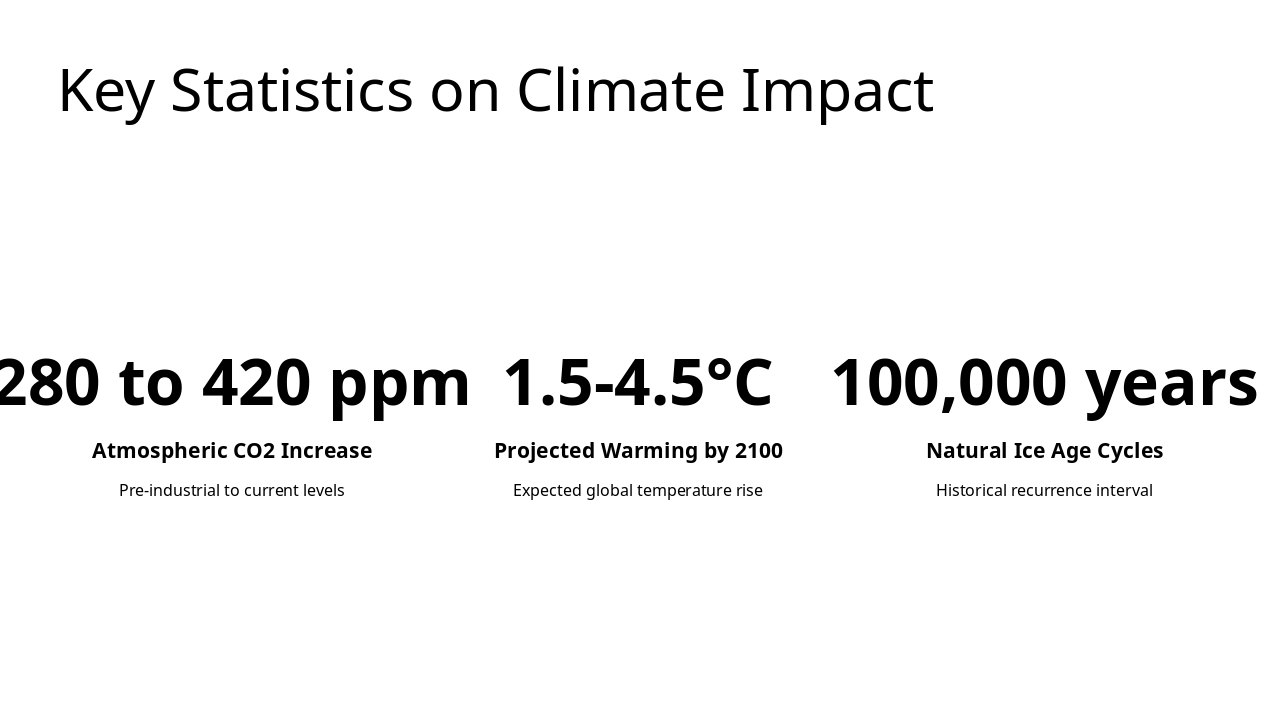
Slide 10 - Key Statistics on Climate Impact

Atmospheric CO2 levels have risen from 280 to 420 ppm since pre-industrial times, contributing to projected global warming of 1.5-4.5°C by 2100. This human-driven change disrupts natural ice age cycles, which historically recur every 100,000 years.

Key Statistics on Climate Impact

  • 280 to 420 ppm: Atmospheric CO2 Increase
  • Pre-industrial to current levels

  • 1.5-4.5°C: Projected Warming by 2100
  • Expected global temperature rise

  • 100,000 years: Natural Ice Age Cycles
  • Historical recurrence interval

Slide 10 - Key Statistics on Climate Impact
Slide 11 of 11

Slide 11 - Conclusion: Lessons from History

The conclusion slide, titled "Lessons from History," emphasizes that history calls for immediate action to address emissions. It urges commitment to reducing emissions to ensure a sustainable future.

Conclusion: Lessons from History

History demands urgent action on emissions.

Commit to reducing emissions for a sustainable future.

Speaker Notes
Scientific history underscores urgency: From early theories to today's evidence, action on emissions is crucial for mitigating climate change.
Slide 11 - Conclusion: Lessons from History
Powered by AI

Create Your Own Presentation

Generate professional presentations in seconds with Karaf's AI. Customize this presentation or start from scratch.

Create New Presentation

Powered by Karaf.ai — AI-Powered Presentation Generator