Understanding Electric Current and Voltage: Measuring in Battery-Lightbulb Circuits
Generated from prompt:
22.2 - 22.3 - What is Current and Voltage & How to measure Current and Voltage in a simple circuit (lightbulb + battery)
This educational presentation explains the fundamentals of electric current and voltage from sections 22.2-22.3. It defines current as the flow of charged particles measured in amperes with an ammeter in series, and voltage as potential difference measured in volts with a voltmeter in parallel. Using a simple battery and lightbulb circuit example, it covers concepts, visualizations, and key measurement techniques, concluding with essential takeaways for circuit analysis.
Slide 2 - Presentation Agenda
- What is Electric Current?
- What is Voltage?
- Simple Circuit: Battery + Lightbulb
- Measuring Current
- Measuring Voltage
- Key Takeaways
---
Photo by Igor Omilaev on Unsplash

Slide 3 - Electric Current

Slide 4 - What is Electric Current?
- Flow of charged particles, such as electrons, through a conductor or space
- Defined as net rate of electric charge flow through a surface
- Unit: Ampere (A), equivalent to 1 coulomb per second
- Measured using an ammeter
Source: Wikipedia: Electric current
Slide 5 - Visualizing Electric Current
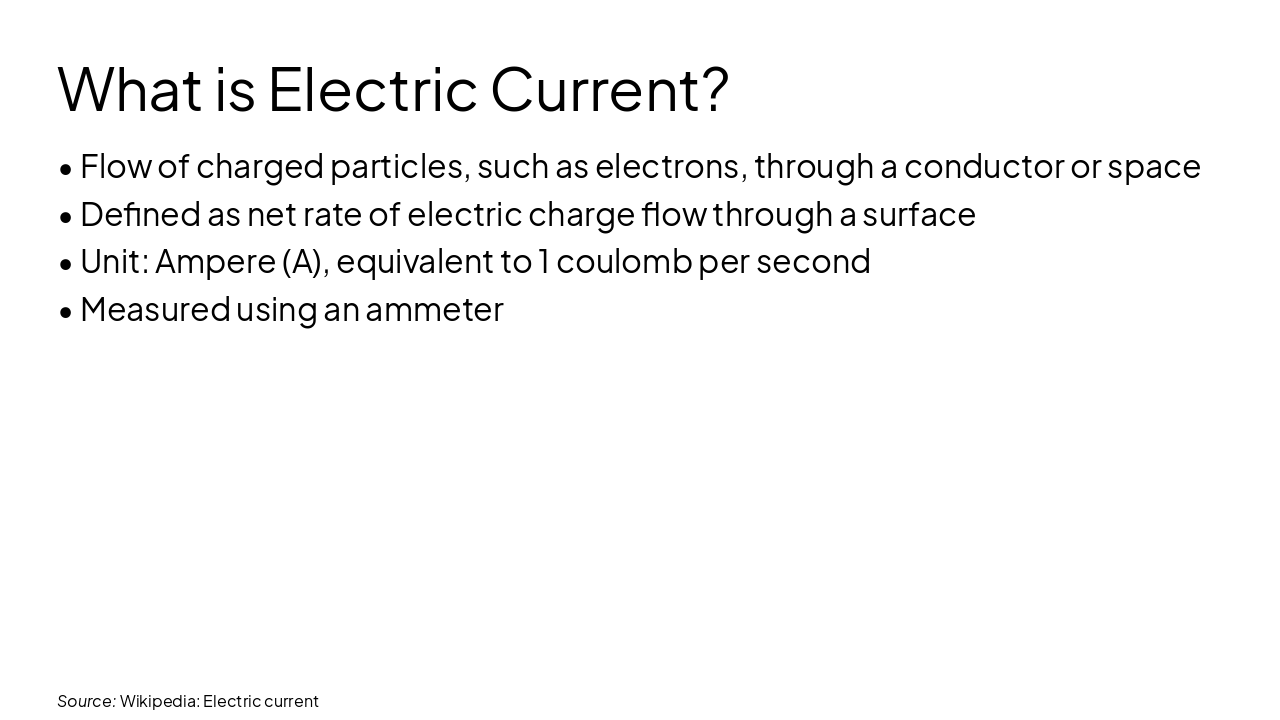
- Charge carriers (electrons in wires) move through conductor
- Causes Joule heating (light in incandescent bulbs)
- Creates magnetic fields used in motors and generators
---
Photo by EnCata PD on Unsplash
Source: Wikipedia: Electric current
Slide 6 - Voltage

Slide 7 - What is Voltage?
- Electric potential difference between two points
- Work needed per unit charge to move positive test charge
- Unit: Volt (V)
- Causes: batteries, capacitors, generators
Source: Wikipedia: Voltage & Voltmeter

Slide 9 - Battery + Lightbulb Circuit
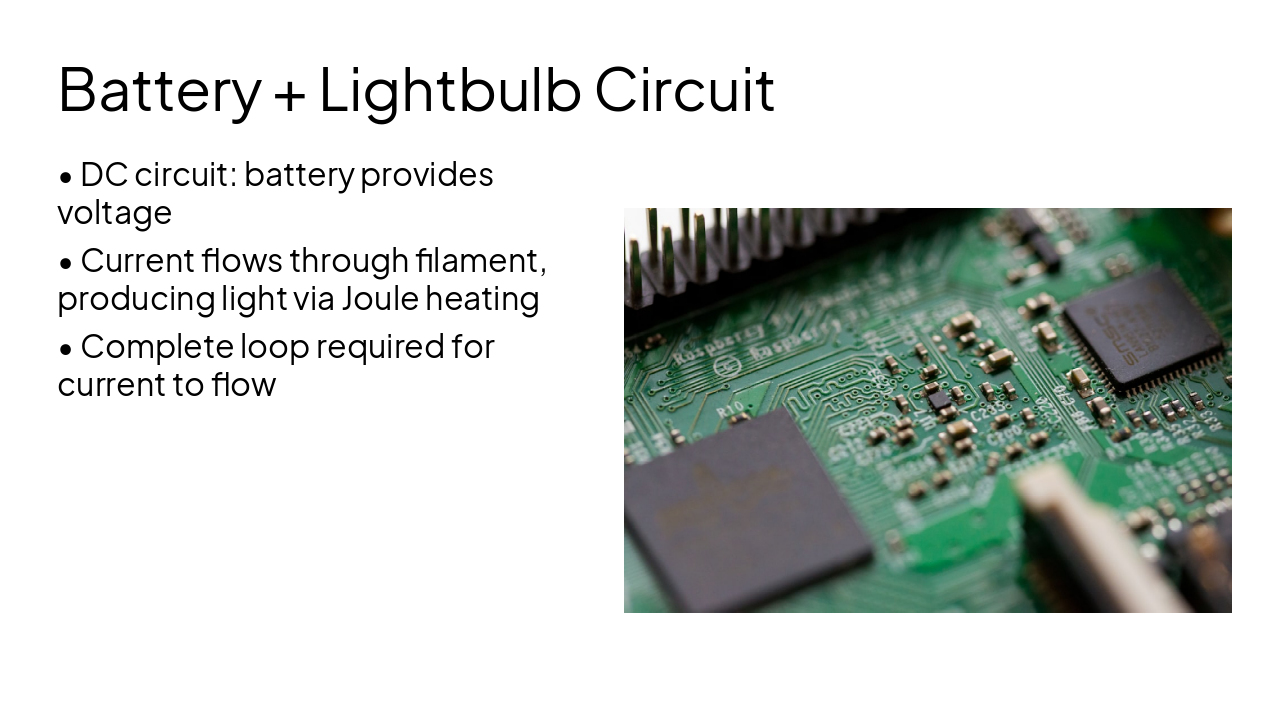
- DC circuit: battery provides voltage
- Current flows through filament, producing light via Joule heating
- Complete loop required for current to flow
---
Photo by Chris Ried on Unsplash
Slide 10 - Measuring Current in the Circuit
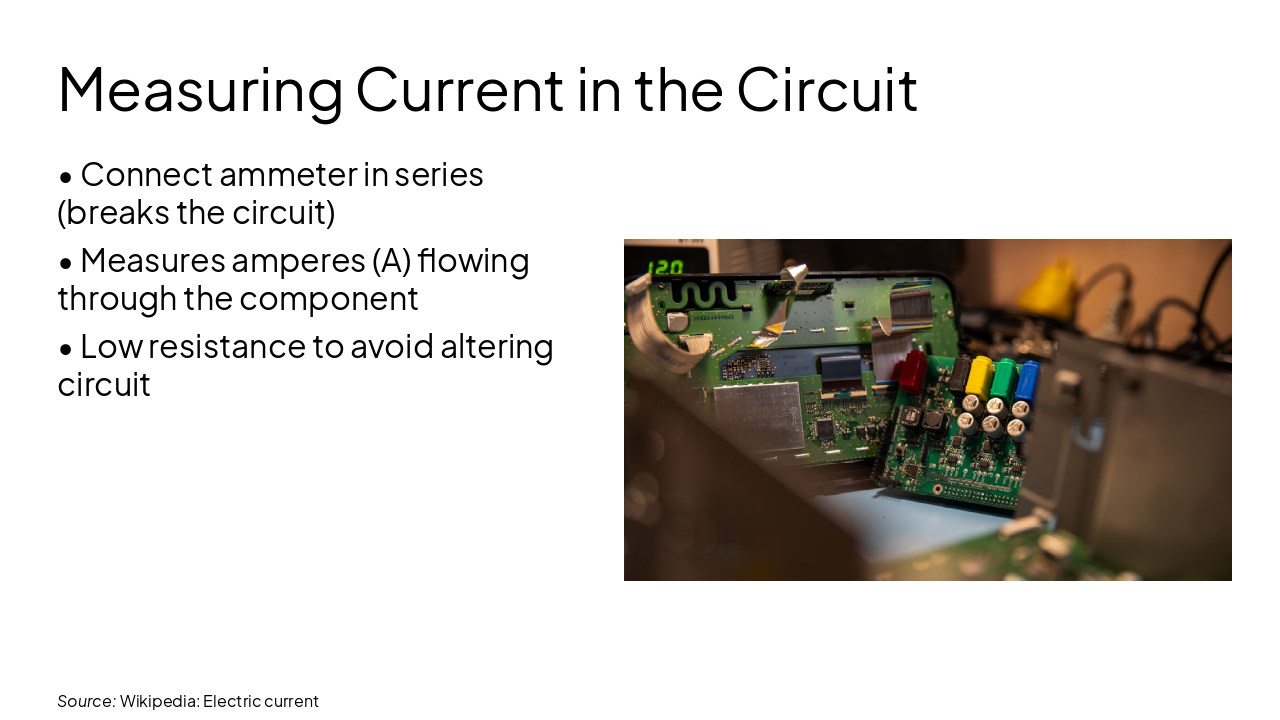
- Connect ammeter in series (breaks the circuit)
- Measures amperes (A) flowing through the component
- Low resistance to avoid altering circuit
---
Photo by Laurens van der Drift on Unsplash
Source: Wikipedia: Electric current
Slide 12 - Summary
Current: Flow of electrons (A), ammeter in SERIES Voltage: Potential difference (V), voltmeter in PARALLEL
Essential for analyzing simple circuits like battery + lightbulb
---
Photo by Igor Omilaev on Unsplash
Discover More Presentations
Explore thousands of AI-generated presentations for inspiration
Create Your Own Presentation
Generate professional presentations in seconds with Karaf's AI. Customize this presentation or start from scratch.