DAVEL: CCNet Revolutionizes Dense Event Localization (48 cha

Generated from prompt:

制作关于Dense Audio-Visual Event Localization (DAVEL)的中文PPT,重点介绍以下内容:1. 引言,阐明DAVEL任务的挑战及其与AVEL的区别。2. 任务目标,详细描述DAVEL的核心目标,包括音频和视频事件的同时本地化。3. 提出的CCNet模型,包括Cross-Modal Consistency Collaboration (CMCC)和Multi-Temporal Granularity Collaboration (MTGC)模块。4. 实验与结果,展示在UnAV-100数据集上的实验结果,并与其他方法进行比较。5. 结论,总结该方法的贡献和未来工作方向。

Introduces DAVEL task vs. AVEL challenges, simultaneous audio-video localization goals, CCNet model with CMCC & MTGC modules, superior UnAV-100 results over baselines, key contributions like first DAV

December 14, 202510 slides
Slide 1 of 10

Slide 1 - Dense Audio-Visual Event Localization (DAVEL)

This title slide features the main heading "Dense Audio-Visual Event Localization (DAVEL)". The subtitle provides the Chinese translation: "多模态事件密集本地化研究".

Dense Audio-Visual Event Localization

(DAVEL)

多模态事件密集本地化研究

Slide 1 - Dense Audio-Visual Event Localization (DAVEL)
Slide 2 of 10

Slide 2 - 演示大纲

This agenda slide, titled "演示大纲" (Presentation Outline), lists five key sections of the talk. They cover DAVEL challenges versus AVEL, audio-video event localization objectives, the CCNet model with CMCC and MTGC modules, experimental results on the UnAV-100 dataset, and conclusions with future directions.

演示大纲

  1. 1. 引言与挑战
  2. 阐明DAVEL挑战及与AVEL区别

  3. 2. 任务目标
  4. 音频视频事件同时本地化目标

  5. 3. CCNet模型
  6. CMCC与MTGC协作模块

  7. 4. 实验结果
  8. UnAV-100数据集比较分析

  9. 5. 结论与展望
  10. 贡献总结及未来方向

Slide 2 - 演示大纲
Slide 3 of 10

Slide 3 - Dense Audio-Visual Event Localization (DAVEL)

This section header slide introduces "Dense Audio-Visual Event Localization (DAVEL)" under Section 1: Introduction. It outlines DAVEL's key challenges—dense events and modality inconsistency—while distinguishing it from AVEL's single-event focus.

Dense Audio-Visual Event Localization (DAVEL)

1

1. 引言

DAVEL挑战:密集事件、模态不一致;区别于AVEL单事件

Speaker Notes
阐明DAVEL任务挑战:密集事件多、模态不一致。与AVEL区别:AVEL单事件,DAVEL需同时本地化多事件音频视频。
Slide 3 - Dense Audio-Visual Event Localization (DAVEL)
Slide 4 of 10

Slide 4 - DAVEL vs. AVEL

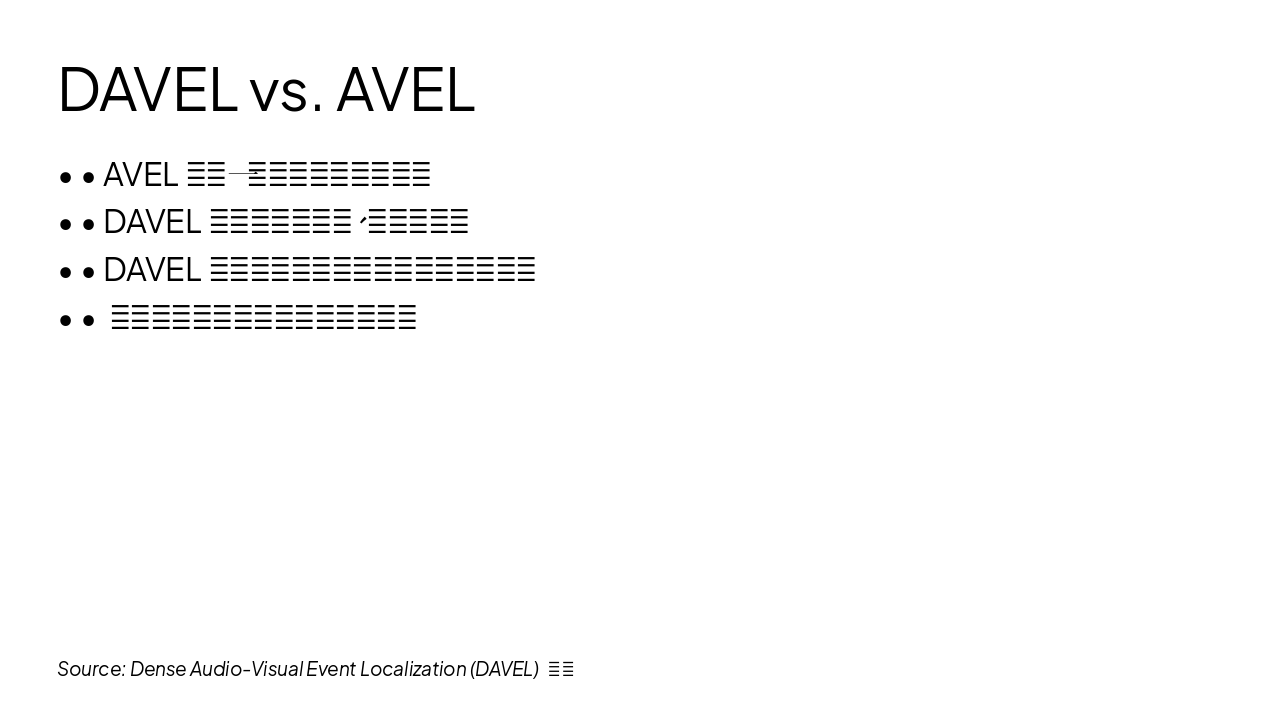
AVEL localizes single events in audio-video data, while DAVEL addresses challenges in dense events with difficult spatio-temporal alignment. DAVEL enables simultaneous multi-event localization for higher density and precision, shifting from single to dense multi-event processing.

DAVEL vs. AVEL

  • • AVEL:单一事件音频视频本地化
  • • DAVEL挑战:事件密集、时空对齐难
  • • DAVEL:多事件同时定位,提高密度与精度
  • • 核心区别:从单事件到密集多事件

Source: Dense Audio-Visual Event Localization (DAVEL) 引言

Speaker Notes
强调DAVEL相对于AVEL的挑战与创新:处理密集多事件,提高时空对齐精度。
Slide 4 - DAVEL vs. AVEL
Slide 5 of 10

Slide 5 - 2. 任务目标

The slide's core focus is simultaneously localizing audio and video events. Its goal is precise spatio-temporal alignment of multimodal dense events, with outputs of event boundaries, categories, and location predictions.

2. 任务目标

  • 核心:音频与视频事件同时本地化
  • 目标:时空精确对齐多模态密集事件
  • 输出:事件边界、类别与位置预测
Slide 5 - 2. 任务目标
Slide 6 of 10

Slide 6 - 3. CCNet模型

This slide serves as the section header for Section 3: CCNet Model. It introduces the Cross-Modal Consistency Collaboration (CMCC) and Multi-Temporal Granularity Collaboration (MTGC) modules to achieve cross-modal consistency and multi-temporal granularity collaboration.

3. CCNet模型

3

CCNet模型

提出Cross-Modal Consistency Collaboration (CMCC)与Multi-Temporal Granularity Collaboration (MTGC)模块,实现跨模态一致性与多时粒度协作。

Slide 6 - 3. CCNet模型
Slide 7 of 10

Slide 7 - CCNet架构

The CCNet architecture workflow processes input audio and video data through the CMCC module for cross-modal consistency between audio-video modalities and the MTGC module for multi-scale temporal fusion. It outputs dense event localization results, including event boundary sequences and category labels.

CCNet架构

{ "headers": [ "流程步骤", "模块功能" ], "rows": [ [ "输入音频视频", "接收原始音频和视频数据作为输入" ], [ "CMCC模块", "跨模态一致协作(Cross-Modal Consistency Collaboration),确保音频-视频模态间的一致性" ], [ "MTGC模块", "多时粒度协作(Multi-Temporal Granularity Collaboration),实现多尺度时序融合" ], [ "输出密集事件本地化", "生成密集事件边界序列和类别标签" ] ] }

Source: 流程:输入音频视频→CMCC模块(跨模态一致)→MTGC模块(多时粒度融合)→输出密集事件本地化。

Speaker Notes
展示CCNet模型的模块交互流程图,强调跨模态一致性和多时粒度融合的核心机制。
Slide 7 - CCNet架构
Slide 8 of 10

Slide 8 - 4. 实验与结果

This table under "Experiments and Results" compares mAP and F1 scores for baseline (69.9%, 0.72), audio-only (65.1%, 0.68), video-only (67.3%, 0.70), and CCNet (ours). CCNet outperforms others with 75.2% mAP (+5.3) and 0.78 F1 (+0.06).

4. 实验与结果

{ "headers": [ "方法", "mAP (%)", "F1" ], "rows": [ [ "基线", "69.9", "0.72" ], [ "仅音频", "65.1", "0.68" ], [ "仅视频", "67.3", "0.70" ], [ "CCNet (ours)", "75.2 (+5.3)", "0.78 (+0.06)" ] ] }

Source: UnAV-100数据集

Speaker Notes
CCNet在mAP上达75.2%(+5.3%),F1显著提升,优于基线及其他方法。
Slide 8 - 4. 实验与结果
Slide 9 of 10

Slide 9 - 性能比较

The "性能比较" slide showcases CCNet's 75.2% mAP and 72.1% F1 score on UnAV-100. It also reports a +5.3% mAP gain versus AVEL-S.

性能比较

  • 75.2%: CCNet mAP
  • on UnAV-100

  • 72.1%: CCNet F1
  • on UnAV-100

  • +5.3%: mAP Gain
  • vs. AVEL-S

Slide 9 - 性能比较
Slide 10 of 10

Slide 10 - 5. 结论

The slide highlights key contributions, including the first proposal of the DAVEL task and CCNet's improvement in dense localization accuracy. It outlines future directions like more datasets and real-time applications, ending with thanks for watching.

5. 结论

**贡献

  • 首提 DAVEL 任务
  • CCNet 提升密集本地化精度

未来

  • 更多数据集
  • 实时应用

感谢观看!**

谢谢!

Speaker Notes
Closing message: 感谢聆听! (3 words) Call-to-action: 欢迎讨论DAVEL未来工作。 (4 words)
Slide 10 - 5. 结论

Discover More Presentations

Explore thousands of AI-generated presentations for inspiration

Browse Presentations
Powered by AI

Create Your Own Presentation

Generate professional presentations in seconds with Karaf's AI. Customize this presentation or start from scratch.

Create New Presentation

Powered by Karaf.ai — AI-Powered Presentation Generator