KPI Institute: Comprehensive Framework (38 chars)

Generated from prompt:

Create a professional presentation titled 'Key Performance Indicators (KPIs)' based entirely on the provided Word document titled 'KPI Institute map - in word version'. Do not delete or summarize any content — instead, organize and structure it clearly across slides. The presentation should include: 1. **Title Slide** — The KPI Institute, with subtitle 'Comprehensive KPI Framework'. 2. **Overview** — The value added by KPIs (Improvement, Clarity, Focus, Engagement, Learning, Communication). 3. **Organizational Levels** — Organizational, Departmental, Team, Employee, PMS. 4. **General Structure** — Corporate identity, mission, vision, values, strategy formulation, value drivers, goals, objectives, etc. 5. **Desired State of Evolution** — Identity and purpose, success factors, relationships, brand, vision, strategy map. 6. **Performance Scorecard** — Objectives, KPIs, trends, targets, and comments. 7. **Performance Dashboard** — Process trends and KPI documentation. 8. **Portfolio of Initiatives** — Initiative details, administrators, risks, and dependencies. 9. **KPI Framework Governance** — Roles of top management, strategy office, and departments. 10. **Terminology and KPI Types** — KRAs, PIs, SMART objectives, leading vs lagging, efficiency vs effectiveness. 11. **KPI DNA Map** — Dimensions (Time, Cost, Quality, Quantity) and KPI selection process. 12. **Target Setting Process** — Documentation, trends, and data quality dimensions. 13. **Data Gathering and Governance** — Roles of custodians, sources, and activation tools. 14. **Closing Slide** — KPI Activation Tools: templates, forms, dashboards. Maintain a corporate and educational visual style, using blue and white as primary colors.

Explores KPI value, organizational levels, structure, scorecards, dashboards, initiatives, governance, terminology, DNA map, target setting, data processes, and activation tools for performance excell

December 8, 202514 slides
Slide 1 of 14

Slide 1 - The KPI Institute

This is a title slide for The KPI Institute. It features the subtitle "Comprehensive KPI Framework."

The KPI Institute

Comprehensive KPI Framework

Source: KPI Institute map - in word version

Speaker Notes
Title slide for professional presentation on Key Performance Indicators (KPIs).
Slide 1 - The KPI Institute
Slide 2 of 14

Slide 2 - Overview

The Overview slide lists key benefits of the system or process. These include driving continuous improvement, providing performance clarity, enhancing strategic focus, boosting stakeholder engagement, facilitating organizational learning, and improving communication effectiveness.

Overview

  • Drives continuous improvement
  • Provides performance clarity
  • Enhances strategic focus
  • Boosts stakeholder engagement
  • Facilitates organizational learning
  • Improves communication effectiveness

Source: KPI Institute map - in word version

Speaker Notes
Highlight the six key values KPIs add to organizations: Improvement, Clarity, Focus, Engagement, Learning, and Communication.
Slide 2 - Overview
Slide 3 of 14

Slide 3 - Organizational Levels

This agenda slide, titled "Organizational Levels," outlines the structure to be discussed. It lists the following items: Organizational, Departmental, Team, Employee, and PMS.

Organizational Levels

  1. Organizational
  2. Departmental
  3. Team
  4. Employee
  5. PMS

Source: KPI Institute map - in word version

Speaker Notes
Organizational, Departmental, Team, Employee, PMS.
Slide 3 - Organizational Levels
Slide 4 of 14

Slide 4 - General Structure

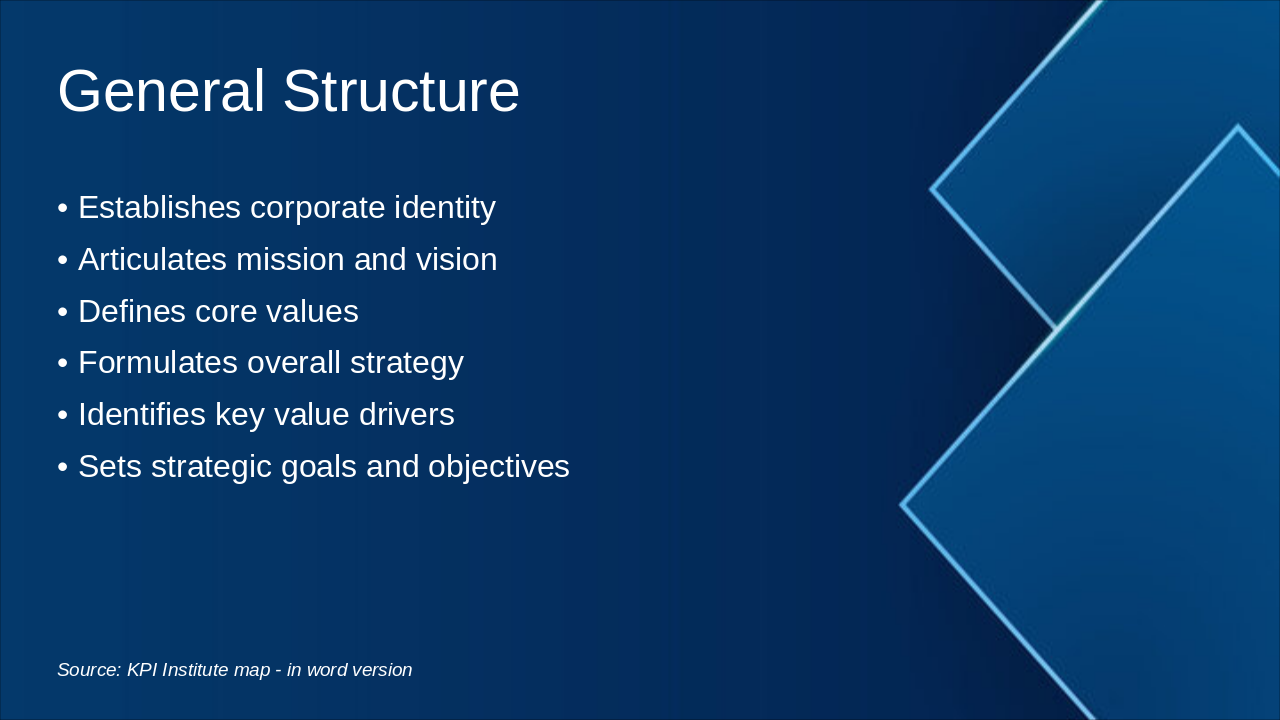
The "General Structure" slide outlines foundational elements of corporate strategy. It covers establishing corporate identity, articulating mission and vision, defining core values, formulating overall strategy, identifying key value drivers, and setting strategic goals and objectives.

General Structure

  • Establishes corporate identity
  • Articulates mission and vision
  • Defines core values
  • Formulates overall strategy
  • Identifies key value drivers
  • Sets strategic goals and objectives

Source: KPI Institute map - in word version

Slide 4 - General Structure
Slide 5 of 14

Slide 5 - Desired State of Evolution

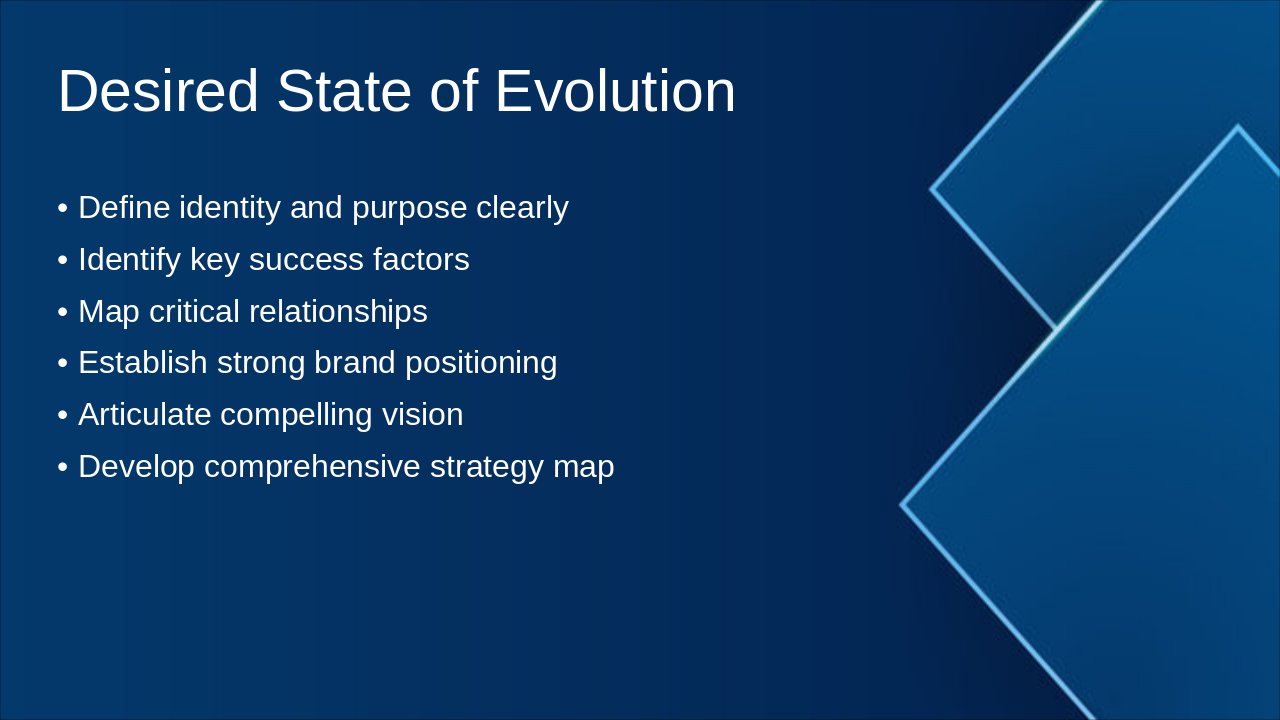
The "Desired State of Evolution" slide outlines key steps for achieving an advanced organizational state. It lists defining identity and purpose, identifying success factors, mapping relationships, establishing brand positioning, articulating a vision, and developing a strategy map.

Desired State of Evolution

  • Define identity and purpose clearly
  • Identify key success factors
  • Map critical relationships
  • Establish strong brand positioning
  • Articulate compelling vision
  • Develop comprehensive strategy map
Slide 5 - Desired State of Evolution
Slide 6 of 14

Slide 6 - Performance Scorecard

The left column of the Performance Scorecard slide covers objectives, KPIs, trends, and targets for outlining goals, measuring performance, visualizing data, and setting benchmarks. The right column provides comments and analysis, interpreting variances, explaining influences, and offering recommendations for enhancements.

Performance Scorecard

Objectives, KPIs, Trends, TargetsComments and Analysis
Objectives outline strategic goals. KPIs quantify performance metrics. Trends visualize historical data patterns. Targets establish measurable benchmarks for achievement and improvement tracking.Interpret variances from targets. Explain trends and influencing factors. Provide recommendations, action plans, and qualitative insights to drive performance enhancements.

Source: KPI Institute map - in word version

Speaker Notes
Highlight how the Performance Scorecard integrates objectives, KPIs, trends, targets with analytical comments for actionable insights.
Slide 6 - Performance Scorecard
Slide 7 of 14

Slide 7 - Performance Dashboard

The Performance Dashboard slide highlights visualizing key process trends over time and documenting KPIs with definitions and formulas. It also covers integrating trends and metrics for insights, real-time monitoring, and proactive decision-making.

Performance Dashboard

  • Visualize key process trends over time.
  • Document KPIs with definitions and formulas.
  • Integrate trends and metrics for insights.
  • Enable real-time performance monitoring.
  • Support proactive decision-making processes.

Source: KPI Institute map - in word version

Speaker Notes
Highlight how the dashboard integrates process trends with detailed KPI documentation for real-time oversight and informed decision-making.
Slide 7 - Performance Dashboard
Slide 8 of 14

Slide 8 - Portfolio of Initiatives

The Portfolio of Initiatives slide details objectives, timelines, resources, deliverables, administrators, owners, accountability structures, risks with mitigation strategies, and dependencies on other initiatives, KPIs, and resources. It also tracks progress, outcomes, and alignment to overall strategy.

Portfolio of Initiatives

  • Details initiative objectives, timelines, resources, and deliverables.
  • Identifies administrators, owners, and accountability structures.
  • Assesses risks with mitigation strategies and contingency plans.
  • Maps dependencies on other initiatives, KPIs, and resources.
  • Tracks progress, outcomes, and alignment to strategy.

Source: KPI Institute map - in word version

Speaker Notes
Emphasize how this portfolio links initiatives to KPIs, highlighting governance of risks and dependencies for strategic alignment.
Slide 8 - Portfolio of Initiatives
Slide 9 of 14

Slide 9 - Key Performance Indicators (KPIs)

This section header slide, titled "Key Performance Indicators (KPIs)", introduces Section 09 on KPI Framework Governance. The subtitle outlines the roles of top management, strategy office, and departments.

Key Performance Indicators (KPIs)

09

KPI Framework Governance

Roles of top management, strategy office, and departments.

Source: KPI Institute map - in word version

Speaker Notes
Discuss the roles and responsibilities in KPI framework governance: top management oversight, strategy office coordination, and departmental execution.
Slide 9 - Key Performance Indicators (KPIs)
Slide 10 of 14

Slide 10 - Terminology and KPI Types

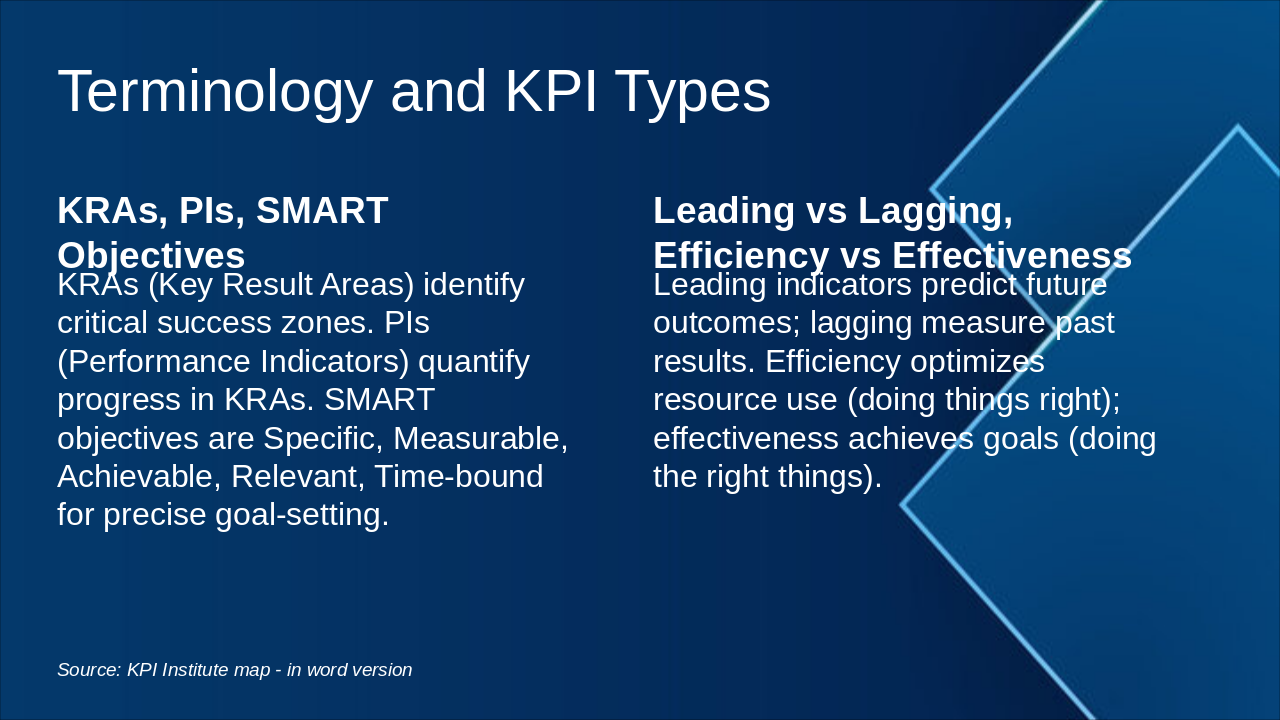
The slide defines KRAs as critical success areas, PIs as measures of progress within them, and SMART objectives as specific, measurable, achievable, relevant, and time-bound goals. It contrasts leading indicators (predicting future outcomes) with lagging ones (measuring past results), and efficiency (optimizing resources) with effectiveness (achieving goals).

Terminology and KPI Types

KRAs, PIs, SMART ObjectivesLeading vs Lagging, Efficiency vs Effectiveness
KRAs (Key Result Areas) identify critical success zones. PIs (Performance Indicators) quantify progress in KRAs. SMART objectives are Specific, Measurable, Achievable, Relevant, Time-bound for precise goal-setting.Leading indicators predict future outcomes; lagging measure past results. Efficiency optimizes resource use (doing things right); effectiveness achieves goals (doing the right things).

Source: KPI Institute map - in word version

Speaker Notes
Introduce core terminology: KRAs and PIs as foundational, SMART for objectives. Contrast leading/lagging for timing, efficiency/effectiveness for focus.
Slide 10 - Terminology and KPI Types
Slide 11 of 14

Slide 11 - KPI DNA Map

The KPI DNA Map slide outlines 4 core dimensions (Time, Cost, Quality, Quantity) with 100% balanced coverage of all performance aspects. It also details 6 selection criteria for KPI identification and 90% success in mapping KPIs to these dimensions.

KPI DNA Map

  • 4: Core Dimensions
  • Time, Cost, Quality, Quantity

  • 100%: Balanced Coverage
  • All performance aspects measured

  • 6: Selection Criteria
  • Steps for KPI identification

  • 90%: Alignment Success

KPIs mapped to dimensions Source: KPI Institute map - in word version

Speaker Notes
Highlight the four core dimensions (Time, Cost, Quality, Quantity) and the structured KPI selection process.
Slide 11 - KPI DNA Map
Slide 12 of 14

Slide 12 - Target Setting Process

The Target Setting Process begins by reviewing KPI documentation, analyzing historical performance trends, and evaluating data quality for accuracy and completeness. It then establishes realistic, challenging targets aligned with strategic objectives and baselines.

Target Setting Process

  • Review comprehensive KPI documentation
  • Analyze historical performance trends
  • Evaluate data quality dimensions (accuracy, completeness)
  • Establish realistic, challenging targets
  • Align with strategic objectives and baselines

Source: KPI Institute map - in word version

Speaker Notes
Highlight how documentation, trends, and data quality ensure robust target setting.
Slide 12 - Target Setting Process
Slide 13 of 14

Slide 13 - Data Gathering and Governance

Custodians own, validate, and ensure data accuracy from sources like systems, reports, and manual inputs, with activation tools automating collection and integration. Governance frameworks enforce quality and compliance standards.

Data Gathering and Governance

  • Custodians own, validate, and ensure data accuracy.
  • Sources include systems, reports, and manual inputs.
  • Activation tools automate collection and integration processes.
  • Governance frameworks enforce quality and compliance standards.

Source: KPI Institute map - in word version

Speaker Notes
Highlight the critical roles in ensuring reliable KPI data: custodians for ownership, sources for origin, and tools for activation.
Slide 13 - Data Gathering and Governance
Slide 14 of 14

Slide 14 - Closing Slide

This closing slide promotes empowering performance through KPI activation tools. It highlights templates, forms, and dashboards, urging viewers to explore them for immediate KPI activation.

Closing Slide

Empower performance with KPI activation tools.

KPI Activation Tools: templates, forms, dashboards.

Explore templates, forms, and dashboards to activate your KPIs today.

Source: KPI Institute map - in word version

Slide 14 - Closing Slide

Discover More Presentations

Explore thousands of AI-generated presentations for inspiration

Browse Presentations
Powered by AI

Create Your Own Presentation

Generate professional presentations in seconds with Karaf's AI. Customize this presentation or start from scratch.

Create New Presentation

Powered by Karaf.ai — AI-Powered Presentation Generator