Exploring Artificial Intelligence

Generated from prompt:

Create a presentation about artificial intelligence

This presentation introduces AI fundamentals, including its core definition, goals compared to human intelligence, key areas like reasoning and knowledge representation, everyday applications such as

November 9, 202510 slides
Slide 1 of 10

Slide 1 - Artificial Intelligence

The slide features the main title "Artificial Intelligence" as a title slide. Its subtitle introduces the topic by exploring the definition, components, and impact of AI.

Artificial Intelligence

Exploring the Definition, Components, and Impact of AI

Source: User request: Create a presentation about artificial intelligence

--- Speaker Notes: Welcome to the world of AI. This presentation explores its definition, key components, and impact.
Slide 1
Slide 2 of 10

Slide 2 - Presentation Agenda

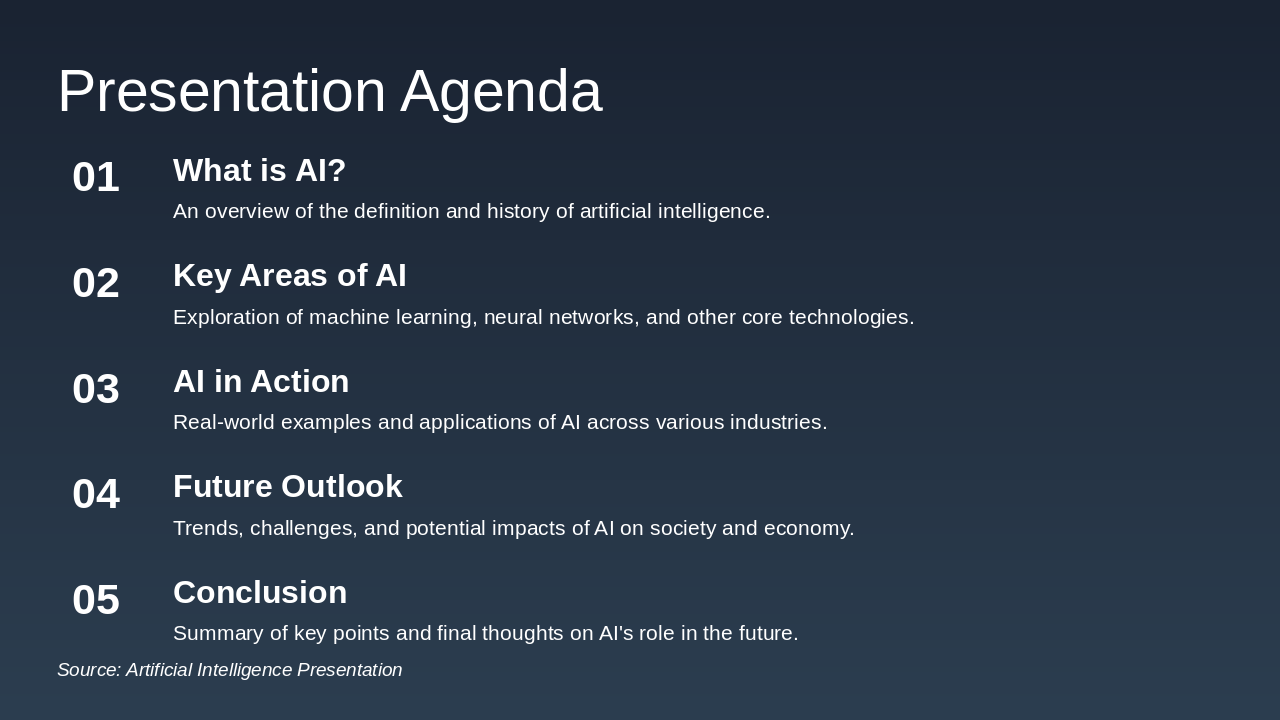
The presentation agenda outlines a structured overview of artificial intelligence, starting with its definition and history in the section "What is AI?" It then covers key areas like machine learning and neural networks, real-world applications across industries, future trends and challenges, and concludes with a summary of AI's societal and economic impacts.

Presentation Agenda

  1. What is AI?

An overview of the definition and history of artificial intelligence.

  1. Key Areas of AI

Exploration of machine learning, neural networks, and other core technologies.

  1. AI in Action

Real-world examples and applications of AI across various industries.

  1. Future Outlook

Trends, challenges, and potential impacts of AI on society and economy.

  1. Conclusion

Summary of key points and final thoughts on AI's role in the future.

Source: Artificial Intelligence Presentation

Slide 2
Slide 3 of 10

Slide 3 - What is Artificial Intelligence?

This section header slide, titled "What is Artificial Intelligence?" and numbered 02, introduces the core concept of AI. It features a subtitle defining AI as enabling machines to mimic human intelligence through processes like learning, reasoning, and decision-making.

What is Artificial Intelligence?

02

What is Artificial Intelligence?

Enabling machines to mimic human intelligence through learning, reasoning, and decision-making.

Source: AI Presentation

--- Speaker Notes: AI enables machines to perform tasks like human intelligence: learning, reasoning, problem-solving, perception, and decision-making.

Slide 3
Slide 4 of 10

Slide 4 - Core Definition of AI

AI is fundamentally defined as the study of methods enabling machines to perceive their environments and employ learning and intelligence to accomplish specific goals. It emphasizes tasks that demand human-level intelligence.

Core Definition of AI

  • AI studies methods for machines to perceive environments
  • Employs learning and intelligence to achieve specific goals
  • Focuses on tasks requiring human-level intelligence
Slide 4
Slide 5 of 10

Slide 5 - AI Goals vs. Human Intelligence

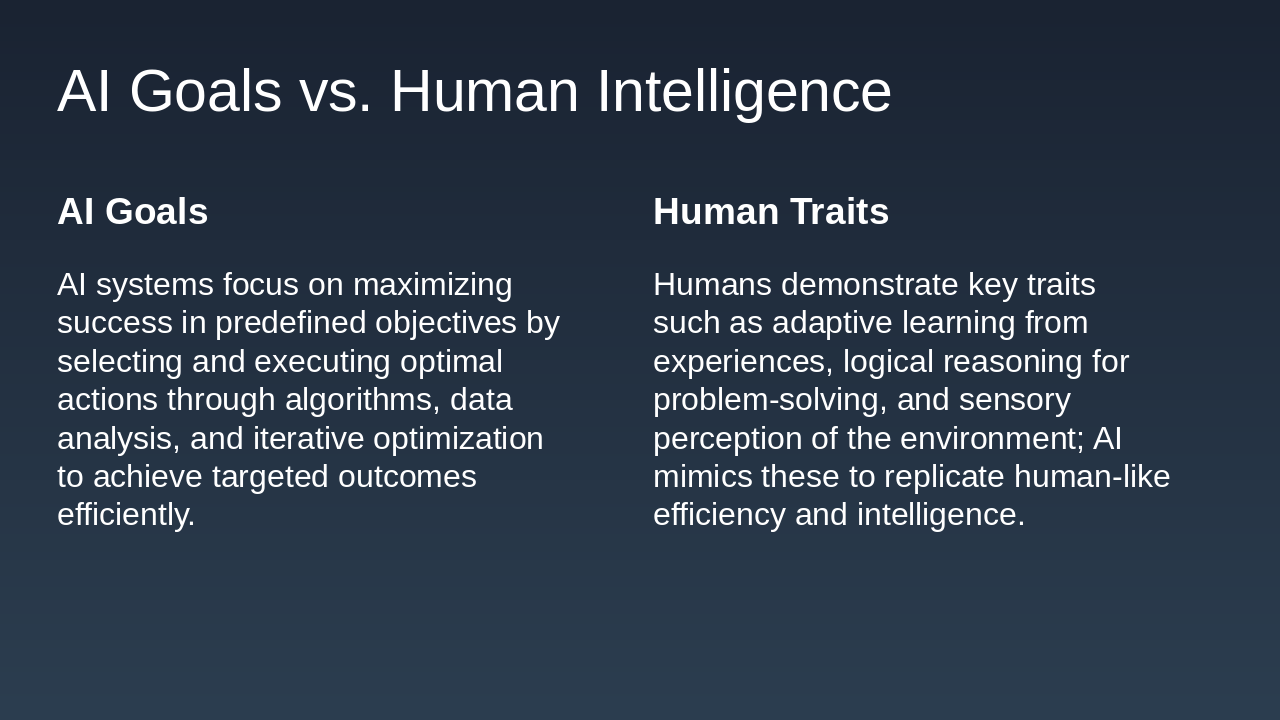
The slide contrasts AI goals with human intelligence traits in a two-column format. On the left, it describes AI as systems that optimize predefined objectives through algorithms, data analysis, and iterative actions for efficient outcomes; on the right, it highlights human adaptive learning, logical reasoning, and sensory perception, which AI aims to mimic for human-like efficiency.

AI Goals vs. Human Intelligence

AI GoalsHuman Traits
AI systems focus on maximizing success in predefined objectives by selecting and executing optimal actions through algorithms, data analysis, and iterative optimization to achieve targeted outcomes efficiently.Humans demonstrate key traits such as adaptive learning from experiences, logical reasoning for problem-solving, and sensory perception of the environment; AI mimics these to replicate human-like efficiency and intelligence.
Slide 5
Slide 6 of 10

Slide 6 - Key Areas in AI

The slide titled "Key Areas in AI" outlines four fundamental aspects of artificial intelligence. These include reasoning and problem-solving for logical deduction, knowledge representation for effective information storage and use, planning and decision-making for strategic optimization, and learning for adaptation through data experiences.

Key Areas in AI

  • Reasoning and problem-solving: Enables logical deduction and inference.
  • Knowledge representation: Facilitates storing and utilizing information effectively.
  • Planning and decision-making: Supports strategic choices and optimization.
  • Learning: Allows adaptation and improvement from data experiences.
Slide 6
Slide 7 of 10

Slide 7 - AI in Everyday Life

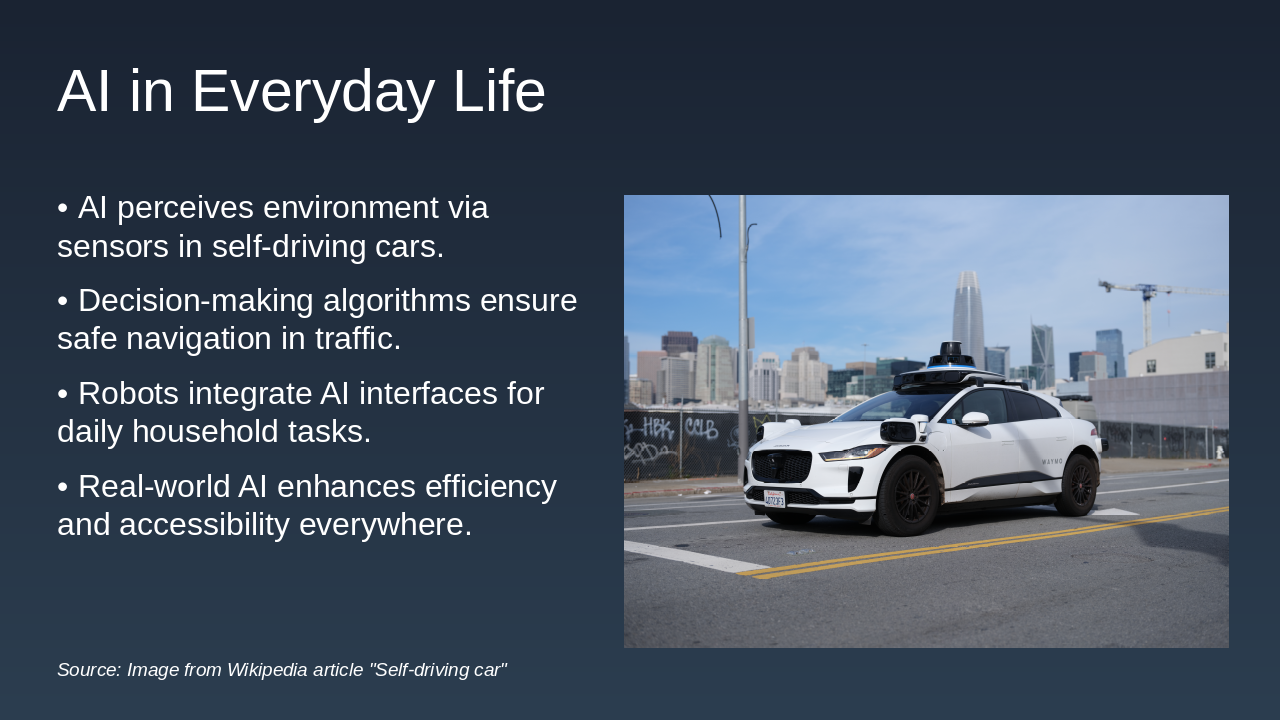
AI plays a key role in everyday life through self-driving cars, where sensors perceive the environment and decision-making algorithms ensure safe navigation in traffic. Additionally, robots with AI interfaces handle household tasks, enhancing overall efficiency and accessibility in real-world applications.

AI in Everyday Life

!Image

  • AI perceives environment via sensors in self-driving cars.
  • Decision-making algorithms ensure safe navigation in traffic.
  • Robots integrate AI interfaces for daily household tasks.
  • Real-world AI enhances efficiency and accessibility everywhere.

Source: Image from Wikipedia article "Self-driving car"

Slide 7
Slide 8 of 10

Slide 8 - A Famous AI Insight

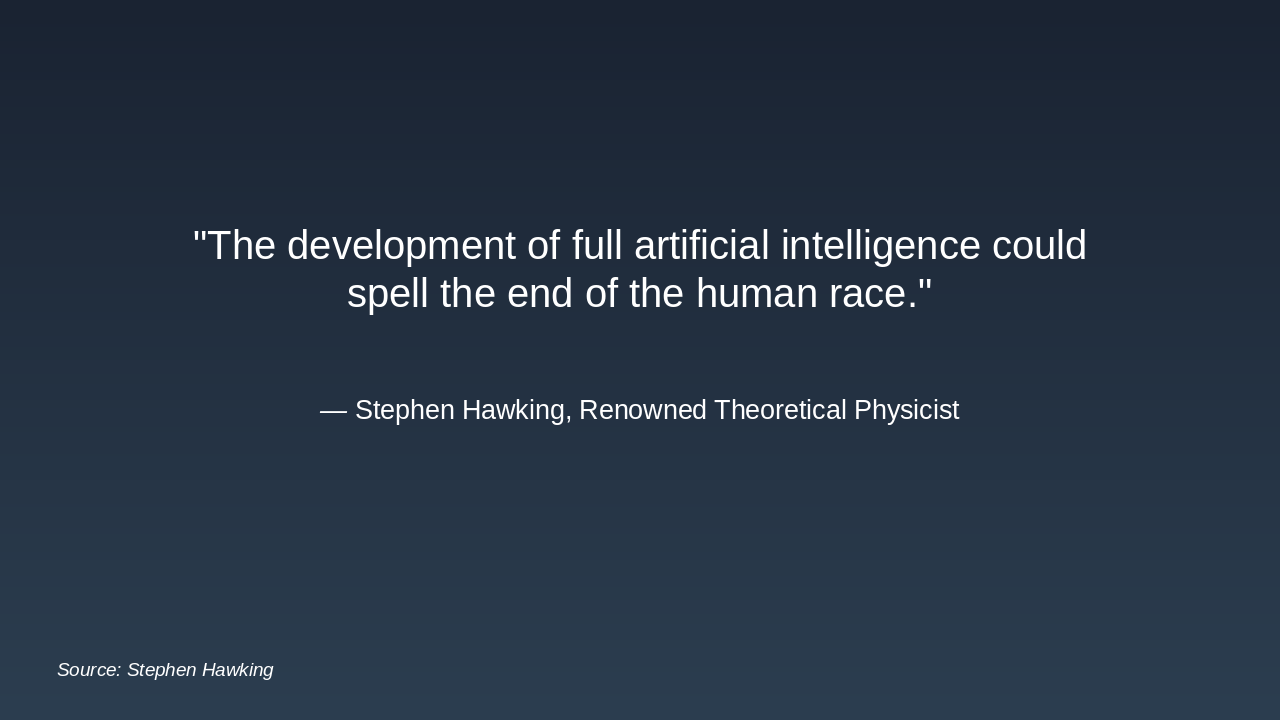
This slide, titled "A Famous AI Insight," features a quote slide type presenting a stark warning about artificial intelligence. It quotes Stephen Hawking, the renowned theoretical physicist, stating: "The development of full artificial intelligence could spell the end of the human race."

A Famous AI Insight

> The development of full artificial intelligence could spell the end of the human race.

— Stephen Hawking, Renowned Theoretical Physicist

Source: Stephen Hawking

--- Speaker Notes: Reflects AI's profound potential.

Slide 8
Slide 9 of 10

Slide 9 - AI Impact Statistics

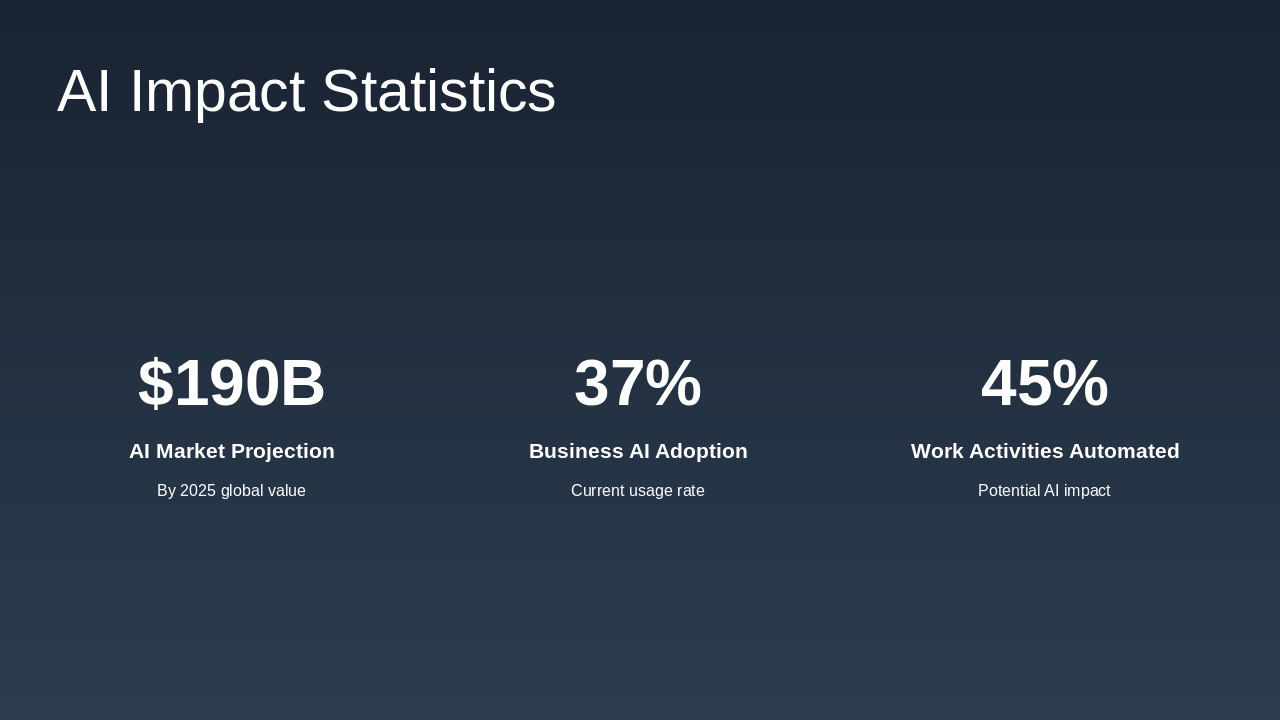
The AI Impact Statistics slide projects the global AI market to reach $190 billion by 2025. It also highlights that 37% of businesses currently adopt AI, with potential to automate 45% of work activities.

AI Impact Statistics

  • $190B: AI Market Projection

By 2025 global value

  • 37%: Business AI Adoption

Current usage rate

  • 45%: Work Activities Automated

Potential AI impact

Slide 9
Slide 10 of 10

Slide 10 - Conclusion: The Future of AI

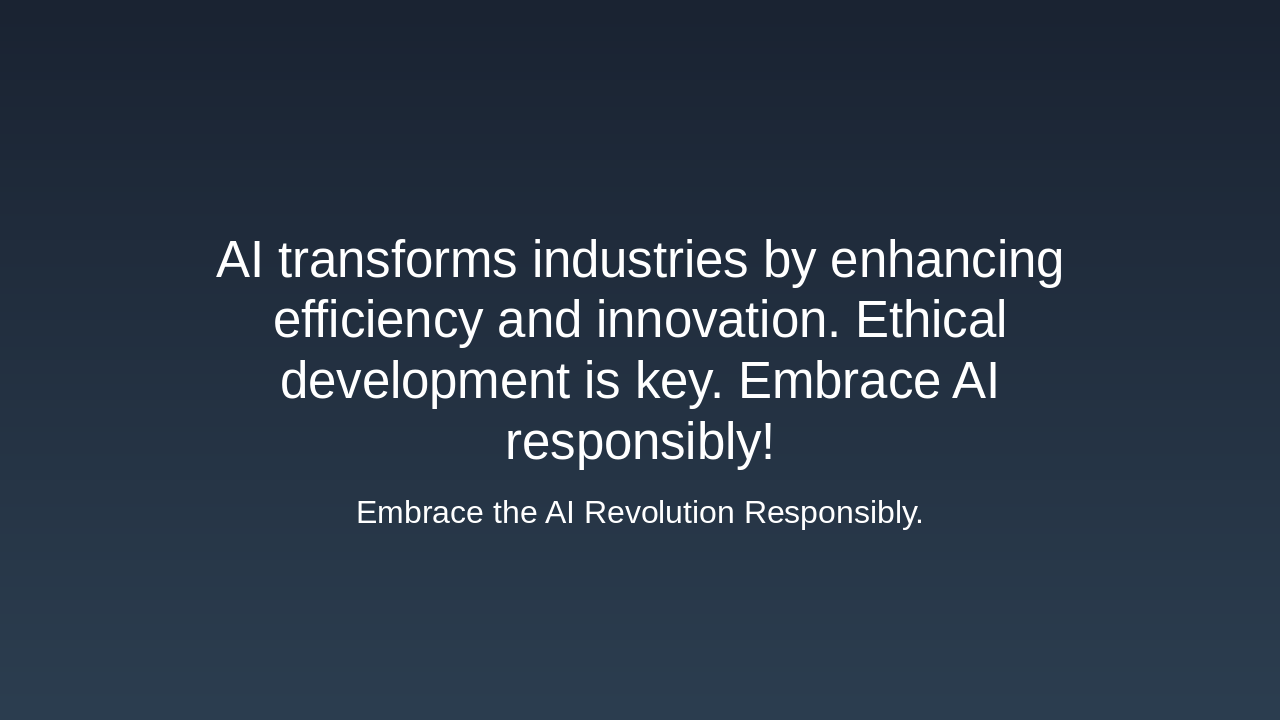
The conclusion slide, titled "The Future of AI," highlights how AI is revolutionizing industries through improved efficiency and innovation. It stresses the importance of ethical development and urges embracing AI responsibly, as echoed in the subtitle "Embrace the AI Revolution Responsibly."

Conclusion: The Future of AI

AI transforms industries by enhancing efficiency and innovation. Ethical development is key. Embrace AI responsibly!

Embrace the AI Revolution Responsibly.

Slide 10
Powered by AI

Create Your Own Presentation

Generate professional presentations in seconds with Karaf's AI. Customize this presentation or start from scratch.

Create New Presentation

Powered by Karaf.ai — AI-Powered Presentation Generator