Discovering Turtles: Biology to Conservation (43 chars)

Generated from prompt:

Create a Google Slides-style presentation about turtles, covering their biology, habitats, species diversity, conservation status, and fun facts.

Explores turtle biology (shell, 50-100+ yr lifespan), habitats (oceans, rivers), species diversity, threats (habitat loss, poaching, climate change), fun facts, and conservation call to action. (168 c

December 10, 20259 slides
Slide 1 of 9

Slide 1 - Discovering Turtles

This is a title slide titled "Discovering Turtles." The subtitle outlines exploring turtles' biology, habitats, species diversity, conservation, and fun facts, with a turtle emoji.

Discovering Turtles

Exploring biology, habitats, species diversity, conservation, and fun facts. 🐢

Source: Google Slides-style presentation about turtles
Slide 1 - Discovering Turtles
Slide 2 of 9

Slide 2 - Presentation Agenda

This slide presents the agenda for a turtle-focused presentation. It lists topics including Turtle Biology, Habitats, Species Diversity, Conservation Status, Fun Facts, and Conclusion.

Presentation Agenda

  1. Turtle Biology
  2. Habitats
  3. Species Diversity
  4. Conservation Status
  5. Fun Facts
  6. Conclusion

Source: Turtle Presentation

Speaker Notes
Outline of the presentation structure covering key topics on turtles.
Slide 2 - Presentation Agenda
Slide 3 of 9

Slide 3 - Turtle Biology

This section header slide introduces the topic "Turtle Biology." Its subtitle covers the fundamentals of anatomy, physiology, and life cycle.

Turtle Biology

Fundamentals of anatomy, physiology, and life cycle.

Slide 3 - Turtle Biology
Slide 4 of 9

Slide 4 - Key Biological Features

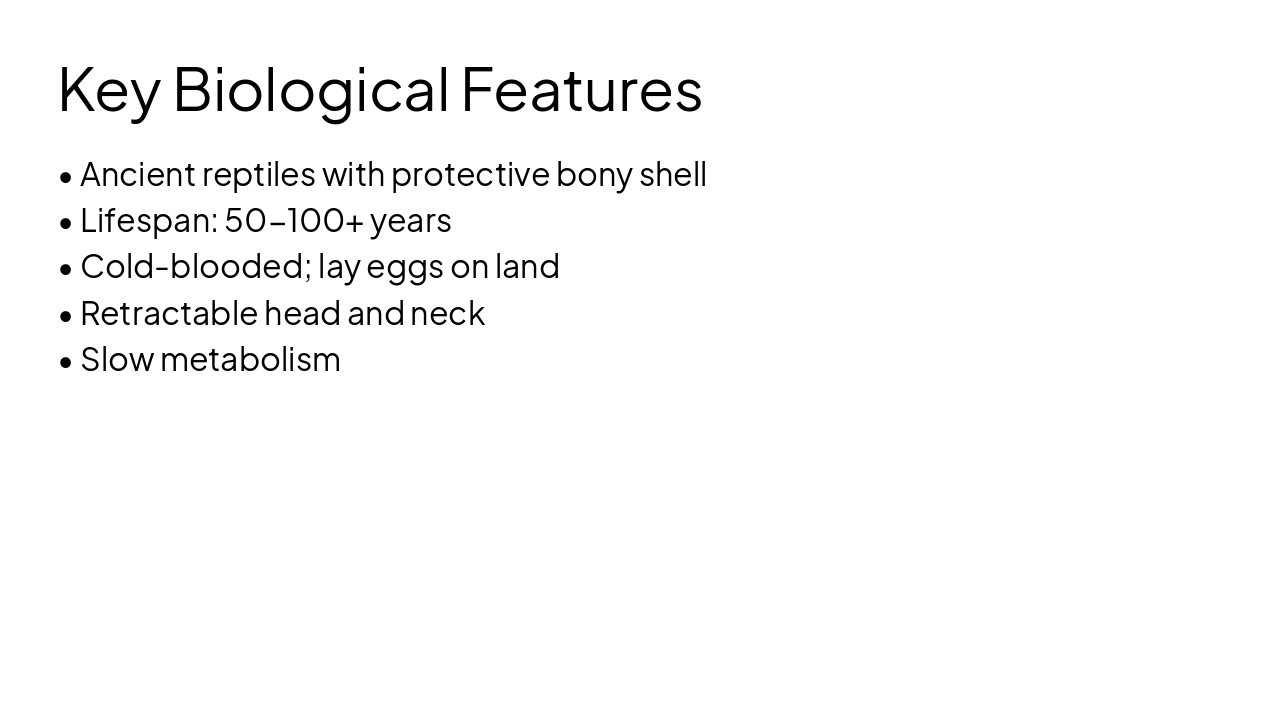
Tortoises are ancient reptiles featuring a protective bony shell, retractable head and neck, and slow metabolism. They are cold-blooded, lay eggs on land, and live 50-100+ years.

Key Biological Features

  • Ancient reptiles with protective bony shell
  • Lifespan: 50-100+ years
  • Cold-blooded; lay eggs on land
  • Retractable head and neck
  • Slow metabolism
Slide 4 - Key Biological Features
Slide 5 of 9

Slide 5 - Turtle Habitats

The slide "Turtle Habitats" features an image illustrating different turtle environments. Sea turtles inhabit oceans and coral reefs, freshwater turtles live in rivers and forests, and tortoises thrive in deserts and arid lands.

Turtle Habitats

!Image

  • Sea turtles inhabit oceans and coral reefs.
  • Freshwater turtles live in rivers and forests.
  • Tortoises thrive in deserts and arid lands.

Source: Image from Wikipedia article "Loggerhead sea turtle"

Slide 5 - Turtle Habitats
Slide 6 of 9

Slide 6 - Species Diversity

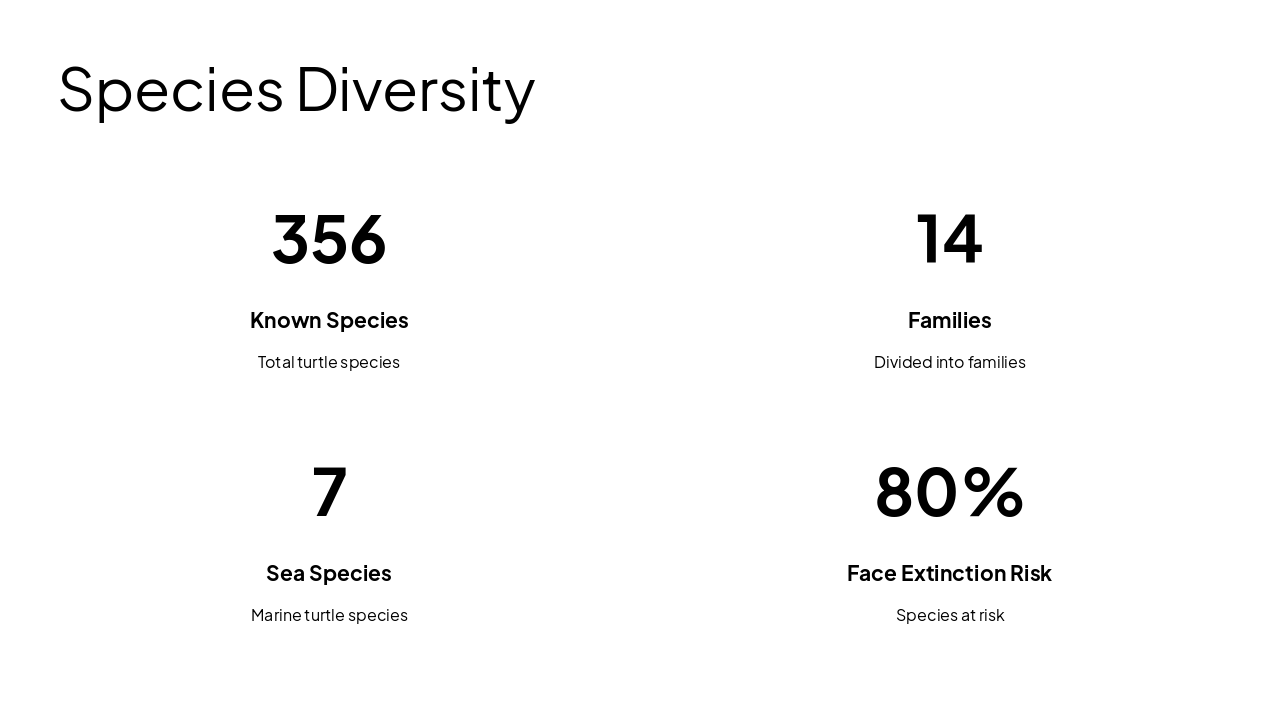
There are 356 known turtle species, divided into 14 families, including 7 marine species. Additionally, 80% of these species face extinction risk.

Species Diversity

  • 356: Known Species
  • Total turtle species

  • 14: Families
  • Divided into families

  • 7: Sea Species
  • Marine turtle species

  • 80%: Face Extinction Risk
  • Species at risk

Slide 6 - Species Diversity
Slide 7 of 9

Slide 7 - Conservation Status

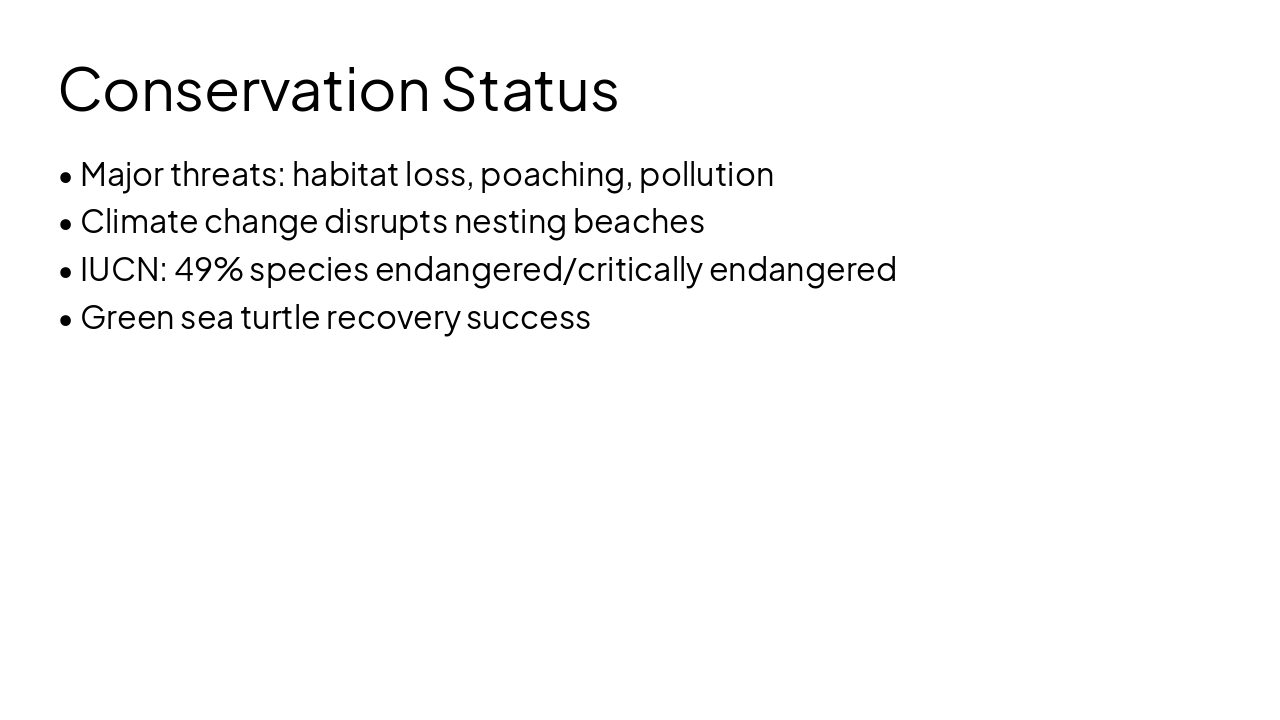
The slide outlines major threats to sea turtles, including habitat loss, poaching, pollution, and climate change disrupting nesting beaches. IUCN reports 49% of species as endangered or critically endangered, with the green sea turtle as a notable recovery success.

Conservation Status

  • Major threats: habitat loss, poaching, pollution
  • Climate change disrupts nesting beaches
  • IUCN: 49% species endangered/critically endangered
  • Green sea turtle recovery success
Slide 7 - Conservation Status
Slide 8 of 9

Slide 8 - Fun Facts

The "Fun Facts" slide presents a quote from renowned turtle biologist Dr. Peter C. H. Pritchard. It highlights that turtles outlived dinosaurs with 220-million-year-old fossils, can survive months without food, and some breathe through their cloaca.

Fun Facts

> Turtles have outlived dinosaurs, with fossils dating back 220 million years. They can survive months without food, and some even breathe through their cloaca!

— Dr. Peter C. H. Pritchard, Renowned Turtle Biologist

Source: Turtle Biology Expert

Speaker Notes
Highlight ancient lineage and unique survival adaptations of turtles.
Slide 8 - Fun Facts
Slide 9 of 9

Slide 9 - Protect Our Turtles

The conclusion slide, titled "Protect Our Turtles," states that turtles are ancient survivors facing modern threats. It calls for supporting conservation efforts now to protect future generations, featuring Earth and turtle emojis.

Protect Our Turtles

Ancient survivors facing modern threats.

Support conservation efforts! Act now for future generations. šŸŒšŸ¢

Slide 9 - Protect Our Turtles

Discover More Presentations

Explore thousands of AI-generated presentations for inspiration

Browse Presentations
Powered by AI

Create Your Own Presentation

Generate professional presentations in seconds with Karaf's AI. Customize this presentation or start from scratch.

Create New Presentation

Powered by Karaf.ai — AI-Powered Presentation Generator