India's Speech Freedom: Free or Controlled?

Generated from prompt:

Create a detailed 18-slide presentation. The tone should be academic, balanced, and analytical. Title: Freedom of Speech in India: Truly Free or Selectively Controlled? Subtitle: An Analysis of Article 19 and its Contemporary Challenges Slide 1: Title Slide Title: Freedom of Speech in India: Truly Free or Selectively Controlled? Subtitle: An Analysis of Article 19 and its Contemporary Challenges Footer: [Your Name/Details] Slide 2: What is Freedom of Speech? Heading: Why Does This Right Matter? Concept: Define freedom of speech as a cornerstone of democracy. Key Functions: Discovery of Truth: Through open debate (John Stuart Mill's "marketplace of ideas"). Self-Governance: An informed citizenry can hold the powerful accountable. Dissent & Critique: The "safety valve" of a nation; allows for peaceful expression of disagreement. Personal Autonomy: The right to express one's identity and beliefs. Slide 3: The Indian Context & The Central Question Heading: The Great Indian Paradox The Promise: India, the world's largest democracy, has a constitution that explicitly guarantees this right. The Problem: It is also a nation with complex social fault lines (religion, caste, class), leading to frequent conflicts over speech. The Central Question: Does our legal framework robustly protect speech, or is it a tool used by the state to selectively silence dissent, critique, and inconvenient voices? Slide 4: The Constitutional Guarantee: Article 19(1)(a) Heading: The Bedrock of Our Freedom The Text: "All citizens shall have the right to freedom of speech and expression." Judicial Interpretation (What it includes): Freedom of the Press Right to Broadcast & Circulate Right to Information (RTI) Right to Criticize Right to Remain Silent Commercial Speech (Advertising) Slide 5: The Constitutional 'Asterisk': Article 19(2) Heading: The "Reasonable Restrictions" Key Point: This slide must list the eight grounds on which speech can be restricted: Sovereignty and integrity of India Security of the State Friendly relations with foreign states Public order Decency or morality Contempt of court Defamation Incitement to an offence Analysis: The core of the debate lies in interpreting "public order," "decency," and "defamation." Slide 6: The "TRULY FREE" Argument (Part 1) Heading: Argument for "Truly Free": The Judiciary as Protector Main Point: The Supreme Court of India has, in many landmark cases, expanded the scope of free speech. Core Principle (from SC): The standard for restricting speech is not what is "offensive," but what is likely to cause "imminent lawless action" (a "spark in a powder keg"). Slide 7: Landmark Case: Shreya Singhal vs. UoI (2015) Heading: A Victory for Online Freedom What it did: Struck down Section 66A of the IT Act. Why? The court found the terms "annoying," "inconvenient," and "grossly offensive" to be unacceptably vague. The Impact: A huge win. It affirmed that vague laws cannot be used to criminalize online speech. This is a primary exhibit for the "Truly Free" side. Slide 8: Landmark Case: Anuradha Bhasin vs. UoI (2020) Heading: The Right to the Internet Context: The internet shutdown in Jammu & Kashmir. What the Court Said: Freedom of speech and expression includes the right to access the internet. Internet shutdowns cannot be indefinite and must be periodically reviewed. The Impact: Established digital rights as a fundamental part of Article 19(1)(a). Slide 9: The "TRULY FREE" Argument (Part 2) Heading: Evidence of "Truly Free": A Vibrant, 'Noisy' Democracy Main Point: The existence of widespread dissent is proof of freedom. Examples: Media: A vast, diverse, and often critical press. Civil Society: Widespread protests (e.g., CAA, Farmers' Protests) show dissent is alive. Art & Satire: A thriving ecosystem of comedians and writers who criticize the government. Slide 10: The "SELECTIVELY CONTROLLED" Argument (Part 1) Heading: Argument for "Selective Control": The 'Chilling Effect' Concept: The "Chilling Effect" is when individuals or journalists self-censor out of fear. How it Works: The fear isn't of conviction, but of the process. Fear of police investigation. Fear of expensive, long legal battles. Fear of pre-trial jail (difficulty in getting bail). Result: The process itself becomes the punishment. Slide 11: The "Control" Toolkit: Colonial-Era Laws Heading: Legal Tool 1: Sedition (Sec 124A, IPC) What it is: A colonial-era law punishing "disaffection" against the government. The "Control": Used against students, activists, and journalists for criticizing the government. Current Status: The Supreme Court has put this law on hold (in abeyance) in May 2022, questioning its validity. Slide 12: The "Control" Toolkit: Modern Laws Heading: Legal Tool 2: UAPA (Unlawful Activities Prevention Act) What it is: A stringent anti-terror law. The "Control": Vague definitions allegedly used against activists and dissidents. Bail is almost impossible to get. Allows the state to jail individuals for years without a trial ("process as punishment"). Slide 13: The "Control" Toolkit: Defamation Heading: Legal Tool 3: Criminal Defamation (Sec 499, IPC) What it is: In India, defamation is both a civil and a criminal offense. The "Control": Used by powerful politicians/corporations to file "SLAPP suits" (Strategic Lawsuits Against Public Participation). Designed to intimidate, silence, and exhaust journalists with legal fees. Slide 14: The Digital Frontier: IT Rules Heading: The New Battleground: The IT Rules (2021 & 2023) The "Control": These rules give the government new powers. Takedown Orders: Power to order platforms to remove content. Fact Check Unit (FCU): A government-appointed unit can identify "fake or false" information related to the government, which platforms must then take down. Criticism: This makes the government the "judge, jury, and executioner" of truth online. Slide 15: Global Comparison & The Data Heading: How Does India Stack Up? The Data: World Press Freedom Index (Published by Reporters Without Borders) India's Rank (2024): 159 out of 180 countries. Please insert a visual: a map from the World Press Freedom Index, highlighting India's position. RSF's Rationale: Cites "violence against journalists," "media concentration," and an "intimidating" environment for critics. Slide 16: Case Studies: The Paradox in Action Heading: Hate Speech vs. Dissent The Paradox: The state is accused of a double standard. Example 1 (Selective Control): Journalists, students, or comedians are arrested for "insulting" sentiments or "inciting" public order. Example 2 (Selective Freedom): In contrast, individuals making explicit calls for violence or hate speech against minorities often face delayed or no action. The Argument: This suggests "reasonable restrictions" are applied selectively. Slide 17: Conclusion: So, What's the Verdict? Heading: Truly Free OR Selectively Controlled? The Answer: It is both. "Truly Free": The constitutional guarantee (Art 19(1)(a)) is strong. The judiciary has protected it (e.g., Shreya Singhal). Dissent is widespread. "Selectively Controlled": The practice is different. A toolkit of vague laws (UAPA), digital regulations (IT Rules), and the "chilling effect" are used to target inconvenient voices. Final Thought: Freedom of speech in India is a constant negotiation—a battlefield between citizen's rights and state control. Slide 18: Thank You Title: Thank You

This academic analysis examines Article 19(1)(a) of the Indian Constitution, weighing judicial protections and vibrant dissent against restrictive laws like UAPA, sedition, and IT Rules that create a

November 16, 202518 slides
Slide 1 of 18

Slide 1 - Freedom of Speech in India: Truly Free or Selectively Controlled?

The title slide poses the question: "Freedom of Speech in India: Truly Free or Selectively Controlled?" It includes a subtitle that frames the presentation as an analysis of Article 19 and its contemporary challenges.

Freedom of Speech in India: Truly Free or Selectively Controlled?

An Analysis of Article 19 and its Contemporary Challenges

Source: User presentation outline on freedom of speech in India

--- Speaker Notes: Footer: [Your Name/Details]. Academic tone introduction to the analysis of Article 19 and contemporary challenges in a balanced, analytical manner.
Slide 1
Slide 2 of 18

Slide 2 - Why Does This Right Matter?

The slide "Why Does This Right Matter?" explains the importance of freedom of speech as a cornerstone of democracy, fostering open expression, debate, and the discovery of truth through John Stuart Mill's marketplace of ideas. It further highlights how this right supports self-governance by empowering an informed citizenry, enables dissent and critique as a safety valve for disagreement, and upholds personal autonomy in expressing identity and beliefs.

Why Does This Right Matter?

  • Freedom of speech: cornerstone of democracy, enabling open expression and debate.
  • Discovery of Truth: Mill's marketplace of ideas through robust public discourse.
  • Self-Governance: Informed citizenry holds power accountable via free information.
  • Dissent & Critique: Safety valve for peaceful disagreement and societal critique.
  • Personal Autonomy: Right to express identity, beliefs, and individual perspectives.
Slide 2
Slide 3 of 18

Slide 3 - Freedom of Speech in India: Truly Free or Selectively Controlled?

This section header slide, titled "Freedom of Speech in India: Truly Free or Selectively Controlled?", introduces Section 03 as "The Great Indian Paradox." It highlights the subtitle on India's status as the largest democracy, where speech guarantees coexist with social conflicts and the silencing of dissent.

Freedom of Speech in India: Truly Free or Selectively Controlled?

03

The Great Indian Paradox

Largest Democracy's Guarantee Amid Social Conflicts and Dissent Silencing

--- Speaker Notes: Heading: The Great Indian Paradox. The Promise: India, the world's largest democracy, has a constitution that explicitly guarantees this right. The Problem: It is also a nation with complex social fault lines (religion, caste, class), leading to frequent conflicts over speech. The Central Question: Does our legal framework robustly protect speech, or is it a tool used by the state to selectively silence dissent, critique, and inconvenient voices?

Slide 3
Slide 4 of 18

Slide 4 - The Bedrock of Our Freedom

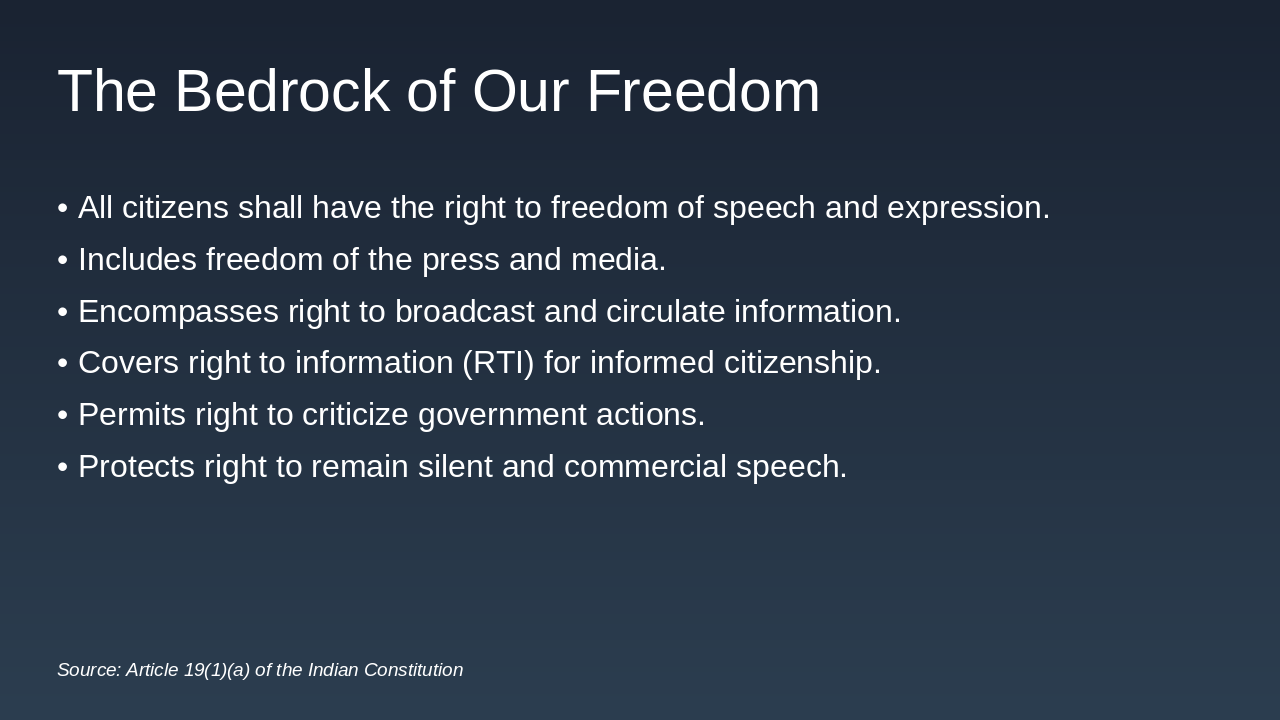
The slide titled "The Bedrock of Our Freedom" outlines the fundamental right to freedom of speech and expression for all citizens, extending to freedom of the press, media, broadcasting, and circulating information. It also emphasizes the right to information for informed citizenship, the ability to criticize government actions, and protections for remaining silent or engaging in commercial speech.

The Bedrock of Our Freedom

  • All citizens shall have the right to freedom of speech and expression.
  • Includes freedom of the press and media.
  • Encompasses right to broadcast and circulate information.
  • Covers right to information (RTI) for informed citizenship.
  • Permits right to criticize government actions.
  • Protects right to remain silent and commercial speech.

Source: Article 19(1)(a) of the Indian Constitution

--- Speaker Notes: Article 19(1)(a) guarantees freedom of speech and expression to all citizens, serving as the foundational pillar of democratic discourse in India. Judicial interpretations have broadened its scope to encompass diverse forms of expression, balancing individual rights with societal needs.

Slide 4
Slide 5 of 18

Slide 5 - The Constitutional 'Asterisk': Article 19(2)

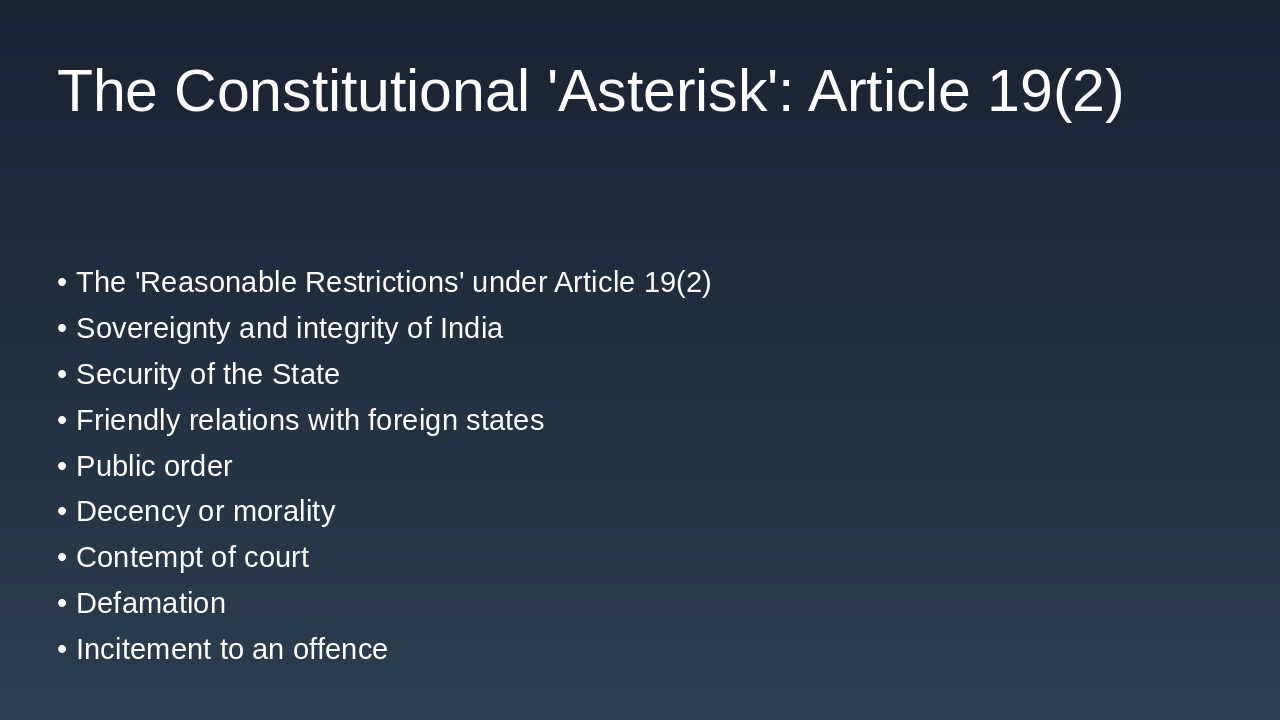
Article 19(2) of the Indian Constitution imposes reasonable restrictions on the freedom of speech and expression to protect key national interests. These include India's sovereignty and integrity, state security, friendly foreign relations, public order, decency or morality, contempt of court, defamation, and incitement to offences.

The Constitutional 'Asterisk': Article 19(2)

  • The 'Reasonable Restrictions' under Article 19(2)
  • Sovereignty and integrity of India
  • Security of the State
  • Friendly relations with foreign states
  • Public order
  • Decency or morality
  • Contempt of court
  • Defamation
  • Incitement to an offence

--- Speaker Notes: The core of the debate lies in interpreting 'public order,' 'decency,' and 'defamation.' These vague terms allow for subjective application, potentially enabling selective control over speech.

Slide 5
Slide 6 of 18

Slide 6 - The 'TRULY FREE' Argument (Part 1)

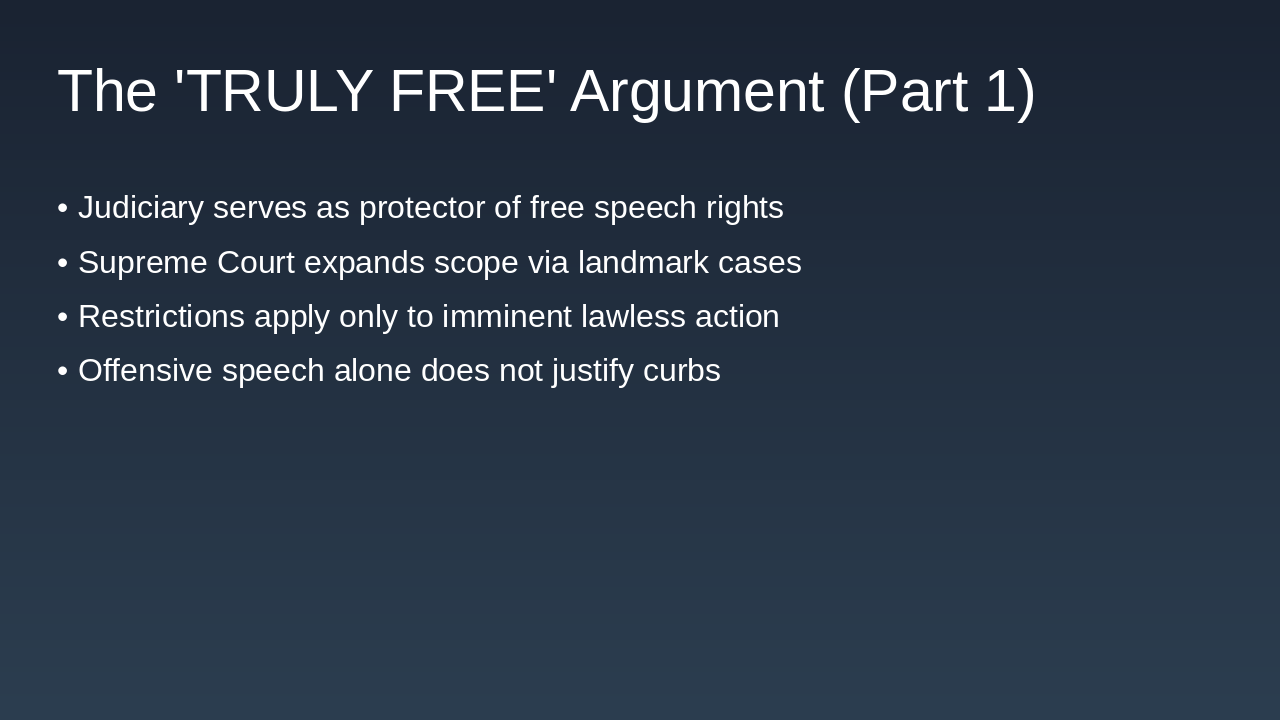
The slide discusses the judiciary's role as a protector of free speech rights, with the Supreme Court expanding its scope through landmark cases. It emphasizes that restrictions are limited to imminent lawless action, and offensive speech alone does not warrant curbs.

The 'TRULY FREE' Argument (Part 1)

  • Judiciary serves as protector of free speech rights
  • Supreme Court expands scope via landmark cases
  • Restrictions apply only to imminent lawless action
  • Offensive speech alone does not justify curbs

--- Speaker Notes: Heading: Argument for 'Truly Free': Judiciary as Protector. SC expanded scope in landmarks. Principle: Restrict only for 'imminent lawless action', not offense.

Slide 6
Slide 7 of 18

Slide 7 - Landmark Case: Shreya Singhal vs. UoI (2015)

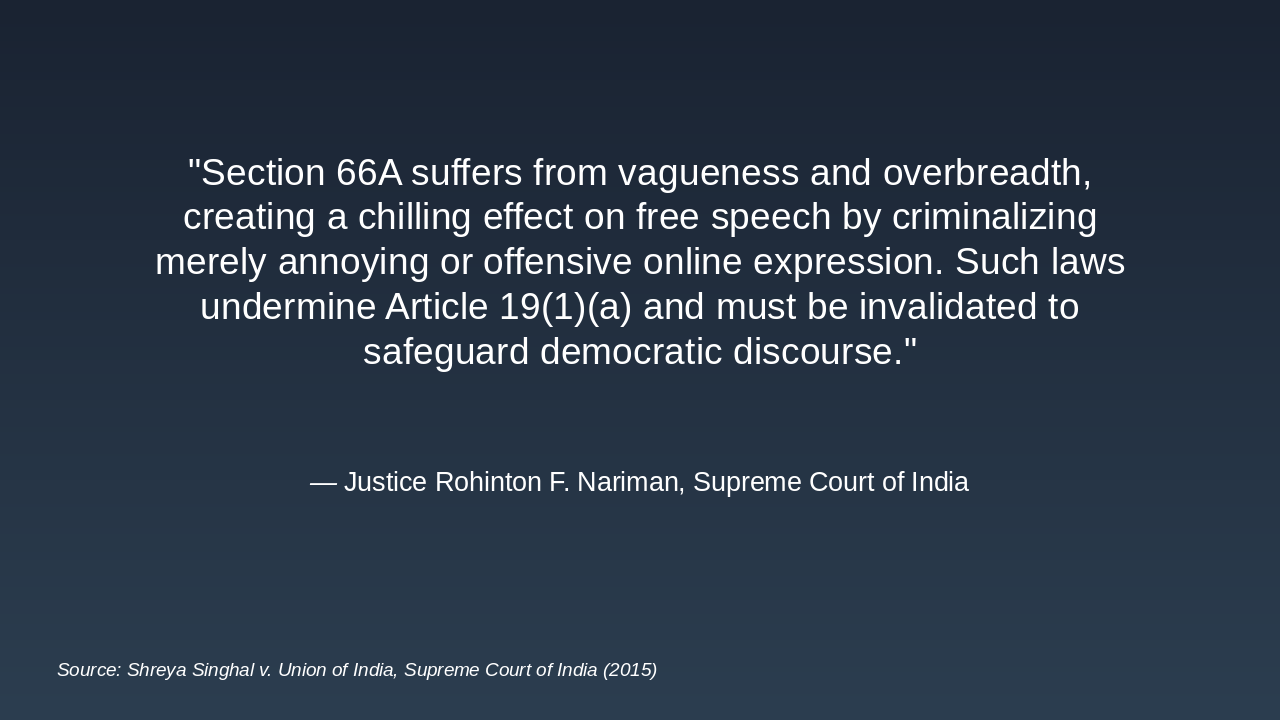
The slide features a landmark 2015 Supreme Court of India case, Shreya Singhal vs. Union of India, highlighting a key quote from Justice Rohinton F. Nariman. In it, he argues that Section 66A of the IT Act is unconstitutionally vague and overbroad, as it chills free speech under Article 19(1)(a) by criminalizing annoying or offensive online expression, warranting its invalidation to protect democratic discourse.

Landmark Case: Shreya Singhal vs. UoI (2015)

> Section 66A suffers from vagueness and overbreadth, creating a chilling effect on free speech by criminalizing merely annoying or offensive online expression. Such laws undermine Article 19(1)(a) and must be invalidated to safeguard democratic discourse.

— Justice Rohinton F. Nariman, Supreme Court of India

Source: Shreya Singhal v. Union of India, Supreme Court of India (2015)

--- Speaker Notes: Heading: A Victory for Online Freedom. Struck down Sec 66A IT Act for vagueness ('annoying', 'offensive'). Impact: Vague laws can't criminalize online speech; key win for free side.

Slide 7
Slide 8 of 18

Slide 8 - Landmark Case: Anuradha Bhasin vs. UoI (2020)

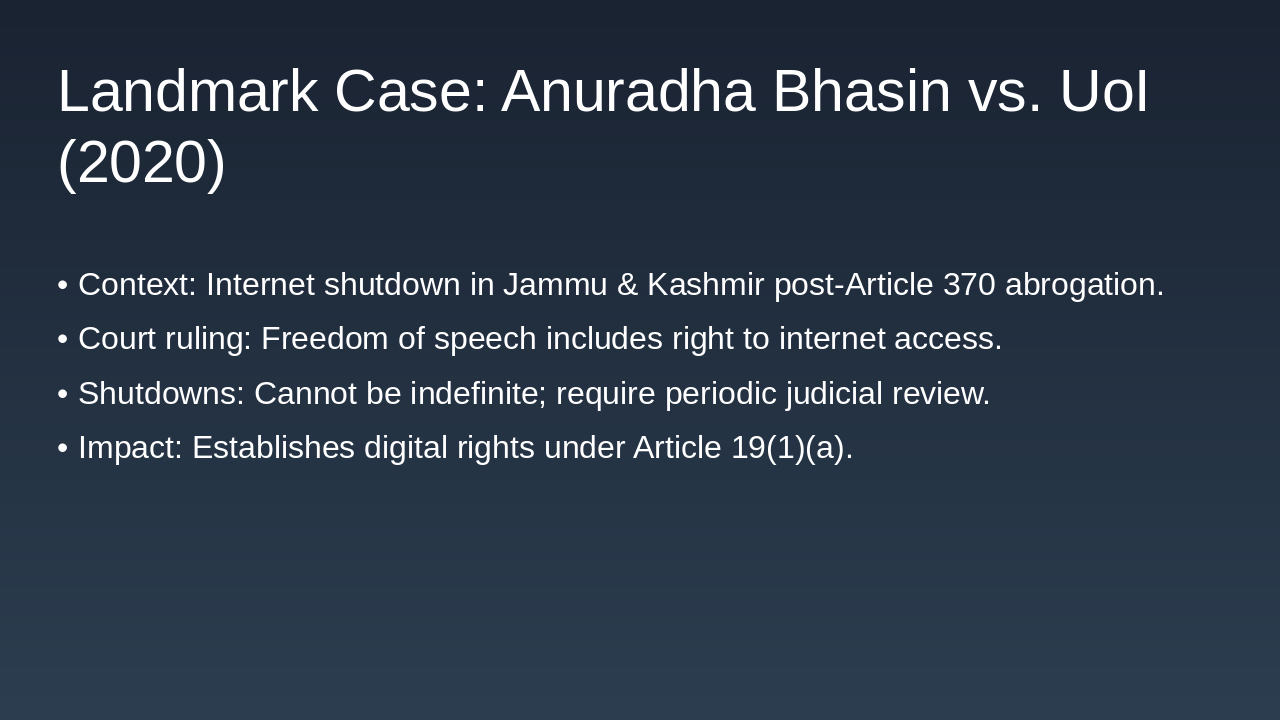
In the landmark case Anuradha Bhasin vs. Union of India (2020), the Supreme Court addressed the internet shutdown in Jammu & Kashmir following the abrogation of Article 370. The ruling affirmed that freedom of speech under Article 19(1)(a) includes the right to internet access, prohibiting indefinite shutdowns and mandating periodic judicial review to protect digital rights.

Landmark Case: Anuradha Bhasin vs. UoI (2020)

  • Context: Internet shutdown in Jammu & Kashmir post-Article 370 abrogation.
  • Court ruling: Freedom of speech includes right to internet access.
  • Shutdowns: Cannot be indefinite; require periodic judicial review.
  • Impact: Establishes digital rights under Article 19(1)(a).
Slide 8
Slide 9 of 18

Slide 9 - The 'TRULY FREE' Argument (Part 2)

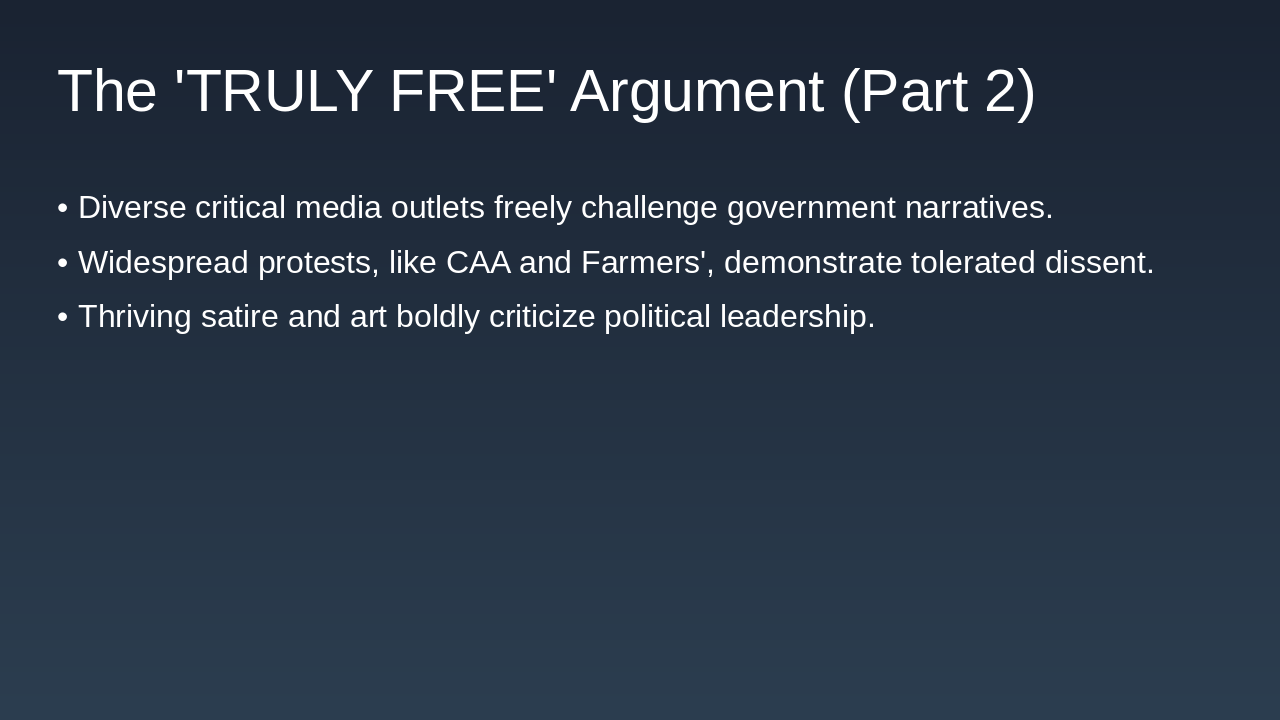
The slide "The 'TRULY FREE' Argument (Part 2)" highlights evidence of freedom in India through diverse critical media outlets that openly challenge government narratives. It also points to widespread tolerated dissent, such as in the CAA and Farmers' protests, alongside thriving satire and art that boldly critique political leadership.

The 'TRULY FREE' Argument (Part 2)

  • Diverse critical media outlets freely challenge government narratives.
  • Widespread protests, like CAA and Farmers', demonstrate tolerated dissent.
  • Thriving satire and art boldly criticize political leadership.

--- Speaker Notes: Emphasize how these examples illustrate a functioning democracy despite challenges; maintain balanced tone by noting they coexist with restrictions.

Slide 9
Slide 10 of 18

Slide 10 - The 'SELECTIVELY CONTROLLED' Argument (Part 1)

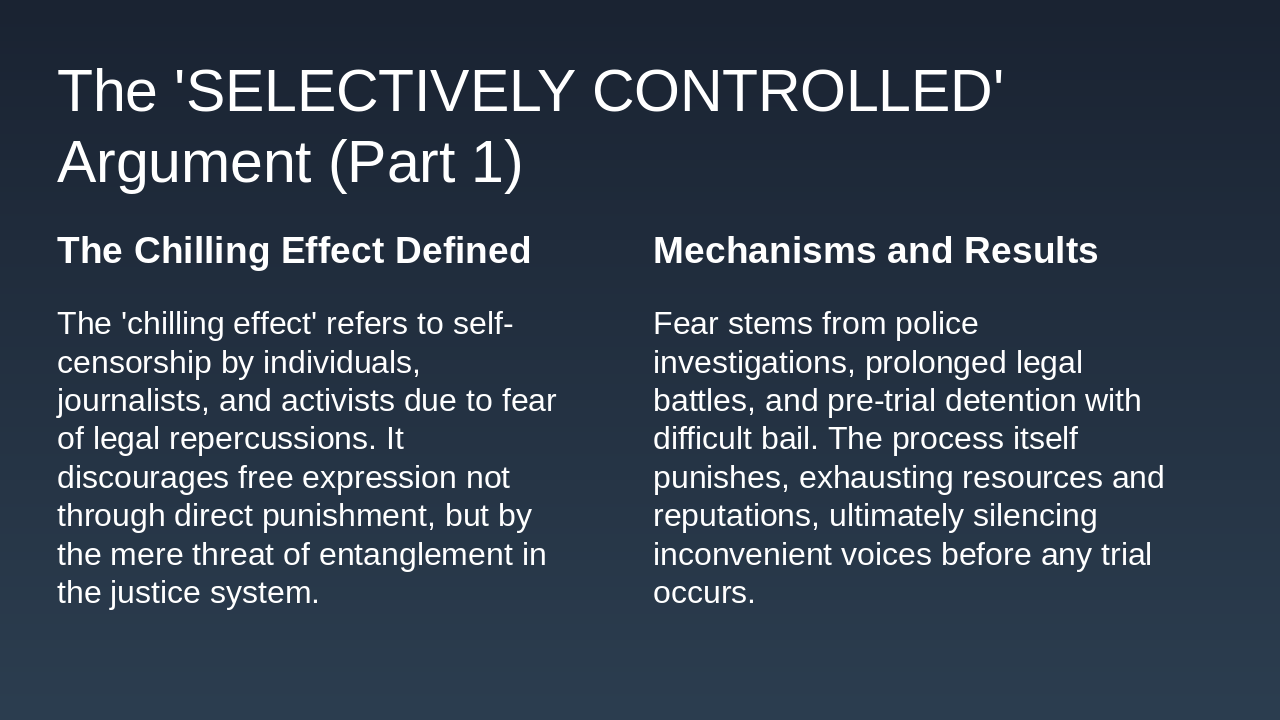
The slide defines the "chilling effect" as self-censorship among individuals, journalists, and activists driven by fear of legal repercussions, which stifles free expression through the mere threat of justice system involvement rather than direct punishment. It explains the mechanisms, including police investigations, lengthy legal battles, and pre-trial detention with tough bail conditions, noting how the process itself drains resources and reputations to silence voices before any trial.

The 'SELECTIVELY CONTROLLED' Argument (Part 1)

The Chilling Effect DefinedMechanisms and Results
The 'chilling effect' refers to self-censorship by individuals, journalists, and activists due to fear of legal repercussions. It discourages free expression not through direct punishment, but by the mere threat of entanglement in the justice system.Fear stems from police investigations, prolonged legal battles, and pre-trial detention with difficult bail. The process itself punishes, exhausting resources and reputations, ultimately silencing inconvenient voices before any trial occurs.

--- Speaker Notes: Explain the chilling effect as a subtle form of control, emphasizing how fear of process leads to self-censorship without needing convictions. Highlight its impact on dissent.

Slide 10
Slide 11 of 18

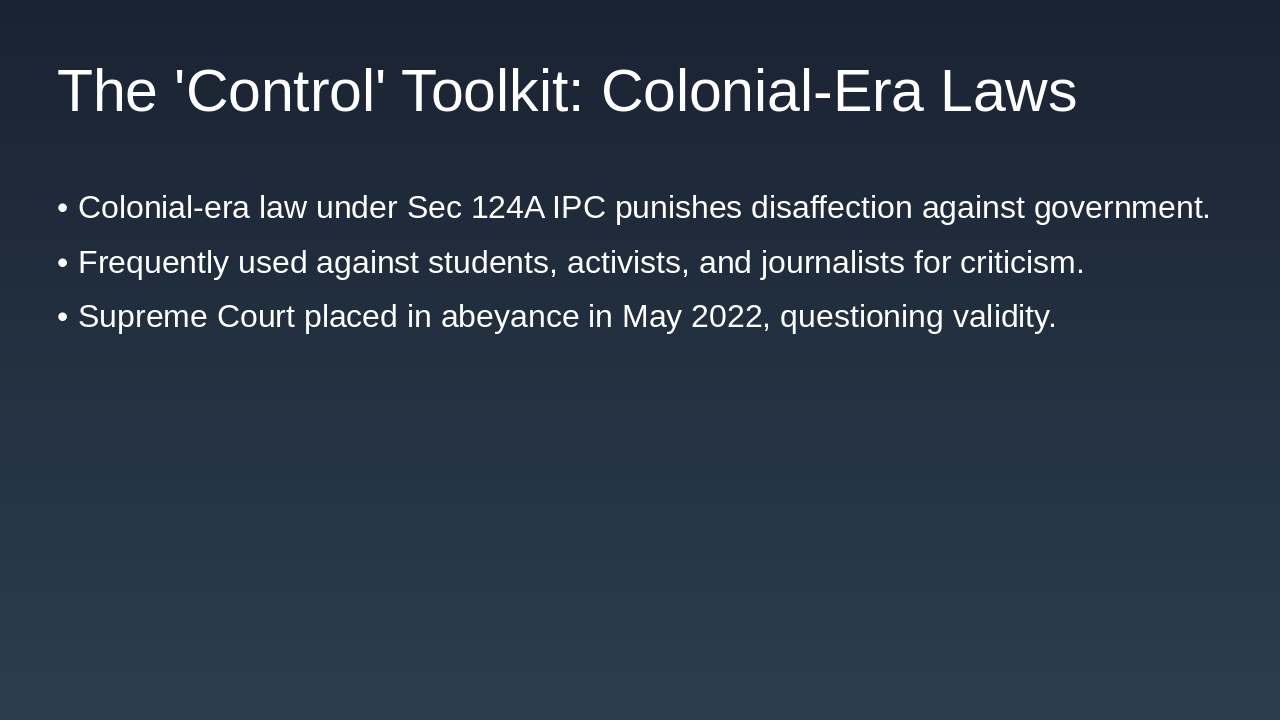
Slide 11 - The 'Control' Toolkit: Colonial-Era Laws

The 'Control' Toolkit slide discusses colonial-era laws, focusing on Section 124A of the IPC, which criminalizes disaffection against the government and is often invoked against students, activists, and journalists for expressing criticism. In May 2022, the Supreme Court placed this law in abeyance while questioning its constitutional validity.

The 'Control' Toolkit: Colonial-Era Laws

  • Colonial-era law under Sec 124A IPC punishes disaffection against government.
  • Frequently used against students, activists, and journalists for criticism.
  • Supreme Court placed in abeyance in May 2022, questioning validity.

--- Speaker Notes: Discuss how sedition law exemplifies selective control through historical misuse and recent judicial scrutiny.

Slide 11
Slide 12 of 18

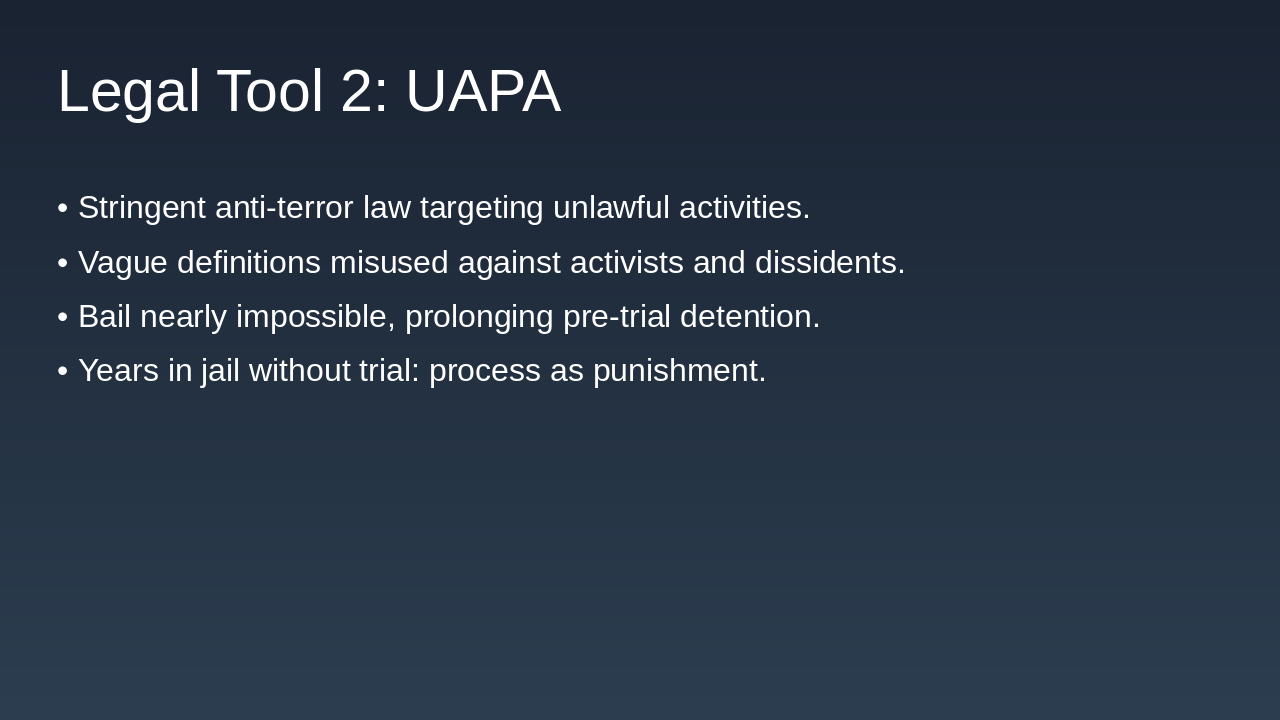
Slide 12 - Legal Tool 2: UAPA

The UAPA is a stringent anti-terror law aimed at curbing unlawful activities, but its vague definitions have been misused to target activists and dissidents. It makes bail nearly impossible, leading to prolonged pre-trial detention and years in jail without trial, effectively turning the process into punishment.

Legal Tool 2: UAPA

  • Stringent anti-terror law targeting unlawful activities.
  • Vague definitions misused against activists and dissidents.
  • Bail nearly impossible, prolonging pre-trial detention.
  • Years in jail without trial: process as punishment.
Slide 12
Slide 13 of 18

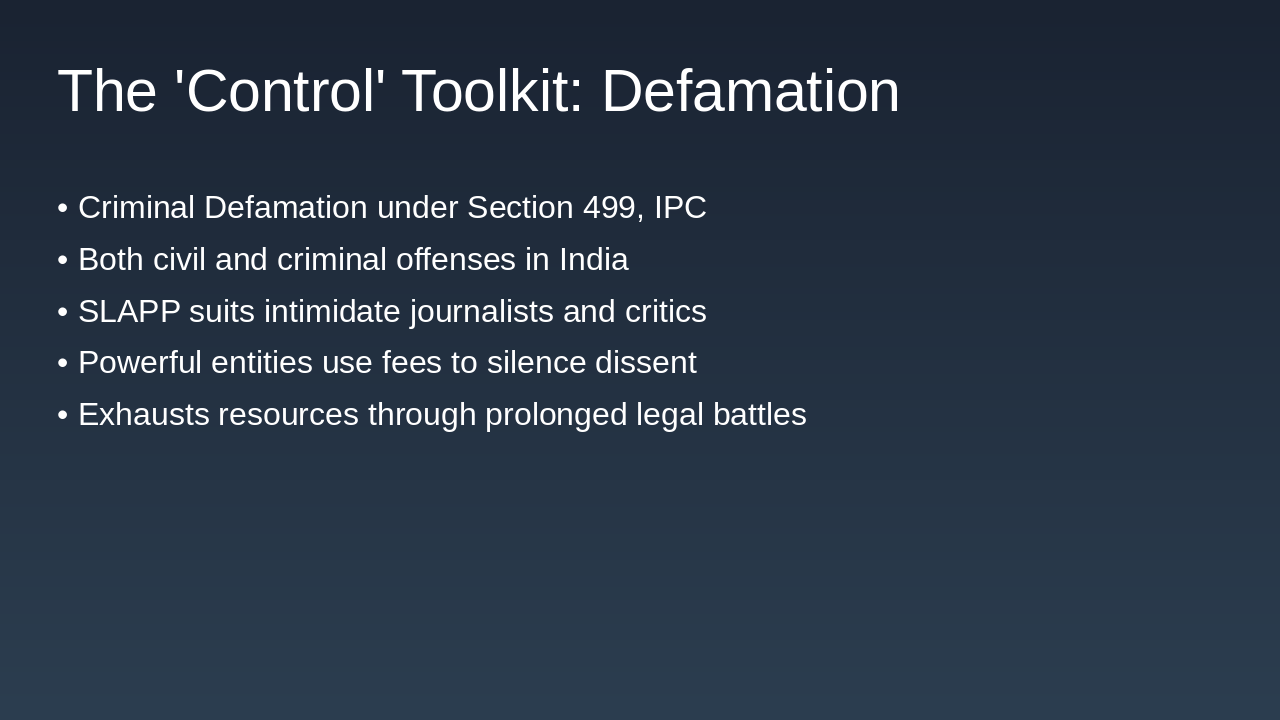
Slide 13 - The 'Control' Toolkit: Defamation

The slide outlines criminal defamation under Section 499 of the Indian Penal Code, noting that it constitutes both civil and criminal offenses in India. It highlights how powerful entities deploy SLAPP suits to intimidate journalists and critics, using high fees and prolonged legal battles to exhaust resources and silence dissent.

The 'Control' Toolkit: Defamation

  • Criminal Defamation under Section 499, IPC
  • Both civil and criminal offenses in India
  • SLAPP suits intimidate journalists and critics
  • Powerful entities use fees to silence dissent
  • Exhausts resources through prolonged legal battles
Slide 13
Slide 14 of 18

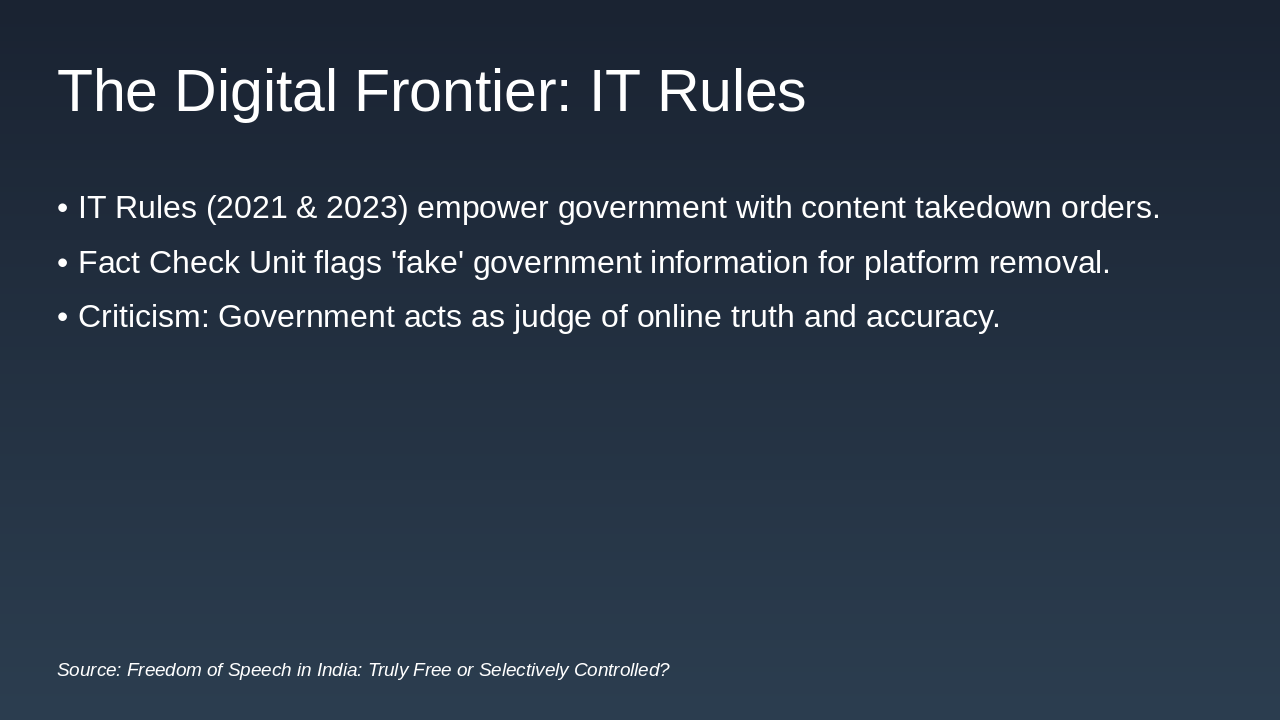
Slide 14 - The Digital Frontier: IT Rules

The IT Rules of 2021 and 2023 grant the government authority to issue content takedown orders and establish a Fact Check Unit to identify and flag "fake" information about government activities for removal by platforms. Critics argue this setup positions the government as the ultimate arbiter of online truth and accuracy.

The Digital Frontier: IT Rules

  • IT Rules (2021 & 2023) empower government with content takedown orders.
  • Fact Check Unit flags 'fake' government information for platform removal.
  • Criticism: Government acts as judge of online truth and accuracy.

Source: Freedom of Speech in India: Truly Free or Selectively Controlled?

--- Speaker Notes: Discuss how IT Rules expand government control over digital speech, highlighting FCU's role and criticisms of bias.

Slide 14
Slide 15 of 18

Slide 15 - How Does India Stack Up?

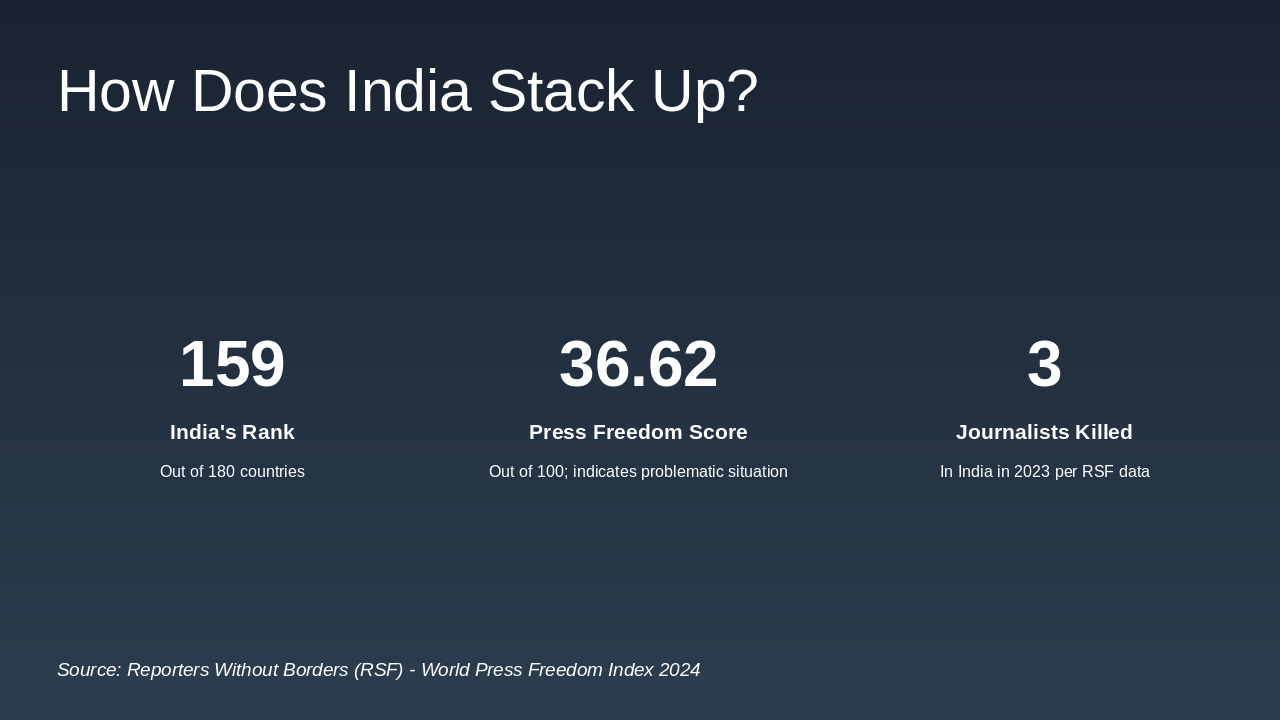
India ranks 159th out of 180 countries in the World Press Freedom Index, with a score of 36.62 out of 100 indicating a problematic situation for media freedom. According to RSF data, three journalists were killed in India in 2023.

How Does India Stack Up?

  • 159: India's Rank

Out of 180 countries

  • 36.62: Press Freedom Score

Out of 100; indicates problematic situation

  • 3: Journalists Killed

In India in 2023 per RSF data

Source: Reporters Without Borders (RSF) - World Press Freedom Index 2024

--- Speaker Notes: This slide provides a data-driven global comparison, highlighting India's low ranking and key contributing factors like violence against journalists, media concentration, and an intimidating environment, underscoring the challenges to press freedom.

Slide 15
Slide 16 of 18

Slide 16 - Case Studies: The Paradox in Action

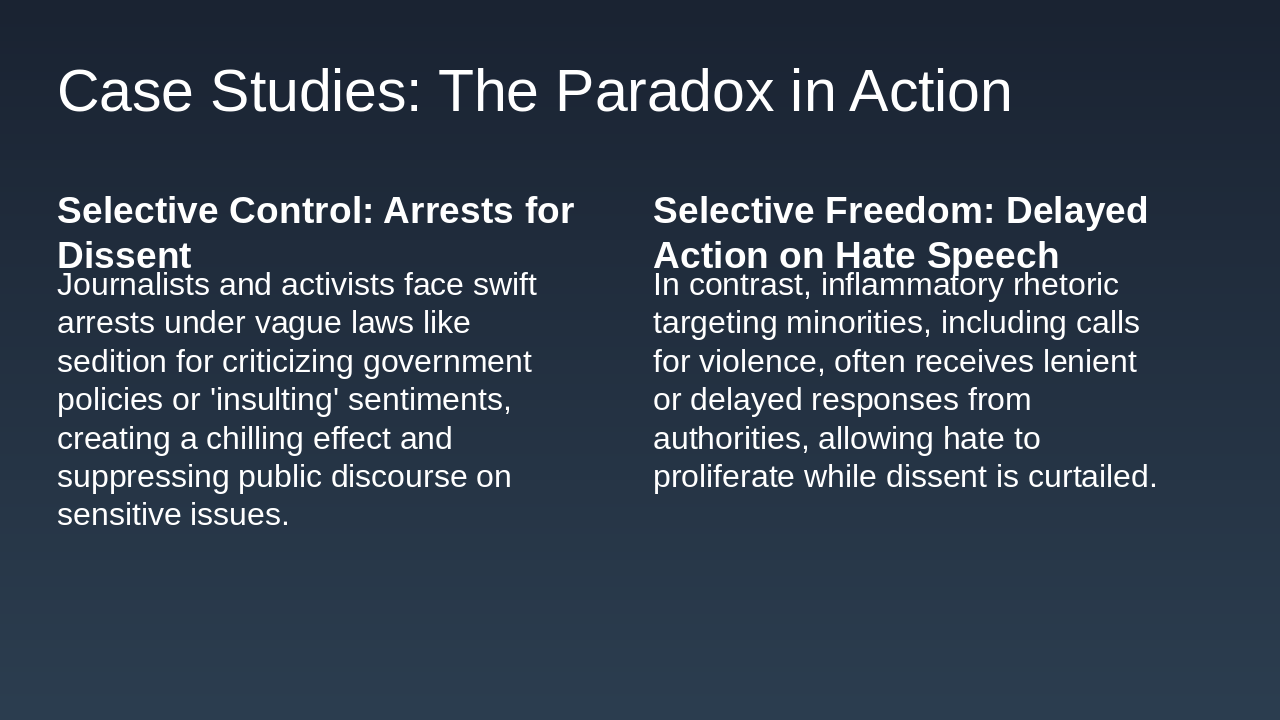
The slide illustrates the paradox of selective control in governance, where journalists and activists are swiftly arrested under vague laws like sedition for criticizing policies or insulting sentiments, thereby suppressing public discourse. In stark contrast, authorities often respond leniently or delay action against inflammatory hate speech targeting minorities, allowing such rhetoric and calls for violence to spread unchecked.

Case Studies: The Paradox in Action

Selective Control: Arrests for DissentSelective Freedom: Delayed Action on Hate Speech
Journalists and activists face swift arrests under vague laws like sedition for criticizing government policies or 'insulting' sentiments, creating a chilling effect and suppressing public discourse on sensitive issues.In contrast, inflammatory rhetoric targeting minorities, including calls for violence, often receives lenient or delayed responses from authorities, allowing hate to proliferate while dissent is curtailed.
Slide 16
Slide 17 of 18

Slide 17 - Conclusion: So, What's the Verdict?

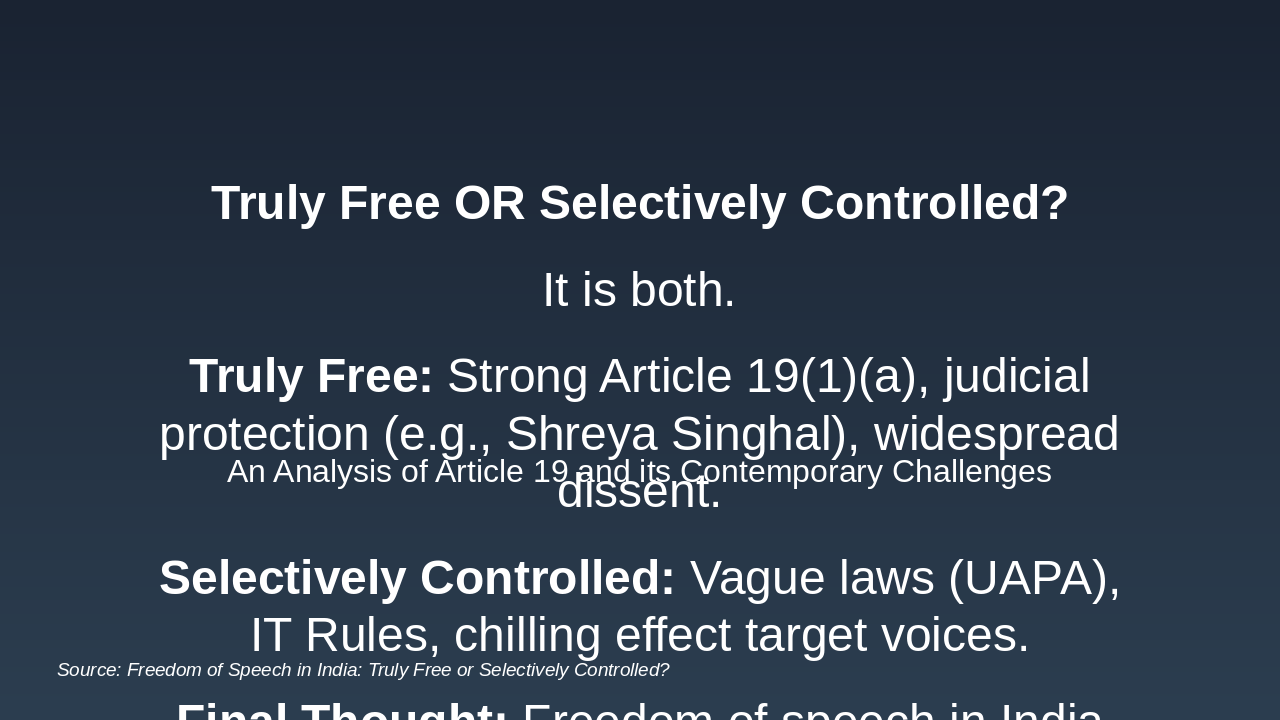
Freedom of speech in India under Article 19(1)(a) is both truly free and selectively controlled, with strong judicial protections like the Shreya Singhal case enabling widespread dissent, while vague laws such as UAPA and IT Rules create a chilling effect on targeted voices. Ultimately, it represents an ongoing negotiation and battlefield between citizens' rights and state control.

Conclusion: So, What's the Verdict?

**Truly Free OR Selectively Controlled?

It is both.

Truly Free: Strong Article 19(1)(a), judicial protection (e.g., Shreya Singhal), widespread dissent.

Selectively Controlled: Vague laws (UAPA), IT Rules, chilling effect target voices.

Final Thought: Freedom of speech in India is a constant negotiation—a battlefield between citizens' rights and state control.

An Analysis of Article 19 and its Contemporary Challenges

Source: Freedom of Speech in India: Truly Free or Selectively Controlled?

--- Speaker Notes**: Summarize the balanced view: India's freedom of speech is constitutionally robust yet practically challenged by selective controls. Emphasize the ongoing negotiation between rights and state power.

Slide 17
Slide 18 of 18

Slide 18 - Thank You

The slide features a simple title reading "Thank You," presented as a title slide. Its subtitle expresses appreciation for the audience's engagement with the analysis.

Thank You

Appreciating your engagement with this analysis

Source: Closing slide for academic presentation on Freedom of Speech in India

--- Speaker Notes: Academic wrap-up: End with thanks, invite questions if time permits.

Slide 18
Powered by AI

Create Your Own Presentation

Generate professional presentations in seconds with Karaf's AI. Customize this presentation or start from scratch.

Create New Presentation

Powered by Karaf.ai — AI-Powered Presentation Generator