Slide 1 of 11
Slide 1 - The Salem Witch Trials (1692 Massachusetts)
The Salem Witch Trials (1692 Massachusetts)
Your Name AP U.S. History October 2024
---
Photo by Arie Oldman on Unsplash
Generated from prompt:
Create a 10-slide (minimum) AP-level Google Slides presentation about the Salem Witch Trials (1692 Massachusetts). The presentation must compare the official textbook explanation with alternative theories and include my own evidence-based conclusion. Follow this exact structure: Slide 1 (Title Slide – not counted): Title, name, class, date Slide 2 (Background Context): Explain what the Salem Witch Trials were, when and where they happened, how many people were accused and executed, and why this event is historically important. Slide 3 (Official/Textbook Explanation): Describe the commonly accepted explanation (mass hysteria and religious extremism). Include Puritan beliefs and the use of spectral evidence. Slide 4 (Problems with the Official Explanation): Identify weaknesses, inconsistencies, or unanswered questions in the official version. Slide 5 (Alternative Theory #1 – Ergot Poisoning): Explain the theory that contaminated rye caused hallucinations. Include supporting evidence and at least one weakness. Slide 6 (Alternative Theory #2 – Social and Economic Conflict): Explain how class divisions, land disputes, and personal rivalries contributed to accusations. Slide 7 (Alternative Theory #3 – Political Instability): Explain how fear, loss of government stability, and external threats may have influenced the trials. Slide 8 (Evidence Comparison): Compare the strengths and weaknesses of the official explanation and the alternative theories. Slide 9 (My Analysis): Clearly state which explanation I believe is most accurate and support it with evidence and reasoning. Slide 10 (Conclusion): Summarize key points and explain why the Salem Witch Trials still matter today. Slide 11 (Works Cited): Include 3–5 credible sources in MLA or APA format. Requirements: - Use bullet points, not long paragraphs - Keep slides clear and organized - Include accurate historical facts - Maintain an academic (AP-level) tone - Add brief speaker notes for each slide (2–3 sentences) - Avoid grammar and spelling errors
This AP U.S. History presentation examines the 1692 Salem Witch Trials in Massachusetts, covering background context, the official mass hysteria explanation rooted in Puritan beliefs and spectral evidence, its shortcomings, and alternative theories: ergot poisoning matching girls' symptoms, social and economic conflicts among families like the Putnams, and political instability from revoked charters and frontier wars. Features an evidence comparison table, analysis favoring social conflicts as primary driver amplified by other factors, modern relevance to fear-driven injustices like McCarthy主义
The Salem Witch Trials (1692 Massachusetts)
Your Name AP U.S. History October 2024
---
Photo by Arie Oldman on Unsplash
Source: Wikipedia
Source: Wikipedia
Source: Wikipedia
---
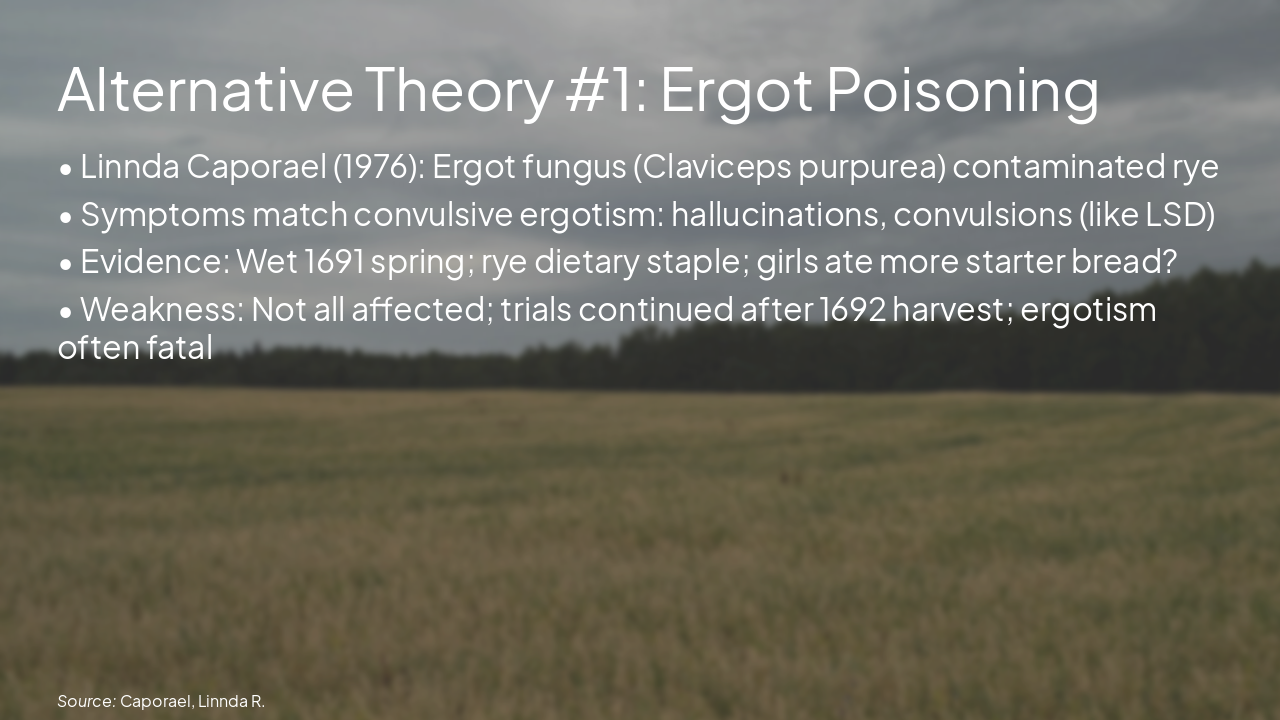
Source: Caporael, Linnda R.
Source: Boyer & Nissenbaum
---
Photo by Volodymyr Grytsiuk on Unsplash
Source: Norton, Mary Beth
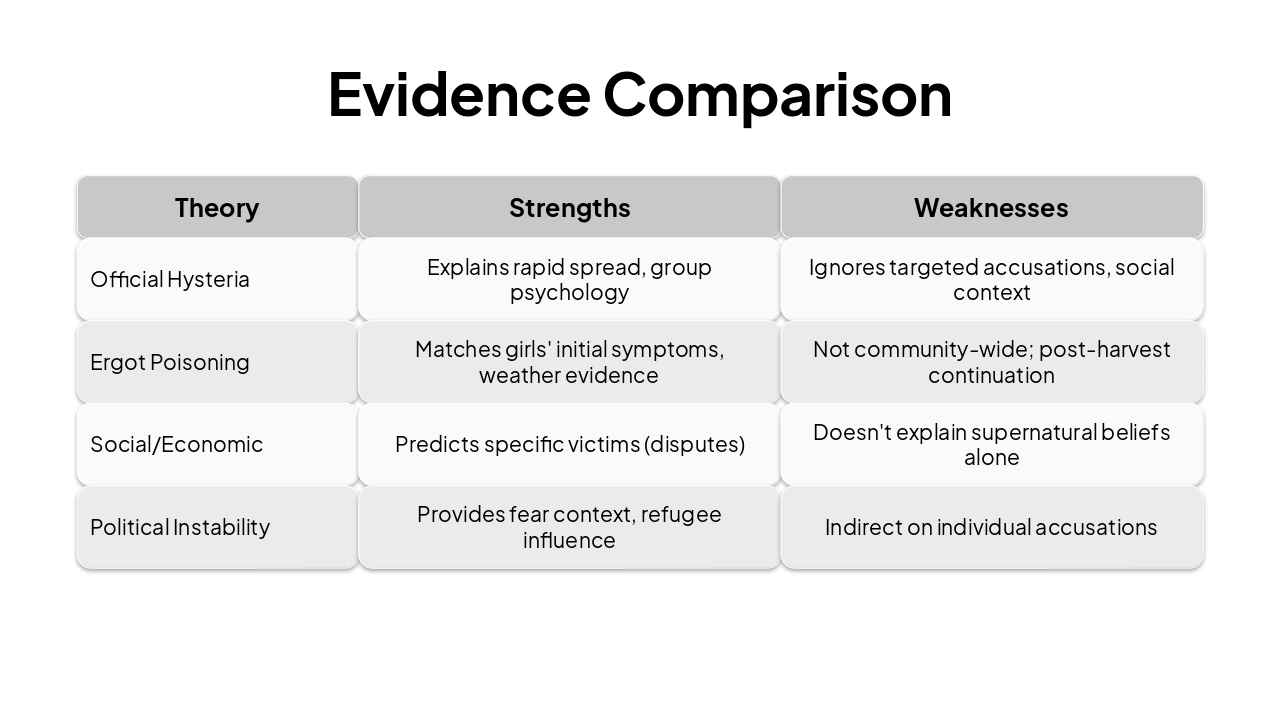
| Theory | Strengths | Weaknesses |
|---|---|---|
| Official Hysteria | Explains rapid spread, group psychology | Ignores targeted accusations, social context |
| Ergot Poisoning | Matches girls' initial symptoms, weather evidence | Not community-wide; post-harvest continuation |
| Social/Economic | Predicts specific victims (disputes) | Doesn't explain supernatural beliefs alone |
| Political Instability | Provides fear context, refugee influence | Indirect on individual accusations |
Salem Witch Trials: Social conflicts triggered hysteria amid instability
Still matters: Echoes in McCarthyism, modern fear-driven injustices
---
Photo by Angelo Casto on Unsplash
Explore thousands of AI-generated presentations for inspiration
Generate professional presentations in seconds with Karaf's AI. Customize this presentation or start from scratch.