Solar System Overview: Planets and Structure

Generated from prompt:

Planets of our solar system

This presentation offers a comprehensive tour of our Solar System, detailing its formation 4.6 billion years ago, the inner terrestrial planets (Mercury, Venus, Earth, Mars), outer gas and ice giants (Jupiter, Saturn, Uranus, Neptune), dwarf planets,

March 25, 202610 slides
Slide 1 of 10

Slide 1 - Solar System Overview

The Planets of Our Solar System

A tour of the eight planets and the structure of our celestial home
Slide 1 - Solar System Overview
Slide 2 of 10

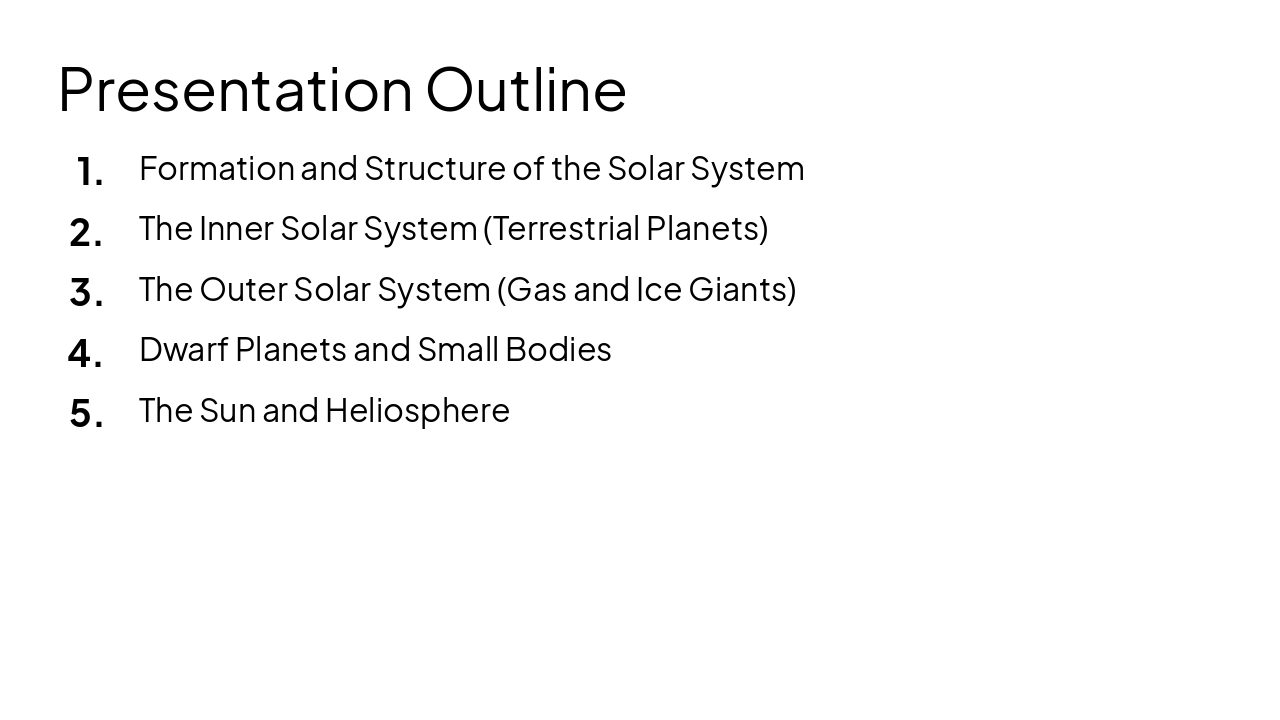
Slide 2 - Presentation Outline

  • Formation and Structure of the Solar System
  • The Inner Solar System (Terrestrial Planets)
  • The Outer Solar System (Gas and Ice Giants)
  • Dwarf Planets and Small Bodies
  • The Sun and Heliosphere
Slide 2 - Presentation Outline
Slide 3 of 10

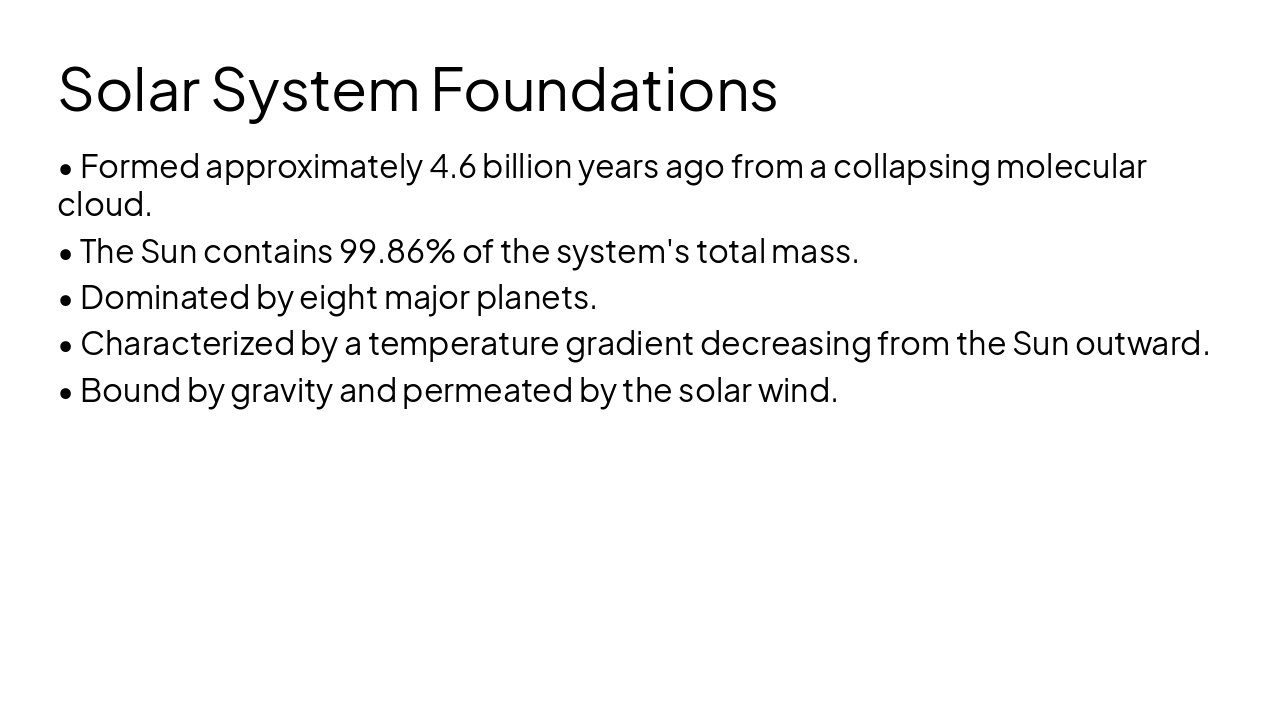
Slide 3 - Solar System Foundations

  • Formed approximately 4.6 billion years ago from a collapsing molecular cloud.
  • The Sun contains 99.86% of the system's total mass.
  • Dominated by eight major planets.
  • Characterized by a temperature gradient decreasing from the Sun outward.
  • Bound by gravity and permeated by the solar wind.
Slide 3 - Solar System Foundations
Slide 4 of 10

Slide 4 - The Inner Worlds

1

Inner Solar System

The Terrestrial Planets

Slide 4 - The Inner Worlds
Slide 5 of 10

Slide 5 - The Terrestrial Planets

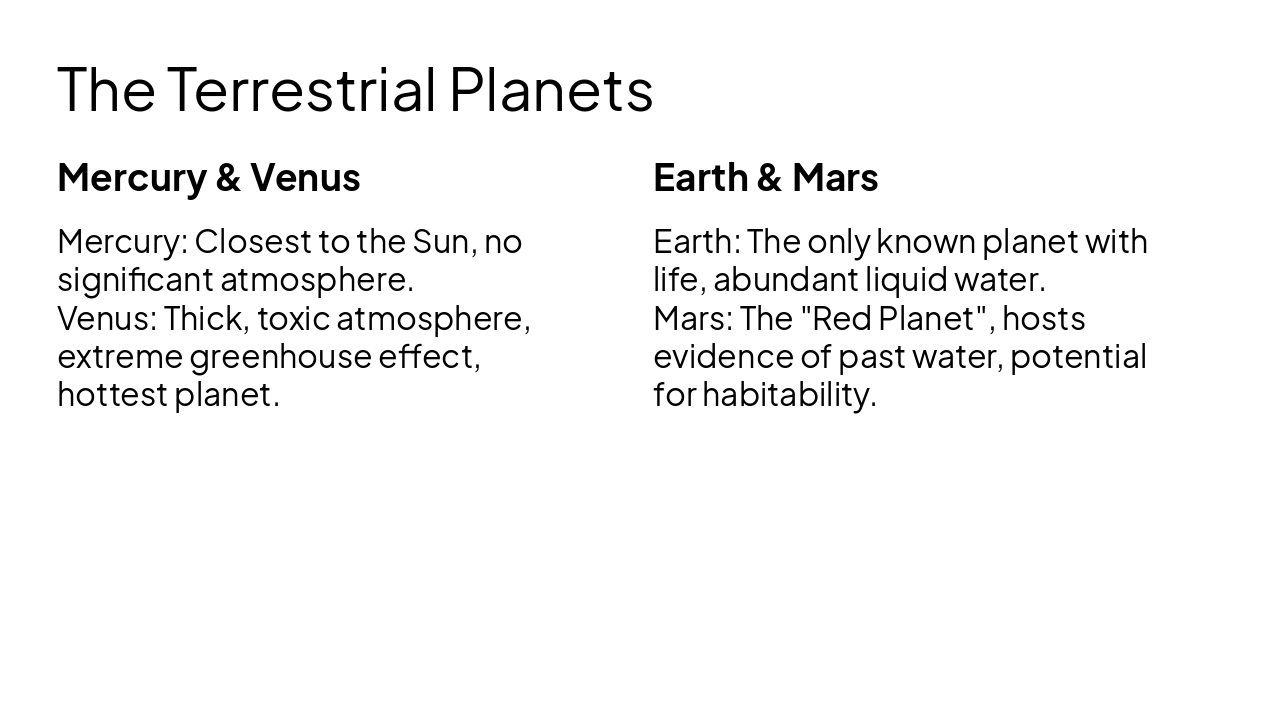
Mercury & Venus Mercury: Closest to the Sun, no significant atmosphere. Venus: Thick, toxic atmosphere, extreme greenhouse effect, hottest planet.

Earth & Mars Earth: The only known planet with life, abundant liquid water. Mars: The "Red Planet", hosts evidence of past water, potential for habitability.
Slide 5 - The Terrestrial Planets
Slide 6 of 10

Slide 6 - The Outer Worlds

2

Outer Solar System

Gas Giants and Ice Giants

Slide 6 - The Outer Worlds
Slide 7 of 10

Slide 7 - Giants Beyond the Frost Line

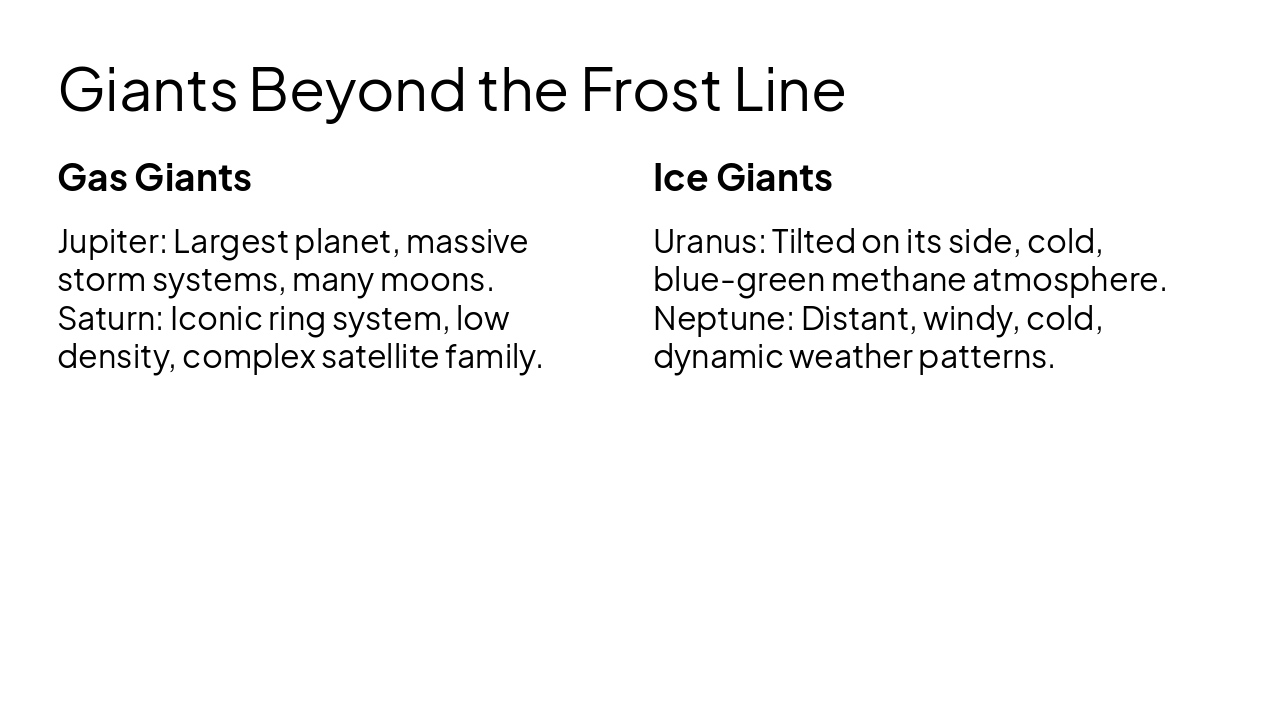
Gas Giants Jupiter: Largest planet, massive storm systems, many moons. Saturn: Iconic ring system, low density, complex satellite family.

Ice Giants Uranus: Tilted on its side, cold, blue-green methane atmosphere. Neptune: Distant, windy, cold, dynamic weather patterns.
Slide 7 - Giants Beyond the Frost Line
Slide 8 of 10

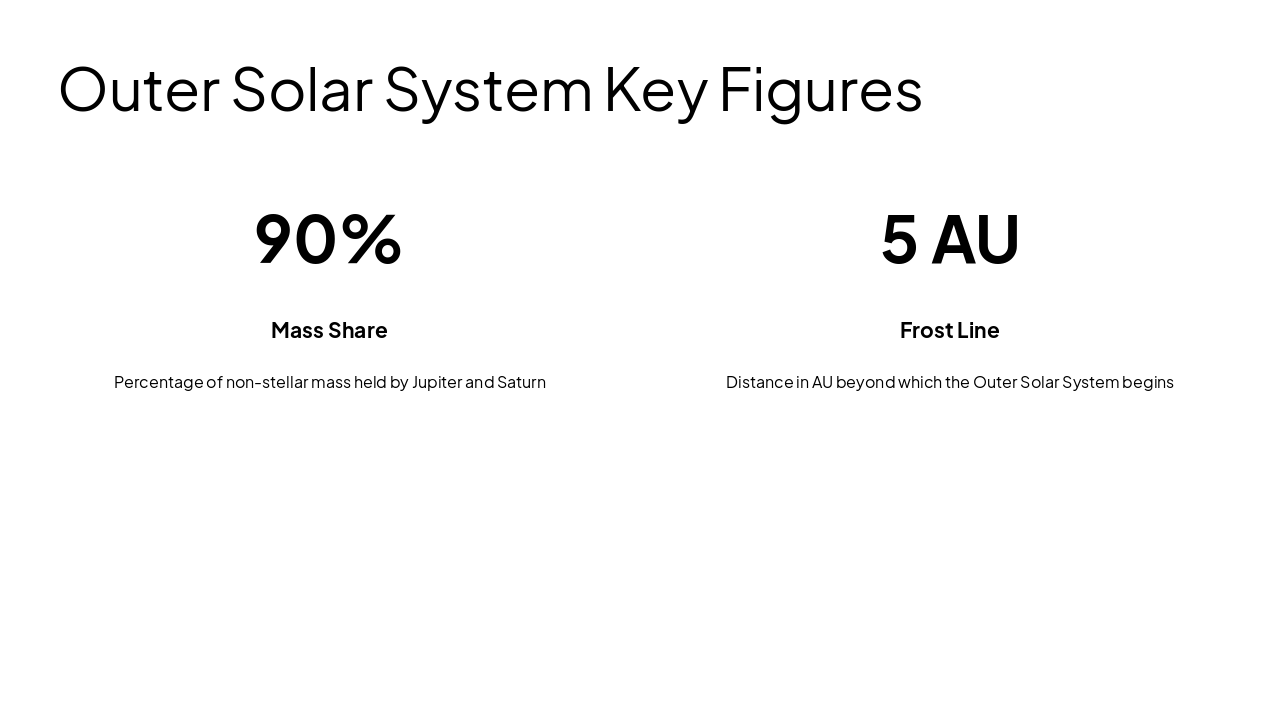
Slide 8 - Outer Solar System Key Figures

  • 90%: Mass Share
  • 5 AU: Frost Line
Slide 8 - Outer Solar System Key Figures
Slide 9 of 10

Slide 9 - Dwarf Planets and Small Bodies

  • Objects that orbit the Sun but do not dominate their orbits.
  • Includes Ceres (in the asteroid belt), Pluto, Eris, Makemake, and Haumea.
  • Often located in the Kuiper belt or scattered disc.
  • Smaller bodies like asteroids, comets, and meteoroids also populate these regions.
Slide 9 - Dwarf Planets and Small Bodies
Slide 10 of 10

Slide 10 - Summary

The Solar System: A Dynamic Cosmic Neighborhood

Our solar neighborhood continues to be explored and understood through science.
Slide 10 - Summary

Discover More Presentations

Explore thousands of AI-generated presentations for inspiration

Browse Presentations
Powered by AI

Create Your Own Presentation

Generate professional presentations in seconds with Karaf's AI. Customize this presentation or start from scratch.

Create New Presentation

Powered by Karaf.ai — AI-Powered Presentation Generator