Osteosynthesis Failure in Femoral Fractures

Generated from prompt:

Make a presentation about Academic presentation on osteosynthesis failure in femoral fractures.

This academic presentation explores osteosynthesis failure in femoral fractures, covering background, techniques, failure mechanisms, rates, risk factors, and key takeaways for optimization and future

January 23, 20268 slides
Slide 1 of 8

Slide 1 - Osteosynthesis Failure in Femoral Fractures

The slide is a title presentation titled "Osteosynthesis Failure in Femoral Fractures." Its subtitle outlines key topics: causes, risk factors, diagnosis, and prevention strategies.

Osteosynthesis Failure

in Femoral Fractures

Causes, Risk Factors, Diagnosis, and Prevention Strategies

Source: Academic presentation exploring causes, risk factors, diagnosis, and prevention strategies

Speaker Notes
Introduction slide for academic presentation on osteosynthesis failure in femoral fractures.
Slide 1 - Osteosynthesis Failure in Femoral Fractures
Slide 2 of 8

Slide 2 - Presentation Agenda

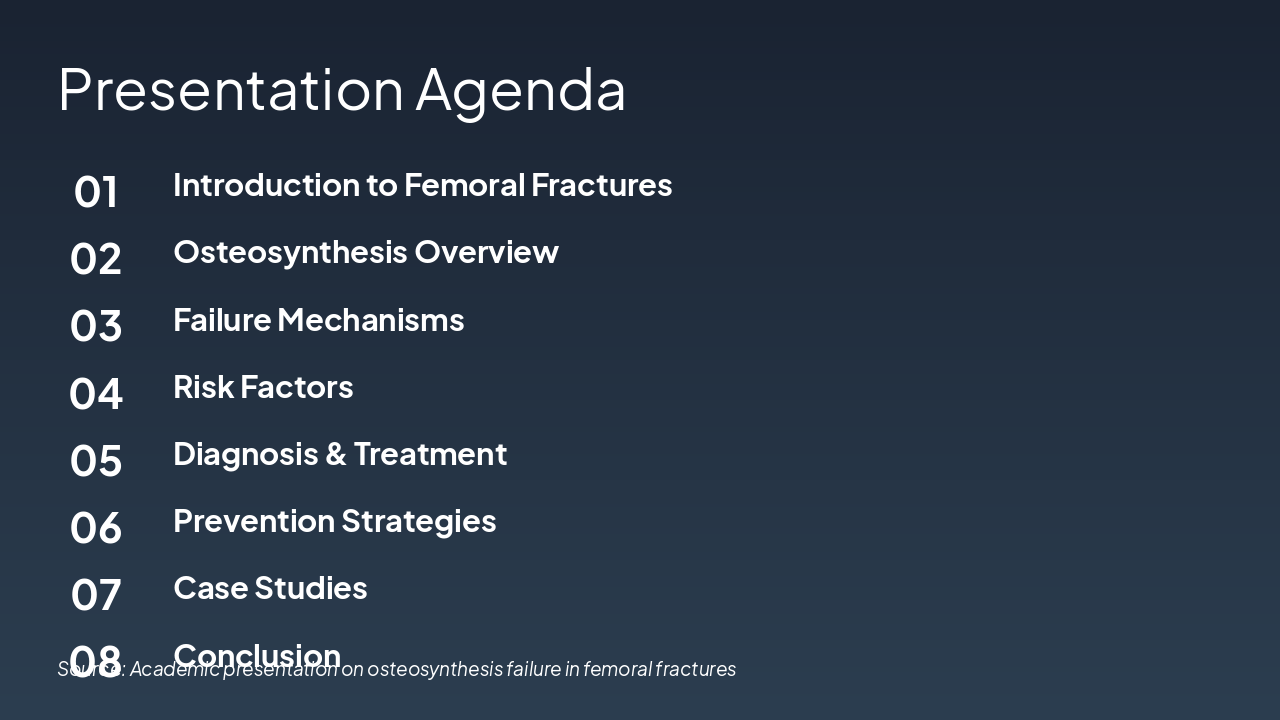
This agenda slide outlines a presentation on femoral fractures, starting with an introduction to the topic and an overview of osteosynthesis. It covers failure mechanisms, risk factors, diagnosis and treatment, prevention strategies, case studies, and concludes with key takeaways.

Presentation Agenda

  1. Introduction to Femoral Fractures
  2. Osteosynthesis Overview
  3. Failure Mechanisms
  4. Risk Factors
  5. Diagnosis & Treatment
  6. Prevention Strategies
  7. Case Studies
  8. Conclusion

Source: Academic presentation on osteosynthesis failure in femoral fractures

Slide 2 - Presentation Agenda
Slide 3 of 8

Slide 3 - Femoral Fractures: Background

  • Common: trauma, elderly falls, osteoporosis
  • Treatments: intramedullary nailing, plating, screws
  • Challenges: biomechanics, poor blood supply
Slide 3 - Femoral Fractures: Background
Slide 4 of 8

Slide 4 - Osteosynthesis Techniques

This section header slide introduces "Osteosynthesis Techniques" as section 03. It features a subtitle reviewing key fixation methods: IM Nails, DHS, and Locking Plates.

Osteosynthesis Techniques

03

Osteosynthesis Techniques

Review of Fixation Methods: IM Nails, DHS, Locking Plates

Source: Academic presentation on osteosynthesis failure in femoral fractures

Speaker Notes
Review of fixation methods: IM nails, DHS, locking plates.
Slide 4 - Osteosynthesis Techniques
Slide 5 of 8

Slide 5 - Mechanisms of Failure

The slide "Mechanisms of Failure" outlines mechanical failures like fatigue from cyclic loading causing implant cracking and overload leading to bending, breakage, or loosening in femoral osteosynthesis. It also covers biological failures such as non-union due to poor stability or biology, and infection resulting in osteomyelitis, implant rejection, and delayed union at fracture sites.

Mechanisms of Failure

Mechanical FailuresBiological Failures
Fatigue: Cyclic loading causes implant cracking over time. Overload: Excessive forces exceed material strength, leading to bending, breakage, or loosening in femoral osteosynthesis.Non-union: Failure of bone healing due to poor stability or biology. Infection: Bacterial invasion causes osteomyelitis, implant rejection, and delayed union in fracture sites.

Source: Academic presentation on osteosynthesis failure in femoral fractures

Speaker Notes
Highlight how mechanical failures relate to implant stress in femoral fractures, while biological issues stem from healing complications; emphasize prevention strategies.
Slide 5 - Mechanisms of Failure
Slide 6 of 8

Slide 6 - Failure Rates & Risk Factors

The slide outlines key statistics on failure rates and risk factors, with an overall failure rate of 5-20% varying across studies, infection incidence at 2-5%, and a 10% non-union rate due to healing failure. It also highlights high-risk factors like smoking, diabetes, and poor reduction, which increase risks by 3x or more.

Failure Rates & Risk Factors

  • 5-20%: Overall Failure Rate
  • Variability across studies

  • 2-5%: Infection Incidence
  • Post-operative complication

  • 10%: Non-Union Rate
  • Healing failure occurrence

  • 3x+: High-Risk Factors

Smoking, diabetes, poor reduction Source: Academic Review on Femoral Fracture Osteosynthesis

Slide 6 - Failure Rates & Risk Factors
Slide 7 of 8

Slide 7 - Risk Factors Comparison

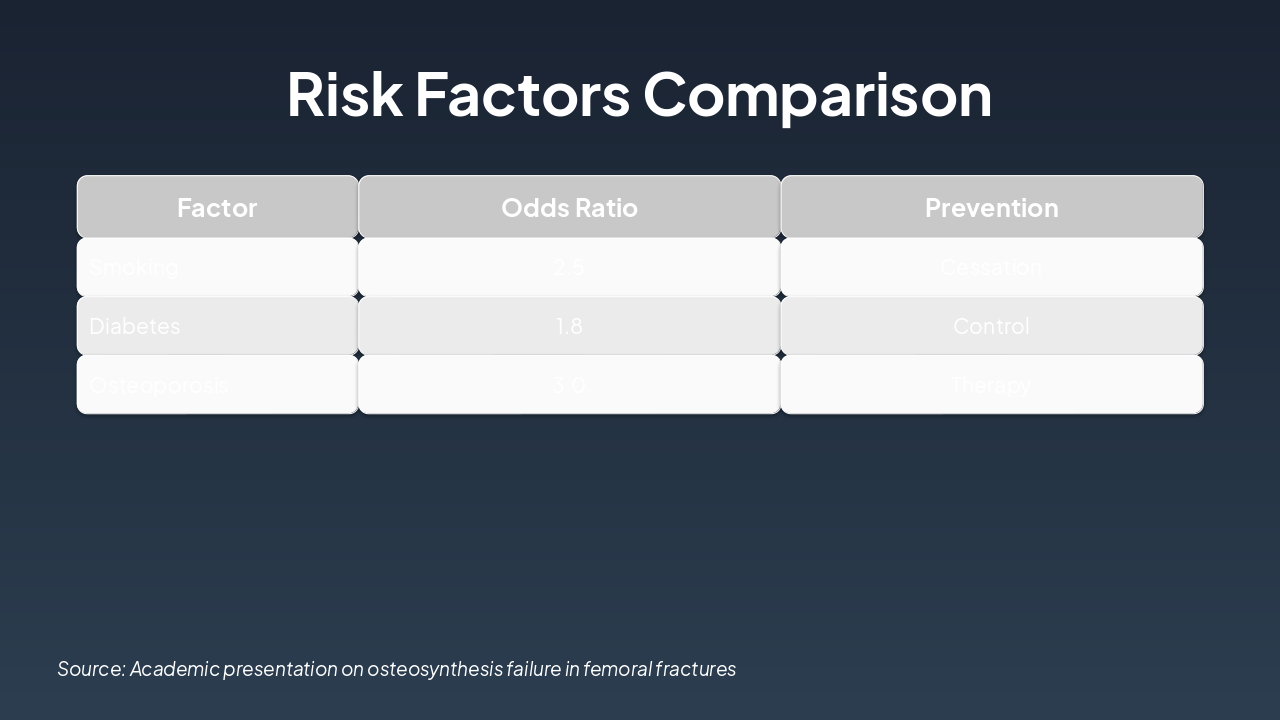
The slide "Risk Factors Comparison" presents a table comparing three factors—Smoking (odds ratio 2.5, prevention: Cessation), Diabetes (1.8, Control), and Osteoporosis (3.0, Therapy)—with their associated odds ratios and prevention strategies. It highlights osteoporosis as the highest-risk factor, emphasizing targeted interventions for risk reduction.

Risk Factors Comparison

FactorOdds RatioPrevention
Smoking2.5Cessation
Diabetes1.8Control
Osteoporosis3.0Therapy

Source: Academic presentation on osteosynthesis failure in femoral fractures

Slide 7 - Risk Factors Comparison
Slide 8 of 8

Slide 8 - Key Takeaways & Future Directions

The slide's key takeaways emphasize optimizing patient factors and surgical technique alongside early diagnosis through imaging. Future directions focus on researching bioabsorbable implants, with a call to advance fracture care together and an invitation for questions.

Key Takeaways & Future Directions

**Key Takeaways:

  • Optimize patient factors and surgical technique
  • Early diagnosis via imaging

Future Directions:

  • Research: Bioabsorbable implants

Advancing fracture care together.

Thank you! Questions?**

Source: Academic presentation on osteosynthesis failure in femoral fractures

Speaker Notes
• Optimize patient factors and surgical technique • Early diagnosis via imaging • Research: Bioabsorbable implants Closing message: 'Advancing fracture care together.' Call-to-action: 'Thank you! Questions?'
Slide 8 - Key Takeaways & Future Directions

Discover More Presentations

Explore thousands of AI-generated presentations for inspiration

Browse Presentations
Powered by AI

Create Your Own Presentation

Generate professional presentations in seconds with Karaf's AI. Customize this presentation or start from scratch.

Create New Presentation

Powered by Karaf.ai — AI-Powered Presentation Generator