A Journey Through Time: Exploring Ancient Worlds and Transformative Eras

Generated from prompt:

Your presentation must include all of the following: • Early Civilizations • Medieval Christian Europe • Civilizations of Asia • The Americas • The Italian Renaissance You need at least 1-2 slides for each topic. Part 1: PowerPoint Requirements 1. Explain Each Topic For every topic, include: • A simple definition or explanation (in your own words) • 2-3 important facts • At least one example (people, places, or events) 2. Use Visuals Every slide must have at least one image • Use maps, pictures, or simple charts • Do NOT make slides with only text 3. Keep It Simple • Use bullet points, not paragraphs • Use easy-to-read fonts and colors • Don't overload your slides with too much information 4. Organization • Title slide (name, class, date) • One section for each topic • Final slide that summarizes what you learned Part 3: Creativity Make your presentation interesting: • Use a theme (ancient world, timeline, travel through history, etc.) • Add at least one creative slide (timeline, drawing, or comparison) • Make connections between topics if you can You will create and present a PowerPoint You should also show effort, creativity, and good presentation skills. create me the slides via images for the presentation make it less AI looking and make it look like it was done by powerpoint . The powerpoint theme is “A Journey Through Time” and about us going back in time and experiencing the olden days.

This presentation embarks on a comprehensive historical journey, exploring the foundational innovations of early civilizations, the cultural and political landscape of Medieval Christian Europe, the vast empires and philosophies of Asia, the indigenous grandeur of the Americas, and the artistic and intellectual rebirth of the Italian Renaissance. It highlights key advancements, societal structures, and enduring legacies that shaped human history across continents and eras.

May 15, 202619 slides
Slide 1 of 19

Slide 1 - A Journey Through Time

A Journey Through Time

Exploring Ancient Worlds and Transformative Eras

---

Photo by Denise Jans on Unsplash
Slide 1 - A Journey Through Time
Slide 2 of 19

Slide 2 - Our Historical Journey

  • Early Civilizations
  • Medieval Christian Europe
  • Civilizations of Asia
  • The Americas
  • The Italian Renaissance
  • Summary of Our Journey

---

Photo by Alex Boyd on Unsplash

Slide 2 - Our Historical Journey
Slide 3 of 19

Slide 3 - Early Civilizations

1

Early Civilizations

Foundations of Human Society

---

Photo by Osama Elsayed on Unsplash
Slide 3 - Early Civilizations
Slide 4 of 19

Slide 4 - Early Civilizations: The Dawn of Society

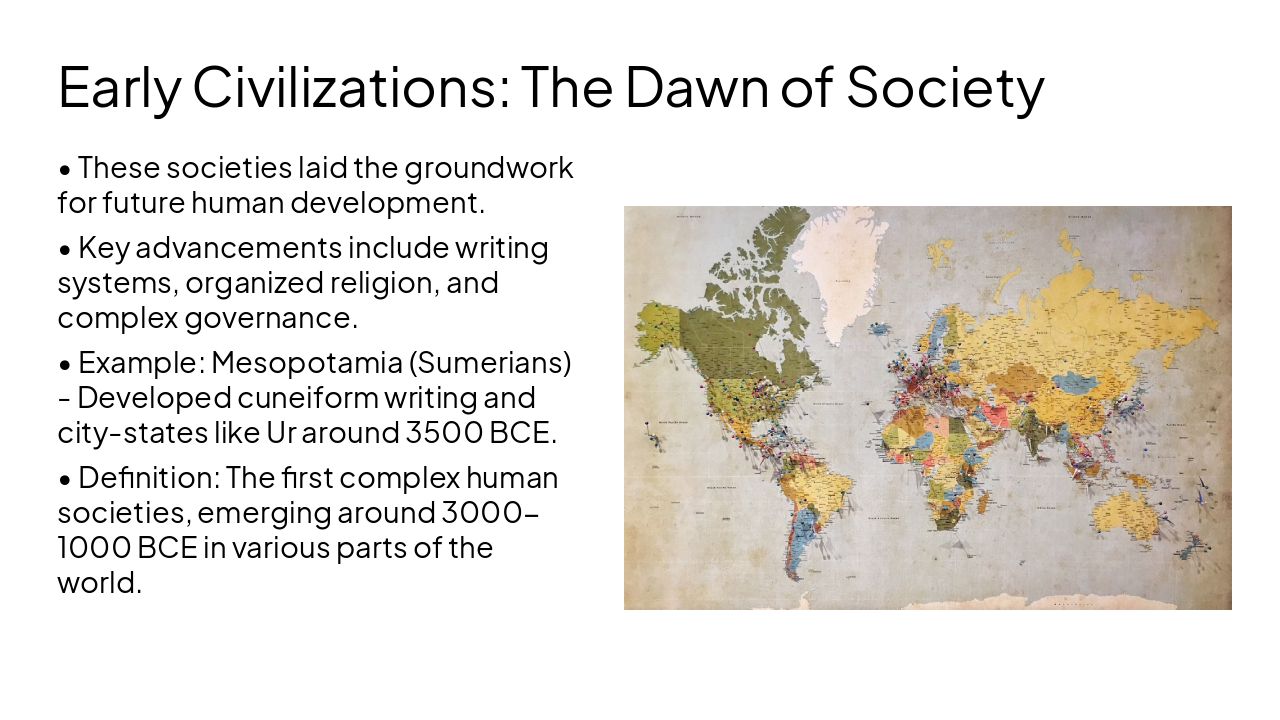
  • These societies laid the groundwork for future human development.
  • Key advancements include writing systems, organized religion, and complex governance.
  • Example: Mesopotamia (Sumerians) - Developed cuneiform writing and city-states like Ur around 3500 BCE.
  • Definition: The first complex human societies, emerging around 3000-1000 BCE in various parts of the world.

---

Photo by Andrew Stutesman on Unsplash
Slide 4 - Early Civilizations: The Dawn of Society
Slide 5 of 19

Slide 5 - More Examples of Early Civilizations

  • Indus Valley Civilization (c. 2500-1900 BCE): Known for sophisticated urban planning and drainage systems.
  • Ancient Egypt (c. 3100-30 BCE): Unified kingdom famous for monumental architecture, hieroglyphs, and pharaohs.
  • Shang Dynasty China (c. 1600-1046 BCE): First documented dynasty, known for bronze metallurgy and oracle bones.
Slide 5 - More Examples of Early Civilizations
Slide 6 of 19

Slide 6 - Medieval Christian Europe

2

Medieval Christian Europe

A Thousand Years of Faith and Feudalism

---

Photo by Cederic Vandenberghe on Unsplash

Slide 6 - Medieval Christian Europe
Slide 7 of 19

Slide 7 - Medieval Europe: Faith & Feudalism

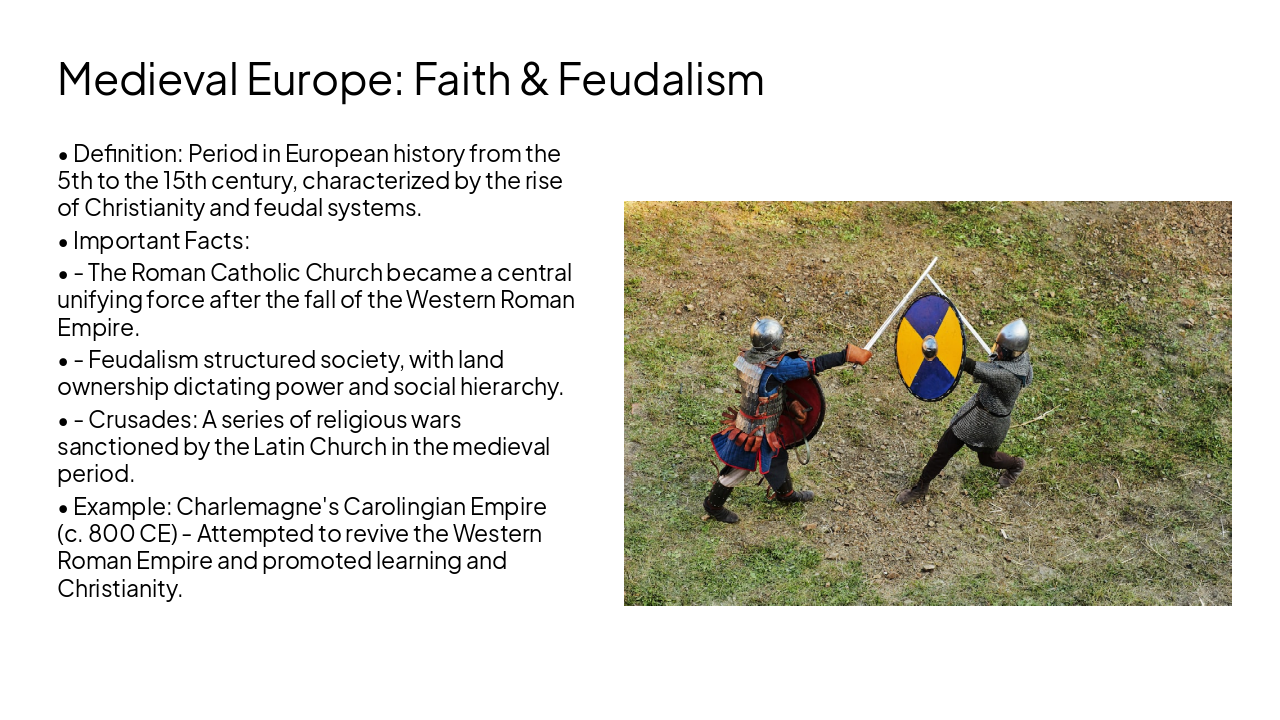
  • Definition: Period in European history from the 5th to the 15th century, characterized by the rise of Christianity and feudal systems.
  • Important Facts:
  • - The Roman Catholic Church became a central unifying force after the fall of the Western Roman Empire.
  • - Feudalism structured society, with land ownership dictating power and social hierarchy.
  • - Crusades: A series of religious wars sanctioned by the Latin Church in the medieval period.
  • Example: Charlemagne's Carolingian Empire (c. 800 CE) - Attempted to revive the Western Roman Empire and promoted learning and Christianity.

---

Photo by Олег Мороз on Unsplash

Slide 7 - Medieval Europe: Faith & Feudalism
Slide 8 of 19

Slide 8 - Medieval Europe: A Timeline

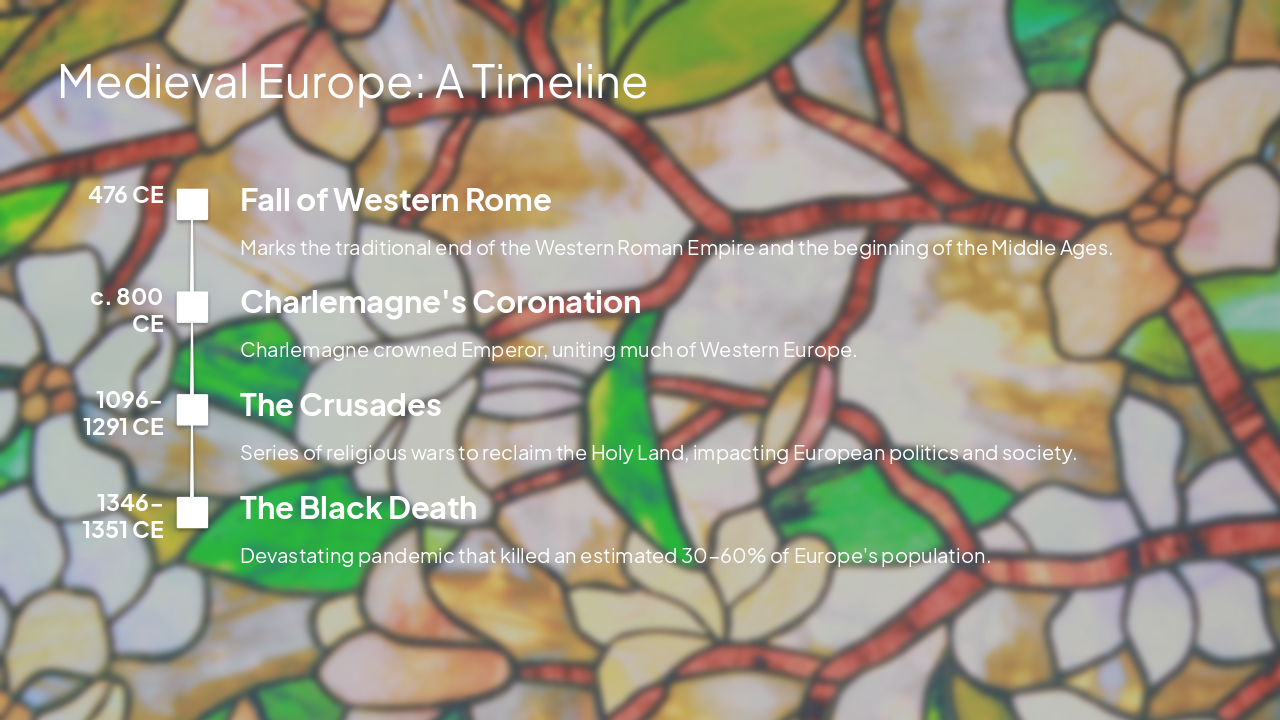
476 CE: Fall of Western Rome Marks the traditional end of the Western Roman Empire and the beginning of the Middle Ages. c. 800 CE: Charlemagne's Coronation Charlemagne crowned Emperor, uniting much of Western Europe. 1096-1291 CE: The Crusades Series of religious wars to reclaim the Holy Land, impacting European politics and society. 1346-1351 CE: The Black Death Devastating pandemic that killed an estimated 30-60% of Europe's population.

---

Photo by Mr. Great Heart on Unsplash

Slide 8 - Medieval Europe: A Timeline
Slide 10 of 19

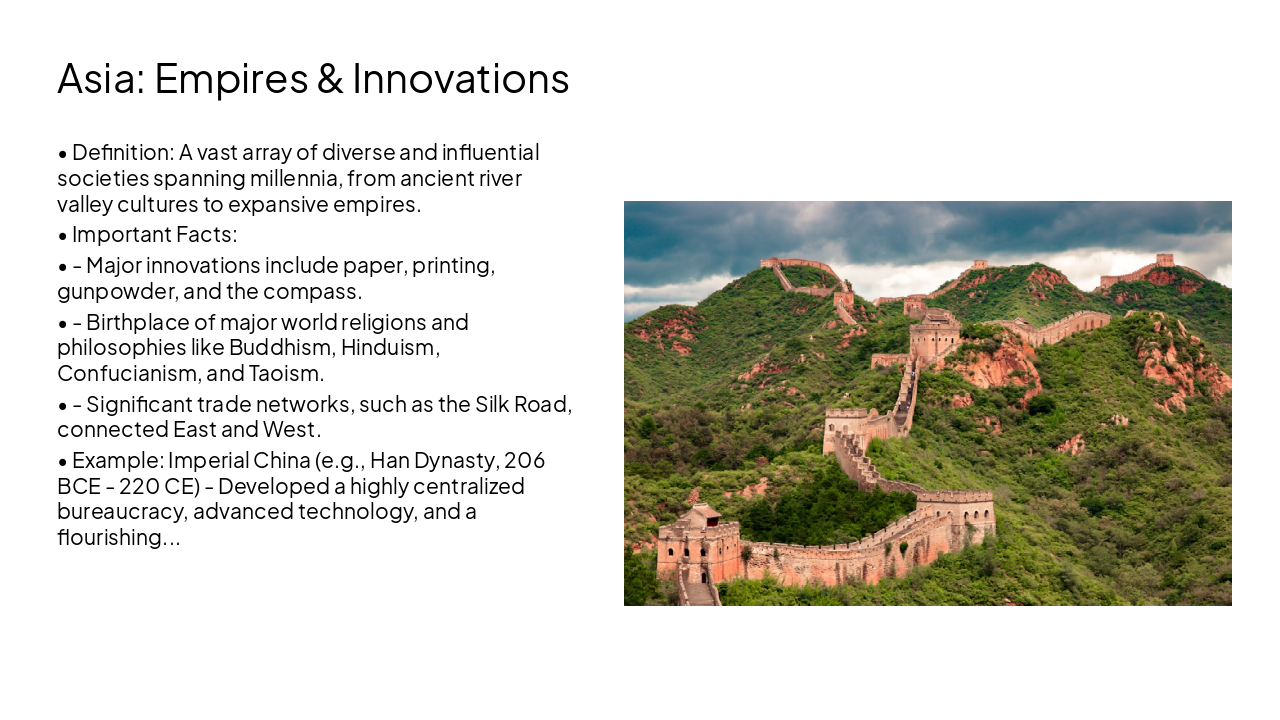
Slide 10 - Asia: Empires & Innovations

  • Definition: A vast array of diverse and influential societies spanning millennia, from ancient river valley cultures to expansive empires.
  • Important Facts:
  • - Major innovations include paper, printing, gunpowder, and the compass.
  • - Birthplace of major world religions and philosophies like Buddhism, Hinduism, Confucianism, and Taoism.
  • - Significant trade networks, such as the Silk Road, connected East and West.
  • Example: Imperial China (e.g., Han Dynasty, 206 BCE - 220 CE) - Developed a highly centralized bureaucracy, advanced technology, and a flourishing cultural scene.

---

Photo by William Olivieri on Unsplash

Slide 10 - Asia: Empires & Innovations
Slide 11 of 19

Slide 11 - Diverse Asian Civilizations

  • Mauryan Empire, India (c. 322-185 BCE): One of the largest empires in ancient India, known for Emperor Ashoka's embrace of Buddhism.
  • Persian Empire (various dynasties, c. 550-330 BCE for Achaemenid): Vast empire known for its efficient administration, road systems, and religious tolerance under rulers like Cyrus the Great.
  • Japanese Feudal Period (c. 1185-1868 CE): Characterized by samurai warriors, shogunates, and unique artistic and spiritual developments.
Slide 11 - Diverse Asian Civilizations
Slide 12 of 19

Slide 12 - The Americas

4

The Americas

From Ancient Civilizations to European Contact

---

Photo by Florian Delée on Unsplash

Slide 12 - The Americas
Slide 13 of 19

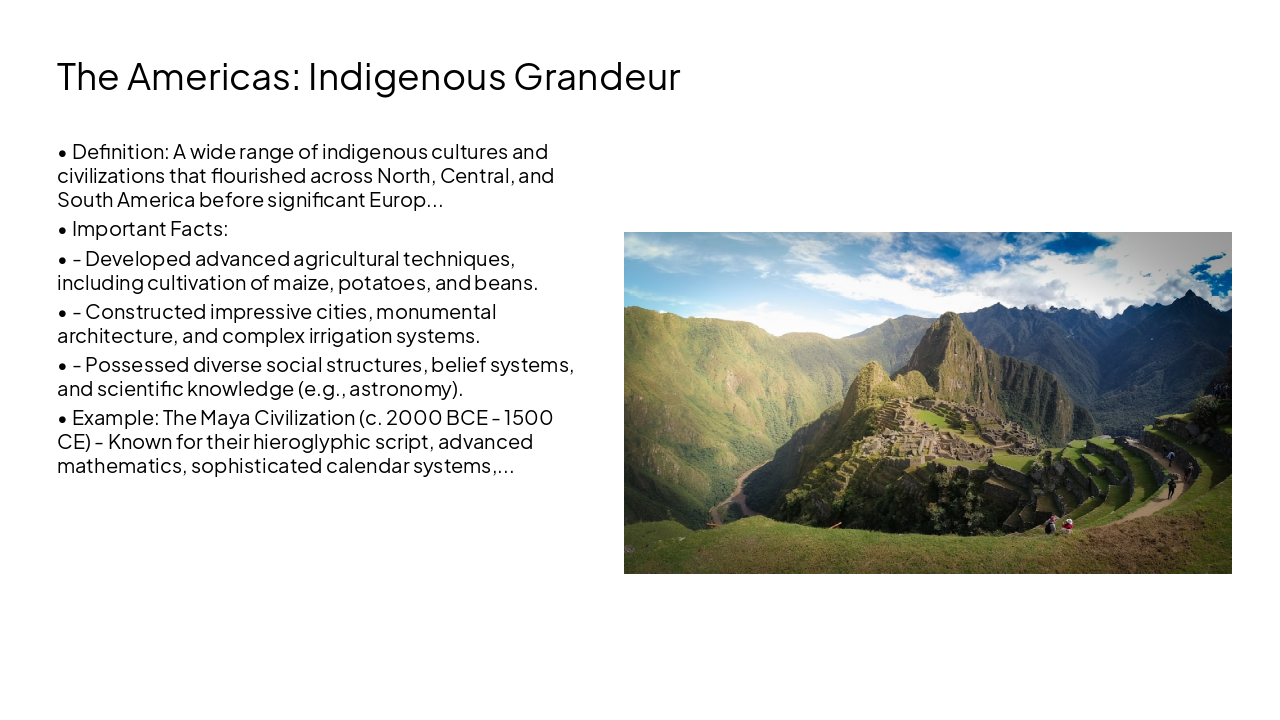
Slide 13 - The Americas: Indigenous Grandeur

  • Definition: A wide range of indigenous cultures and civilizations that flourished across North, Central, and South America before significant European colonization.
  • Important Facts:
  • - Developed advanced agricultural techniques, including cultivation of maize, potatoes, and beans.
  • - Constructed impressive cities, monumental architecture, and complex irrigation systems.
  • - Possessed diverse social structures, belief systems, and scientific knowledge (e.g., astronomy).
  • Example: The Maya Civilization (c. 2000 BCE - 1500 CE) - Known for their hieroglyphic script, advanced mathematics, sophisticated calendar systems, and impressive pyramid temples in Mesoamerica.

---

Photo by Giorgia Doglioni on Unsplash

Slide 13 - The Americas: Indigenous Grandeur
Slide 14 of 19

Slide 14 - Diverse Civilizations of the Americas

  • Inca Empire (c. 1400-1532 CE): Largest empire in pre-Columbian America, known for its vast road network, complex administrative system, and sophisticated masonry in the Andes.
  • Aztec Empire (c. 1300-1521 CE): Dominated Mesoamerica, famous for its capital Tenochtitlan, agricultural innovations like chinampas, and elaborate religious rituals.
  • Pueblo Peoples (c. 1150 CE - present): Developed distinct adobe architecture, intricate societal structures, and advanced irrigation in the Southwestern United States.
Slide 14 - Diverse Civilizations of the Americas
Slide 15 of 19

Slide 15 - The Italian Renaissance

5

The Italian Renaissance

A Rebirth of Art, Science, and Humanism

---

Photo by Viktor SOLOMONIK on Unsplash

Slide 15 - The Italian Renaissance
Slide 16 of 19

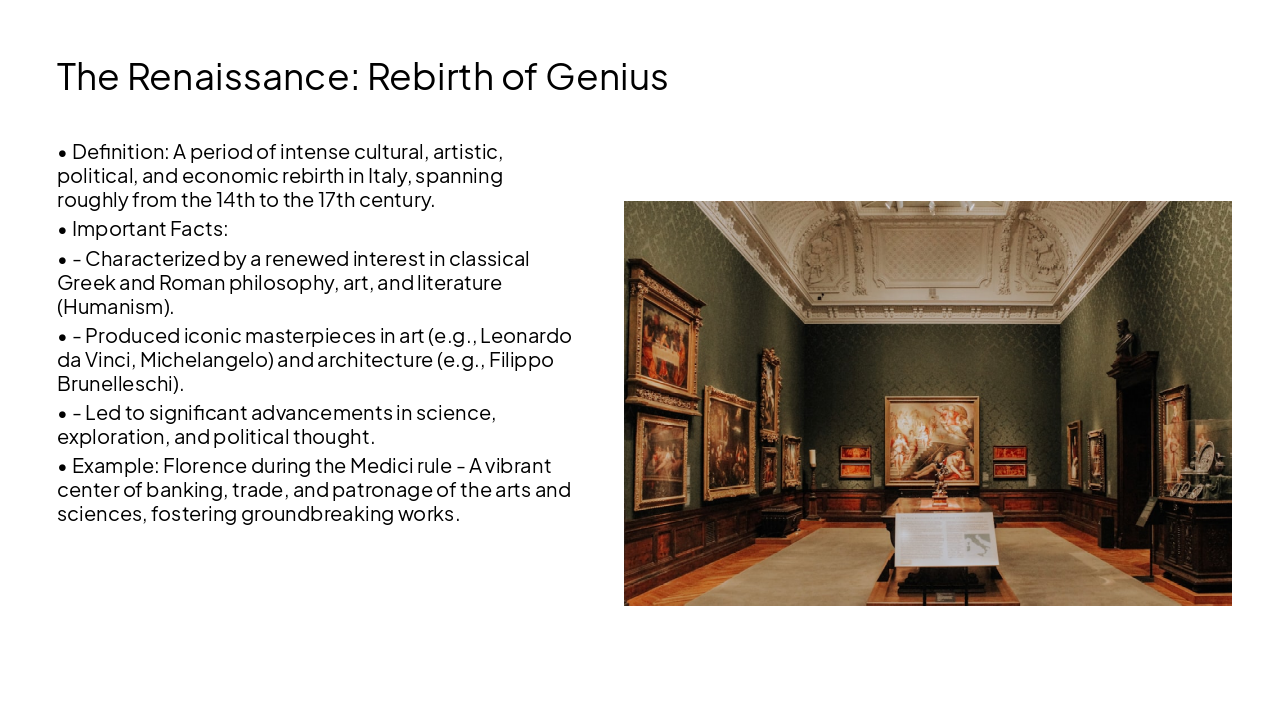
Slide 16 - The Renaissance: Rebirth of Genius

  • Definition: A period of intense cultural, artistic, political, and economic rebirth in Italy, spanning roughly from the 14th to the 17th century.
  • Important Facts:
  • - Characterized by a renewed interest in classical Greek and Roman philosophy, art, and literature (Humanism).
  • - Produced iconic masterpieces in art (e.g., Leonardo da Vinci, Michelangelo) and architecture (e.g., Filippo Brunelleschi).
  • - Led to significant advancements in science, exploration, and political thought.
  • Example: Florence during the Medici rule - A vibrant center of banking, trade, and patronage of the arts and sciences, fostering groundbreaking works.

---

Photo by Hester Qiang on Unsplash

Slide 16 - The Renaissance: Rebirth of Genius
Slide 17 of 19

Slide 17 - Renaissance Centers & Influence

  • Venice: A powerful maritime republic, known for its unique artistic style, glassmaking, and extensive trade networks.
  • Rome: Restored as a center of religious and artistic power, with projects like the Sistine Chapel and St. Peter's Basilica.
  • Impact on Europe: The ideas and innovations of the Italian Renaissance spread across Europe, laying foundations for the Scientific Revolution and the Age of Enlightenment.
Slide 17 - Renaissance Centers & Influence
Slide 18 of 19

Slide 18 - A Comparative Look: Governance Through Time

Governing Early Societies Early Civilizations often featured centralized monarchies or priestly rule (e.g., Pharaohs in Egypt, city-state kings in Mesopotamia). Divine right played a significant role in legitimizing power.

Governance in Later Eras Medieval Europe saw feudal systems and strong Church influence. Asian empires (e.g., Imperial China) developed highly structured bureaucracies. The Renaissance fostered new political philosophies, challenging traditional rule.

---

Photo by Andrew Stutesman on Unsplash
Slide 18 - A Comparative Look: Governance Through Time
Slide 19 of 19

Slide 19 - Conclusion: What We Learned

Our journey through time has revealed the incredible diversity, resilience, and ingenuity of human civilizations across different eras and continents. From the foundational innovations of early societies to the artistic and intellectual explosion of the Renaissance, each period has profoundly shaped the world we inhabit today. Understanding these connections helps us appreciate the tapestry of human history.

Reflecting on the Tapestry of Human History

---

Photo by Cristina Gottardi on Unsplash
Slide 19 - Conclusion: What We Learned

Discover More Presentations

Explore thousands of AI-generated presentations for inspiration

Browse Presentations
Powered by AI

Create Your Own Presentation

Generate professional presentations in seconds with Karaf's AI. Customize this presentation or start from scratch.

Create New Presentation

Powered by Karaf.ai — AI-Powered Presentation Generator