Banglalink School: ESG Learning Initiative

Generated from prompt:

Create a professional PowerPoint presentation titled 'Banglalink School — A Community Learning & Empowerment Initiative under ESG & EHS'. Include the following slides: 1. **Title Slide** – Banglalink School: A Purpose-Driven Learning Initiative for Support Staff & Communities. Led by: Banglalink ESG & EHS. Supported by: Banglalink Employees Nationwide. 2. **Executive Summary** – Describe how Banglalink School aims to uplift support staff, extended partners, and communities with literacy, digital, financial, and life skills, strengthening ESG culture and employee engagement. 3. **Why This Initiative** – Context & Problem: lack of education and employable skills among support staff/community; opportunity for Banglalink to bridge the gap. 4. **Alignment with ESG & Company Values** – Connect to ESG Social Pillar, EHS, and Banglalink’s care-driven culture. 5. **Vision** – Empower underprivileged individuals with learning and digital readiness. 6. **Target Beneficiaries (Phase-wise)** – Phase 1: Support staff; Phase 2: Vendor staff; Phase 3: Community; Phase 4: Families. 7. **Learning Curriculum** – Literacy, digital literacy, financial literacy, life skills, career pathing, mentoring. 8. **Delivery Model** – Weekly sessions, hybrid format, mobile kits, regional coverage. 9. **Employee Engagement Model** – Roles of employees (teacher, mentor, volunteer). 10. **Governance Model** – ESG lead, supported by EHS/HR/Admin; monitoring and feedback. 11. **Phase-wise Rollout Plan** – Pilot → Expansion → National CSR program. 12. **Budget Overview** – Phase 1 (BDT 50k–150k), Phase 2 (2–4 lakh), Phase 3 (10–25 lakh annually). 13. **Strategic Outcomes** – Strengthen ESG identity, culture, goodwill, and talent pipeline. 14. **KPIs & Success Metrics** – Enrollment, volunteer hours, literacy improvement, media reach, engagement uplift. 15. **Risks & Mitigation** – Attendance, volunteers, skill gaps, logistics. 16. **Call for Approval** – CHRO, CXO, ESG Board. 17. **Closing Slide** – Inspirational closing: 'Where learning becomes a bridge to dignity, opportunity, and a better future.'

This presentation outlines Banglalink School, a phased initiative to empower support staff, partners, and communities via literacy, digital, financial, and life skills training. Aligned with ESG value

December 2, 202517 slides
Slide 1 of 17

Slide 1 - Banglalink School Initiative

The slide introduces the Banglalink School Initiative as a purpose-driven learning program. It targets support staff and communities, led by Banglalink's ESG and EHS teams with nationwide employee support.

Banglalink School: A Purpose-Driven Learning Initiative

for Support Staff & Communities. Led by Banglalink ESG & EHS. Supported by Banglalink Employees Nationwide.

Slide 1 - Banglalink School Initiative
Slide 2 of 17

Slide 2 - Executive Summary

This executive summary slide outlines a program that uplifts support staff, partners, and communities by providing targeted skills training in literacy, digital, financial, and life skills to bridge educational gaps. It emphasizes fostering an ESG culture through inclusive initiatives that boost employee engagement and empower underprivileged groups for sustainable personal and professional growth.

Executive Summary

  • Uplifts support staff, partners, and communities through targeted skills training.
  • Delivers literacy, digital, financial, and life skills to address educational gaps.
  • Fosters ESG culture and strengthens employee engagement via inclusive initiatives.
  • Empowers underprivileged groups for sustainable personal and professional growth.
Slide 2 - Executive Summary
Slide 3 of 17

Slide 3 - Why This Initiative

Support staff and communities often lack essential education and employable skills, which hinders their personal growth, social inclusion, and economic participation. Banglalink addresses this gap by bridging educational and skill deficits, thereby boosting workforce readiness and delivering broader social impact.

Why This Initiative

  • Context: Support staff and communities lack education and employable skills.
  • Problem: Hinders personal growth, inclusion, and economic participation.
  • Opportunity: Banglalink bridges gaps, enhancing workforce readiness and social impact.
Slide 3 - Why This Initiative
Slide 4 of 17

Slide 4 - Alignment with ESG & Company Values

This slide highlights how the initiative aligns with ESG principles and Banglalink's values by promoting education equity under the Social Pillar and integrating Environmental, Health, and Safety (EHS) measures for secure learning environments. It further reinforces the company's care-driven culture through empowerment and advances sustainability via community skill-building programs.

Alignment with ESG & Company Values

  • Promotes education equity under ESG Social Pillar.
  • Integrates EHS for safe, secure learning environments.
  • Reinforces Banglalink’s care-driven culture via empowerment.
  • Advances sustainability through community skill-building initiatives.
Slide 4 - Alignment with ESG & Company Values
Slide 5 of 17

Slide 5 - Vision

The slide, titled "Vision" and presented as a quote, features the statement: "Empowering underprivileged individuals with essential learning and digital readiness unlocks opportunities and fosters self-reliance, transforming lives one skill at a time." It is attributed to Dr. Aisha Rahman, an expert in education and empowerment.

Vision

> Empowering underprivileged individuals with essential learning and digital readiness unlocks opportunities and fosters self-reliance, transforming lives one skill at a time.

— Dr. Aisha Rahman, Education and Empowerment Expert

Source: Banglalink School Initiative

Slide 5 - Vision
Slide 6 of 17

Slide 6 - Target Beneficiaries (Phase-wise)

The timeline slide outlines a four-phase initiative for target beneficiaries, starting in 2024 with Phase 1 focused on training Banglalink support staff in literacy and digital skills for immediate impact. It progresses to Phase 2 in 2025 for vendor staff inclusion to boost employability, Phase 3 in 2026 for community outreach in underserved areas, and Phase 4 in 2027 extending programs to beneficiaries' families for holistic, long-term transformation.

Target Beneficiaries (Phase-wise)

2024: Phase 1: Support Staff Training Focus on upskilling Banglalink support staff with literacy and digital skills for immediate impact. 2025: Phase 2: Vendor Staff Inclusion Extend training to vendor employees, fostering partnerships and enhancing employability across the supply chain. 2026: Phase 3: Community Outreach Launch programs for local communities, promoting education and empowerment in underserved areas. 2027: Phase 4: Family Extension Include families of beneficiaries for holistic development, ensuring long-term community transformation.

Slide 6 - Target Beneficiaries (Phase-wise)
Slide 7 of 17

Slide 7 - Learning Curriculum

The Learning Curriculum slide outlines key educational areas to build essential skills, including core literacy for reading and writing, digital literacy for technology navigation, financial literacy for money management, and life skills for daily independence. It also covers career pathing guidance to pursue opportunities and personalized mentoring for long-term growth.

Learning Curriculum

  • Core Literacy Basics for Foundational Reading and Writing Skills
  • Digital Literacy to Navigate Technology and Online Resources
  • Financial Literacy for Effective Money Management and Savings
  • Essential Life Skills for Daily Independence and Well-Being
  • Career Pathing Guidance to Identify and Pursue Opportunities
  • Personalized Mentoring for Long-Term Sustainable Growth
Slide 7 - Learning Curriculum
Slide 8 of 17

Slide 8 - Delivery Model

The Delivery Model slide outlines a weekly hybrid approach that integrates in-person and virtual sessions for flexible engagement. It also features mobile kits to improve accessibility in remote areas and ensures comprehensive coverage throughout Bangladesh.

Delivery Model

  • Weekly hybrid sessions combining in-person and virtual formats
  • Mobile kits for enhanced accessibility in remote areas
  • Comprehensive regional coverage across Bangladesh
Slide 8 - Delivery Model
Slide 9 of 17

Slide 9 - Employee Engagement Model

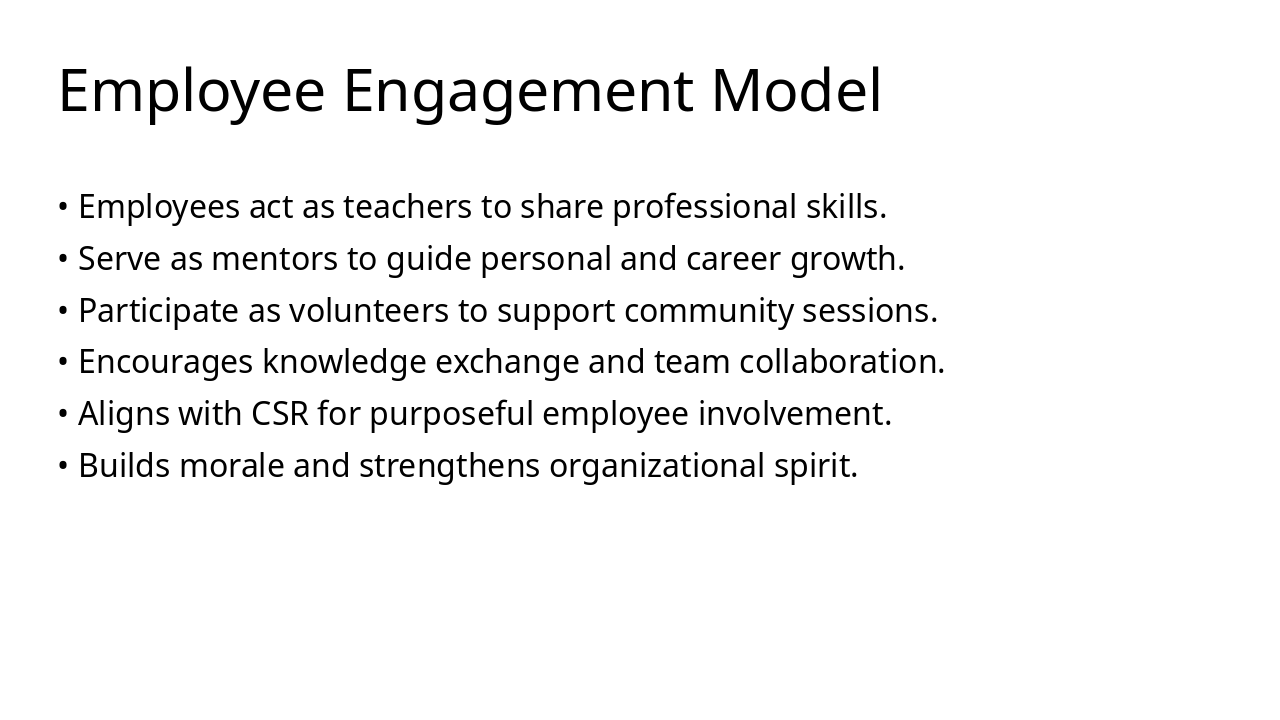
The Employee Engagement Model promotes employees taking active roles as teachers to share professional skills, mentors for personal and career growth, and volunteers in community sessions. It fosters knowledge exchange, team collaboration, alignment with corporate social responsibility, and builds morale to strengthen organizational spirit.

Employee Engagement Model

  • Employees act as teachers to share professional skills.
  • Serve as mentors to guide personal and career growth.
  • Participate as volunteers to support community sessions.
  • Encourages knowledge exchange and team collaboration.
  • Aligns with CSR for purposeful employee involvement.
  • Builds morale and strengthens organizational spirit.
Slide 9 - Employee Engagement Model
Slide 10 of 17

Slide 10 - Governance Model

The governance model is led by the ESG team for strategic oversight and supported by EHS, HR, and Admin functions. It features regular monitoring for program adherence, feedback loops for ongoing refinements, and impact assessments to measure continuous improvement.

Governance Model

  • Led by ESG team for strategic oversight
  • Supported by EHS, HR, and Admin functions
  • Regular monitoring ensures program adherence
  • Feedback loops drive ongoing refinements
  • Impact assessments measure continuous improvement
Slide 10 - Governance Model
Slide 11 of 17

Slide 11 - Phase-wise Rollout Plan

The Phase-wise Rollout Plan timeline outlines the program's progression starting with a Pilot Phase Launch in Q1 2024, where testing begins with support staff at select sites to validate the curriculum. It continues with Regional Expansion Rollout in Q3 2024 to extend the program to key areas including vendor staff, culminating in National CSR Scaling in 2025 for full integration with ongoing funding and monitoring.

Phase-wise Rollout Plan

Q1 2024: Pilot Phase Launch Initiate testing with support staff in select sites for curriculum validation. Q3 2024: Regional Expansion Rollout Extend program to key regions, including vendor staff for broader impact. 2025: National CSR Scaling Achieve full integration as national program with sustained funding and monitoring.

Slide 11 - Phase-wise Rollout Plan
Slide 12 of 17

Slide 12 - Budget Overview

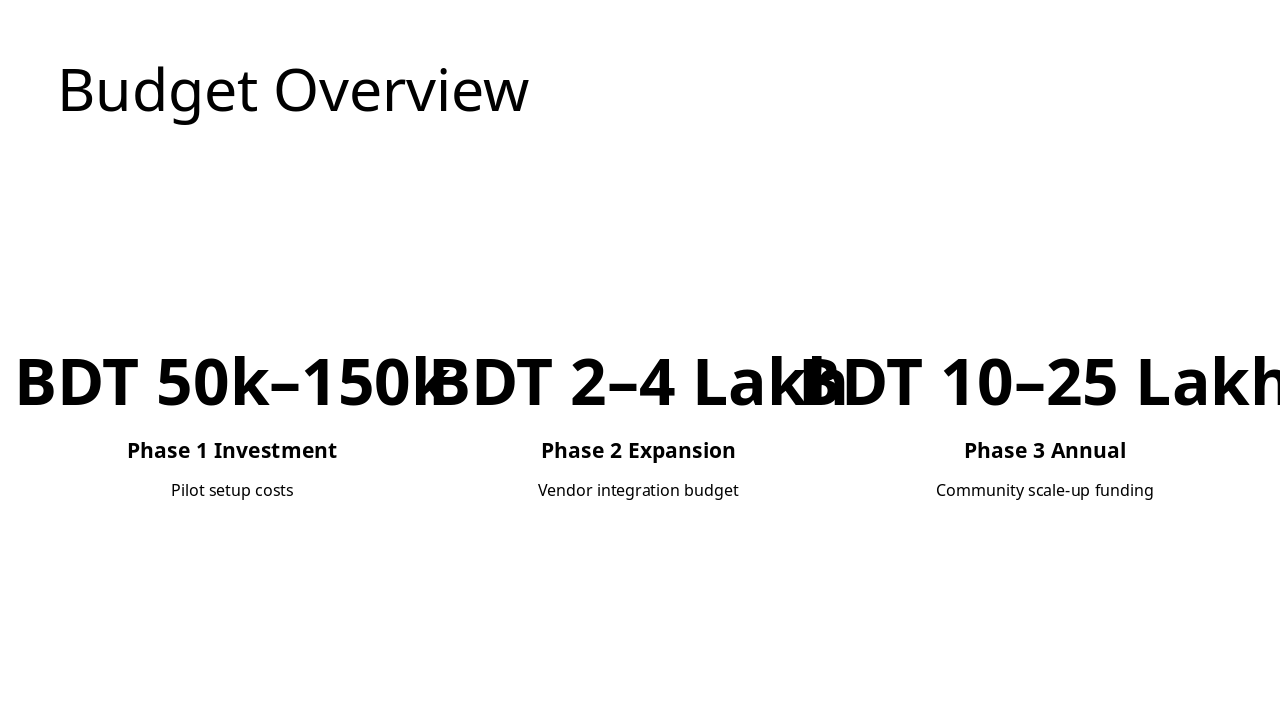
The Budget Overview slide outlines phased investments for a project, starting with Phase 1's pilot setup costs at BDT 50k–150k. It continues with Phase 2's vendor integration budget of BDT 2–4 Lakh and Phase 3's annual community scale-up funding at BDT 10–25 Lakh.

Budget Overview

  • BDT 50k–150k: Phase 1 Investment
  • Pilot setup costs

  • BDT 2–4 Lakh: Phase 2 Expansion
  • Vendor integration budget

  • BDT 10–25 Lakh: Phase 3 Annual
  • Community scale-up funding

Slide 12 - Budget Overview
Slide 13 of 17

Slide 13 - Strategic Outcomes

The "Strategic Outcomes" slide outlines key benefits of ESG initiatives, including strengthening the organization's ESG identity and culture while building community goodwill and a positive reputation. It also highlights creating a talent pipeline for future growth and enhancing employee morale through purposeful engagement.

Strategic Outcomes

  • Strengthens ESG identity and organizational culture
  • Builds community goodwill and positive reputation
  • Creates talent pipeline for future growth
  • Enhances employee morale through purposeful engagement
Slide 13 - Strategic Outcomes
Slide 14 of 17

Slide 14 - KPIs & Success Metrics

The KPIs & Success Metrics slide highlights key performance indicators for a program, including a 90% enrollment rate targeting participation levels and 5,000 volunteer hours contributed annually. It also showcases 25% literacy gains from pre/post tests and over 1 million media reach through social impressions.

KPIs & Success Metrics

  • 90%: Enrollment Rate
  • Target participation level

  • 5,000: Volunteer Hours
  • Total contributed annually

  • 25%: Literacy Gains
  • Pre/post test improvement

  • 1M+: Media Reach
  • Social impressions generated

Slide 14 - KPIs & Success Metrics
Slide 15 of 17

Slide 15 - Risks & Mitigation

The slide outlines key risks for the program, including low attendance from scheduling conflicts, volunteer shortages due to employee commitments, skill gaps in digital literacy teaching, and logistical challenges in remote areas. It proposes mitigations such as incentives like recognition awards to improve attendance, training for volunteers, partnerships with local NGOs for expertise, and detailed planning with contingency measures for smooth delivery.

Risks & Mitigation

RisksMitigation
Potential challenges include low attendance due to scheduling conflicts, volunteer shortages from employee commitments, skill gaps in teaching digital literacy, and logistics issues in remote areas affecting program delivery.Address risks through incentives like recognition awards to boost attendance, comprehensive training programs for volunteers, strategic partnerships with local NGOs for expertise, and robust planning with contingency logistics for seamless execution.
Slide 15 - Risks & Mitigation
Slide 16 of 17

Slide 16 - Call for Approval

The slide outlines a call for approvals to launch a transformative initiative focused on community empowerment and change. It requires CHRO endorsement for employee engagement and HR support, CXO approval to align with strategic business goals, and ESG Board sign-off for social impact commitment.

Call for Approval

  • Seek CHRO endorsement for employee engagement and HR support.
  • Request CXO approval to align with strategic business goals.
  • Obtain ESG Board sign-off for social impact commitment.
  • Launch transformative initiative to drive community empowerment and change.
Slide 16 - Call for Approval
Slide 17 of 17

Slide 17 - Closing Slide

The slide's text portrays learning as a vital bridge to dignity, opportunity, and a brighter future, while expressing thanks to supporters of Banglalink School with a sparkling emoji. Its subtitle invites viewers to join in empowering communities through education.

Closing Slide

Where learning becomes a bridge to dignity, opportunity, and a better future.

Thank you for supporting Banglalink School! 🌟

Join us in empowering communities through education.

Source: Banglalink School — A Community Learning & Empowerment Initiative under ESG & EHS

Slide 17 - Closing Slide

Discover More Presentations

Explore thousands of AI-generated presentations for inspiration

Browse Presentations
Powered by AI

Create Your Own Presentation

Generate professional presentations in seconds with Karaf's AI. Customize this presentation or start from scratch.

Create New Presentation

Powered by Karaf.ai — AI-Powered Presentation Generator