GSR Study: TikTok & Emotional Responses

Generated from prompt:

fill in the presentation gsr case study presentaition im giving you and fill in all the slides so ill give you each hypothesis case study etc- and the data- Hypothesis 1- bethany-by showing people brain rot tiktoks, we expect to see a higher correlation between amusement and recognition in gsr analysis, then hypothesis 2- zoha- to gauge people's reaction to tik tok media comment pictures to see if people will have a reaction to it, nya- asking people a rnage of neutral and more deeper questions to see thdfifferencr brtwen emotional heights, and cyerah hypoyhesis 4- asking deep personal questions to gauge heightened emotions on the gsr- here is the data i want you to analsysi fill out the presentation for me how it is please make it clean and nice

This presentation explores GSR case study hypotheses testing emotional reactions to brain rot TikToks (amusement correlation), controversial comments (surprise/annoyance), neutral vs. deep questions (

December 1, 202516 slides
Slide 1 of 16

Slide 1 - GSR Case Study: Emotional Reactions

This title slide introduces a GSR case study focused on emotional reactions. It explores GSR hypotheses related to TikTok content, user questions, amusement, recognition, and emotional peaks.

GSR Case Study: Emotional Reactions

Exploring GSR hypotheses on TikTok content, questions, amusement, recognition, and emotional peaks.
Slide 1
Slide 2 of 16

Slide 2 - Presentation Agenda

The presentation agenda begins with an introduction to Galvanic Skin Response (GSR) technology and its applications. It then covers four hypotheses exploring emotional reactions via GSR—analyzing TikTok "brain rot" for amusement correlations (Bethany), TikTok comment images (Zoha), neutral versus deep questions (Nya), and personal questions (Cyerah)—before concluding with key insights from the case study.

Presentation Agenda

  1. Introduction to GSR

Overview of Galvanic Skin Response technology and its applications.

  1. Hypothesis 1: TikTok Brain Rot (Bethany)

Analyzing amusement and recognition correlations via brain rot TikToks in GSR.

  1. Hypothesis 2: TikTok Comments (Zoha)

Gauging reactions to TikTok media comment images using GSR measurements.

  1. Hypothesis 3: Neutral vs. Deep Questions (Nya)

Comparing emotional responses to neutral and deeper questions in GSR data.

  1. Hypothesis 4: Personal Questions (Cyerah)

Assessing heightened emotions from deep personal questions via GSR.

  1. Conclusion and Insights

Summarizing findings and key takeaways from the GSR case study.

Slide 2
Slide 3 of 16

Slide 3 - What is GSR?

GSR measures changes in the skin's electrical conductance caused by sweat gland activity, which is triggered by emotional arousal like stress or excitement. It detects subconscious reactions to stimuli such as media or questions, analyzing key emotions including amusement, stress, and engagement levels.

What is GSR?

  • Measures skin's electrical conductance changes from sweat gland activity.
  • Triggered by emotional arousal, such as stress or excitement.
  • Detects subconscious reactions to stimuli like media or questions.
  • Analyzes key emotions: amusement, stress, and engagement levels.

--- Speaker Notes: Galvanic Skin Response (GSR) is a key tool for measuring emotional responses in our case study on TikTok media and questions.

Slide 3
Slide 4 of 16

Slide 4 - GSR Case Study Presentation

This slide serves as a section header in the GSR Case Study Presentation, introducing Hypothesis 1 focused on Bethany and the concept of "brain rot" TikToks. It outlines testing the correlation between amusement and recognition using GSR measurements while viewing these TikToks, marked as section 01.

GSR Case Study Presentation

01

Hypothesis 1: Bethany - Brain Rot TikToks

Testing correlation between amusement and recognition via GSR while viewing 'brain rot' TikToks.

--- Speaker Notes: Hypothesis 1 - Bethany: By showing people brain rot TikToks, we expect to see a higher correlation between amusement and recognition in GSR analysis. This tests reactions to amusing, low-effort content.

Slide 4
Slide 5 of 16

Slide 5 - Hypothesis 1 Details

This slide details Hypothesis 1, which involves exposing participants to short, absurd TikToks designed to induce "brain rot" and then analyzing galvanic skin response (GSR) data to identify stronger correlations with amusement recognition. It predicts elevated emotional peaks from the humorous and memorable content, with the study led by Bethany focusing specifically on TikTok-induced emotional responses.

Hypothesis 1 Details

  • Expose participants to short, absurd TikToks causing brain rot.
  • Analyze GSR data for stronger amusement-recognition correlation.
  • Predict elevated emotional peaks from humorous, memorable content.
  • Led by Bethany: Focus on TikTok-induced emotional responses.
Slide 5
Slide 6 of 16

Slide 6 - Sample Brain Rot TikTok

This slide presents a sample "Brain Rot" TikTok video as a silly viral clip example. It highlights how the content triggers GSR spikes linked to laughter, thereby boosting correlations between amusement and recognition.

Sample Brain Rot TikTok

!Image

  • Silly viral TikTok clip example
  • GSR spikes with laughter response
  • Boosts amusement and recognition correlation

Source: Image from Wikipedia article "Keyboard Cat"

--- Speaker Notes: Visual: Example of a silly, viral TikTok clip (e.g., dancing cat meme). GSR expected to spike with laughter and recall.

Slide 6
Slide 7 of 16

Slide 7 - Hypothesis 2: Zoha - TikTok Media Comments

This slide serves as a section header titled "Hypothesis 2: Zoha - TikTok Media Comments," marking it as the second section in the presentation. It features a subtitle that focuses on gauging emotional responses to screenshots of TikTok comments.

02

Hypothesis 2: Zoha - TikTok Media Comments

Gauging emotional responses to TikTok comment screenshots.

Slide 7
Slide 8 of 16

Slide 8 - Hypothesis 2 Details

Hypothesis 2 involves presenting images of controversial or funny TikTok comments to participants and measuring their galvanic skin response (GSR) for reactions like surprise or annoyance. This approach aims to detect subconscious engagement with social media discourse, gauge emotional responses to the visuals, and analyze correlations between comment types and GSR peaks.

Hypothesis 2 Details

  • Present images of controversial or funny TikTok comments
  • Measure GSR responses for strong reactions like surprise or annoyance
  • Detect subconscious engagement with social media discourse
  • Gauge emotional reactions to TikTok comment visuals
  • Analyze correlations between comment type and GSR peaks
Slide 8
Slide 9 of 16

Slide 9 - Hypothesis 2: Left - Neutral Comment | Right - Controversial

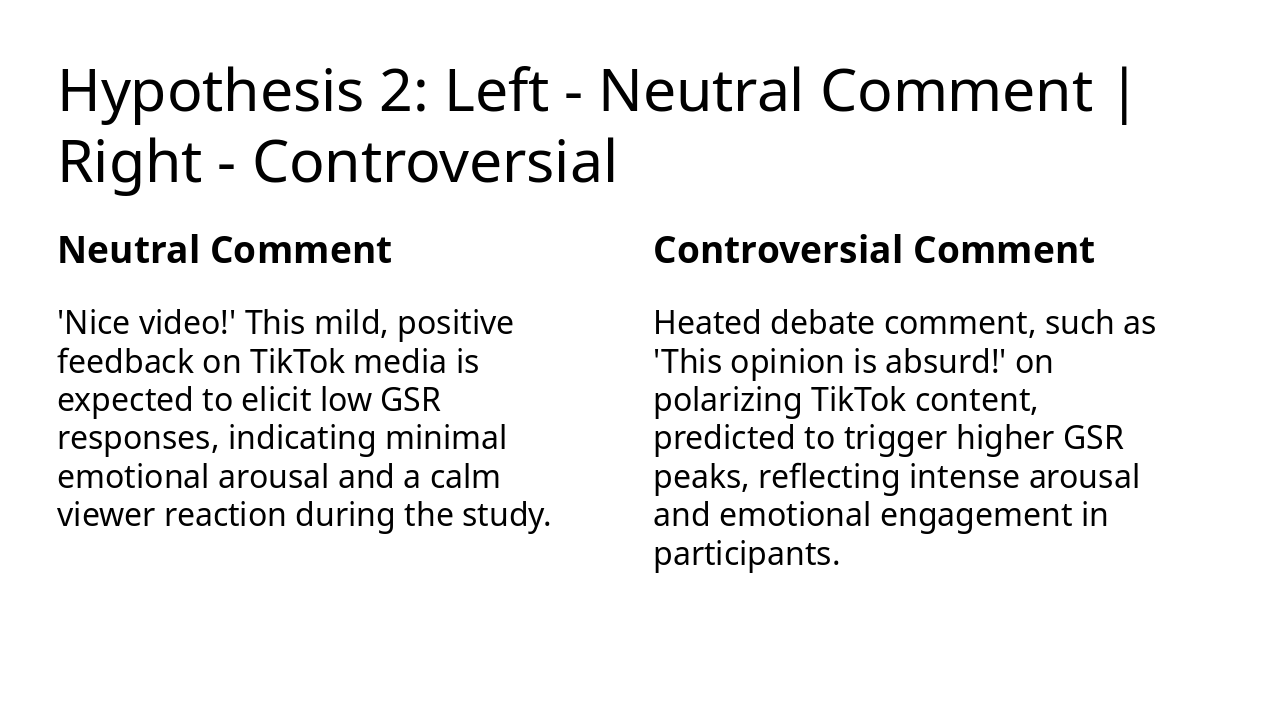
Hypothesis 2 contrasts a neutral comment like "Nice video!" on TikTok media, which is expected to produce low GSR responses indicating minimal emotional arousal and a calm reaction. In comparison, a controversial comment such as "This opinion is absurd!" on polarizing content is predicted to elicit higher GSR peaks, signaling intense emotional engagement.

Hypothesis 2: Left - Neutral Comment | Right - Controversial

Neutral CommentControversial Comment
'Nice video!' This mild, positive feedback on TikTok media is expected to elicit low GSR responses, indicating minimal emotional arousal and a calm viewer reaction during the study.Heated debate comment, such as 'This opinion is absurd!' on polarizing TikTok content, predicted to trigger higher GSR peaks, reflecting intense arousal and emotional engagement in participants.
Slide 9
Slide 10 of 16

Slide 10 - Hypothesis 3: Nya - Neutral vs. Deep Questions

This section header slide introduces Hypothesis 3, titled "Nya - Neutral vs. Deep Questions," as the third segment in the presentation. It focuses on comparing galvanic skin response (GSR) to neutral and deeper questions to identify emotional differences.

Hypothesis 3: Nya - Neutral vs. Deep Questions

03

Hypothesis 3: Nya - Neutral vs. Deep Questions

Comparing GSR responses to neutral and deeper questions for emotional differences.

Slide 10
Slide 11 of 16

Slide 11 - Hypothesis 3 Details

The slide outlines a method for Hypothesis 3 by first administering neutral questions to establish a baseline for GSR-measured arousal. It then involves posing deeper questions to provoke emotional responses, tracking GSR variations, comparing arousal levels between neutral and deep inquiries, and analyzing correlations between question depth and GSR peaks.

Hypothesis 3 Details

  • Administer neutral questions to establish GSR baseline arousal.
  • Pose deeper questions to elicit heightened emotional responses.
  • Track GSR variations for emotional intensity differences.
  • Compare arousal levels between neutral and deep inquiries.
  • Analyze correlations between question depth and GSR peaks.
Slide 11
Slide 12 of 16

Slide 12 - Expected GSR Data for Hypothesis 3

The slide presents expected galvanic skin response (GSR) data for Hypothesis 3, showing an average baseline arousal of 2.1 μS for neutral questions. It indicates an elevated emotional response averaging 5.3 μS for deep questions, representing a 150% increase in arousal from neutral to deep.

Expected GSR Data for Hypothesis 3

  • 2.1 μS: Neutral Questions Average

Baseline arousal level measured

  • 5.3 μS: Deep Questions Average

Elevated emotional response detected

  • 150%: Arousal Increase

Rise from neutral to deep questions

Slide 12
Slide 13 of 16

Slide 13 - Hypothesis 4: Cyerah - Deep Personal Questions

This slide introduces Hypothesis 4, titled "Cyerah - Deep Personal Questions," as the fourth section in the presentation. It focuses on using GSR (Galvanic Skin Response) to measure heightened emotional reactions elicited by personal inquiries.

Hypothesis 4: Cyerah - Deep Personal Questions

04

Hypothesis 4: Deep Personal Questions

Using GSR to gauge heightened emotions from personal inquiries

Slide 13
Slide 14 of 16

Slide 14 - Hypothesis 4 Details

Hypothesis 4 involves posing deep personal questions, such as asking about life regrets, to evoke vulnerability and introspection in participants. The approach includes monitoring GSR for emotional intensity peaks, tracking arousal differences between introspective and neutral stimuli, and anticipating the strongest responses to personal, reflective queries.

Hypothesis 4 Details

  • Pose deep personal questions to evoke vulnerability.
  • Example: 'Describe a life regret' prompts introspection.
  • Monitor GSR for peaks in emotional intensity.
  • Track arousal from introspective versus neutral stimuli.
  • Expect strongest responses to personal, reflective queries.
Slide 14
Slide 15 of 16

Slide 15 - Key Insight from Study

The slide, titled "Key Insight from Study," features a quote highlighting how GSR reveals subtle emotional undercurrents in daily media interactions and introspective moments, providing deep insights into human reactions. It is attributed to the GSR Research Team and Case Study Investigators.

Key Insight from Study

> GSR unveils the subtle emotional undercurrents in our everyday encounters with media and moments of introspection, offering profound insights into human reactions.

— GSR Research Team, Case Study Investigators

Source: GSR Case Study Presentation

--- Speaker Notes: Highlight how GSR uncovers emotional responses in media interactions and self-reflection, tying into hypotheses on TikTok content and personal questions.

Slide 15
Slide 16 of 16

Slide 16 - Conclusion: Key Findings

GSR successfully identifies subtle emotions, supporting all hypotheses by showing how TikToks evoke amusement and questions reveal deeper insights. The slide suggests future refinements for more precise emotion mapping and invites questions to discuss GSR applications.

Conclusion: Key Findings

GSR effectively detects subtle emotions across all hypotheses: TikToks spark amusement, questions uncover depths. Future: Refine for precise mapping.

Thank you! Questions? Let's explore GSR applications together.

--- Speaker Notes: All hypotheses show GSR's value in detecting subtle emotions. TikToks evoke amusement; questions reveal depths. Future: Refine stimuli for precise emotional mapping. Thank you!

Slide 16
Powered by AI

Create Your Own Presentation

Generate professional presentations in seconds with Karaf's AI. Customize this presentation or start from scratch.

Create New Presentation

Powered by Karaf.ai — AI-Powered Presentation Generator