Mastering the Ellipsis: Usage Guide

Generated from prompt:

...

This presentation explores the ellipsis (...), its role in indicating omissions and pauses, variations in style guides, comparisons across languages, key facts, and visual examples, concluding with ti

November 4, 202512 slides
Slide 1 of 12

Slide 1 - The Ellipsis: Punctuation and Usage

The slide is titled "The Ellipsis: Punctuation and Usage" and serves as a title slide for an introduction to the topic. Its subtitle describes the ellipsis as a tool for omission, implication, and creating pauses in text.

The Ellipsis: Punctuation and Usage

Introduction to Omission, Implication, and Pauses in Text

Source: Introduction to the ellipsis (…), a series of three dots used for omission, implication, or pauses in text and speech.

Slide 1
Slide 2 of 12

Slide 2 - Presentation Agenda

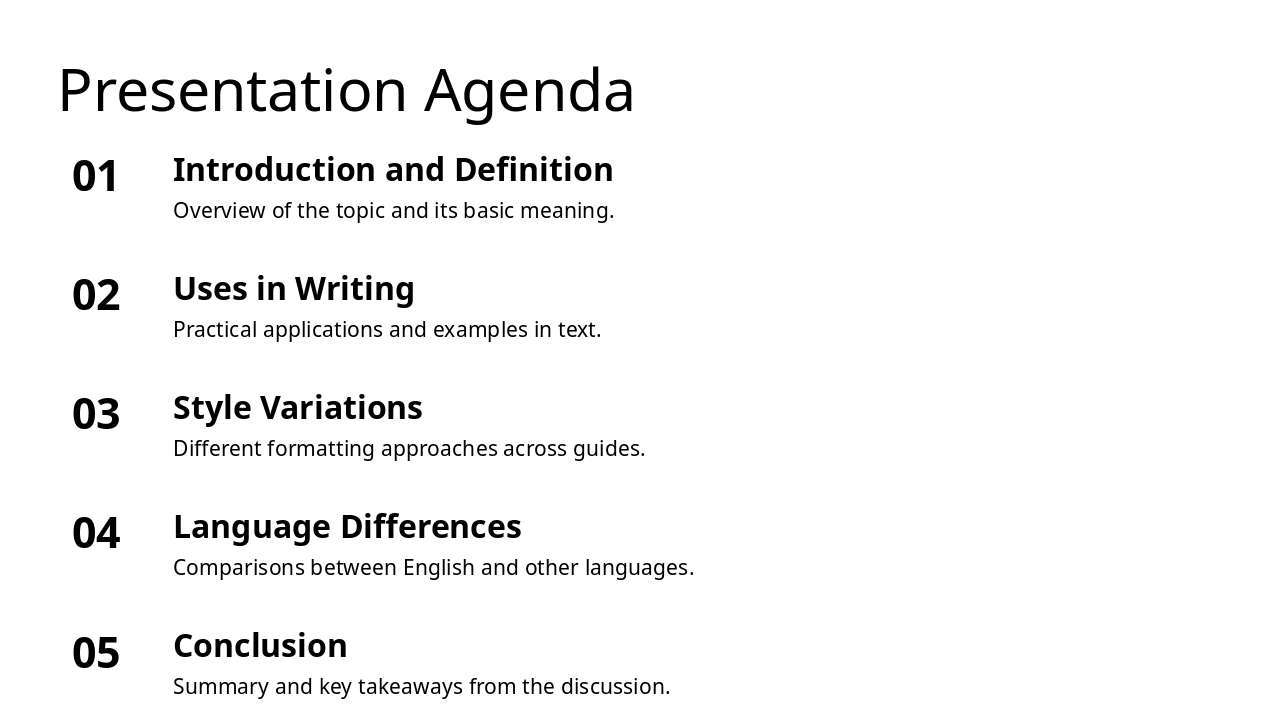
The presentation agenda outlines a structured discussion on the topic, starting with an introduction and definition that provides an overview of its basic meaning. It then covers practical uses in writing with examples, style variations across formatting guides, language differences between English and other languages, and concludes with a summary of key takeaways.

Presentation Agenda

  1. Introduction and Definition

Overview of the topic and its basic meaning.

  1. Uses in Writing

Practical applications and examples in text.

  1. Style Variations

Different formatting approaches across guides.

  1. Language Differences

Comparisons between English and other languages.

  1. Conclusion

Summary and key takeaways from the discussion.

Slide 2
Slide 3 of 12

Slide 3 - What is an Ellipsis?

An ellipsis consists of three dots (...) used to indicate omission of text or numbers, imply unspoken ideas or trailing thoughts, and mark pauses in dialogue or speech; it is also known as suspension points or dot-dot-dot. Style guides differ on how to render it in print versus digital formats.

What is an Ellipsis?

  • Consists of three dots (...) to indicate omission or pause.
  • Also known as suspension points or dot-dot-dot.
  • Used for omitting text or numbers in writing.
  • Implies unspoken ideas or trailing thoughts.
  • Marks pauses in dialogue or speech.
  • Style guides vary on rendering in print versus digital.
Slide 3
Slide 4 of 12

Slide 4 - Uses in Writing

This section header slide introduces the topic "Uses in Writing," focusing on the practical applications of the ellipsis. It invites exploration of how this punctuation mark is commonly employed in different writing contexts.

Uses in Writing

Uses in Writing

Explore common applications of the ellipsis in various contexts.

Slide 4
Slide 5 of 12

Slide 5 - Omission and Implication

The slide on "Omission and Implication" explores two literary techniques in a two-column format. Omission involves intentionally excluding text in quotes or narratives to create gaps that encourage readers to infer details and build intrigue, while implication uses subtle hints, context, or trailing thoughts to convey unspoken ideas and evoke emotions without direct language, allowing for nuanced interpretations.

Omission and Implication

OmissionImplication
Intentional exclusion of text in quotes or narratives creates deliberate gaps, prompting readers to infer missing details and heighten narrative intrigue.Conveys unspoken ideas through subtle hints, context, or trailing thoughts, evoking emotions and concepts without direct words for nuanced interpretation.
Slide 5
Slide 6 of 12

Slide 6 - Ellipsis in Literature

The slide titled "Ellipsis in Literature" features a quote from Dr. Elena Ramirez, a Professor of Literary Devices, explaining how ellipsis subtly hints at unspoken depths in writing. It creates pauses that encourage readers to envision what lies beyond the text, illustrated by the example: "The road seemed to go on forever..." as a path of implication and endless possibility.

Ellipsis in Literature

> The ellipsis whispers unspoken depths in literature, creating pauses that invite readers to imagine what lies beyond the page, as in 'The road seemed to go on forever...'—a trail of implication and endless possibility.

— Dr. Elena Ramirez, Professor of Literary Devices

--- Speaker Notes: Description: 'The road seemed to go on forever...' – Example showing pause and implication in storytelling. Context: ...

Slide 6
Slide 7 of 12

Slide 7 - Style Guides and Variations

Style guides for ellipses show variations, such as using three dots as the standard or four periods in some cases, with spacing that is typically added in print but omitted in digital formats to prioritize compactness. Content creators should adapt to the medium—following traditional rules for print—and integrate ellipses seamlessly with other punctuation like commas or quotes.

Style Guides and Variations

  • Style guides vary: three dots standard, some use four periods.
  • Spacing differs: spaced in print, unspaced in digital formats.
  • Adapt to medium: print follows traditional rules, digital prioritizes compactness.
  • Integrate with punctuation: combine ellipses with commas or quotes.
Slide 7
Slide 8 of 12

Slide 8 - Ellipsis in Different Languages

This section header slide is titled "Ellipsis in Different Languages." It features a subtitle explaining how ellipsis is used and rendered across various languages.

Ellipsis in Different Languages

Ellipsis in Different Languages

How ellipsis is used and rendered across languages.

Slide 8
Slide 9 of 12

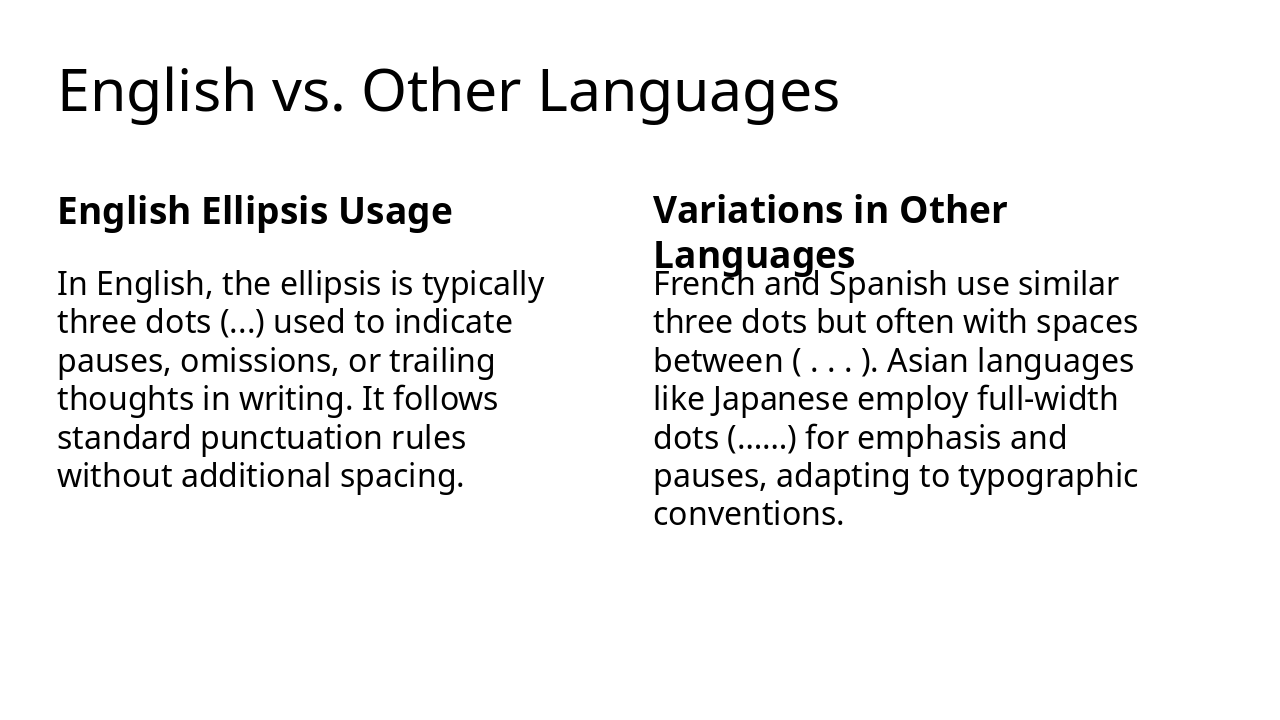
Slide 9 - English vs. Other Languages

In English, the ellipsis consists of three dots (...) to signal pauses, omissions, or trailing thoughts, adhering to standard punctuation without extra spacing. Other languages vary this usage, such as French and Spanish employing three spaced dots ( . . . ), while Asian languages like Japanese use full-width dots (……) for emphasis and pauses in line with their typographic norms.

English vs. Other Languages

English Ellipsis UsageVariations in Other Languages
In English, the ellipsis is typically three dots (...) used to indicate pauses, omissions, or trailing thoughts in writing. It follows standard punctuation rules without additional spacing.French and Spanish use similar three dots but often with spaces between ( . . . ). Asian languages like Japanese employ full-width dots (……) for emphasis and pauses, adapting to typographic conventions.
Slide 9
Slide 10 of 12

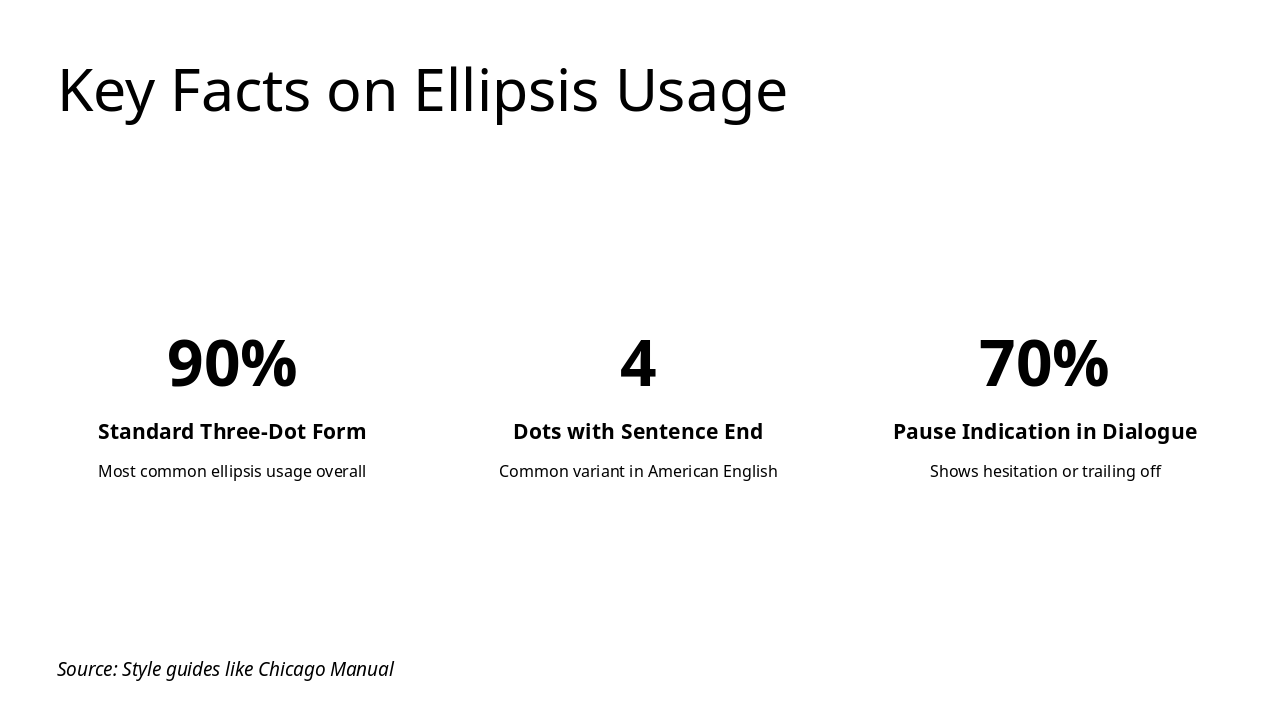
Slide 10 - Key Facts on Ellipsis Usage

The slide highlights that 90% of ellipsis usage employs the standard three-dot form, which is the most common overall. It also notes a frequent American English variant using four dots at sentence ends and that 70% of ellipses indicate pauses, hesitation, or trailing off in dialogue.

Key Facts on Ellipsis Usage

  • 90%: Standard Three-Dot Form

Most common ellipsis usage overall

  • 4: Dots with Sentence End

Common variant in American English

  • 70%: Pause Indication in Dialogue

Shows hesitation or trailing off

Source: Style guides like Chicago Manual

Slide 10
Slide 11 of 12

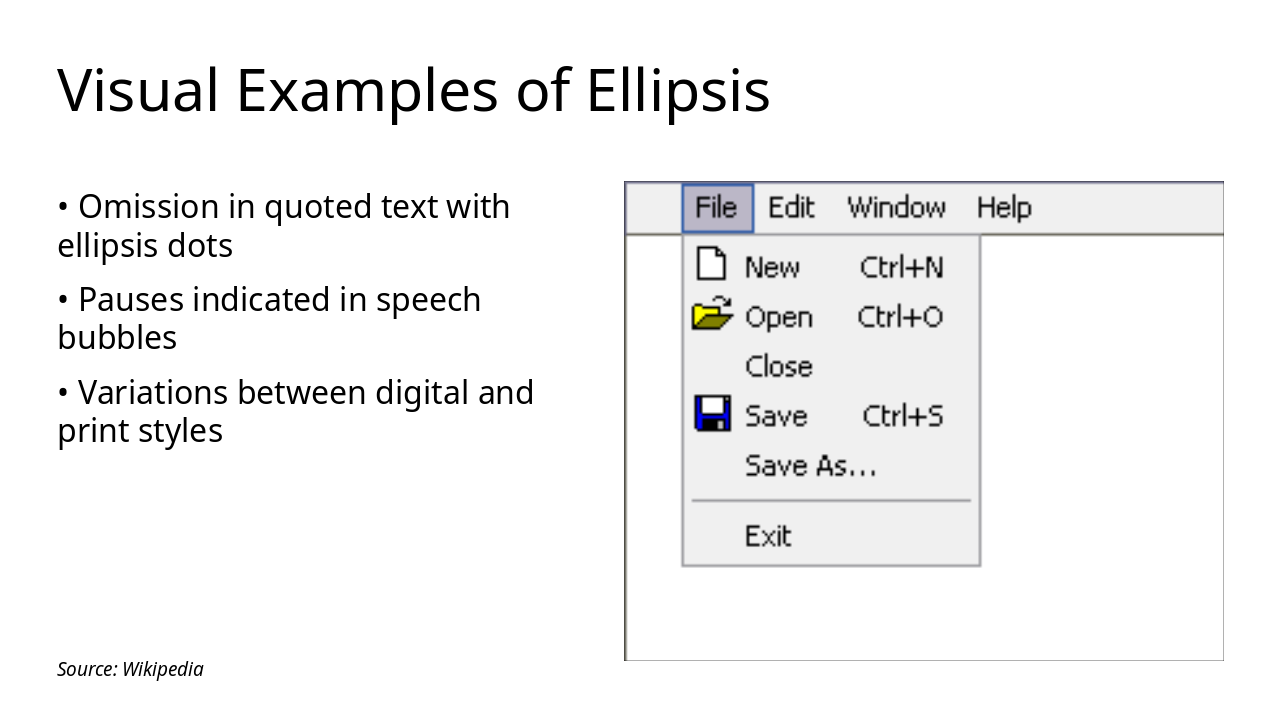
Slide 11 - Visual Examples of Ellipsis

The slide titled "Visual Examples of Ellipsis" features an image illustrating the use of ellipsis in various contexts, such as omitting parts of quoted text with dots and indicating pauses in speech bubbles. It also highlights differences in ellipsis styles between digital and print formats.

Visual Examples of Ellipsis

!Image

  • Omission in quoted text with ellipsis dots
  • Pauses indicated in speech bubbles
  • Variations between digital and print styles

Source: Wikipedia

--- Speaker Notes: Images showing ellipsis in texts: omission in quotes, speech bubbles with pauses, and digital vs. print styles.

Slide 11
Slide 12 of 12

Slide 12 - Conclusion: Mastering the Ellipsis

The conclusion slide highlights the ellipsis as a versatile punctuation mark for indicating omissions, implications, and pauses, emphasizing the need to follow style guides for consistency while it enhances writing clarity and rhythm. It closes with a message to embrace the power of pauses and a call-to-action to experiment with ellipses in your next piece.

Conclusion: Mastering the Ellipsis

Versatile punctuation for omission, implication, and pauses. Follow style guides for consistency. Enhances writing clarity and rhythm.

Closing message: Embrace the power of pauses.

Call-to-action: Experiment with ellipses in your next piece.

Slide 12
Powered by AI

Create Your Own Presentation

Generate professional presentations in seconds with Karaf's AI. Customize this presentation or start from scratch.

Create New Presentation

Powered by Karaf.ai — AI-Powered Presentation Generator