Advanced ML for Water Potability Prediction (39 chars)

Generated from prompt:

Create an advanced PowerPoint presentation titled 'Advanced Water Potability Prediction Using Machine Learning' in a Scientific Minimal style. Use a monochrome gray-white-aqua palette, Roboto Condensed and Lato fonts, clean scientific layouts, and minimal iconography. Include sections: Title, Project Motivation, Problem Definition, Dataset & Features, Methodology, Machine Learning Models Evaluated, Results & Evaluation (with charts and heatmaps), Deployment Strategy, Conclusion & Future Scope.

Scientific presentation on ML-driven water potability prediction addressing global crisis. Covers motivation, imbalanced binary classification problem, dataset/features, methodology, models evaluated,

December 13, 202510 slides
Slide 1 of 10

Slide 1 - Advanced Water Potability Prediction Using Machine Learning

This title slide presents "Advanced Water Potability Prediction Using Machine Learning" as the main topic. The subtitle emphasizes leveraging ML for safe drinking water assessment, followed by the presenter's name and date.

Advanced Water Potability Prediction Using Machine Learning

Leveraging ML for safe drinking water assessment. Your Name | Date

Slide 1 - Advanced Water Potability Prediction Using Machine Learning
Slide 2 of 10

Slide 2 - Presentation Agenda

This agenda slide outlines the presentation structure with eight key sections. It covers project motivation, problem definition, dataset and features, methodology, ML models evaluated, results and evaluation, deployment strategy, and conclusion with future scope.

Presentation Agenda

  1. 1. Project Motivation
  2. 2. Problem Definition
  3. 3. Dataset & Features
  4. 4. Methodology
  5. 5. ML Models Evaluated
  6. 6. Results & Evaluation
  7. 7. Deployment Strategy
  8. 8. Conclusion & Future Scope

Source: Advanced Water Potability Prediction Using Machine Learning

Slide 2 - Presentation Agenda
Slide 3 of 10

Slide 3 - Project Motivation

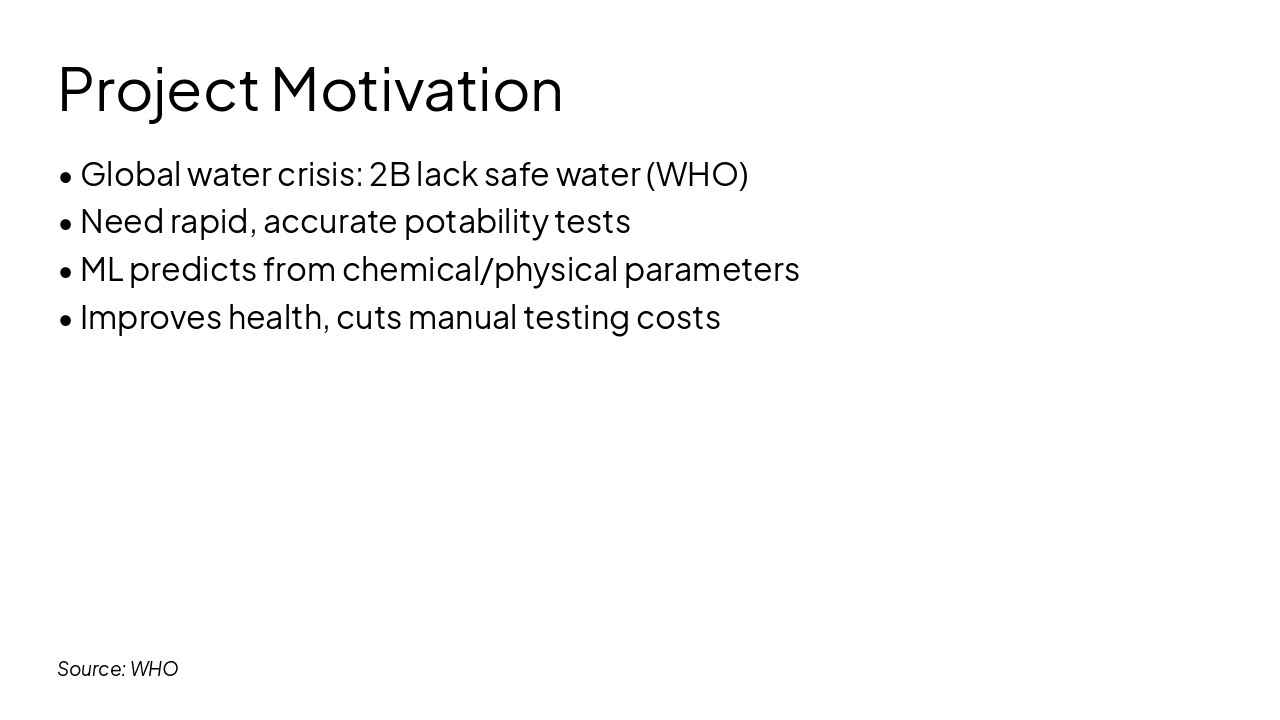
The slide motivates the project by noting the global water crisis, where 2 billion people lack safe water per WHO, and the need for rapid, accurate potability tests. It proposes using ML to predict potability from chemical/physical parameters, improving health and cutting manual testing costs.

Project Motivation

  • Global water crisis: 2B lack safe water (WHO)
  • Need rapid, accurate potability tests
  • ML predicts from chemical/physical parameters
  • Improves health, cuts manual testing costs

Source: WHO

Speaker Notes
Highlight the global water crisis, need for quick tests, ML's role, and project aims to underscore urgency and impact.
Slide 3 - Project Motivation
Slide 4 of 10

Slide 4 - Problem Definition

The slide defines the problem as binary classification of water potability (1 for potable, 0 for non-potable). It notes challenges like imbalanced data and multicollinearity, targets >95% prediction accuracy, and emphasizes a deployable field-testing solution.

Problem Definition

  • Binary classification: Potable (1) vs. Non-potable (0)
  • Challenges: Imbalanced data, multicollinearity in features
  • Goal: Predict potability with >95% accuracy
  • Impact: Deployable solution for field testing
Speaker Notes
Highlight the binary classification setup, key challenges like imbalance and multicollinearity, ambitious accuracy goal, and practical deployment impact.
Slide 4 - Problem Definition
Slide 5 of 10

Slide 5 - Dataset & Features

The slide details a dataset of 3276 water source samples with potability as the binary target, where missing values were handled in preprocessing. Key features include ph, Hardness, Solids, Chloramines, Sulfate, Conductivity, OrganicCarbon, Trihalomethanes, and Turbidity.

Dataset & Features

{ "headers": [ "Attribute", "Description" ], "rows": [ [ "Dataset Size", "3276 samples from water sources" ], [ "Target", "Potability (binary)" ], [ "Preprocessing", "Missing values handled" ], [ "Key Features", "ph, Hardness, Solids, Chloramines, Sulfate, Conductivity, OrganicCarbon, Trihalomethanes, Turbidity" ] ] }

Source: Water Quality Dataset

Slide 5 - Dataset & Features
Slide 6 of 10

Slide 6 - Methodology

The slide presents a machine learning methodology workflow with five phases: Data Collection & EDA (dataset acquisition and exploratory analysis), Feature Engineering (scaling and feature selection), Model Training (cross-validation), Hyperparameter Tuning (GridSearchCV), and Evaluation & Selection (performance metrics and model selection). It uses a table format to pair each phase with its key techniques for clarity.

Methodology

{ "headers": [ "Phase", "Key Techniques" ], "rows": [ [ "Data Collection & EDA", "Dataset acquisition and exploratory data analysis" ], [ "Feature Engineering", "Scaling and feature selection" ], [ "Model Training", "Cross-validation" ], [ "Hyperparameter Tuning", "GridSearchCV" ], [ "Evaluation & Selection", "Performance metrics and model selection" ] ] }

Source: Advanced Water Potability Prediction Using Machine Learning

Speaker Notes
This slide illustrates the sequential workflow of the machine learning methodology applied to water potability prediction, from data preparation to model selection.
Slide 6 - Methodology
Slide 7 of 10

Slide 7 - Machine Learning Models Evaluated

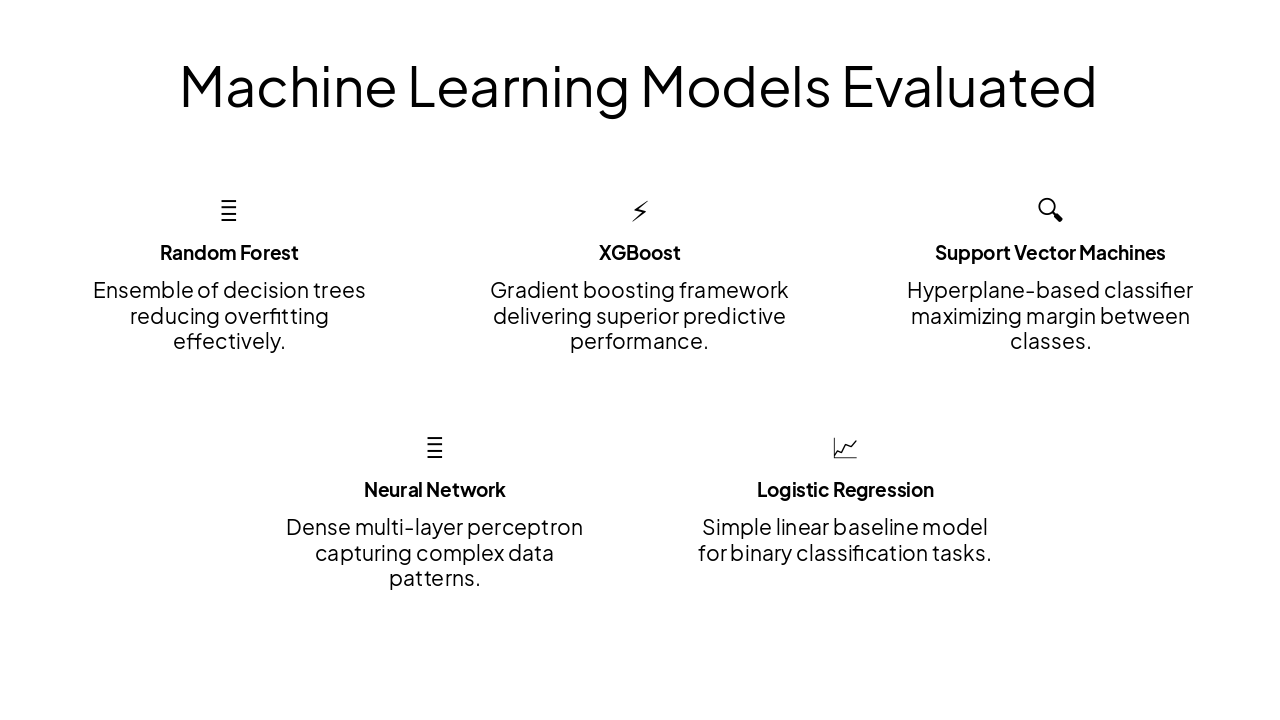
The slide "Machine Learning Models Evaluated" features a grid of five models: Random Forest, XGBoost, Support Vector Machines, Neural Network, and Logistic Regression. Each includes an icon and a concise description of its core strengths, such as reducing overfitting or capturing complex patterns.

Machine Learning Models Evaluated

{ "features": [ { "icon": "🌳", "heading": "Random Forest", "description": "Ensemble of decision trees reducing overfitting effectively." }, { "icon": "⚔", "heading": "XGBoost", "description": "Gradient boosting framework delivering superior predictive performance." }, { "icon": "šŸ”", "heading": "Support Vector Machines", "description": "Hyperplane-based classifier maximizing margin between classes." }, { "icon": "🧠", "heading": "Neural Network", "description": "Dense multi-layer perceptron capturing complex data patterns." }, { "icon": "šŸ“ˆ", "heading": "Logistic Regression", "description": "Simple linear baseline model for binary classification tasks." } ] }

Slide 7 - Machine Learning Models Evaluated
Slide 8 of 10

Slide 8 - Results & Evaluation

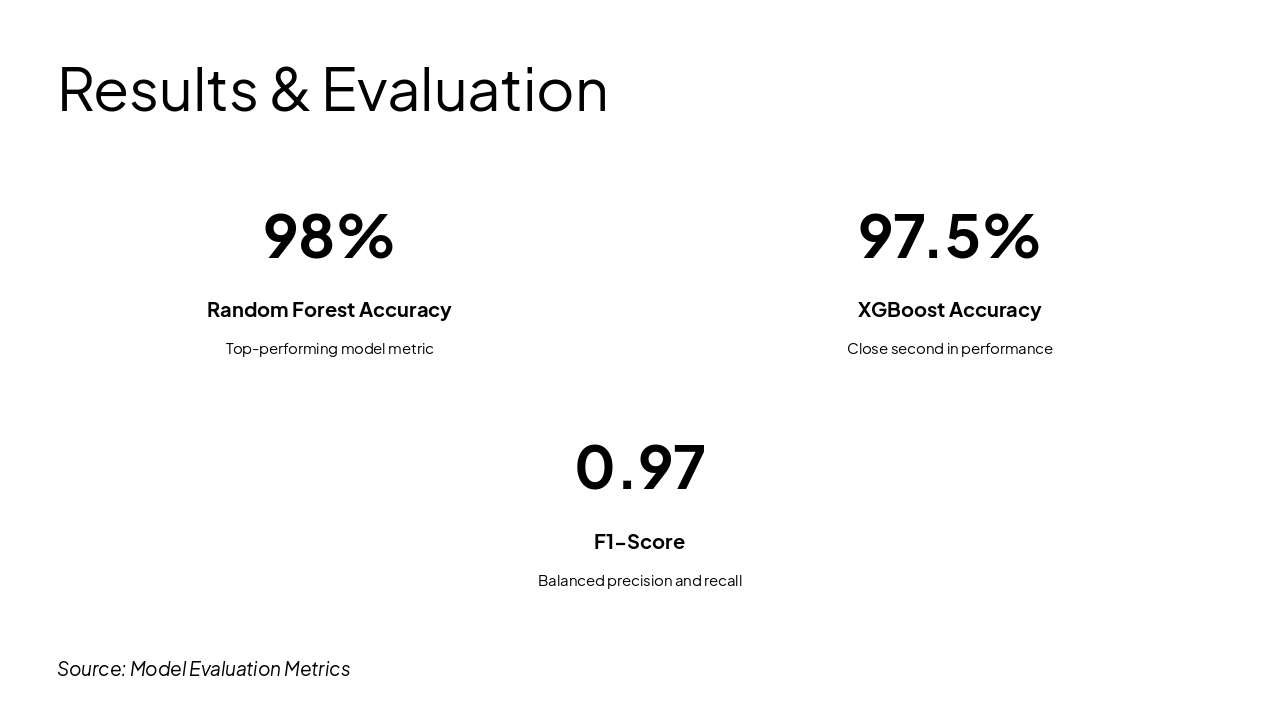
The Results & Evaluation slide showcases Random Forest at 98% accuracy as the top model, with XGBoost at 97.5% as a close second. It also reports a 0.97 F1-Score for balanced precision and recall.

Results & Evaluation

  • 98%: Random Forest Accuracy
  • Top-performing model metric

  • 97.5%: XGBoost Accuracy
  • Close second in performance

  • 0.97: F1-Score

Balanced precision and recall Source: Model Evaluation Metrics

Speaker Notes
Emphasize RF's top accuracy, strong F1-score, and key features like Sulfate and pH. Reference confusion matrix and ROC heatmap visuals.
Slide 8 - Results & Evaluation
Slide 9 of 10

Slide 9 - Deployment Strategy

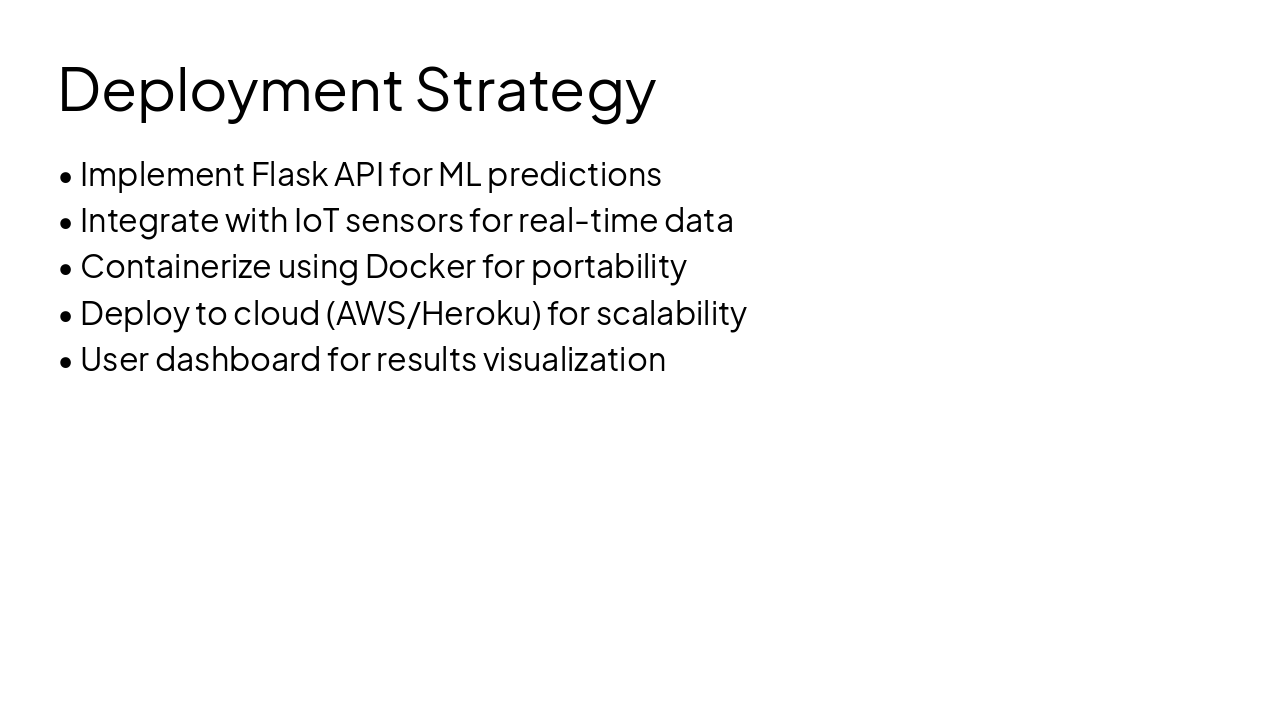
The deployment strategy implements a Flask API for ML predictions, integrates with IoT sensors for real-time data, and includes a user dashboard for results visualization. It uses Docker for containerization and deploys to cloud platforms like AWS or Heroku for scalability.

Deployment Strategy

  • Implement Flask API for ML predictions
  • Integrate with IoT sensors for real-time data
  • Containerize using Docker for portability
  • Deploy to cloud (AWS/Heroku) for scalability
  • User dashboard for results visualization
Slide 9 - Deployment Strategy
Slide 10 of 10

Slide 10 - Conclusion & Future Scope

The slide concludes with a high-accuracy ML model successfully achieved for water potability prediction. Future scope includes ensemble methods for better performance, real-time streaming data processing, and mobile app integration for on-site testing.

Conclusion & Future Scope

āœ… High-accuracy ML model achieved for water potability prediction.

Future Scope:

  • Ensemble methods for superior performance
  • Real-time streaming data processing
  • Mobile app integration for on-site testing

Safer water, powered by ML. Explore ensembles next.

Source: Advanced Water Potability Prediction Using Machine Learning

Speaker Notes
Emphasize high-accuracy achievement and tease future innovations like ensembles and real-time apps.
Slide 10 - Conclusion & Future Scope

Discover More Presentations

Explore thousands of AI-generated presentations for inspiration

Browse Presentations
Powered by AI

Create Your Own Presentation

Generate professional presentations in seconds with Karaf's AI. Customize this presentation or start from scratch.

Create New Presentation

Powered by Karaf.ai — AI-Powered Presentation Generator