Natural Gas: A Clean Energy Source?

Generated from prompt:

Follow the links provided throughout the activity. They will help you plan and research your presentation. This guide about the research process provides a helpful overview of the steps you should take. Part A Your presentation should make a convincing argument supporting or opposing the idea that natural gas is a clean energy source. Your presentation should answer some of these questions What is natural gas? What geological processes form natural gas? Is natural gas found in equal amounts around the globe? Why or why not? How much natural gas is used in the United States each year? How does this compare with oil and coall use? How does burning natural gas influence the carbon cycle? How much carbon dioxide (CO₂) does natural gas emit compared with other fossil fuels? Are there energy alternatives that emiltless CO, than natural gas does? If so, are these solutions equally available everywhere on Earth? Based on your findings, would you consider natural gas a clean source of energy? Winbe down two additional questions you have about natural gas that will help you make this argument in your presentation. provide sources

This presentation offers an in-depth analysis of natural gas, covering its geological formation, global distribution, and significant role in energy consumption. It critically examines the environmental impact of natural gas, comparing its carbon dioxide emissions with other fossil fuels, and emphasizes the crucial issue of methane leakage and its influence on the carbon cycle. The discussion also explores energy alternatives, culminating in a nuanced assessment of whether natural gas truly qualifies as a clean energy source.

May 15, 202611 slides
Slide 1 of 11

Slide 1 - Natural Gas: A Clean Energy Source?

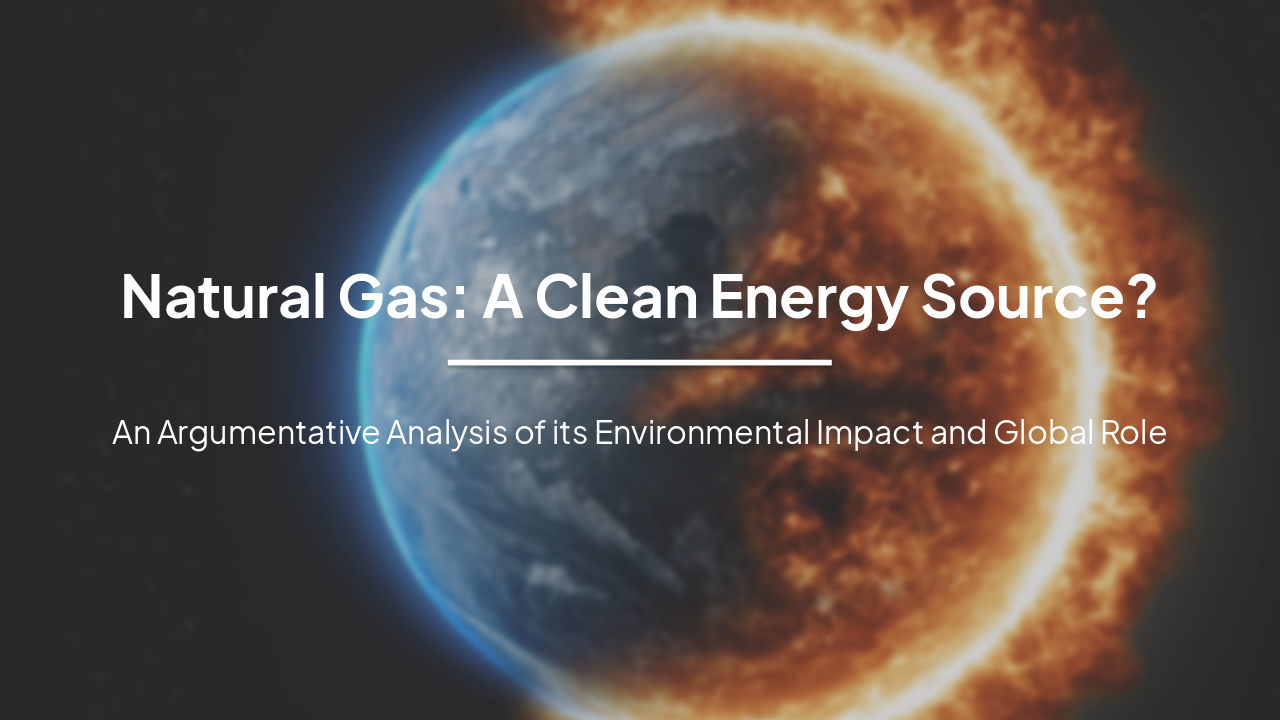
Natural Gas: A Clean Energy Source?

An Argumentative Analysis of its Environmental Impact and Global Role

---

Photo by Javier Miranda on Unsplash
Slide 1 - Natural Gas: A Clean Energy Source?
Slide 2 of 11

Slide 2 - Presentation Agenda

  • What is Natural Gas & its Formation?
  • Global Distribution and Availability
  • U.S. Consumption vs. Other Fossil Fuels
  • Influence on the Carbon Cycle
  • CO₂ Emissions Compared to Other Fossil Fuels
  • Energy Alternatives and Global Availability
  • Is Natural Gas a Clean Energy Source?
  • Further Questions for Consideration

---

Photo by Gábor Szűts on Unsplash

Slide 2 - Presentation Agenda
Slide 3 of 11

Slide 3 - What is Natural Gas?

  • Natural gas is a fossil fuel, naturally occurring in geological formations.
  • Primarily composed of methane (95%), with small amounts of higher alkanes, carbon dioxide, and nitrogen.
  • Methane is a colorless, odorless gas, and the second-greatest greenhouse gas after CO₂.
  • Commercial odorizers (e.g., methanethiol) are added for leak detection due to its odorless nature.

Source: https://en.wikipedia.org/wiki/Natural_gas
Slide 3 - What is Natural Gas?
Slide 4 of 11

Slide 4 - Geological Formation of Natural Gas

  • Formed from layers of organic matter (primarily marine microorganisms) thermally decomposed.
  • Occurs under oxygen-free conditions, subjected to intense heat and pressure underground over millions of years.
  • Energy from decayed organisms (via photosynthesis) stored as chemical energy in methane and other hydrocarbons.
  • Collected from underground geological formations, often alongside coal and oil.
  • Often a byproduct of petroleum production; can be vented, flared, or collected.

Source: https://en.wikipedia.org/wiki/Natural_gas
Slide 4 - Geological Formation of Natural Gas
Slide 5 of 11

Slide 5 - Global Distribution of Natural Gas

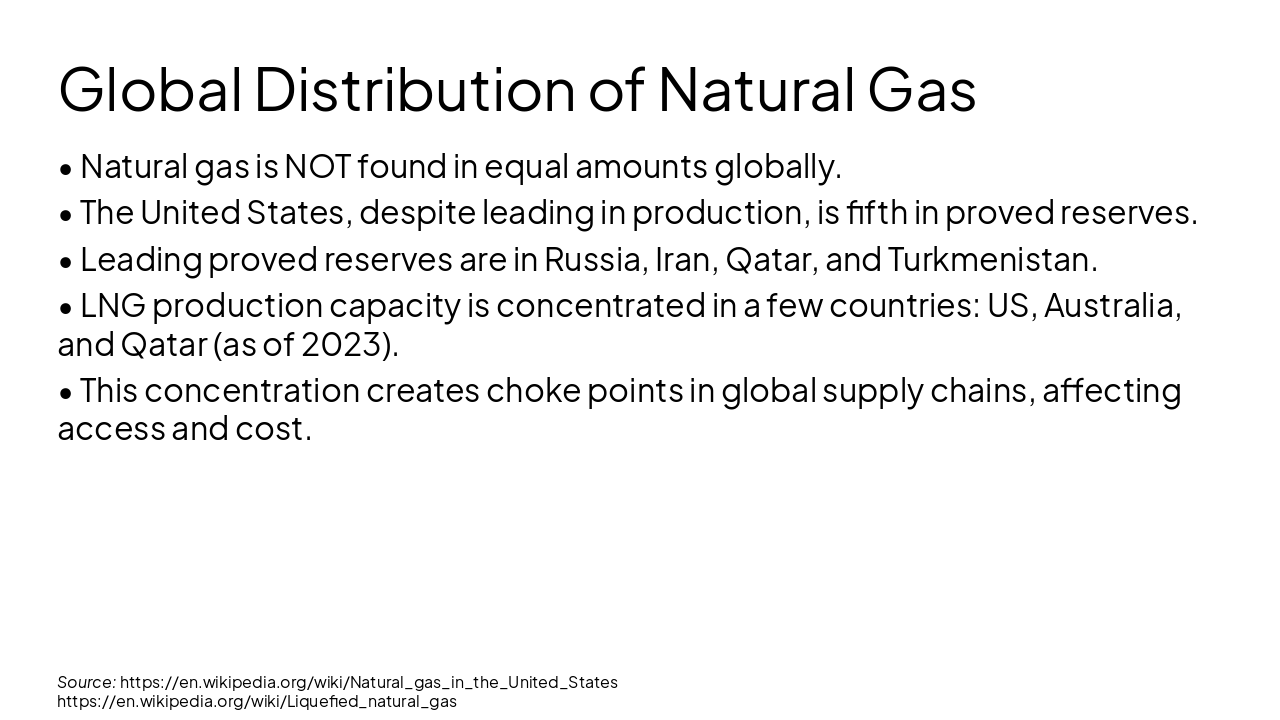
  • Natural gas is NOT found in equal amounts globally.
  • The United States, despite leading in production, is fifth in proved reserves.
  • Leading proved reserves are in Russia, Iran, Qatar, and Turkmenistan.
  • LNG production capacity is concentrated in a few countries: US, Australia, and Qatar (as of 2023).
  • This concentration creates choke points in global supply chains, affecting access and cost.

Source: https://en.wikipedia.org/wiki/Natural_gas_in_the_United_States https://en.wikipedia.org/wiki/Liquefied_natural_gas
Slide 5 - Global Distribution of Natural Gas
Slide 6 of 11

Slide 6 - U.S. Natural Gas Consumption

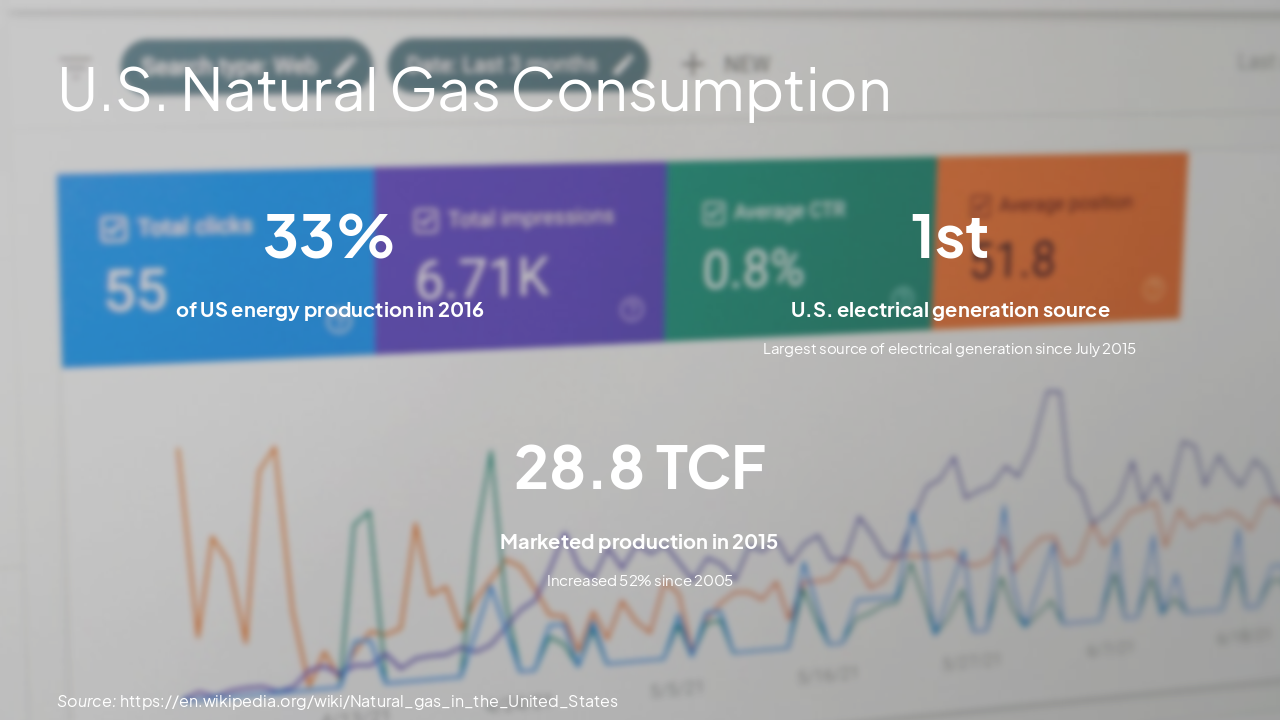
  • 33%: of US energy production in 2016
  • 1st: U.S. electrical generation source
  • 28.8 TCF: Marketed production in 2015

---

Photo by Justin Morgan on Unsplash

Source: https://en.wikipedia.org/wiki/Natural_gas_in_the_United_States
Slide 6 - U.S. Natural Gas Consumption
Slide 7 of 11

Slide 7 - Natural Gas and the Carbon Cycle

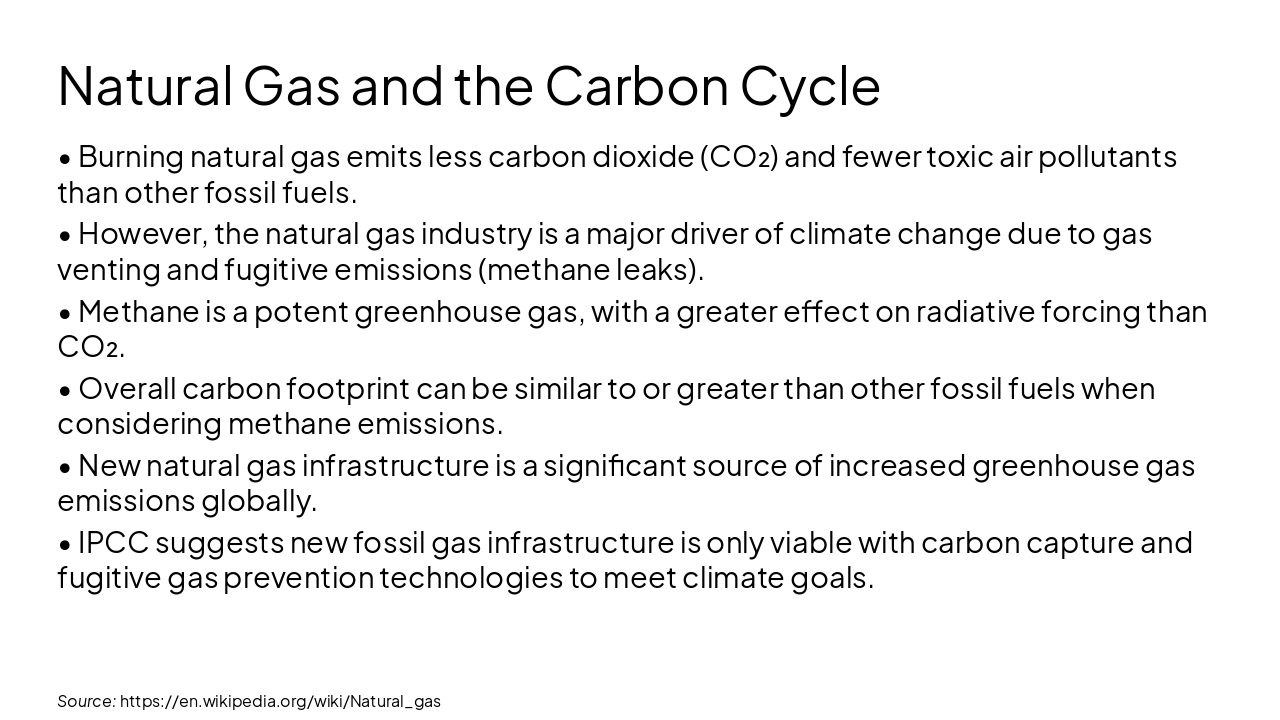
  • Burning natural gas emits less carbon dioxide (CO₂) and fewer toxic air pollutants than other fossil fuels.
  • However, the natural gas industry is a major driver of climate change due to gas venting and fugitive emissions (methane leaks).
  • Methane is a potent greenhouse gas, with a greater effect on radiative forcing than CO₂.
  • Overall carbon footprint can be similar to or greater than other fossil fuels when considering methane emissions.
  • New natural gas infrastructure is a significant source of increased greenhouse gas emissions globally.
  • IPCC suggests new fossil gas infrastructure is only viable with carbon capture and fugitive gas prevention technologies to meet climate goals.

Source: https://en.wikipedia.org/wiki/Natural_gas
Slide 7 - Natural Gas and the Carbon Cycle
Slide 8 of 11

Slide 8 - CO₂ Emissions: Natural Gas vs. Other Fossil Fuels

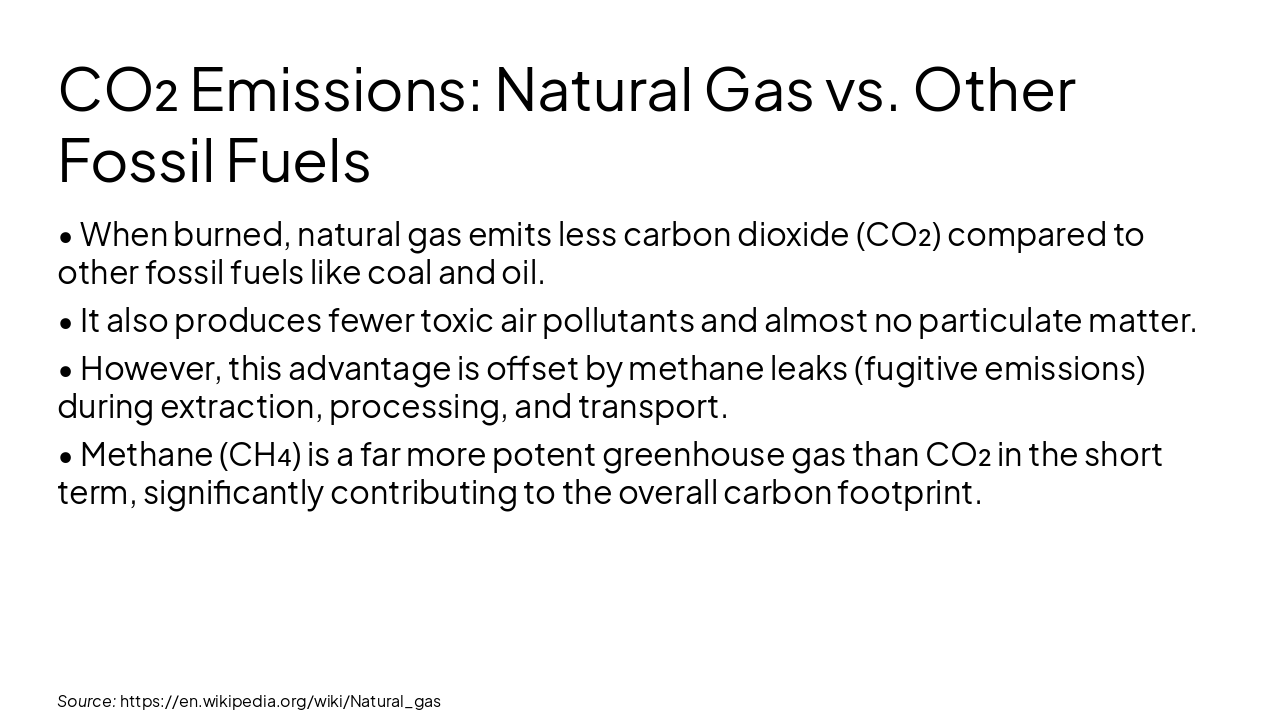
  • When burned, natural gas emits less carbon dioxide (CO₂) compared to other fossil fuels like coal and oil.
  • It also produces fewer toxic air pollutants and almost no particulate matter.
  • However, this advantage is offset by methane leaks (fugitive emissions) during extraction, processing, and transport.
  • Methane (CH₄) is a far more potent greenhouse gas than CO₂ in the short term, significantly contributing to the overall carbon footprint.

Source: https://en.wikipedia.org/wiki/Natural_gas
Slide 8 - CO₂ Emissions: Natural Gas vs. Other Fossil Fuels
Slide 9 of 11

Slide 9 - Energy Alternatives with Lower CO₂ Emissions

  • Yes, several energy alternatives emit less CO₂ than natural gas.
  • Renewable sources like solar, wind, and hydropower, along with nuclear energy, produce minimal to zero direct CO₂ emissions during operation.
  • Natural hydrogen is a nascent alternative, with models suggesting vast potential, but only one well currently exploited in Mali.
  • Availability of these alternatives is NOT equal everywhere on Earth.
  • Factors like geography, climate, resource endowment, and technological infrastructure dictate regional suitability and scalability of these solutions.

Source: https://en.wikipedia.org/wiki/Natural_hydrogen
Slide 9 - Energy Alternatives with Lower CO₂ Emissions
Slide 10 of 11

Slide 10 - Is Natural Gas a Clean Energy Source?

Considering both its combustion benefits and upstream methane emissions, natural gas cannot be definitively considered a 'clean' energy source.

A Nuanced Perspective

---

Photo by Wolfgang Weiser on Unsplash
Slide 10 - Is Natural Gas a Clean Energy Source?
Slide 11 of 11

Slide 11 - Further Questions for Consideration

  • What are the most effective and economically viable technologies currently available to mitigate methane leakage across the natural gas supply chain, and how widely are they implemented globally?
  • How does the full lifecycle emissions (extraction, processing, transport, and combustion) of natural gas, including all greenhouse gases, compare against that of leading renewable energy sources when accounting for infrastructure manufacturing and deployment?

---

Photo by Irina Iriser on Unsplash
Slide 11 - Further Questions for Consideration

Discover More Presentations

Explore thousands of AI-generated presentations for inspiration

Browse Presentations
Powered by AI

Create Your Own Presentation

Generate professional presentations in seconds with Karaf's AI. Customize this presentation or start from scratch.

Create New Presentation

Powered by Karaf.ai — AI-Powered Presentation Generator