Philosophers of Ancient Times: Their Lives and Enduring Contributions

Generated from prompt:

Create an attractive, educational, comprehensive presentation on the topic: 'UNIT-5: Philosophers of Ancient Times: Their Lives and Contributions'. The presentation should be visually engaging, suitable for students and educators, with clear headings, icons, timelines, quotes, and educational illustrations. Structure the presentation professionally with approximately 18–22 slides. Include the following sections: 1. Title Slide - UNIT-5: Philosophers of Ancient Times - Subtitle: Their Lives and Contributions - Educational theme with ancient philosophy visuals. 2. Introduction Slide - Meaning of philosophy - Importance of ancient philosophers in education, ethics, science, and society - Brief overview of Socrates, Confucius, and Avicenna. 3–7. Socrates (469 BC – 399 BC) Include: - Early life and background - Historical context of Ancient Greece - Teaching methods (Socratic Method) - Major philosophies and ideas - Ethics, virtue, and knowledge - Famous quote(s) - Trial and death of Socrates - Contributions to education and Western philosophy - Legacy and influence on Plato and modern education. 8–12. Confucius (551 BC – 479 BC) Include: - Early life and historical background in China - Core teachings and philosophy - Confucianism principles: Ren, Li, Xiao, morality, respect - Importance of education and discipline - Influence on Chinese society and government - Famous quote(s) - Contributions to ethics, family values, and social harmony - Global impact and modern relevance. 13–17. Avicenna (980 – 1037) Include: - Early life and background in Persia - Contributions to medicine, science, and philosophy - Major works: The Canon of Medicine and The Book of Healing - Contributions to education and Islamic philosophy - Relationship between science and reason - Influence on Europe and the Islamic Golden Age - Famous ideas and achievements - Legacy in medicine and higher education. 18. Comparative Analysis - Compare Socrates, Confucius, and Avicenna in a table: * Time period * Region * Main teachings * Contributions * Educational impact. 19. Relevance in Modern Education - How their ideas influence modern teaching, ethics, leadership, and critical thinking. 20. Conclusion - Summary of major contributions - Importance of preserving philosophical thought. 21. References - Educational references and historical sources. Design Requirements: - Use a modern educational PowerPoint style. - Add relevant visuals, ancient art, maps, books, philosophy icons, timelines, and educational infographics. - Use attractive color themes (royal blue, parchment beige, gold accents). - Include concise speaker notes/content for each slide. - Ensure readability and balanced slide layouts. - Add smooth transitions and professional typography.

This presentation explores the lives, key teachings, and enduring legacies of three pivotal ancient philosophers: Socrates, Confucius, and Avicenna. It delves into their historical contexts, philosophical contributions, and the profound impact they had on education, ethics, science, and societal development, culminating in a comparative analysis and discussion of their modern relevance.

May 17, 202619 slides
Slide 1 of 19

Slide 1 - UNIT-5: Philosophers of Ancient Times

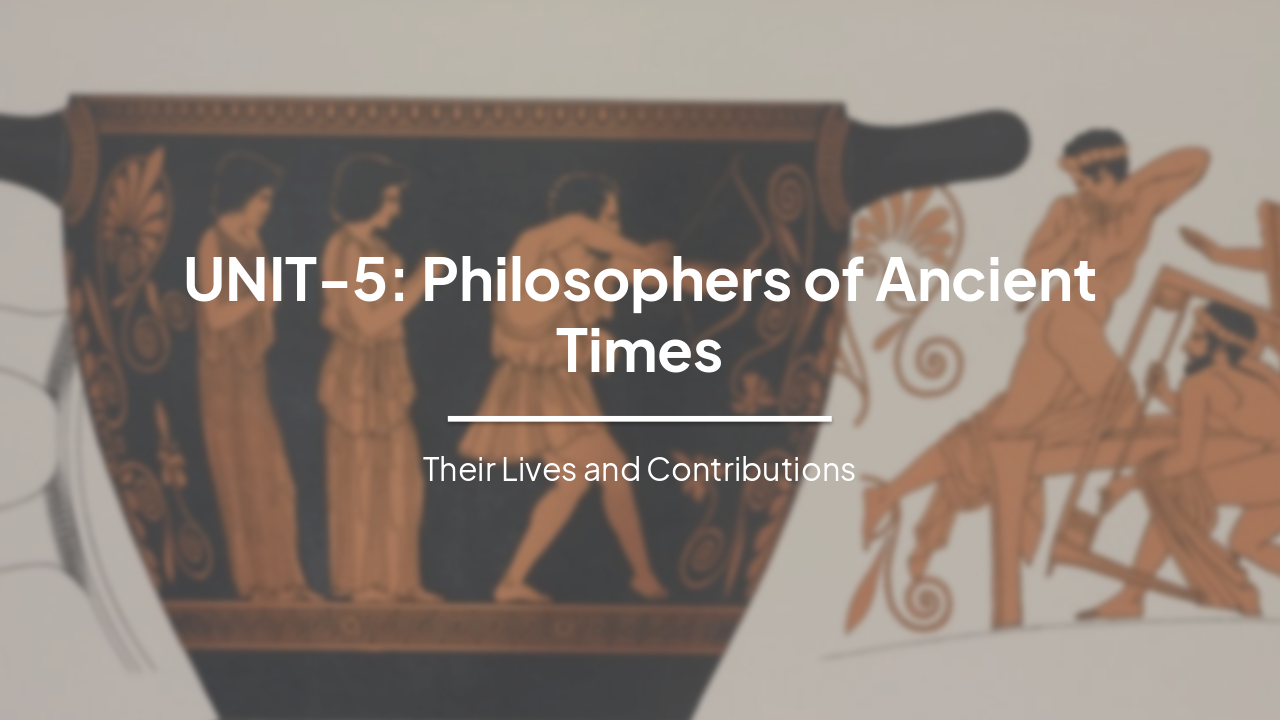
UNIT-5: Philosophers of Ancient Times

Their Lives and Contributions

---

Photo by The New York Public Library on Unsplash
Slide 1 - UNIT-5: Philosophers of Ancient Times
Slide 2 of 19

Slide 2 - Introduction to Ancient Philosophy

  • Philosophy: The study of fundamental questions about existence, knowledge, values, reason, mind, and language.
  • Ancient philosophers laid foundations for modern thought in education, ethics, science, and society.
  • This presentation explores the profound impact of Socrates, Confucius, and Avicenna.

---

Photo by Milad Fakurian on Unsplash
Slide 2 - Introduction to Ancient Philosophy
Slide 3 of 19

Slide 3

Socrates

The Father of Western Philosophy

---

Photo by Joel Arbaje on Unsplash

Slide 3
Slide 4 of 19

Slide 4 - Socrates: Early Life and Historical Context

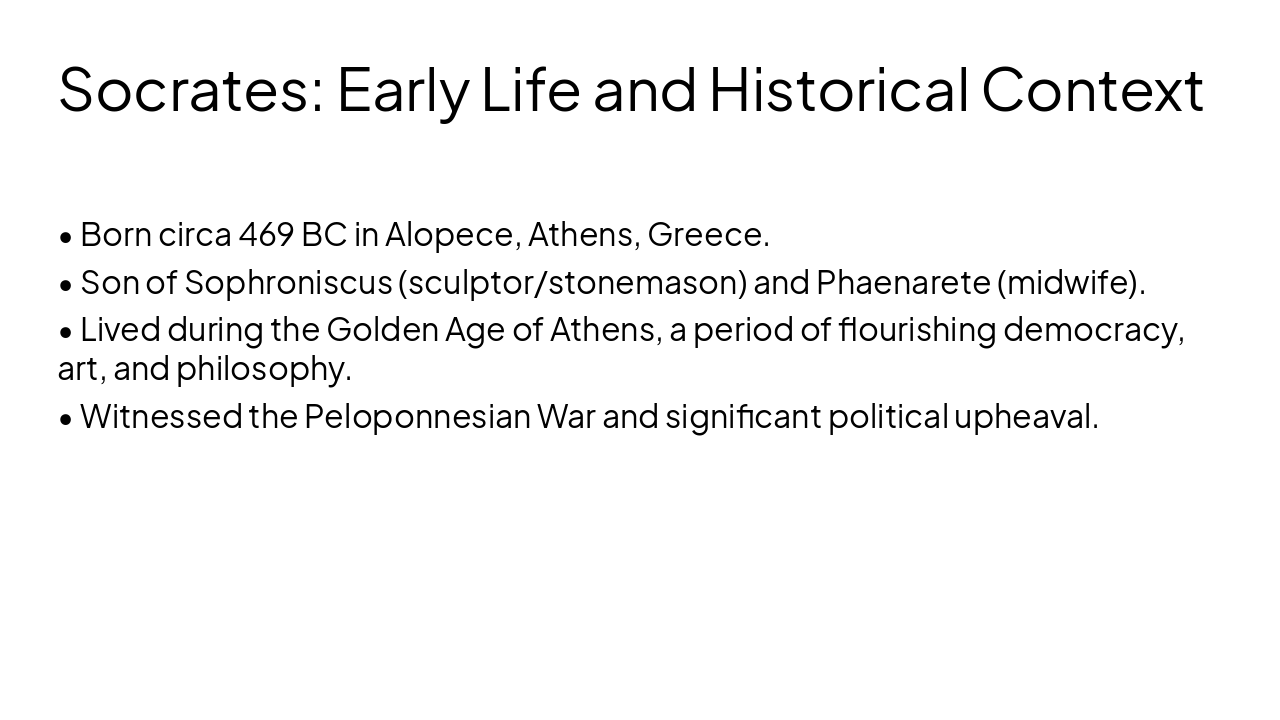
  • Born circa 469 BC in Alopece, Athens, Greece.
  • Son of Sophroniscus (sculptor/stonemason) and Phaenarete (midwife).
  • Lived during the Golden Age of Athens, a period of flourishing democracy, art, and philosophy.
  • Witnessed the Peloponnesian War and significant political upheaval.
Slide 4 - Socrates: Early Life and Historical Context
Slide 5 of 19

Slide 5 - Socrates: Teaching Methods and Key Ideas

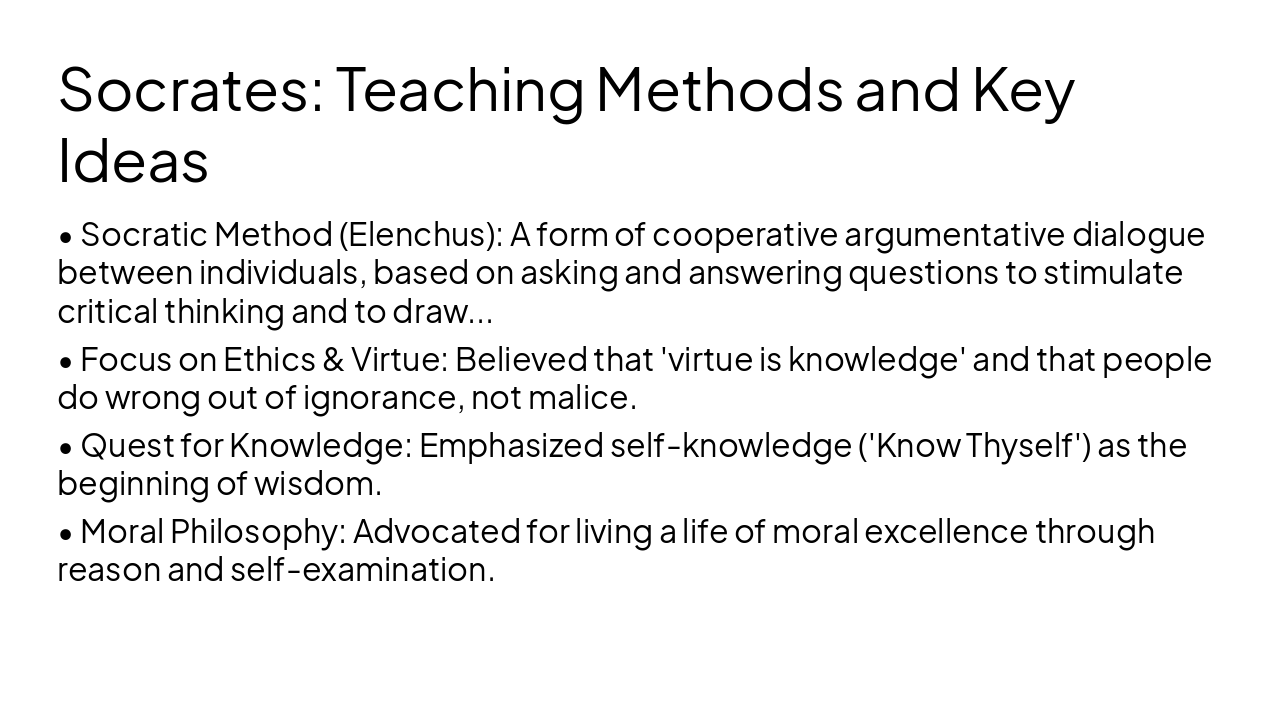
  • Socratic Method (Elenchus): A form of cooperative argumentative dialogue between individuals, based on asking and answering questions to stimulate critical thinking and to draw out ideas and underlying presumptions.
  • Focus on Ethics & Virtue: Believed that 'virtue is knowledge' and that people do wrong out of ignorance, not malice.
  • Quest for Knowledge: Emphasized self-knowledge ('Know Thyself') as the beginning of wisdom.
  • Moral Philosophy: Advocated for living a life of moral excellence through reason and self-examination.
Slide 5 - Socrates: Teaching Methods and Key Ideas
Slide 6 of 19

Slide 6

> The only true wisdom is in knowing you know nothing.

— Socrates

---

Photo by Pierre Bamin on Unsplash
Slide 6
Slide 7 of 19

Slide 7 - Socrates: Trial, Death, and Enduring Legacy

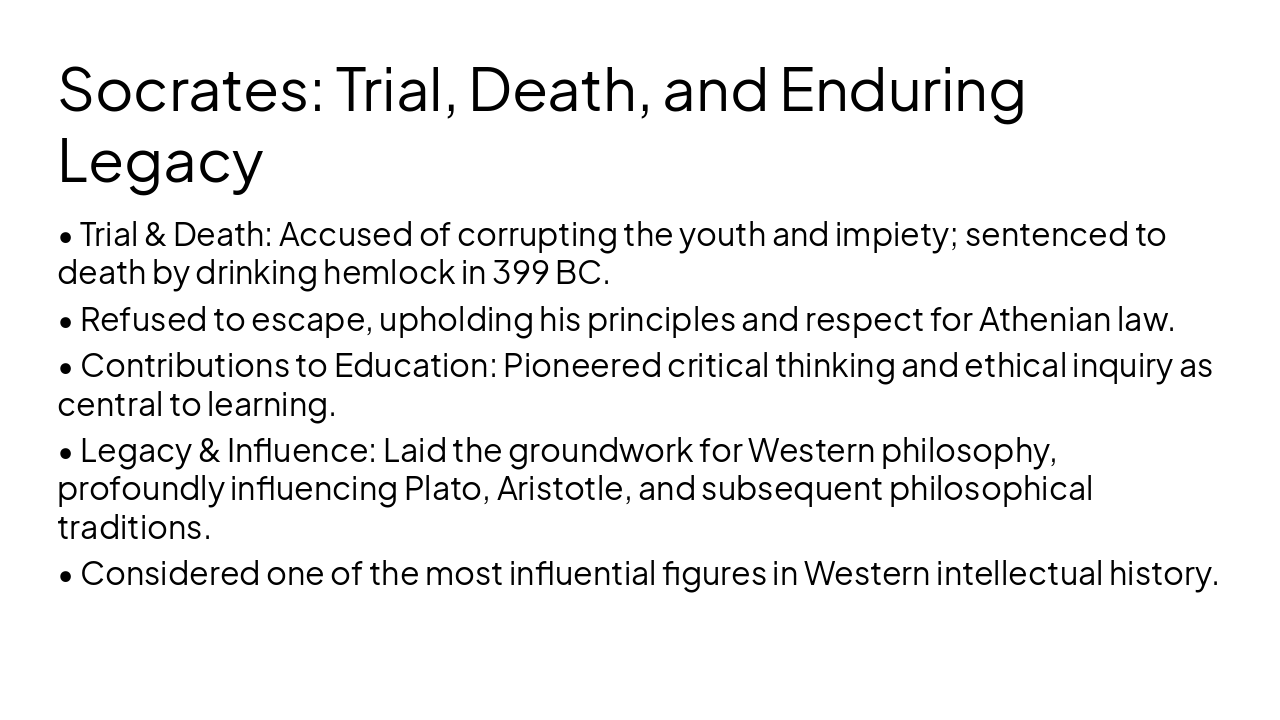
  • Trial & Death: Accused of corrupting the youth and impiety; sentenced to death by drinking hemlock in 399 BC.
  • Refused to escape, upholding his principles and respect for Athenian law.
  • Contributions to Education: Pioneered critical thinking and ethical inquiry as central to learning.
  • Legacy & Influence: Laid the groundwork for Western philosophy, profoundly influencing Plato, Aristotle, and subsequent philosophical traditions.
  • Considered one of the most influential figures in Western intellectual history.
Slide 7 - Socrates: Trial, Death, and Enduring Legacy
Slide 8 of 19

Slide 8

Confucius

The Sage of Chinese Thought

---

Photo by Art Institute of Chicago on Unsplash
Slide 8
Slide 9 of 19

Slide 9 - Confucius: Early Life and Historical Background

  • Born Kong Qiu (Kong Fuzi) around 551 BC in the State of Lu (present-day Shandong Province, China).
  • Lived during the Spring and Autumn period, a time of political instability and social unrest.
  • Emphasized personal and governmental morality, harmonious social relationships, and justice.
  • Considered himself a transmitter of cultural values from earlier periods.

Source: Wikipedia: Confucius

Slide 9 - Confucius: Early Life and Historical Background
Slide 10 of 19

Slide 10 - Confucius: Core Teachings and Philosophy (Confucianism)

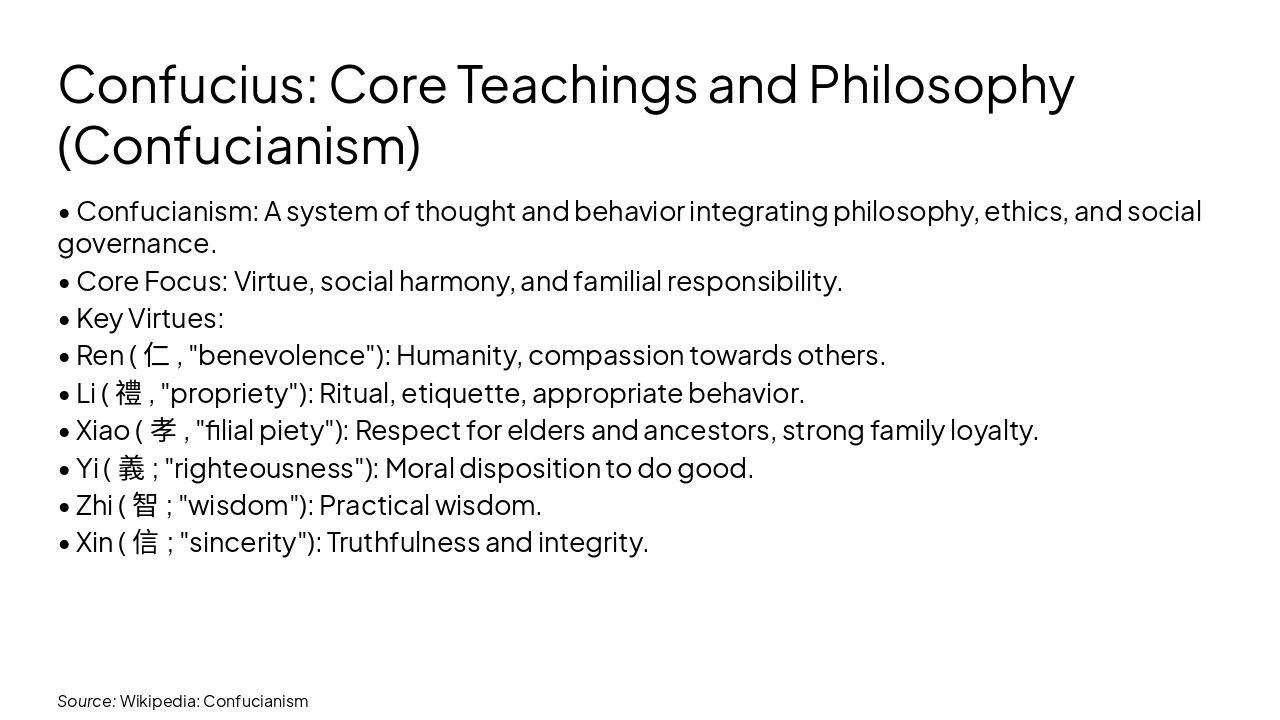
  • Confucianism: A system of thought and behavior integrating philosophy, ethics, and social governance.
  • Core Focus: Virtue, social harmony, and familial responsibility.
  • Key Virtues:
  • Ren (仁, "benevolence"): Humanity, compassion towards others.
  • Li (禮, "propriety"): Ritual, etiquette, appropriate behavior.
  • Xiao (孝, "filial piety"): Respect for elders and ancestors, strong family loyalty.
  • Yi (義; "righteousness"): Moral disposition to do good.
  • Zhi (智; "wisdom"): Practical wisdom.
  • Xin (信; "sincerity"): Truthfulness and integrity.

Source: Wikipedia: Confucianism

Slide 10 - Confucius: Core Teachings and Philosophy (Confucianism)
Slide 11 of 19

Slide 11 - Confucius: Education and Societal Influence

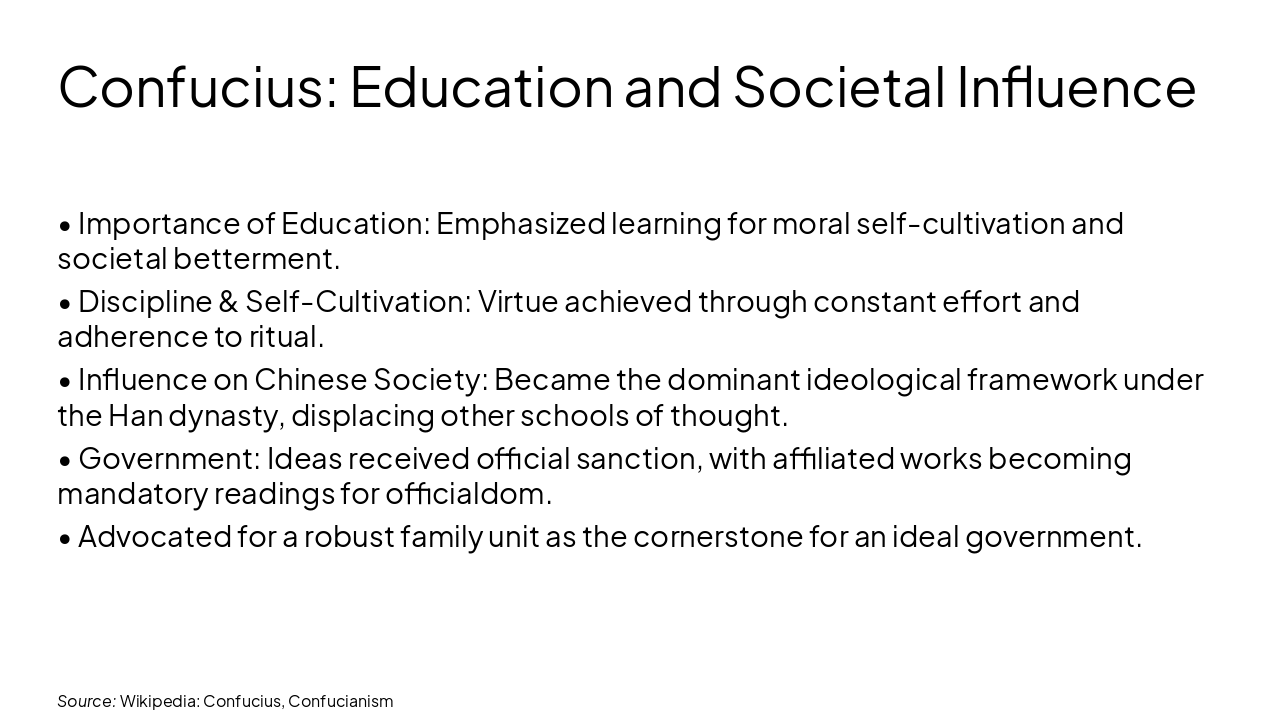
  • Importance of Education: Emphasized learning for moral self-cultivation and societal betterment.
  • Discipline & Self-Cultivation: Virtue achieved through constant effort and adherence to ritual.
  • Influence on Chinese Society: Became the dominant ideological framework under the Han dynasty, displacing other schools of thought.
  • Government: Ideas received official sanction, with affiliated works becoming mandatory readings for officialdom.
  • Advocated for a robust family unit as the cornerstone for an ideal government.

Source: Wikipedia: Confucius, Confucianism

Slide 11 - Confucius: Education and Societal Influence
Slide 12 of 19

Slide 12

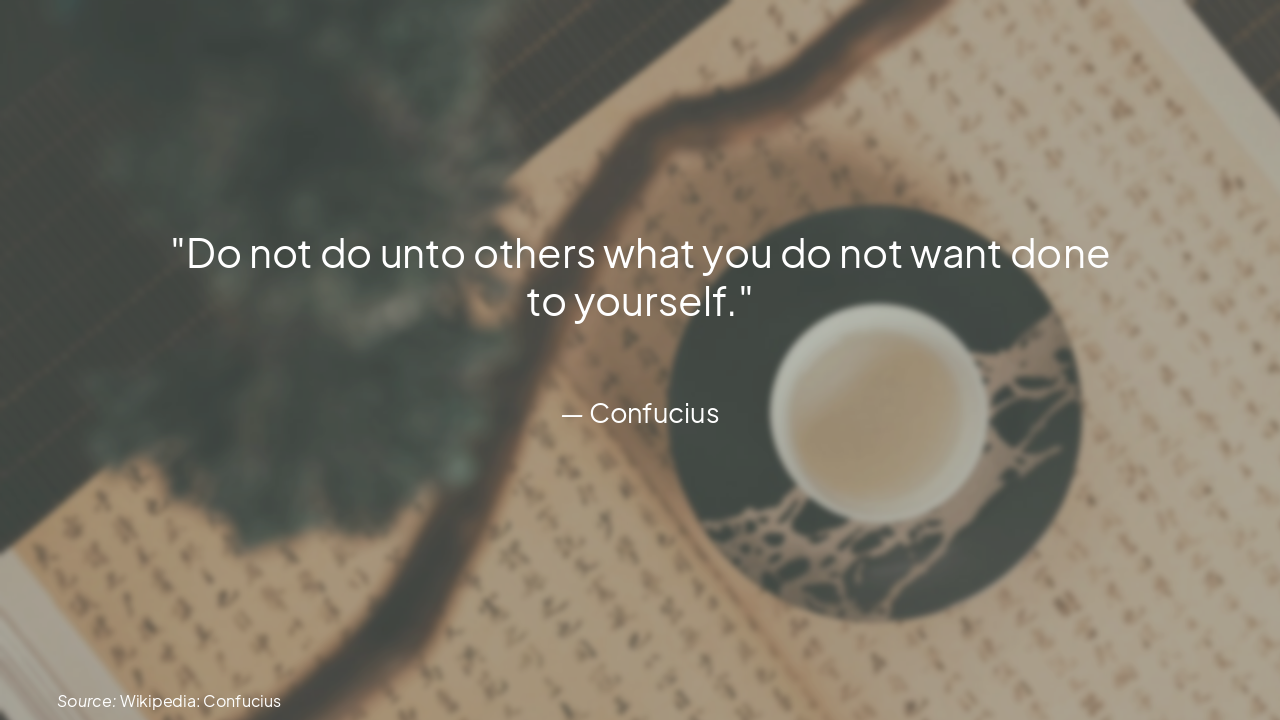
> Do not do unto others what you do not want done to yourself.

— Confucius

---

Photo by 五玄土 ORIENTO on Unsplash

Source: Wikipedia: Confucius
Slide 12
Slide 13 of 19

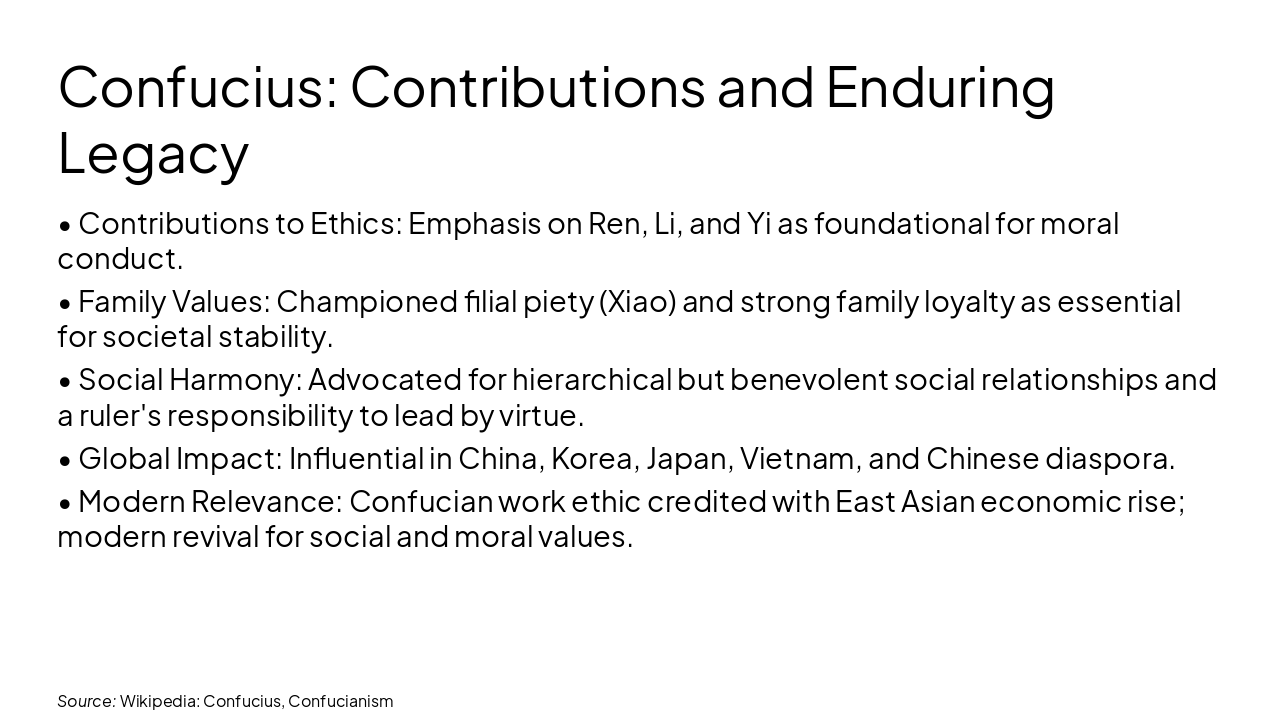
Slide 13 - Confucius: Contributions and Enduring Legacy

  • Contributions to Ethics: Emphasis on Ren, Li, and Yi as foundational for moral conduct.
  • Family Values: Championed filial piety (Xiao) and strong family loyalty as essential for societal stability.
  • Social Harmony: Advocated for hierarchical but benevolent social relationships and a ruler's responsibility to lead by virtue.
  • Global Impact: Influential in China, Korea, Japan, Vietnam, and Chinese diaspora.
  • Modern Relevance: Confucian work ethic credited with East Asian economic rise; modern revival for social and moral values.

Source: Wikipedia: Confucius, Confucianism
Slide 13 - Confucius: Contributions and Enduring Legacy
Slide 14 of 19

Slide 14

Avicenna

The Polymath of the Islamic Golden Age

---

Photo by Iñaki del Olmo on Unsplash
Slide 14
Slide 15 of 19

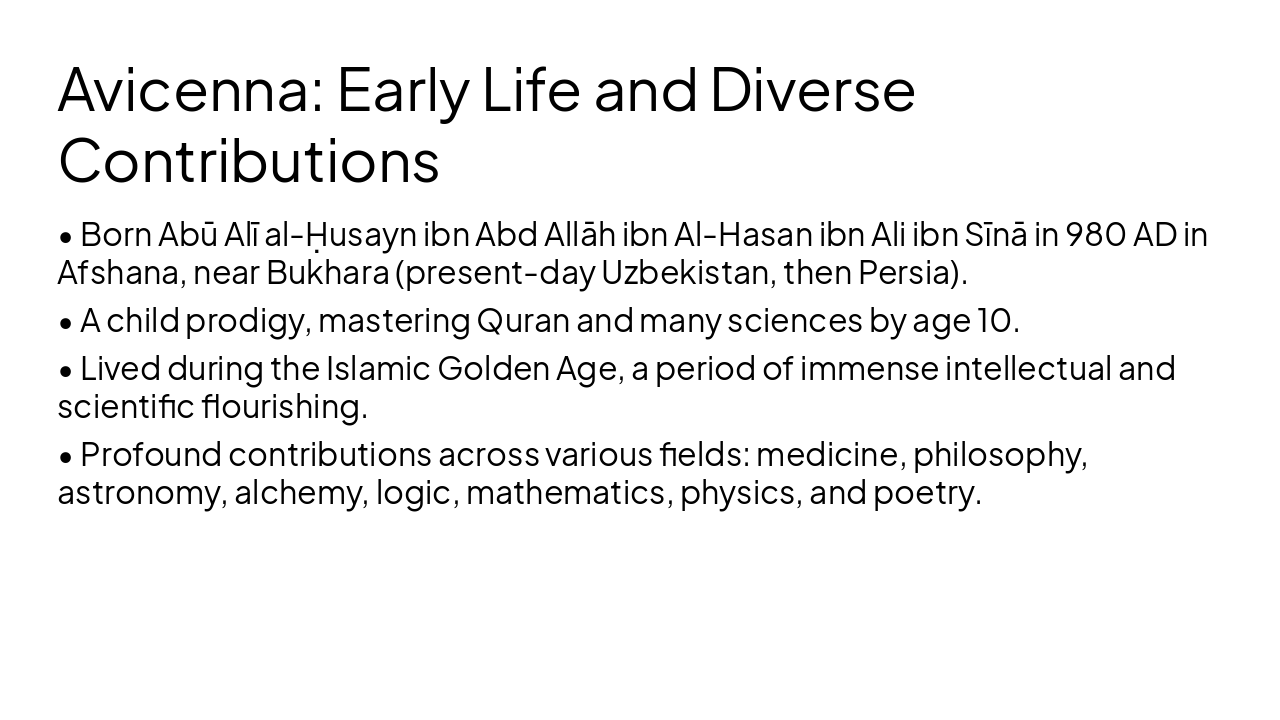
Slide 15 - Avicenna: Early Life and Diverse Contributions

  • Born Abū Alī al-Ḥusayn ibn Abd Allāh ibn Al-Hasan ibn Ali ibn Sīnā in 980 AD in Afshana, near Bukhara (present-day Uzbekistan, then Persia).
  • A child prodigy, mastering Quran and many sciences by age 10.
  • Lived during the Islamic Golden Age, a period of immense intellectual and scientific flourishing.
  • Profound contributions across various fields: medicine, philosophy, astronomy, alchemy, logic, mathematics, physics, and poetry.
Slide 15 - Avicenna: Early Life and Diverse Contributions
Slide 16 of 19

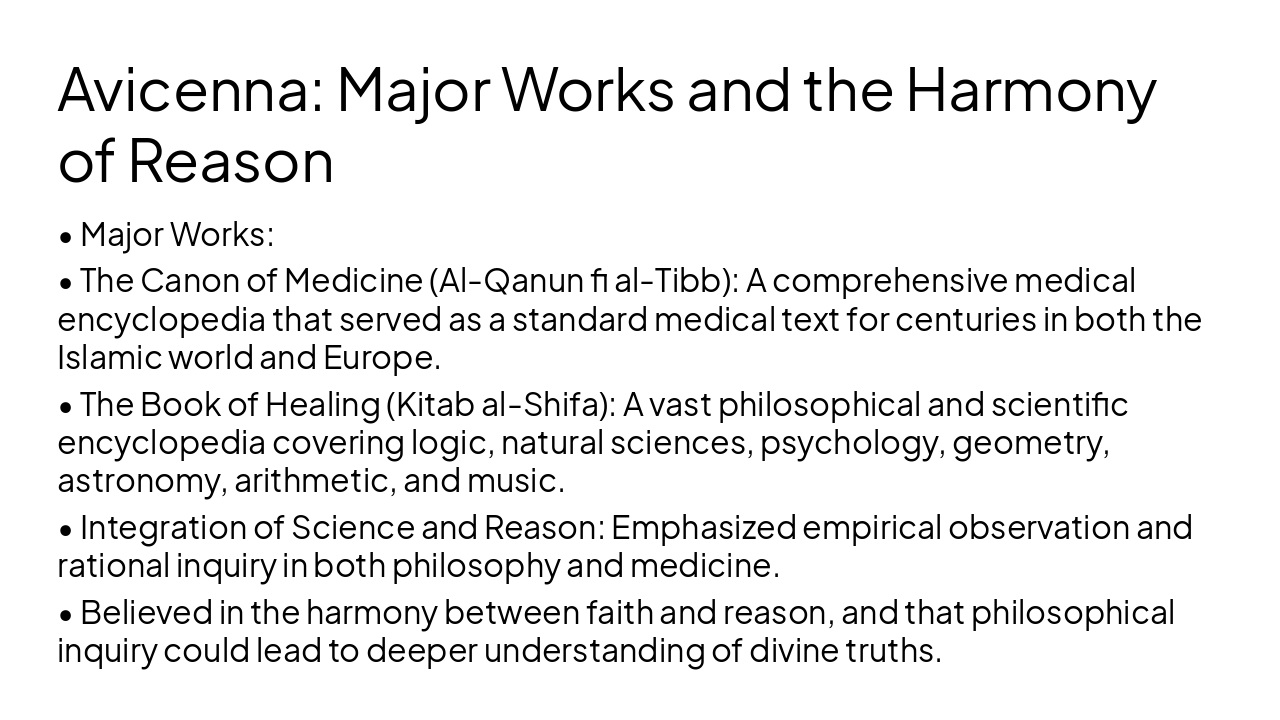
Slide 16 - Avicenna: Major Works and the Harmony of Reason

  • Major Works:
  • The Canon of Medicine (Al-Qanun fi al-Tibb): A comprehensive medical encyclopedia that served as a standard medical text for centuries in both the Islamic world and Europe.
  • The Book of Healing (Kitab al-Shifa): A vast philosophical and scientific encyclopedia covering logic, natural sciences, psychology, geometry, astronomy, arithmetic, and music.
  • Integration of Science and Reason: Emphasized empirical observation and rational inquiry in both philosophy and medicine.
  • Believed in the harmony between faith and reason, and that philosophical inquiry could lead to deeper understanding of divine truths.
Slide 16 - Avicenna: Major Works and the Harmony of Reason
Slide 17 of 19

Slide 17 - Avicenna: Enduring Legacy in Scholarship and Medicine

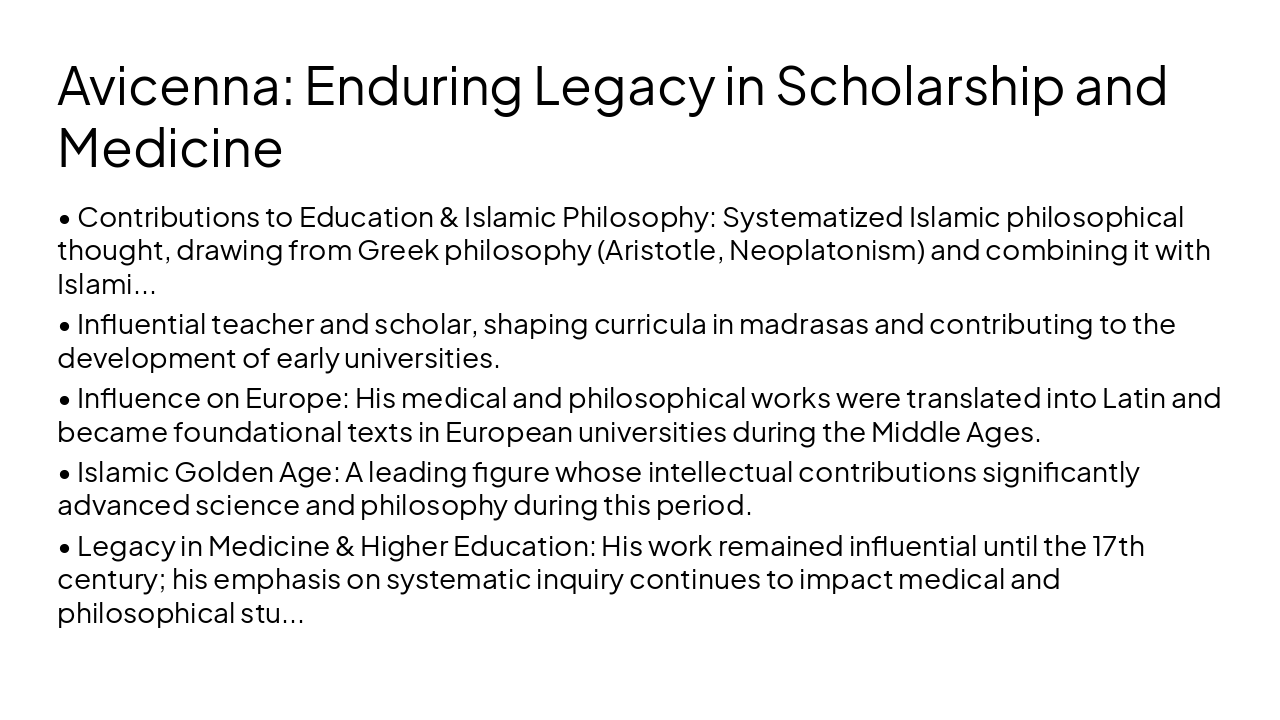
  • Contributions to Education & Islamic Philosophy: Systematized Islamic philosophical thought, drawing from Greek philosophy (Aristotle, Neoplatonism) and combining it with Islamic theological concepts.
  • Influential teacher and scholar, shaping curricula in madrasas and contributing to the development of early universities.
  • Influence on Europe: His medical and philosophical works were translated into Latin and became foundational texts in European universities during the Middle Ages.
  • Islamic Golden Age: A leading figure whose intellectual contributions significantly advanced science and philosophy during this period.
  • Legacy in Medicine & Higher Education: His work remained influential until the 17th century; his emphasis on systematic inquiry continues to impact medical and philosophical studies.
Slide 17 - Avicenna: Enduring Legacy in Scholarship and Medicine
Slide 18 of 19

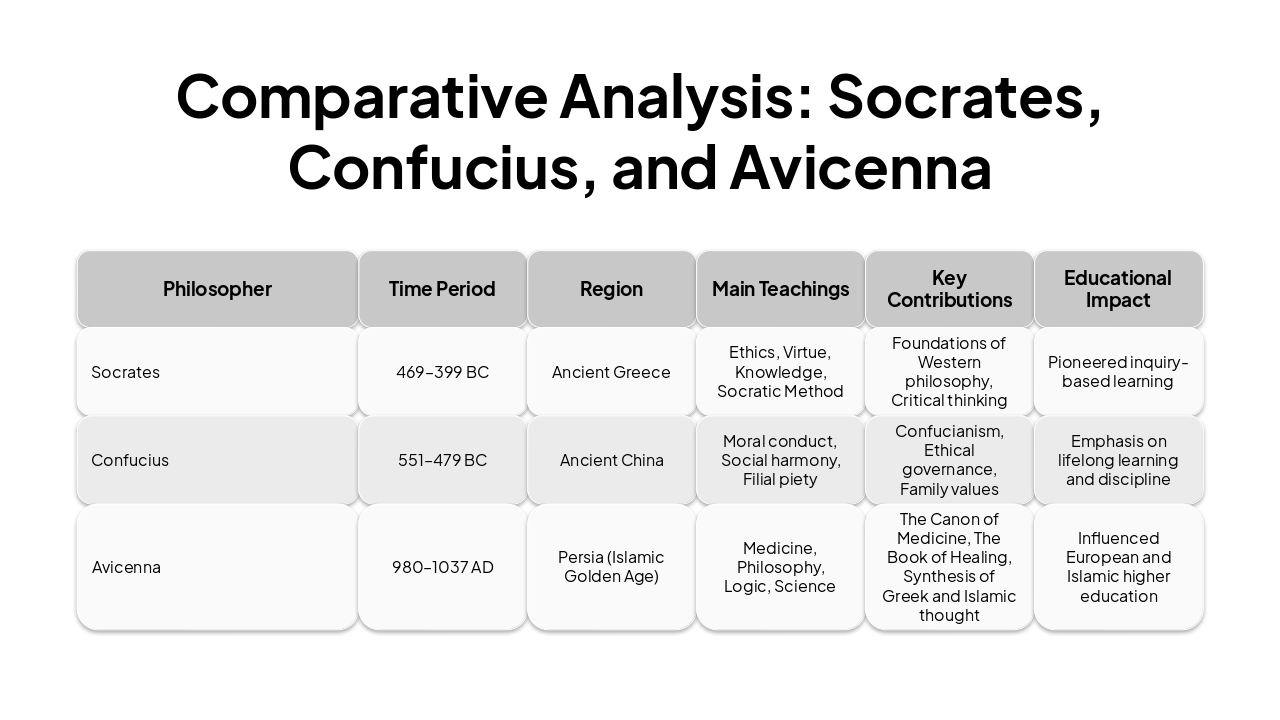
Slide 18 - Comparative Analysis: Socrates, Confucius, and Avicenna

PhilosopherTime PeriodRegionMain TeachingsKey ContributionsEducational Impact
Socrates469–399 BCAncient GreeceEthics, Virtue, Knowledge, Socratic MethodFoundations of Western philosophy, Critical thinkingPioneered inquiry-based learning
Confucius551–479 BCAncient ChinaMoral conduct, Social harmony, Filial pietyConfucianism, Ethical governance, Family valuesEmphasis on lifelong learning and discipline
Avicenna980–1037 ADPersia (Islamic Golden Age)Medicine, Philosophy, Logic, ScienceThe Canon of Medicine, The Book of Healing, Synthesis of Greek and Islamic thoughtInfluenced European and Islamic higher education
Slide 18 - Comparative Analysis: Socrates, Confucius, and Avicenna
Slide 19 of 19

Slide 19 - Relevance in Modern Education

  • Modern Teaching: Socratic Method encourages critical thinking, active learning, and questioning assumptions.
  • Ethics: Philosophical ethics continue to inform discussions on moral dilemmas, character development, and civic responsibility.
  • Leadership: Confucian principles of virtuous leadership and social harmony offer insights into effective governance and organizational culture.
  • Critical Thinking: Emphasis on reasoned argument, logic, and self-reflection from all three philosophers is foundational for analytical skills.
  • Global Citizenship: Understanding diverse philosophical traditions fosters cultural empathy and broader perspectives in a globalized world.

---

Photo by Quilia on Unsplash

Slide 19 - Relevance in Modern Education

Discover More Presentations

Explore thousands of AI-generated presentations for inspiration

Browse Presentations
Powered by AI

Create Your Own Presentation

Generate professional presentations in seconds with Karaf's AI. Customize this presentation or start from scratch.

Create New Presentation

Powered by Karaf.ai — AI-Powered Presentation Generator