AI's Journey: From Concepts to Future

Generated from prompt:

make a presentation about the history of artificial intelligence

This presentation traces AI's evolution, from early ideas by Turing and Wiener in the 1950s, through milestones, winters, and revivals, to modern deep learning breakthroughs and growth stats, concludi

November 21, 202512 slides
Slide 1 of 12

Slide 1 - The History of Artificial Intelligence

The slide is titled "The History of Artificial Intelligence" and serves as a title slide for the presentation. Its subtitle provides an overview of AI's evolution, tracing from its conceptual origins to the transformative technologies influencing the modern world.

The History of Artificial Intelligence

An overview of AI's evolution, from conceptual beginnings to transformative technologies shaping our world today.
Slide 1
Slide 2 of 12

Slide 2 - Presentation Agenda

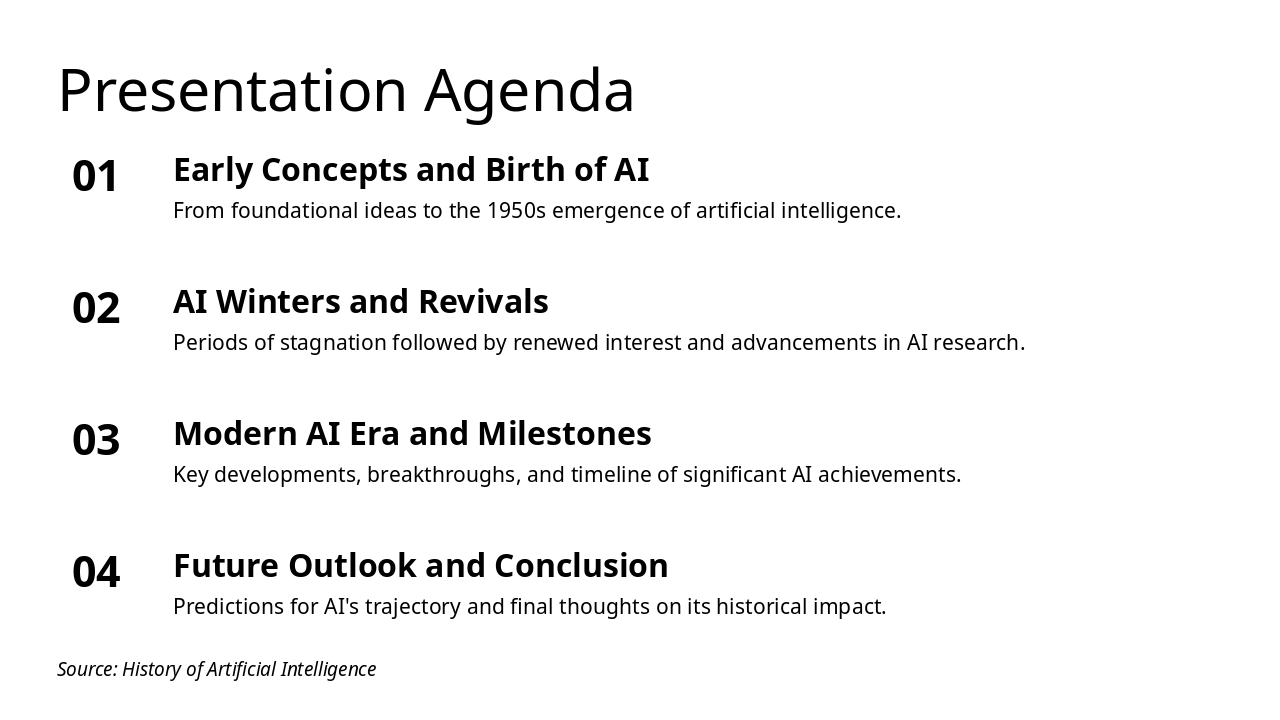
The presentation agenda outlines the historical evolution of AI, starting with early concepts from foundational ideas to its emergence in the 1950s. It then covers AI winters and revivals, key milestones in the modern era, and concludes with future predictions and reflections on AI's impact.

Presentation Agenda

  1. Early Concepts and Birth of AI

From foundational ideas to the 1950s emergence of artificial intelligence.

  1. AI Winters and Revivals

Periods of stagnation followed by renewed interest and advancements in AI research.

  1. Modern AI Era and Milestones

Key developments, breakthroughs, and timeline of significant AI achievements.

  1. Future Outlook and Conclusion

Predictions for AI's trajectory and final thoughts on its historical impact.

Source: History of Artificial Intelligence

Slide 2
Slide 3 of 12

Slide 3 - Early Concepts of AI

This section header slide introduces the topic of early concepts in AI, marking it as the second section. It highlights foundational ideas from the 1940s and 1950s, focusing on Alan Turing and the Turing Test.

02

Early Concepts of AI

Foundational ideas from 1940s-1950s: Alan Turing and the Turing Test

Slide 3
Slide 4 of 12

Slide 4 - Pioneers and Ideas

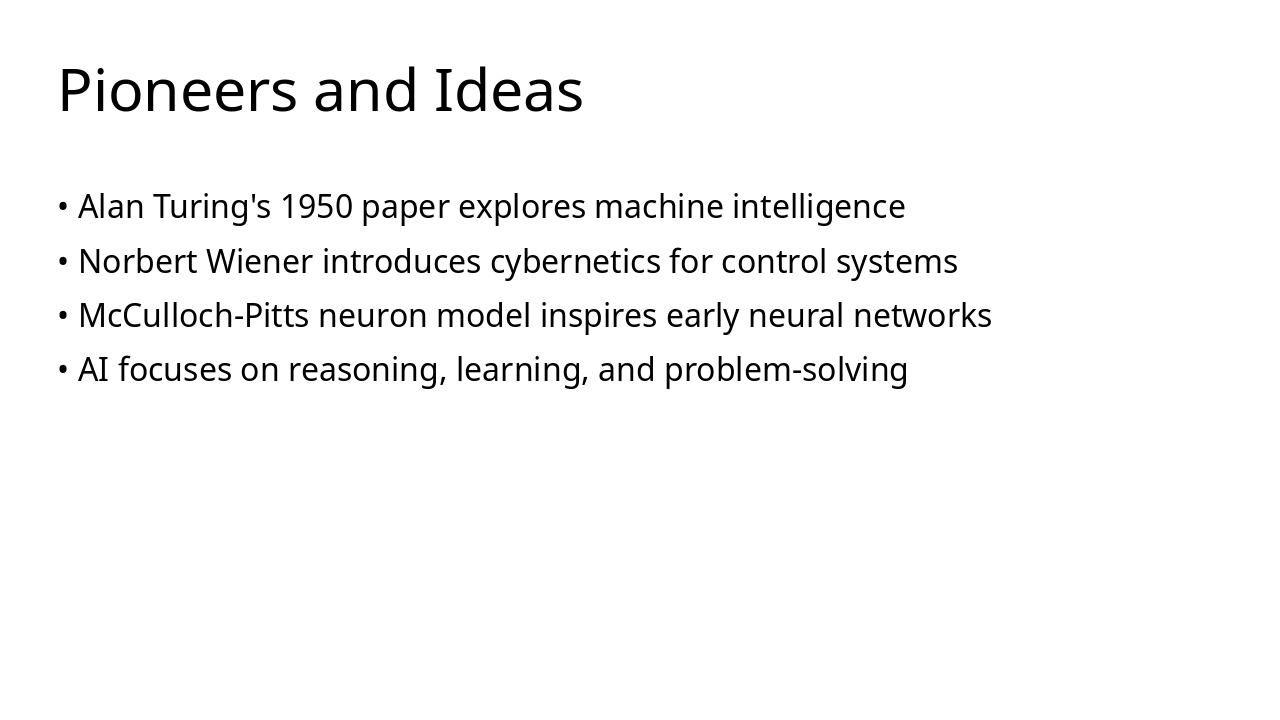
The slide "Pioneers and Ideas" highlights key early contributions to AI, including Alan Turing's 1950 paper on machine intelligence, Norbert Wiener's introduction of cybernetics for control systems, and the McCulloch-Pitts neuron model that inspired initial neural networks. It also emphasizes AI's core focus on reasoning, learning, and problem-solving.

Pioneers and Ideas

  • Alan Turing's 1950 paper explores machine intelligence
  • Norbert Wiener introduces cybernetics for control systems
  • McCulloch-Pitts neuron model inspires early neural networks
  • AI focuses on reasoning, learning, and problem-solving
Slide 4
Slide 5 of 12

Slide 5 - Turing's Vision

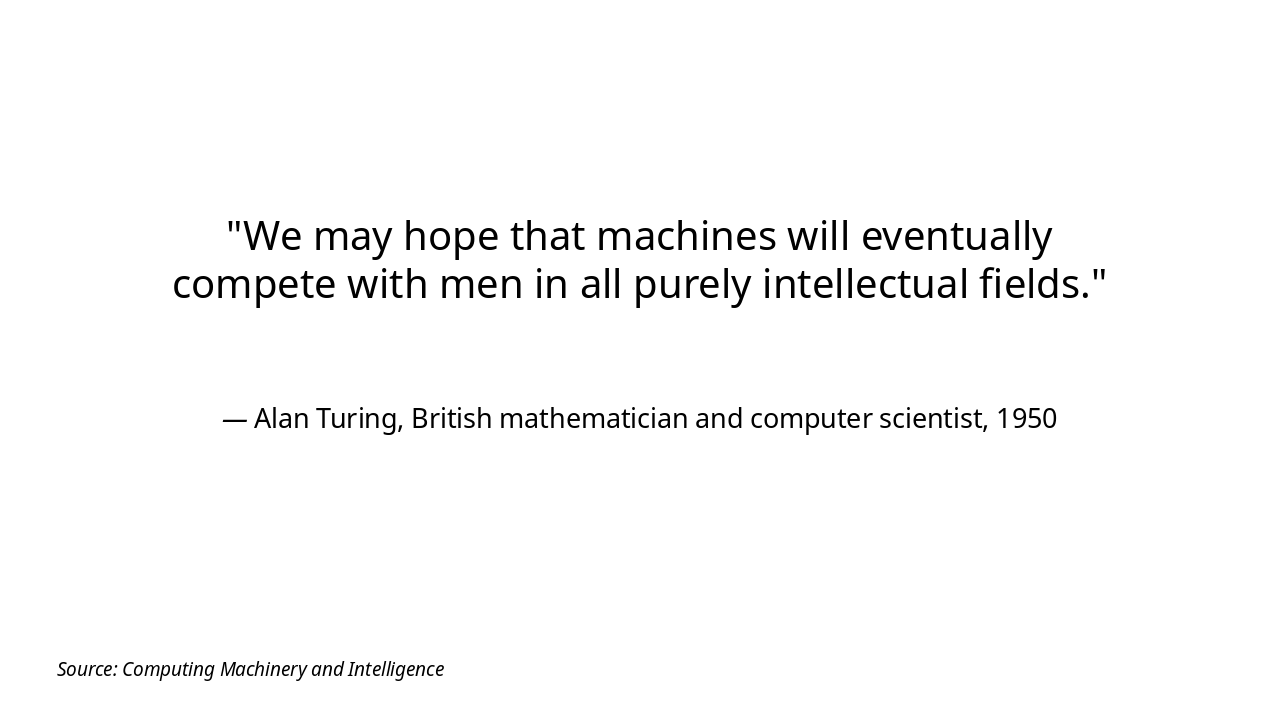
The slide, titled "Turing's Vision," features a quote from Alan Turing, the British mathematician and computer scientist. In 1950, he expressed optimism that machines would one day rival humans in all purely intellectual pursuits.

Turing's Vision

> We may hope that machines will eventually compete with men in all purely intellectual fields.

— Alan Turing, British mathematician and computer scientist, 1950

Source: Computing Machinery and Intelligence

--- Speaker Notes: This quote highlights the early optimism for AI's potential in human-like intelligence.

Slide 5
Slide 6 of 12

Slide 6 - History of Artificial Intelligence

The slide titled "History of Artificial Intelligence" introduces the section "The Birth of AI." It highlights the Dartmouth Conference of 1956 as the pivotal event marking AI's emergence, with a focus on knowledge representation and planning goals.

History of Artificial Intelligence

The Birth of AI

Dartmouth Conference 1956 marks AI's emergence, focusing on knowledge representation and planning goals.

Slide 6
Slide 7 of 12

Slide 7 - Key Milestones in AI History

The timeline slide outlines key milestones in AI history, starting with Alan Turing's foundational concepts in computing and intelligence during the 1940s, followed by the 1956 Dartmouth Conference that coined the term AI and launched the field. It then covers early innovations like the 1960s ELIZA chatbot, the 1970s AI winter due to funding cuts, and the 2010s deep learning revolution that advanced neural networks for image and speech recognition.

Key Milestones in AI History

1940s: Turing's Theoretical Foundations Alan Turing establishes key concepts in computing and intelligence. 1956: Dartmouth Conference Births AI First AI conference coins term and sparks research field. 1960s: Early Programs Like ELIZA ELIZA chatbot demonstrates natural language processing capabilities. 1970s: First AI Winter Arrives Funding shortages cause significant slowdown in AI development. 2010s: Deep Learning Revolution Ignites Neural networks advance, enabling breakthroughs in image and speech recognition.

Slide 7
Slide 8 of 12

Slide 8 - AI Winters and Revivals

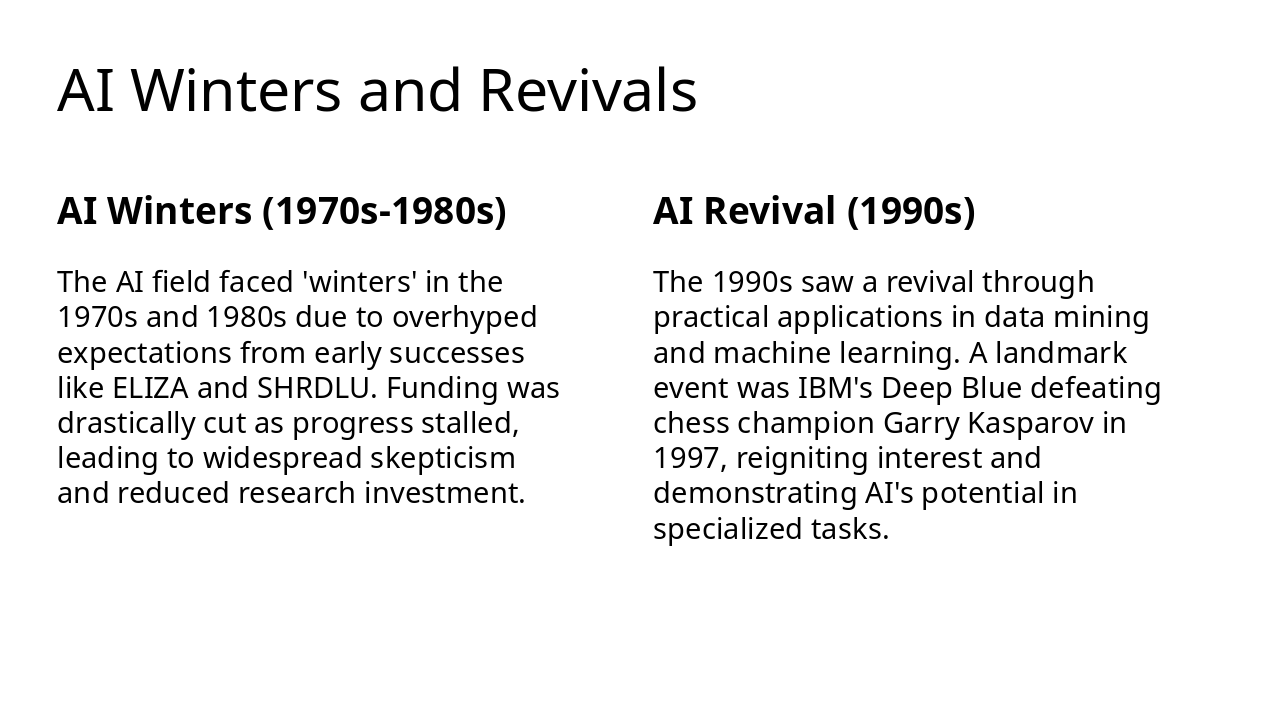
In the 1970s and 1980s, AI experienced "winters" due to overhyped expectations from early programs like ELIZA and SHRDLU, resulting in stalled progress, drastic funding cuts, and widespread skepticism. The 1990s brought a revival through practical advances in data mining and machine learning, highlighted by IBM's Deep Blue defeating chess champion Garry Kasparov in 1997, which reignited interest in AI's specialized capabilities.

AI Winters and Revivals

AI Winters (1970s-1980s)AI Revival (1990s)
The AI field faced 'winters' in the 1970s and 1980s due to overhyped expectations from early successes like ELIZA and SHRDLU. Funding was drastically cut as progress stalled, leading to widespread skepticism and reduced research investment.The 1990s saw a revival through practical applications in data mining and machine learning. A landmark event was IBM's Deep Blue defeating chess champion Garry Kasparov in 1997, reigniting interest and demonstrating AI's potential in specialized tasks.
Slide 8
Slide 9 of 12

Slide 9 - Modern AI Breakthroughs

The slide titled "Modern AI Breakthroughs" highlights key advancements in deep learning during the 2010s, which significantly improved AI's perception capabilities. It notes that deep learning excels in decision-making for AI systems and powers applications like self-driving cars and virtual assistants.

Modern AI Breakthroughs

!Image

  • Deep learning advanced perception in 2010s
  • Excelled in decision-making for AI systems
  • Powers self-driving cars and assistants

Source: Deep learning

--- Speaker Notes: The 2010s saw deep learning excel in perception and decision-making, powering tools like self-driving cars and virtual assistants.

Slide 9
Slide 10 of 12

Slide 10 - AI Growth Stats

Slide 10
Slide 11 of 12

Slide 11 - The Future of AI

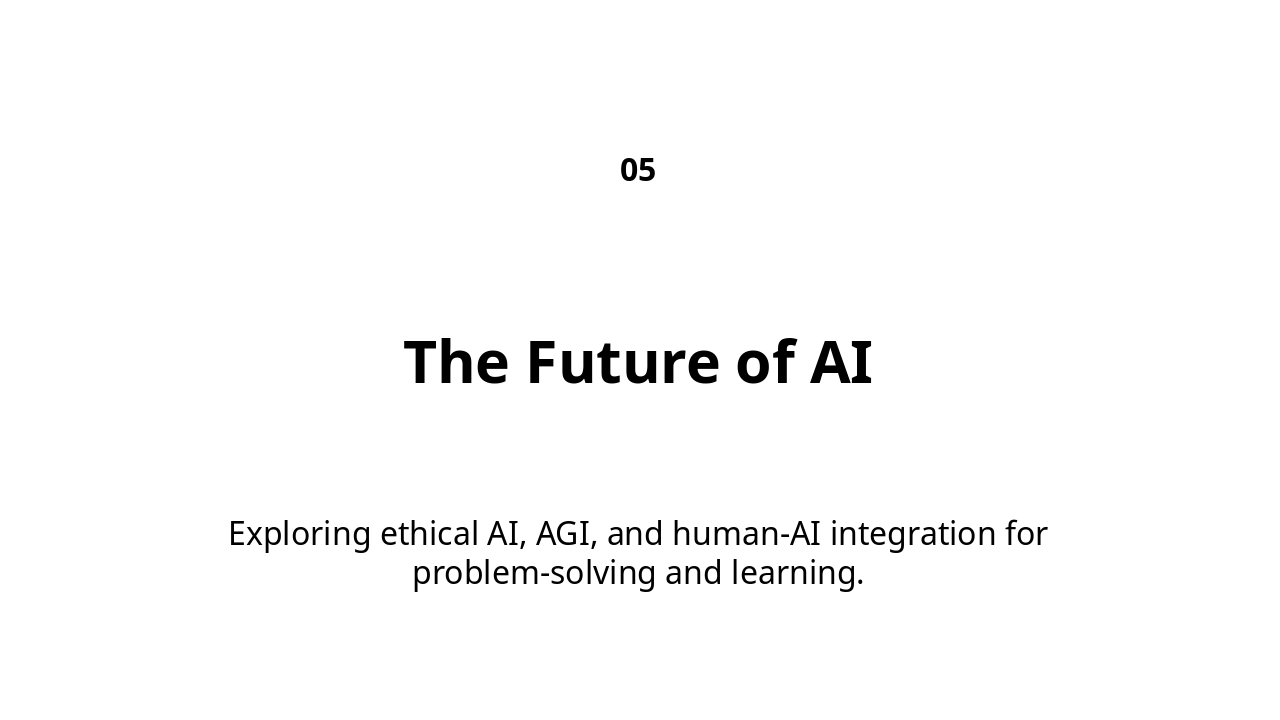
This section header slide, titled "The Future of AI" and numbered 05, introduces key advancements in the field. It features a subtitle exploring ethical AI, artificial general intelligence (AGI), and the integration of human-AI collaboration to enhance problem-solving and learning.

The Future of AI

05

The Future of AI

Exploring ethical AI, AGI, and human-AI integration for problem-solving and learning.

Slide 11
Slide 12 of 12

Slide 12 - Conclusion: AI's Enduring Impact

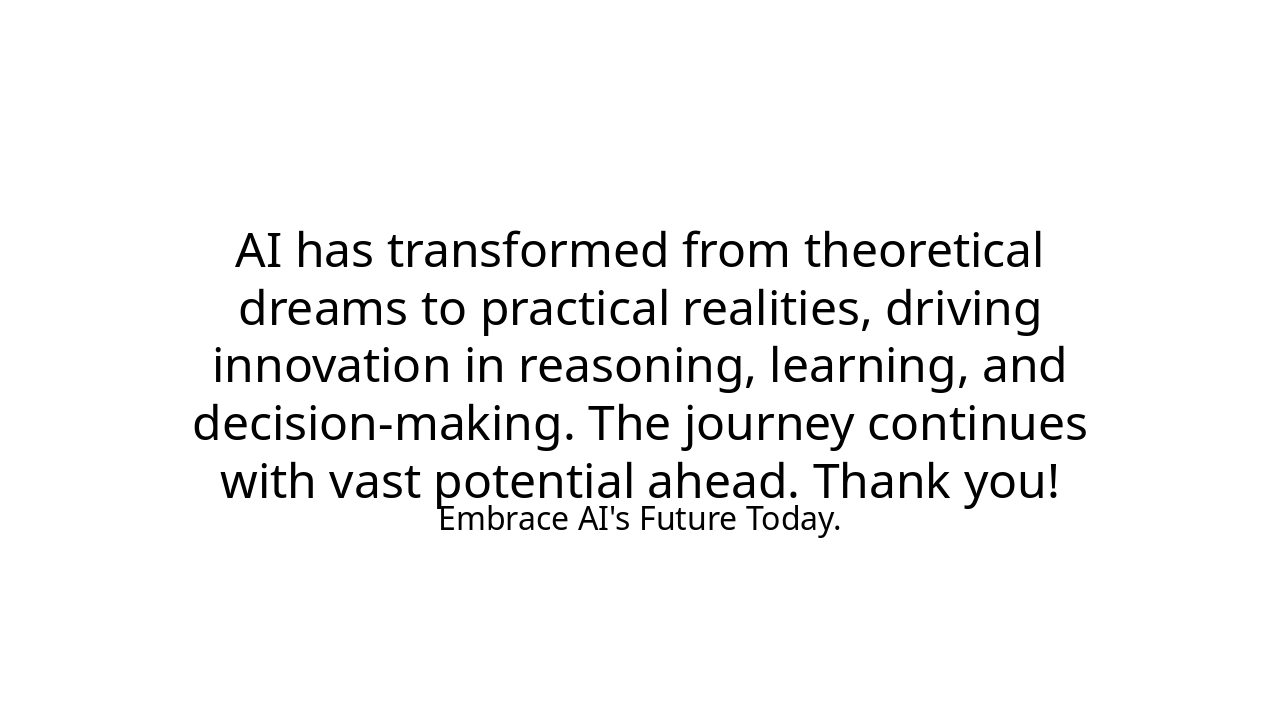
AI has evolved from theoretical concepts into practical tools that advance reasoning, learning, and decision-making, fueling ongoing innovation with immense potential. The slide urges embracing AI's future today, ending with a thank you.

Conclusion: AI's Enduring Impact

AI has transformed from theoretical dreams to practical realities, driving innovation in reasoning, learning, and decision-making. The journey continues with vast potential ahead. Thank you!

Embrace AI's Future Today.

Slide 12
Powered by AI

Create Your Own Presentation

Generate professional presentations in seconds with Karaf's AI. Customize this presentation or start from scratch.

Create New Presentation

Powered by Karaf.ai — AI-Powered Presentation Generator