Predicting High-Risk Medical Clients with ML

Generated from prompt:

Create a 19-slide English PowerPoint titled 'Predicting High-Risk Medical Cost Clients Using Machine Learning'. Follow this outline: 1. Title Slide — title, subtitle, team info. 2. Why Predict Medical Costs? 3. Project Objective & Task Summary 4. Dataset Overview 5. Business Problem & Target Definition 6. Data Preprocessing Pipeline 7. Key Feature Insights (Before Modeling) 8. Baseline Models Overview 9. Baseline Models Performance 10. Limitations of Baseline Models 11. Ensemble Methods: The Turning Point 12. Boosting Models: The Best Performers 13. Hyperparameter Tuning Lessons 14. Neural Network Model 15. Model Comparison Summary 16. Key Insights 17. Business Implications 18. Conclusion 19. Q&A Include concise professional text, charts, and icons with a modern data science design style.

ML project predicts high-risk medical cost clients using boosting models (top performers post-tuning). Covers data prep, baselines, NN comparison, key insights, and business implications.

December 20, 20256 slides
Slide 1 of 6

Slide 1 - Predicting High-Risk Medical Cost Clients Using Machine Learning

This title slide is titled "Predicting High-Risk Medical Cost Clients Using Machine Learning." The subtitle states "Identifying High-Risk Clients with ML | Data Science Team | 2023."

Predicting High-Risk Medical Cost Clients Using Machine Learning

Identifying High-Risk Clients with ML | Data Science Team | 2023

Slide 1 - Predicting High-Risk Medical Cost Clients Using Machine Learning
Slide 2 of 6

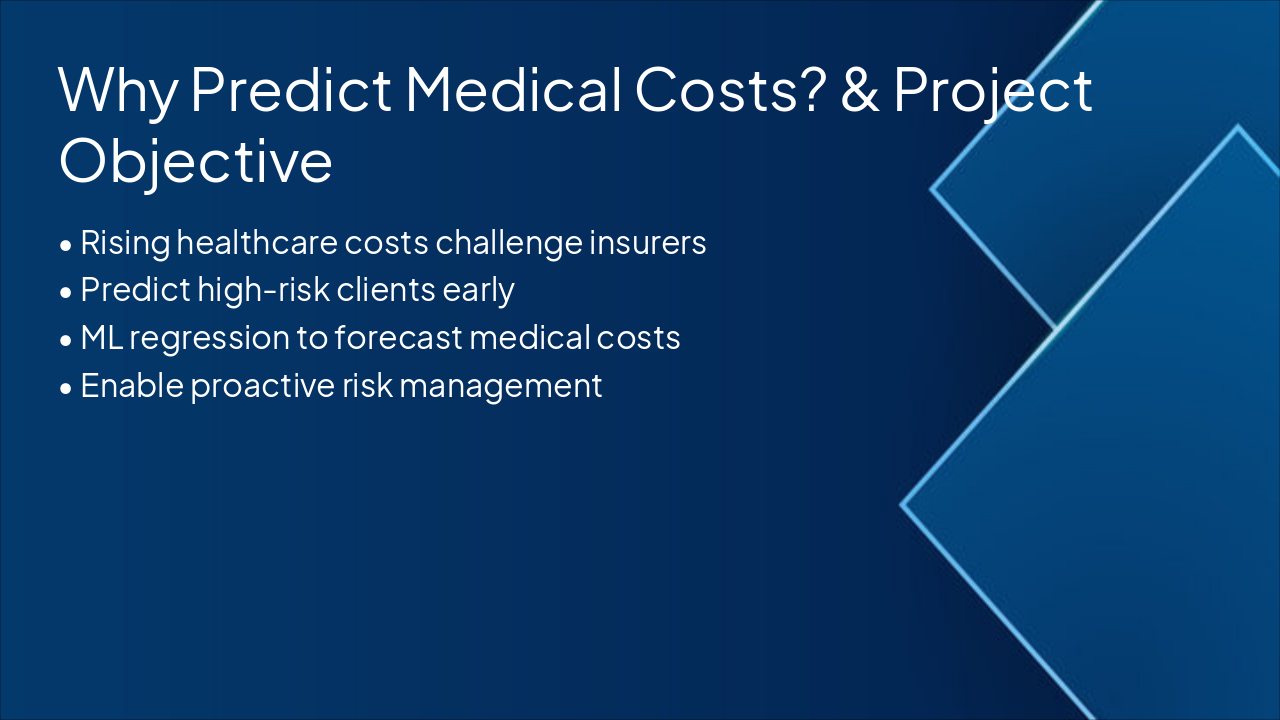
Slide 2 - Why Predict Medical Costs? & Project Objective

Rising healthcare costs challenge insurers, necessitating early prediction of high-risk clients. The project objective is to use ML regression for forecasting medical costs and enabling proactive risk management.

Why Predict Medical Costs? & Project Objective

  • Rising healthcare costs challenge insurers
  • Predict high-risk clients early
  • ML regression to forecast medical costs
  • Enable proactive risk management
Slide 2 - Why Predict Medical Costs? & Project Objective
Slide 3 of 6

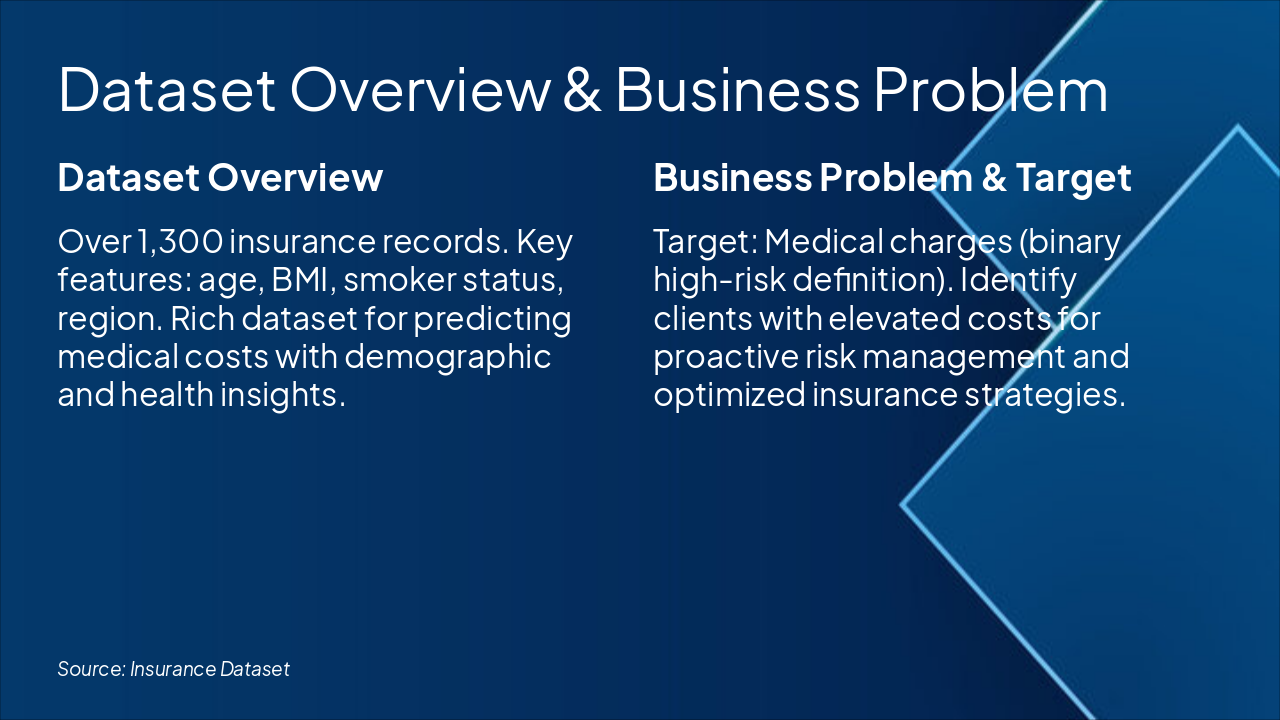
Slide 3 - Dataset Overview & Business Problem

The slide overviews a dataset of over 1,300 insurance records with key features like age, BMI, smoker status, and region for predicting medical costs. It defines the business problem as identifying high-risk clients via binary medical charges to enable proactive risk management and optimized insurance strategies.

Dataset Overview & Business Problem

Dataset OverviewBusiness Problem & Target
Over 1,300 insurance records. Key features: age, BMI, smoker status, region. Rich dataset for predicting medical costs with demographic and health insights.Target: Medical charges (binary high-risk definition). Identify clients with elevated costs for proactive risk management and optimized insurance strategies.

Source: Insurance Dataset

Speaker Notes
Highlight dataset size and features on left; explain target and business goal on right. Emphasize binary high-risk classification.
Slide 3 - Dataset Overview & Business Problem
Slide 4 of 6

Slide 4 - Data Preprocessing Pipeline & Key Features

The slide details a data preprocessing pipeline with stages for handling missing values (via imputation or row dropping), encoding categoricals (one-hot or label), and scaling features (StandardScaler). Key insights from correlation heatmaps and bar charts identify smoker status and age as top cost drivers.

Data Preprocessing Pipeline & Key Features

Source: Medical Cost Dataset

Speaker Notes
Overview of the data preprocessing steps followed by key feature insights. Emphasize how smoker status and age are primary cost drivers, supported by charts/icons.
Slide 4 - Data Preprocessing Pipeline & Key Features
Slide 5 of 6

Slide 5 - Model Performance Summary

The slide summarizes model performances: baseline RMSE at 10,000, neural network at 5,000, and XGBoost (best performer) at 4,000. It highlights a 60% RMSE reduction over the baseline.

Model Performance Summary

  • 10,000: Baseline RMSE
  • Simple model performance

  • 5,000: Neural Network RMSE
  • 4,000: XGBoost RMSE
  • Best performer (Boosting)

  • 60%: RMSE Reduction
  • Improvement over baseline

Slide 5 - Model Performance Summary
Slide 6 of 6

Slide 6 - Key Insights, Implications & Q&A

Boosting excels with hyperparameter tuning for top performance, implying 20% cost savings. Next steps include model deployment, with precision prediction driving efficiency—questions welcome.

Key Insights, Implications & Q&A

• Boosting excels; tune hypers for top performance

  • Implications: 20% cost savings
  • Next: Deploy model

Questions?

Closing: Precision prediction drives efficiency.

Source: Predicting High-Risk Medical Cost Clients Using Machine Learning

Speaker Notes
Summarize boosting success, highlight 20% savings, urge deployment, open for Q&A.
Slide 6 - Key Insights, Implications & Q&A

Discover More Presentations

Explore thousands of AI-generated presentations for inspiration

Browse Presentations
Powered by AI

Create Your Own Presentation

Generate professional presentations in seconds with Karaf's AI. Customize this presentation or start from scratch.

Create New Presentation

Powered by Karaf.ai — AI-Powered Presentation Generator